
Every used equipment lot tells two stories. One is written in steel, dents, patched hydraulics, and sun-bleached paint. The other is written on the hour meter, and it rarely lies. In the used equipment market, few numbers carry as much weight as engine hours, and few machines make that number matter more than the motor grader, a workhorse whose blade sees more abuse per shift than almost anything else on a jobsite.
Low-hour motor graders occupy a strange, desirable middle ground. They’re not new, nobody expects showroom pricing or zero-hour paint, but they haven’t been run into the ground either. They sit in the sweet spot where a buyer gets real machine life left, a lower risk of surprise repairs, and often a stronger resale position down the road. That combination is why the listings below, currently among the lowest-hour used motor graders on usedmotorgrader.com, deserve more than a passing glance.
What follows isn’t a simple hour-count leaderboard. Age, generation, technology, and condition all shape what a given hour figure actually means. A 1975 Caterpillar 140G with 6,900 hours and a 2015 12M3 with 5,711 hours are both low for their type, but they represent entirely different ownership experiences. This guide breaks down ten standout listings, ranked by hours, and explains what each one is really offering the buyer who’s paying attention.
The Full Ranking at a Glance
Before digging into each machine individually, here’s the complete lineup in order.
| Rank | Model | Listed Hours |
| 1 | 1999 Caterpillar 140H | 812 |
| 2 | 1985 Caterpillar 140G | 4,520 |
| 3 | 2015 Caterpillar 12M3 | 5,711 |
| 4 | 2015 John Deere 772GP | 6,063 |
| 5 | 1985 Caterpillar 140G | 6,171 |
| 6 | 2019 John Deere 772GP | 6,416 |
| 7 | 2015 Caterpillar 140M3 | 6,482 |
| 8 | 2014 Caterpillar 140M2 | 6,529 |
| 9 | 1975 Caterpillar 140G | 6,900 |
| 10 | 2016 Caterpillar 12M3 | 7,000 |
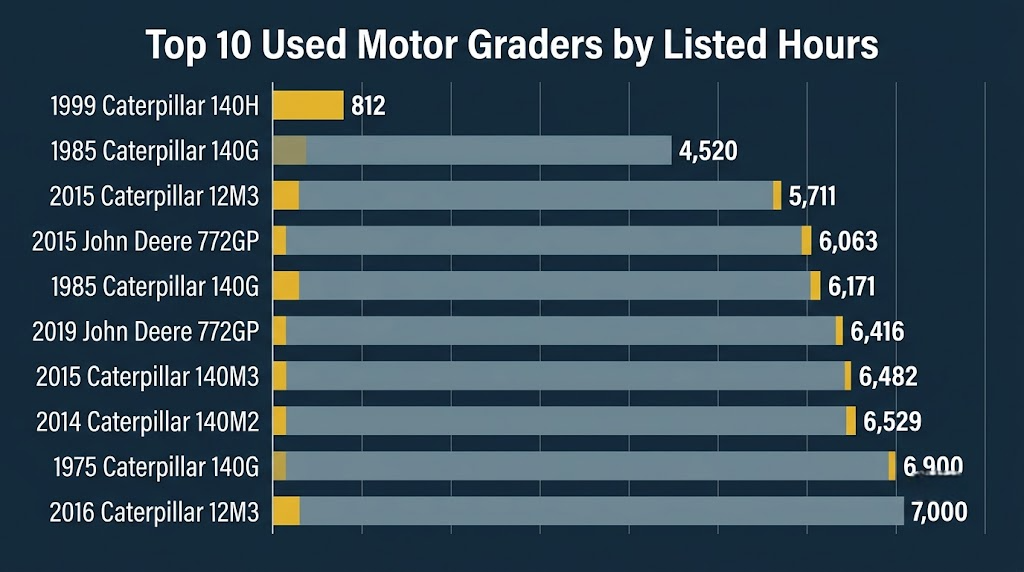
A side-by-side look at how the ten lowest-hour listings on usedmotorgrader.com stack up against each other. The gap between the top and bottom of the ranking is smaller than it looks.
The Rankings
1. 1999 Caterpillar 140H, 812 Hours
Heading the list by a wide margin, this 140H’s 812-hour reading is the kind of number that makes seasoned buyers pause and reread the listing twice. The 140H arrived as Caterpillar’s answer to a market that wanted more electronic control without abandoning the mechanical simplicity operators trusted, and it became one of the most respected mid-size graders of its era.
At 812 hours, this unit has barely moved past its break-in period. Structural wear, blade cylinder seals, and drivetrain components are all still operating well inside their designed service life. Its articulated frame and moldboard geometry remain close to factory tolerances, which matters enormously for fine-grade work where a few degrees of blade drift can ruin a finish pass.
This is a grader built for contractors who need precision road maintenance, site prep, and drainage shaping without the premium of a brand-new machine. The takeaway here is simple: a 1999 model with under a thousand hours isn’t really a decades-old machine in any meaningful sense; it’s a low-mileage classic that happens to have a vintage year stamped on the title.
2. 1985 Caterpillar 140G, 4,520 Hours
The 140G is the machine that built Caterpillar’s reputation in motor graders, and this 1985 example carries that legacy well. Mechanically simpler than its successors, the 140G relies on proven hydraulic and drivetrain architecture that has kept thousands of these units working decades past when lesser machines would have been scrapped.
At 4,520 hours, this listing sits comfortably in what many equipment buyers consider a grader’s prime working window, enough runtime to confirm the machine performs as expected, but far short of the wear thresholds that typically trigger major component work. The 140G’s cast-iron circle and drawbar assembly is known for shrugging off years of abuse, and this unit’s hour count suggests an owner who used it purposefully rather than constantly.
Buyers drawn to the 140G tend to value serviceability above all else. Parts availability, mechanical familiarity, and straightforward repairs make this a favorite for operations that would rather fix a grader themselves than wait on a dealer. It’s less flashy than newer machines, but its low hours mean the fundamentals are still very much intact.
3. 2015 Caterpillar 12M3, 5,711 Hours
The 12M3 represents a different philosophy entirely, a larger-frame grader built for operations that move serious volumes of material and need the horsepower to match. Where the 140-series machines handle finish work and maintenance grading, the 12M3 is happiest on major road construction, mining haul roads, and large-scale earthmoving projects.
At 5,711 hours, this 2015 unit has seen real work but remains well-positioned within its expected service curve. The M3-series platform introduced refinements to hydraulic response and operator ergonomics that made long shifts noticeably less punishing, and those improvements hold up well at this hour range. Grade-control technology, when equipped, still performs accurately on machines with this kind of usage history.
For fleet managers running mixed equipment lists, this listing represents an efficient way to add heavy-grading capacity without the wait or premium of new equipment. The 12M3’s size and power make it a natural fit for contractors who need one machine to cover a wide range of grading tasks across a large site.
4. 2015 John Deere 772GP, 6,063 Hours
Deere’s 772GP has carved out a loyal following among contractors who prioritize operator comfort and control precision, and this 2015 listing shows why. The GP series brought a redesigned cab, improved visibility over the moldboard, and a smooth powershift transmission that makes shifting between grading tasks feel almost automatic.
At 6,063 hours, the machine has clearly been put to work, but nothing about that number suggests excessive strain. Deere’s mainframe and circle drive components are engineered for exactly this kind of sustained, moderate-duty usage, and buyers researching the model closely will find that this generation’s balance of power and finesse tends to hold up impressively well over time, a theme explored in more depth in this breakdown of how the 2015 John Deere 772GP balances versatility and productivity.
This grader suits contractors juggling varied work, subdivision roads one week, agricultural access lanes the next. Its relatively low hours mean the precision hydraulics and electronic controls that make the 772GP so adaptable are still performing at their best.
5. 1985 Caterpillar 140G, 6,171 Hours
A second 140G appears on this list, and its presence underscores just how consistently this platform delivers long service life. At 6,171 hours, this unit has logged more runtime than its counterpart earlier in this ranking, but it remains firmly within the range where a well-maintained 140G is expected to perform reliably.
What distinguishes this listing is the combination of a proven chassis with a comfortably moderate hour count for a machine of its age. Forty-year-old equipment with this kind of usage history typically means one thing: an owner who valued the machine enough to keep it in regular, careful rotation rather than running it continuously until failure.
This 140G suits buyers who want dependable grading capability without the complexity of modern electronics, municipal maintenance crews, smaller contractors, and anyone who prioritizes mechanical transparency. Its low hours relative to its age make it a strong candidate for years of continued service, provided routine maintenance keeps pace.
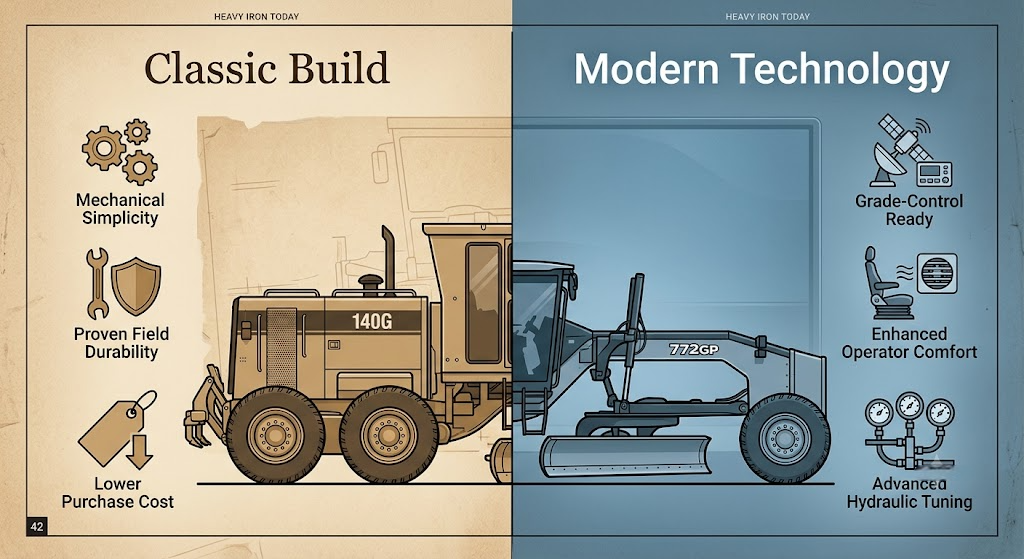
Two very different engineering philosophies are represented in this ranking. Neither approach is outdated; they simply serve different priorities.
6. 2019 John Deere 772GP, 6,416 Hours
This 2019 772GP is the newest machine on the list by manufacture date, and its hour count is a useful reminder that newer doesn’t always mean lower. At 6,416 hours, this unit has worked harder and faster than its 2015 sibling, likely a reflection of near-continuous use since purchase rather than any shortcoming in the machine itself.
The upside for buyers is significant. This grader carries Deere’s most current cab design, updated electronic controls, and the latest refinements to the GP platform’s hydraulic tuning, all packed into a machine still several years and thousands of hours away from major component service. For contractors who want current technology without new-equipment pricing, this is about as close as the used market gets.
Given its age, the 772GP here suits buyers planning for long-term ownership, those who want a decade or more of service life ahead of them, paired with features that won’t feel dated even five years from now.
7. 2015 Caterpillar 140M3, 6,482 Hours
The 140M3 sits at the heart of Caterpillar’s mid-size grader lineup, built to handle everything from fine-finish road work to general site maintenance. This 2015 example, at 6,482 hours, represents a grader that has been worked steadily but not excessively, a profile that tends to correlate with strong remaining component life across the drivetrain and hydraulic system.
The M3 series brought meaningful upgrades over earlier generations, including refined blade control response and cab ergonomics designed to reduce operator fatigue over long shifts. Machines in this hour range typically still deliver the crisp, responsive grading feel that made the M3 platform popular when new, since the core hydraulic components haven’t yet accumulated enough cycles to show meaningful drift.
This grader is well-suited to contractors handling municipal roadwork, subdivision development, and general civil projects where reliability and consistent finish quality matter more than raw size. Its hour count places it firmly in the still-has-plenty-left category.
8. 2014 Caterpillar 140M2, 6,529 Hours
The 140M2 was the platform that set the stage for the M3’s later refinements, and it remains a highly capable machine in its own right. This 2014 unit, sitting at 6,529 hours, offers buyers a slightly earlier design generation at what’s typically a more accessible price point than its M3 successor, without sacrificing much in the way of real-world capability.
At this hour count, the machine has moved well past its break-in period but remains within the range where major structural and hydraulic components are expected to perform reliably. The M2’s blade control system and articulated steering continue to be well regarded among operators who’ve spent real time behind the controls, a point explored further in this closer look at how the 2014 Caterpillar 140M2 handles road work projects.
This listing suits buyers who want dependable mid-size grading power for road maintenance and construction support work, particularly those comfortable trading a slightly older design generation for a more favorable price.
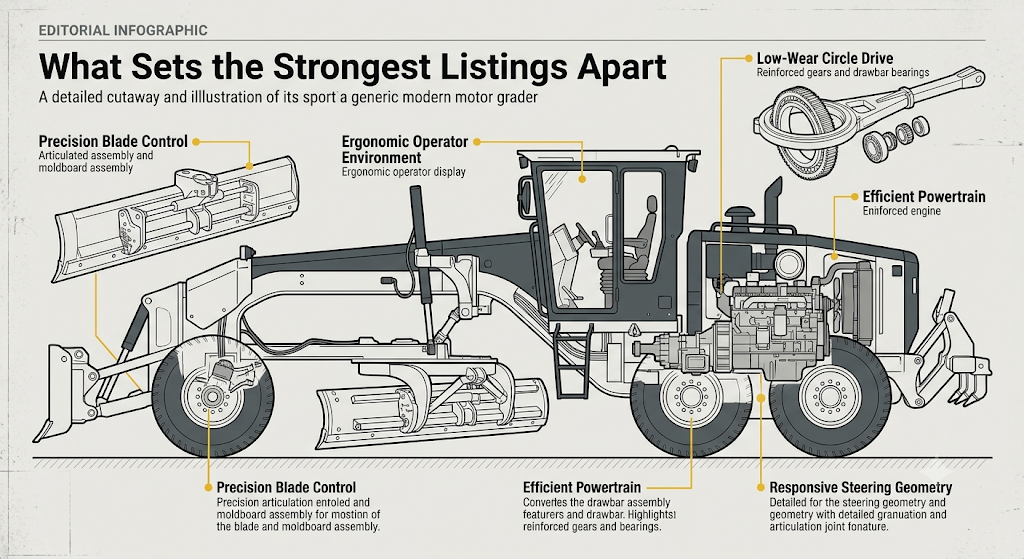
The features that separate a genuinely strong low-hour listing from one that just happens to have a good number on the meter.
9. 1975 Caterpillar 140G, 6,900 Hours
The oldest machine in this ranking, this 1975 140G, is a genuine testament to how well-built these early graders were. At 6,900 hours across roughly five decades of existence, the math alone tells a story: this machine has spent far more of its life parked than working, which for a grader this age is a remarkable position to be in.
Machines from this era were built with a mechanical simplicity that, ironically, works in their favor on the used market today. There’s less to fail electronically, parts remain available through Caterpillar’s extensive legacy support network, and any competent diesel mechanic can service one without specialized diagnostic equipment.
This 140G will appeal most to buyers who see equipment as an investment in mechanical reliability rather than technological convenience, smaller operations, agricultural users, and municipalities with tight budgets and long planning horizons. Its low hours for its age suggest a machine that could realistically outlast several newer graders bought new today.
10. 2016 Caterpillar 12M3, 7,000 Hours
Closing out the ranking is a second 12M3, this one a 2016 model with exactly 7,000 hours on the clock. As the newest and largest-frame machine at the bottom of this list, it represents the point where “low hours” starts to mean something slightly different, not barely broken in, but still comfortably within the healthy working life of a heavy-duty grading platform.
The 12M3’s size and power make it particularly well-suited to large-scale projects: highway construction, mining infrastructure, and any job where moving significant volumes of material efficiently matters more than fine precision. At 7,000 hours, the machine has proven itself in real conditions while leaving substantial service life ahead, a balance discussed further in this look at whether the 2016 Caterpillar 12M3 represents the peak of Cat’s mid-size grading power.
For buyers running large fleets or tackling major infrastructure work, this listing offers heavy-grader capability at a fraction of new-equipment cost, with hours low enough to support years of continued heavy use.
Age, Strengths, and Ideal Applications
| Model | Era | Key Strength | Ideal Application |
| 1999 Caterpillar 140H | Late classic | Near break-in condition | Precision road maintenance |
| 1985 Caterpillar 140G (4,520 hrs) | Classic | Mechanical simplicity, easy service | Small-to-midsize contractor work |
| 2015 Caterpillar 12M3 | Modern | High power, grade-control ready | Heavy earthmoving, mining roads |
| 2015 John Deere 772GP | Modern | Operator comfort, control precision | Varied civil and subdivision work |
| 1985 Caterpillar 140G (6,171 hrs) | Classic | Proven chassis, low relative wear | Municipal maintenance |
| 2019 John Deere 772GP | Newest | Latest technology, long ownership runway | Long-term fleet investment |
| 2015 Caterpillar 140M3 | Modern | Refined blade control, ergonomics | Municipal and subdivision roadwork |
| 2014 Caterpillar 140M2 | Modern (earlier gen) | Strong value, dependable controls | Road maintenance and construction support |
| 1975 Caterpillar 140G | Vintage | Mechanical durability, easy parts access | Agricultural, municipal, budget-focused ops |
| 2016 Caterpillar 12M3 | Modern | Heavy-duty capacity | Highway and infrastructure projects |
Classic Iron Versus Modern Technology: What This Ranking Really Shows
Line up these ten listings side by side, and a pattern emerges quickly: this isn’t a ranking of old versus new so much as a ranking of well-kept versus worn-out, with age acting as a secondary variable rather than the deciding one. Three separate 140G units from 1975 and 1985 sit comfortably alongside grade-control-equipped machines from 2015 and 2019, all clustered within a similar hour range.
For buyers drawn to the classic Caterpillar 140G, the appeal is straightforward. These machines were engineered before manufacturers layered extensive electronics onto grading equipment, which means fewer sensors to fail, fewer modules to replace, and a mechanical directness that many longtime operators still prefer. A 140G with under 7,000 hours, regardless of whether it was built in 1975 or 1985, is a machine with a lot of honest working life still ahead of it, provided the buyer values simplicity over sophistication.
The newer machines on this list, the 12M3s, the 772GPs, the M2 and M3, tell a different story. These graders were built in an era of GPS-ready grade control, refined hydraulic tuning, and cab environments designed around operator comfort during long shifts. Their low hours matter differently here: rather than proving decades of durability, they signal that a buyer is getting a technologically current machine before it accumulates the wear that typically triggers major component replacement.
Trust and perceived value follow a similar split. Classic-machine buyers tend to trust track record and mechanical transparency; a 140G’s reputation is built on decades of field data, not marketing claims. Buyers leaning toward modern equipment trust engineering advancement and features that directly reduce operating costs, like fuel-efficient engines and precision grading that cuts down on rework. Neither instinct is wrong; they simply reflect different priorities around what value means in a used grader.
What ties every listing on this page together is that low hours, in every case, function as a kind of insurance policy. They don’t guarantee a perfect machine, but they meaningfully lower the odds of the kind of catastrophic, budget-wrecking failure that haunts buyers of high-hour equipment. That holds true whether the grader in question rolled off the line in 1975 or 2019.
Buyer Fit and Value at a Glance
| Model | Best Buyer Fit | Value Profile | Practical Takeaway |
| 1999 Caterpillar 140H | Precision-focused contractors | Exceptional, near-new condition at used pricing | Rare pairing of vintage build and minimal wear |
| 1985 Caterpillar 140G (4,520 hrs) | DIY-minded operators | Strong, low complexity, low cost | Prioritizes serviceability over features |
| 2015 Caterpillar 12M3 | Fleet managers, large sites | Strong, power at a fraction of new cost | Efficient way to add heavy-grading capacity |
| 2015 John Deere 772GP | Varied civil contractors | Strong, comfort and control intact | Adaptable machine still performing near peak |
| 1985 Caterpillar 140G (6,171 hrs) | Municipal crews | Solid, dependable, budget-friendly | Mechanical transparency over electronics |
| 2019 John Deere 772GP | Long-term owners | Premium, newest tech, most runway | Best pick for a decade-plus ownership horizon |
| 2015 Caterpillar 140M3 | Municipal and subdivision work | Strong, responsive controls intact | Reliable mid-size choice for civil projects |
| 2014 Caterpillar 140M2 | Budget-conscious buyers | Strong, earlier design, lower price | Trades a slight tech gap for better value |
| 1975 Caterpillar 140G | Agricultural and budget-focused ops | Exceptional for its age | Fifty years old, still has real life left |
| 2016 Caterpillar 12M3 | Infrastructure and highway contractors | Strong, heavy capacity, healthy hours | Big-project power without new-equipment cost |
The Bigger Picture
Rankings like this one exist because hours, while not the only variable that matters, remain the single most honest number on any used equipment listing. Everything else, paint, dealer reputation, and even service records, can be dressed up. An hour meter reading, when genuine, tells a buyer almost exactly how much life a machine has already spent.
What this particular lineup reveals is that low-hour opportunities exist across every era of motor grader production, not just among recent models. A well-kept 140G from the 1970s can represent just as strong a value proposition as a nearly new 12M3, provided a buyer understands what they’re actually trading between the two: mechanical simplicity versus technological capability, decades of proven track record versus a shorter but more advanced service history.
Opportunities like these don’t stay listed for long. When condition, maintenance history, and low hours line up on the same machine, informed buyers tend to move quickly, and for good reason. The ten graders featured here represent exactly that kind of alignment, a snapshot of what’s currently available for contractors and fleet managers who understand that in the used equipment market, the smartest purchase is rarely the newest one. It’s the one with the most life still left to give.
Find Your Next Grader
Machines with hour counts this low move fast once they’re listed. Our current inventory at usedmotorgrader.com features dependable used motor graders across every era and hour range, each one inspected and priced to reflect its true condition. Contact our team today to secure a grader built to outlast the work ahead.
FAQs
1. Do low-hour used motor graders cost more than higher-hour machines of the same model?
Generally, yes. Lower hours typically command a premium because they reduce the buyer’s risk of near-term major repairs. However, the exact markup depends on condition, maintenance records, and demand for that specific model.
2. Are older graders like the Caterpillar 140G still reliable at 6,000-plus hours?
Yes, provided maintenance has been consistent. The 140G’s mechanical simplicity means components tend to wear predictably, and many units remain fully serviceable well beyond the hour counts featured in this ranking.
3. What should I inspect before buying a low-hour used grader?
Beyond the hour meter, check hydraulic cylinder seals, circle and drawbar wear, undercarriage or tire condition, and service records confirming regular fluid and filter changes. A low hour count is a strong signal, not a substitute for inspection.
4. Does a lower hour count always mean better overall condition?
Not always. Storage conditions, maintenance quality, and how the machine was operated all affect condition independently of hours. Low hours reduce risk, but they work best alongside a documented service history and a physical inspection.
Tags: Motor Grader Condition Vs Hours, Top Motor Grader Models, Top Performing Motor Graders