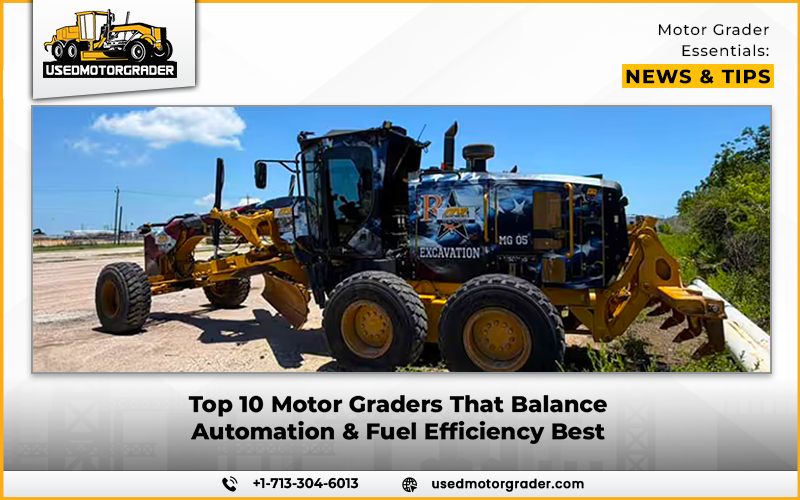
There is a conversation happening on job sites right now, and it sounds something like this: “We ran three fewer passes on that section than we did last year, and the fuel numbers came in 12% lower.” That is not luck. That is what happens when a motor grader has the right automation doing the heavy lifting, holding cross slope, flipping the blade at the end of a pass, or reading a 3D design file without masts or cables getting in the way.
Fuel costs and operator skill shortages are squeezing contractors from both sides. The graders that are earning their keep in 2026 are the ones built to close that gap: efficient engines, smart hydraulics, eco modes that actually work, and grade control systems that cut the number of passes needed to finish a road to spec. More passes mean more fuel burned and more wear on the machine. Fewer passes, done right the first time, mean real money back in the fleet budget.
This list ranks the top ten motor graders in 2026 based on how well they balance automation quality, fuel efficiency, ease of operation, reliability, and the maturity of their technology. Every model included has enough supporting evidence, from manufacturer spec sheets, industry publications, dealer sources, and field reviews, to justify its place. Where data is limited, that is noted clearly.
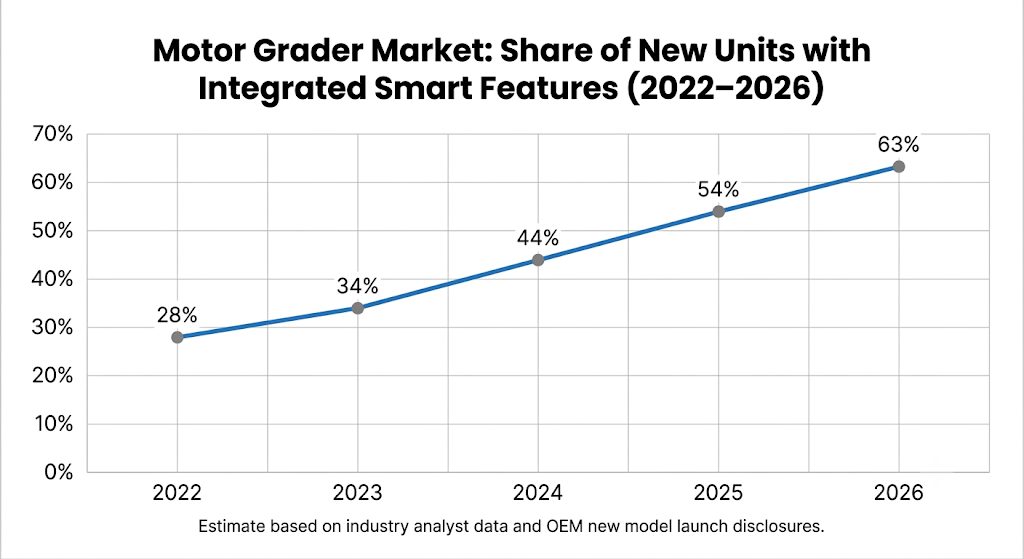
The shift toward automation-equipped graders is accelerating, by 2026, nearly two-thirds of new units will leave factories with some form of integrated smart feature. This trend is reshaping both the new machine and used equipment markets.
Why Automation and Fuel Efficiency Go Together
Before getting into the ranking, it is worth making one point that often gets missed: automation does not just make grading more precise; it makes it more fuel-efficient. Every extra pass over a section burns diesel. Every correction an operator makes because the blade drifted off slope costs time and fuel. Grade control systems that hold the blade automatically, combined with eco modes and load-sensing hydraulics, can meaningfully reduce both.
John Deere’s internal data shows that using automation suite features reduced novice operator inputs by 75 percent when grading a flat pad with obstacles, while Auto-Shift Plus reduced foot movements by 65 percent compared to running with the inching pedal. Fewer corrections equal fewer wasted movements and fewer wasted engine cycles.
On the Caterpillar 140, Cat Grade with Cross Slope delivers lower fuel consumption and up to 40% less material usage, a figure that speaks directly to the link between precision grading and operating economy.
For contractors dealing with rising fuel costs, the article Rising Fuel Prices: Best Practices to Improve Grader Fuel Efficiency on usedmotorgrader.com breaks down exactly how smart machine use translates to cost savings at the pump.
The Ranking Methodology
Models were scored across six criteria:
- Fuel efficiency (engine tech, eco mode, idle reduction, hydraulic efficiency)
- Automation quality (grade control integration, blade automation, smart assist)
- Productivity (passes to grade, operator assist, cycle time)
- Ease of operation (controls, cab quality, training curve)
- Maintenance and operating cost (service intervals, telematics, modular design)
- Reliability and 2026 market standing (production status, sales data, brand reputation)
The Top 10 Motor Graders for Automation and Fuel Efficiency in 2026
1. John Deere 772 P-Tier with SmartGrade
- Model Year: 2026 (P-Tier generation, launched at ConExpo 2026)
- Engine: John Deere PowerTech, approximately 205 hp / 153 kW, Tier 4 Final
- Operating Weight: Approximately 20,000 kg (44,000 lb)
- Blade Length: 14 ft standard
The John Deere motor grader 772 P-Tier is the standout model in a completely refreshed P-Tier lineup that John Deere unveiled publicly at ConExpo 2026 in March. The new P-Tier models, covering the 620, 622, 670, 672, 770, 772, 870, and 872, are outfitted with new automation features, updated displays, and redesigned cabs. Operators can upgrade grade control with either Topcon or Leica Geosystems and move between 2D and 3D solutions through the G5 10.1-inch touchscreen display.
What sets the 772 P-Tier apart is the depth of its factory-integrated automation. John Deere first brought factory-integrated, mastless grade control to the motor grader market back in 2019 under the SmartGrade brand, and the new P-Tier generation takes it significantly further. In addition to standard blade flip, auto articulation, and machine presets, the new P-Tier models receive a boost with new cutting-edge wear automation features, intelligent blade control automation to help operators maintain a level blade, and SmartSaddle automation to put the blade in the optimum saddle position with one button press.
The 772 P-Tier offers fuel savings of up to 10 percent over larger models, while SmartGrade allowed an experienced operator to increase grade accuracy by 42 percent when grading a flat pad with obstacles. For novice operators, the increase in grade accuracy was 49 percent in the same application.
- Fuel Efficiency Features: Auto-Shift Plus, Eco mode, load-sensing hydraulics, variable horsepower engine matching
- Telematics: John Deere Operations Center, wireless data transfer, Remote Display Access
- Best Use Cases: Road construction, municipal grading, site prep, precision finish work
- Strengths: Best factory-integrated automation in class, mastless 3D system, multi-provider grade control flexibility, outstanding operator assistance for less experienced crews
- Limitations: Premium price on new P-Tier models; Trimble compatibility confirmed for later in 2026
- 2026 Status: Current production, debuted at ConExpo 2026
For a deeper look at why the John Deere motor grader line consistently delivers strong fuel economy numbers, the article How John Deere Motor Graders Deliver Better Fuel Economy is worth reading before your next purchase decision.
2. Caterpillar 140 (Next Generation, including 140 LVR)
- Model Year: 2026 (next generation, Q1 2026 production)
- Engine: Cat C7.1, 248 hp / 185 kW, Tier 4 Final
- Operating Weight: 19 tonnes (42,000 lb)
- Blade Length: 4.2 m (13.8 ft)
The CAT motor grader 140 has been Caterpillar’s most popular grader model for decades, and the next-generation platform, which entered production in Q1 2026, updates it comprehensively. The new Cat 140 continues its proven design and exceptional reliability to ensure low operating costs coupled with favourable fuel efficiency, with a ‘sweet spot’ power-to-weight ratio and excellent fuel consumption rates, backed by more than 40,000 hours of accumulated test data worldwide.
The Cat 140 allows operators to save up to 10 percent on fuel consumption with Eco mode, and its hydraulic system provides multifunction capability of up to seven simultaneous functions for superior performance. The next-gen platform adds a 10-inch touchscreen integrating Cat Grade, standard rearview camera, enlarged cab windows for improved blade visibility, and optional 360-degree camera coverage.
The automation suite is extensive. In addition to Cat Grade with Cross Slope, Caterpillar offers optional 3D machine control compatibility and enhancements like Stable Blade and Auto-Shift Plus. These systems improve traction, reduce engine load, and offer automatic gear shifting based on terrain, giving a smoother and more efficient grade.
- Fuel Efficiency Features: Eco mode (up to 10% fuel savings), on-demand cooling fan, electronic throttle control, extended synchronized maintenance intervals
- Telematics: Cat Product Link / VisionLink, fuel usage, idle time, location, diagnostic codes
- Best Use Cases: Road construction, ditching, snow removal, municipal contracts, rental fleets
- Strengths: Exceptional versatility, the most popular grader model in the world, upgraded automation for 2026, strong dealer support globally
- Limitations: Lever-control LVR version lacks the joystick ergonomics of the joystick (JOY) platform
- 2026 Status: Current production, Q1 2026 launch
The head-to-head comparison between this model and its key rivals is covered in detail at Cat 140 LVR vs John Deere SmartGrade vs Komatsu Dual Mode: The New Grader Race.
3. Komatsu GD655-7
- Model Year: 2020–present (current generation, widely available 2024–2026)
- Engine: Komatsu SAA6D107E-3, 218 hp / 163 kW, Tier 4 Final
- Operating Weight: 19.3–20.2 tonnes (42,500–44,500 lb)
- Blade Length: 4.27 m (14 ft)
The Komatsu grader GD655-7 is the steady performer of this list, a machine that has been proving itself on job sites globally since 2020 and continues to rank in the top ten of new-financed equipment sales in North America. The GD655-7 comes with a Komatsu SAA6D107E-3 Tier 4 Final engine, and operators benefit from maximum control while reducing fuel consumption by up to 5% in Power Mode and 15% in Economy Mode through Komatsu’s Dual Mode Transmission.
The GD655-7 accepts Topcon components without any additional modification to the hydraulic circuit. Just plug them in, and the machine control system provides complete control of the blade, delivering higher productivity by generating more accurate results in less time, using less fuel and construction material.
Standard on the GD655-7 is factory-fitted cabling, controls, and bracketing for multiple makes of 3D machine control systems, allowing customers to install a plug-and-play kit from Trimble, Topcon, or other leading suppliers without spending time or money on preparation. The load-sensing hydraulic pump reduces heat and improves response, key factors in both operator comfort and fuel consumption.
- Fuel Efficiency Features: Dual Mode Transmission (5% fuel savings in P mode, 15% in E mode vs. GD655-5), electronically controlled cooling fan, variable displacement pump, automatic engine stall prevention
- Telematics: Komtrax remote monitoring (standard), location, hours, fuel consumption, fault codes
- Best Use Cases: Road maintenance, civil construction, site prep, municipal fleets
- Strengths: Best-in-class transmission flexibility, outstanding plug-and-play grade control readiness, reliable fuel savings data, strong resale value
- Limitations: Grade control is retrofit rather than factory-integrated mastless; Komatsu’s IMC system is more developed on dozers than graders
- 2026 Status: Current production, widely available new and used
4. Caterpillar 16 (Mining Grade)
- Model Year: Current generation
- Engine: Cat C13, 290 hp / 216 kW, Tier 4 Final
- Operating Weight: 71,454 lb (32,400 kg)
- Blade Length: 16 ft
For mining operations and heavy haul road construction, the CAT motor grader 16 is the reference machine. The Cat 16 is built for mine operations and haul road construction, with a fuel-efficient design, robust build, and advanced technology that deliver maximum uptime, lower costs, and superior productivity. Major components are modular, so most can be removed and reinstalled without disturbing other components.
The Cat C13 engine has been optimized for efficiency without compromising performance, and Eco mode can be activated to control high engine idle speed, offering additional fuel savings. The 16 supports Cat Grade with 3D, Cat MineStar Fleet, and Cat MineStar Health, a full mine-site telematics ecosystem that monitors every cycle in real time.
- Fuel Efficiency Features: Eco mode, Variable Horsepower Plus (VHP) system, Tier 4 Final C13 engine, modular maintenance design reducing service time
- Telematics: Cat MineStar Fleet, MineStar Health, real-time payload, cycle time, fuel, maintenance scheduling
- Best Use Cases: Mining haul road construction and maintenance, large infrastructure projects
- Strengths: Unmatched durability at scale, full mine fleet integration, Grade with 3D support, excellent blade down force
- Limitations: High operating weight makes it unsuitable for smaller jobs; significant capital cost
- 2026 Status: Current production
5. John Deere 672 P-Tier with SmartGrade
- Model Year: 2026 (P-Tier refresh)
- Engine: John Deere PowerTech, 190 hp / 142 kW, Tier 4 Final
- Operating Weight: Approximately 19,000 kg (41,800 lb)
- Blade Length: 14 ft
The 672 P-Tier occupies the same role in the John Deere motor grader lineup as the 772, but in a slightly lighter, more maneuverable package that suits mid-scale contractors and municipalities extremely well. The 672G has been among Deere’s top-selling models, and the new P-Tier version is climbing the sales ladder.
Sitting in the middle of the Deere range, the 672 produces 190 kW and delivers 22,453 kg of blade pull. It comes standard with cross-slope control and can be upgraded to the full 3D SmartGrade system. The same P-Tier automation suite available on the 772, blade flip, auto articulation, SmartSaddle, advanced vision system, is available here at a more accessible price point.
- Fuel Efficiency Features: Auto-Shift Plus, load-sensing hydraulics, Eco mode, six-wheel drive controls optimized for lower fuel draw in lighter applications
- Telematics: John Deere Operations Center, Remote Display Access, wireless data transfer
- Best Use Cases: Road construction, municipal maintenance, mid-scale site prep
- Strengths: Full SmartGrade capability in a more manageable size and cost bracket; ideal for operators stepping up from manual grading
- Limitations: Less blade pull than the 772 for heavier material
- 2026 Status: Current production
6. Volvo G976 (AWD) with Co-Pilot
- Model Year: Produced through prior generation; widely available, used, and in some markets, new
- Engine: Volvo D9, 262 hp / 195 kW, Tier 4 compliant
- Operating Weight: 43,650 lb (19,800 kg)
- Blade Length: 12 ft (3.66 m) standard; extensions available
The Volvo G976 is the largest all-wheel-drive grader Volvo produces and remains one of the most capable fine-grading machines available. Volvo Co-Pilot provides operators on models like the G976 and G990 with real-time insights into blade position, machine slope, and fuel efficiency. The Active Blade Monitor uses sensors and in-cab displays to give real-time updates on moldboard position, making precision grading straightforward. These features, combined with electro-hydraulic joystick controls and customizable operator settings, help reduce operator fatigue and improve grading consistency.
Volvo’s 11-speed HTE1160 transmission delivered an average fuel-efficiency advantage of 6.1 percent under controlled test conditions compared to the 8-speed version, demonstrating that the additional gearing has a measurable real-world impact on running costs.
The AWD system on the G976 is particularly sophisticated. Its all-wheel-drive system can automatically divert extra power to the ground in soft conditions, increasing output by up to 26 kW when additional traction is required, an advantage for rural and regional operators. Volvo’s joystick controls reduce hand and arm movement by up to 78 percent, according to Caterpillar.
- Fuel Efficiency Features: 11-speed direct-drive transmission (6.1% measured fuel advantage), Creep Mode for fine grading with reduced engine load, Proportional Demand Flow hydraulics, CareTrack telematics
- Telematics: Volvo CareTrack, position, operating hours, fuel consumption, and real-time machine conditions
- Best Use Cases: Fine grading, rural road maintenance, mixed surface work requiring AWD, larger contractor fleets
- Strengths: Best AWD system in class, unmatched fine-grading stability, 11-speed transmission, long wheelbase for precision
- Limitations: The G900 series has not received a full next-generation refresh; the Volvo grader product roadmap is less public-facing than Cat or Deere in 2026
- 2026 Status: Available used and in some international markets; no announced new-generation successor yet
7. Komatsu GD955-7 (Heavy Construction and Mining)
- Model Year: Current generation
- Engine: Komatsu, 426 hp, Tier 4 Final
- Operating Weight: Approximately 50+ tonnes
- Blade Length: Available in extended configurations
The GD955-7 is Komatsu’s newest motor grader on the market, designed for mining, heavy-duty construction, and large infrastructure projects. It delivers a lot of power in a surprisingly maneuverable package, powered by a 426 hp Komatsu engine, making it ideal for expansive projects and long site days.
The GD955-7 shares the Komtrax telematics foundation and plug-and-play 3D machine control architecture of the GD655-7 but scales it up significantly for operations where smaller graders would be overwhelmed. The Dual Mode Transmission carries over, providing the same power/economy flexibility in a much larger machine.
- Fuel Efficiency Features: Dual Mode Transmission (Power/Economy modes), Komtrax telematics for idle tracking and fuel monitoring, electronically controlled cooling fan
- Telematics: Komtrax standard
- Best Use Cases: Mine haul road construction, large earthworks, heavy infrastructure
- Strengths: Scale and power for the most demanding applications, Komatsu’s build quality and transmission technology, strong parts availability
- Limitations: Less precision-automation depth than Cat 16’s MineStar ecosystem; high capital cost; limited detailed public performance data compared to lighter models
- 2026 Status: Current production
8. Case 865C VHP (B Series/D Series Update)
- Model Year: 865C current; D Series update previewed at ConExpo 2026
- Engine: FPT 6.7L turbocharged diesel, up to 220 hp / 164 kW, Tier 4 Final
- Operating Weight: 15,481 kg (34,100 lb)
- Blade Length: 3.962 m (13 ft)
Case’s 865C is a capable, underrated machine that punches well above its price point. Case graders are known for their distinctive multi-radius blade design, which rolls material rather than pushing it. This reduces horsepower demand and improves overall fuel efficiency. The 865C’s load-sensing hydraulic system provides precise blade movement, a key efficiency advantage in demanding grading conditions.
Case at ConExpo 2026 featured new D Series motor graders with optional electro-hydraulic joystick controls, upgraded cabs with 8-inch touchscreens, and a technology hub demonstrating 2D and 3D machine control solutions. These systems allow operators of all skill levels to achieve precise grades with less rework. Case is also actively marketing the myCASEConstruction app for fleet and fuel monitoring.
The engine offers three power curves, low, mid, and high, allowing operators to adjust performance based on specific job requirements, enhancing fuel efficiency and productivity.
- Fuel Efficiency Features: Multi-radius blade (lower horsepower demand), three-curve engine power adjustment, load-sensing hydraulics, torque converter lock-up
- Telematics: myCASEConstruction app, fuel consumption, maintenance alerts, machine diagnostics
- Best Use Cases: Road maintenance, site preparation, small-to-mid contractors, value-focused fleet buyers
- Strengths: Excellent value for money, unique blade design for better material rolling efficiency, strong dealer network in North America, the new D Series brings joystick controls
- Limitations: 3D grade control is optional retrofit, not factory-integrated; less brand recognition in precision grading vs. Cat/Deere in North America
- 2026 Status: 865C current production; D Series announced at ConExpo 2026
9. Volvo G930 with CareTrack
- Model Year: G900 series; widely available used, some new markets
- Engine: Volvo D7, 204 hp / 152 kW, Tier 4 compliant
- Operating Weight: 34,830 lb (15,800 kg)
- Blade Length: 12 ft (3.65 m)
The Volvo G930 is the entry point into the Volvo G900 family, and it makes this list because it delivers a strong combination of fuel-efficient engine design, Proportional Demand Flow hydraulics, CareTrack telematics, and proven operator ergonomics, all at a price point considerably below the bigger models. The G930 is very well adapted to the needs of the small fine-grade contractor, with a tight turning radius and good clearance under the front axle, along with strong operator visibility to the blade and blade control displays at eye level.
The Volvo D7 engine produces high torque at low rpm, a design feature that contributes to fuel efficiency during normal grading cycles by avoiding the high-rev engine operation that burns more fuel without improving blade performance.
- Fuel Efficiency Features: D7 engine (high torque at low rpm), Proportional Demand Flow hydraulics, CareTrack fuel consumption monitoring, 8-speed powershift transmission
- Telematics: CareTrack, operating hours, fuel consumption, machine position, condition monitoring
- Best Use Cases: Fine grading, parking lots, smaller road projects, municipal contractors
- Strengths: Tight turning radius for confined sites, excellent fine-grading stability, CareTrack telematics standard, strong used market availability
- Limitations: No factory-integrated grade control (relies on retrofit systems); older generation design relative to 2026 competitors; Volvo has not announced a grader refresh
- 2026 Status: Widely available and used; limited new market availability depending on region
10. SANY SMG200C-8
- Model Year: Current production
- Engine: Cummins QSL9, 253 hp / 188 kW, Tier 4 Final / Stage V
- Operating Weight: 45,768 lb (20,760 kg)
- Blade Length: 14 ft standard
The SANY SMG200C-8 earns its place on this list as the value challenger, a machine built with name-brand components (Cummins engine, Kawasaki pumps, Danfoss controls) that is making genuine inroads in markets where total cost of ownership matters as much as brand prestige. Loaded with components like a Cummins engine, Kawasaki pumps, and Danfoss controls, the SMG200C-8 motor grader is ready to meet the needs of any road job.
Komatsu and SANY developed autonomous grader prototypes tested across mining operations in Australia and China, indicating that SANY’s R&D commitment to automation is real and progressing. The SMG200C-8 features a multifunction color LCD monitor with diagnostic capability, maintenance tracking, and system monitoring with alarm features, a solid telematics foundation for fleet managers.
- Fuel Efficiency Features: Cummins Tier 4 Final/Stage V engine (compliance-certified fuel burn), Kawasaki load-sensing hydraulics, electronic system monitoring, maintenance tracking
- Telematics: Multifunction LCD monitor with diagnostic and maintenance tracking; SANY’s broader fleet connectivity platform
- Best Use Cases: Road construction, site prep, emerging market infrastructure, price-sensitive fleet buyers
- Strengths: Premium component sourcing (Cummins/Kawasaki/Danfoss), strong value proposition, Tier 4 Final compliance, growing dealer network in North America
- Limitations: Less established automation depth than Deere/Cat/Komatsu; fewer independent long-term fleet reviews available
- 2026 Status: Current production.
Key Specifications at a Glance
| Rank | Model | Engine HP | Operating Weight | Blade Length | Grade Control Type | 2026 Status |
| 1 | John Deere 772 P-Tier | ~205 hp | ~20,000 kg | 14 ft | Factory mastless 3D SmartGrade | Current production |
| 2 | Cat 140 (Next Gen / LVR) | 248 hp | 19,000 kg | 4.2 m (13.8 ft) | Cat Grade 3D, Cross Slope | Current production (Q1 2026) |
| 3 | Komatsu GD655-7 | 218 hp | 19.3–20.2 tonnes | 4.27 m (14 ft) | Plug-and-play 3D (Topcon/Trimble) | Current production |
| 4 | Cat 16 | 290 hp | 32,400 kg | 16 ft | Cat Grade 3D + MineStar | Current production |
| 5 | John Deere 672 P-Tier | ~190 hp | ~19,000 kg | 14 ft | Factory mastless 3D SmartGrade | Current production (2026) |
| 6 | Volvo G976 AWD | 262 hp | 19,800 kg | 3.66 m (12 ft) | Co-Pilot + retrofit 3D | Available (no new-gen refresh yet) |
| 7 | Komatsu GD955-7 | 426 hp | 50+ tonnes | Extended configs | Plug-and-play 3D + Komtrax | Current production |
| 8 | Case 865C VHP | 220 hp | 15,481 kg | 3.96 m (13 ft) | Retrofit 2D/3D; D Series adds joystick | Current (D Series 2026) |
| 9 | Volvo G930 | 204 hp | 15,800 kg | 3.65 m (12 ft) | Retrofit 3D + CareTrack | Widely available used |
| 10 | SANY SMG200C-8 | 253 hp | 20,760 kg | 4.27 m (14 ft) | Retrofit compatible (LCD monitoring) | Current production |
Fuel Efficiency Features by Model
| Model | Eco Mode | Load-Sensing Hydraulics | On-Demand Fan | Idle Reduction | Fuel Savings Claim |
| John Deere 772 P-Tier | Yes | Yes | Yes | Yes (Auto-Shift Plus) | Up to 10% over larger models |
| Cat 140 (Next Gen) | Yes (up to 10% savings) | Yes | Yes (on-demand) | Yes (Product Link idle tracking) | Up to 10% Eco mode |
| Komatsu GD655-7 | Yes (E mode) | Yes (variable displacement pump) | Yes (electronically controlled) | Yes (Komtrax) | 15% vs. GD655-5 in E mode |
| Cat 16 | Yes | Yes | Yes | Yes (MineStar) | Optimized C13 engine |
| John Deere 672 P-Tier | Yes | Yes | Yes | Yes | Up to 10% vs. larger models |
| Volvo G976 AWD | Yes (Creep Mode) | Yes (PDF hydraulics) | Yes | Yes (CareTrack) | 6.1% measured with 11-speed trans |
| Komatsu GD955-7 | Yes | Yes | Yes | Yes (Komtrax) | Dual Mode fuel savings |
| Case 865C VHP | Yes (3-curve engine) | Yes | Yes | Yes (myCASEConstruction) | Lower HP demand from multi-radius blade |
| Volvo G930 | Yes | Yes (PDF) | Yes | Yes (CareTrack) | High torque at low rpm |
| SANY SMG200C-8 | Yes | Yes (Kawasaki pumps) | Yes | Yes (system monitoring) | Cummins Tier 4 Final compliance |
Standout Models by Application Category
Road Construction (Highway Grade): John Deere 772 P-Tier, Cat 140 Next Gen, Komatsu GD655-7. These three cover the most common highway and infrastructure grading work. The Deere’s SmartGrade system is the most automated out of the box. The CAT motor grader 140 offers the broadest versatility and dealer coverage. The Komatsu grader GD655-7 gives the best plug-and-play grade control flexibility for operations that already run Trimble or Topcon on their site.
Road Maintenance (Municipal and County): John Deere 672 P-Tier, Volvo G930, Case 865C VHP Smaller, more maneuverable machines that suit tight budgets and less demanding cycles. The 672 P-Tier brings full SmartGrade capability to a mid-sized platform. The G930 and 865C are proven performers with strong used market availability.
Mining and Heavy Haul: Cat 16, Komatsu GD955-7. Both machines are built for mine-scale durability, and both offer grade control compatibility. The Cat 16 has deeper integration through MineStar. The GD955-7 gives Komatsu’s transmission technology at scale.
Small-to-Mid Contractors: John Deere 672 P-Tier, Komatsu GD655-7, Case 865C VHP, SANY SMG200C-8. The GD655-7 and 672 P-Tier deliver the best combination of technology depth and operating efficiency for growing fleets. The SANY SMG200C-8 is the best value option for contractors entering precision grading without a massive capital commitment.
Large Fleets: Cat 140 (Next Gen), John Deere 772 P-Tier, Komatsu GD655-7. Fleet managers benefit from the telematics depth of these three platforms. Cat’s VisionLink, Deere’s Operations Center, and Komatsu’s Komtrax each offer the kind of real-time fuel and productivity monitoring that fleet-level decision-making requires.
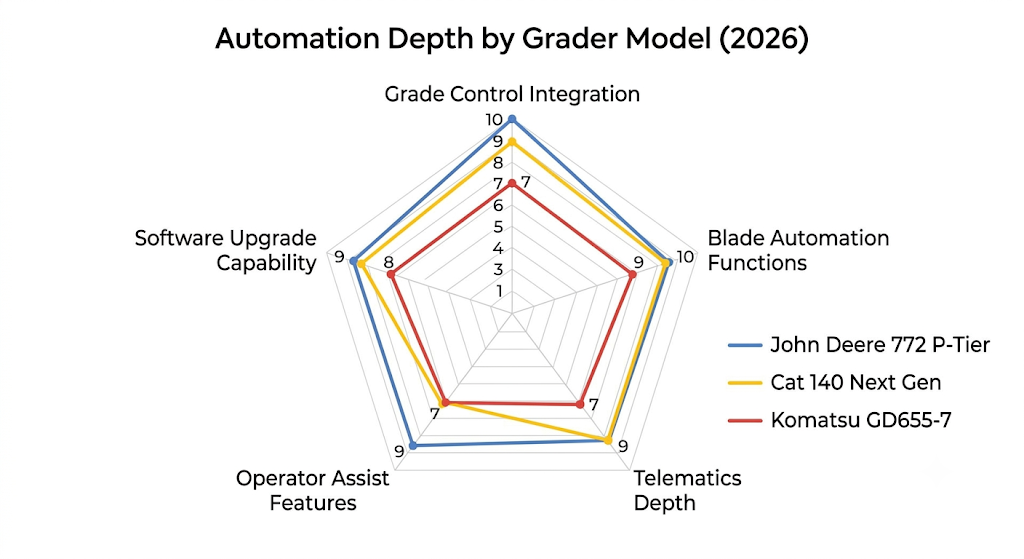
The radar chart shows how each brand approaches automation differently. Deere leads in factory-integrated grade control, Cat in telematics depth, and Komatsu in plug-and-play flexibility. No single model dominates all five dimensions.
Automation Quality and Grade Control Depth
| Model | Grade Control Integration | 2D Standard | 3D Option | Blade Auto Functions | Telematics Integration |
| John Deere 772 P-Tier | Factory mastless (SmartGrade) | Yes | Yes (Topcon/Leica; Trimble later 2026) | Blade flip, auto articulation, SmartSaddle, Machine Damage Avoidance, Auto Pass | Operations Center, Remote Display Access |
| Cat 140 Next Gen | Factory integrated (Cat Grade) | Yes (Cross Slope) | Yes (Cat Grade 3D) | Stable Blade, Auto-Shift Plus, auto articulation | Product Link / VisionLink |
| Komatsu GD655-7 | Plug-and-play retrofit | Yes (2D Cross Slope standard) | Yes (Topcon/Trimble plug-and-play) | Dual Mode Transmission auto-stall prevention, fingertip control | Komtrax |
| Cat 16 | Factory integrated (Cat Grade 3D) | Yes | Yes (Cat Grade 3D + MineStar) | VHP, Eco mode, Grade 3D | MineStar Fleet, MineStar Health |
| John Deere 672 P-Tier | Factory mastless (SmartGrade) | Yes | Yes (Topcon/Leica) | Same as 772 P-Tier | Operations Center |
| Volvo G976 AWD | Add-on compatible (Co-Pilot) | Yes (Co-Pilot slope/position) | Yes (Trimble/Topcon add-on) | Creep Mode AWD, 16-level AWD aggression | CareTrack |
| Komatsu GD955-7 | Plug-and-play | Yes | Yes | Dual Mode, Komtrax | Komtrax |
| Case 865C VHP | Retrofit (2D/3D) | Optional | Optional | 3-curve engine, torque converter lock-up | myCASEConstruction |
| Volvo G930 | Retrofit | Optional | Optional | Proportional Demand Flow | CareTrack |
| SANY SMG200C-8 | Retrofit compatible | Optional | Optional | Electronic system monitoring | LCD diagnostics + SANY connectivity |
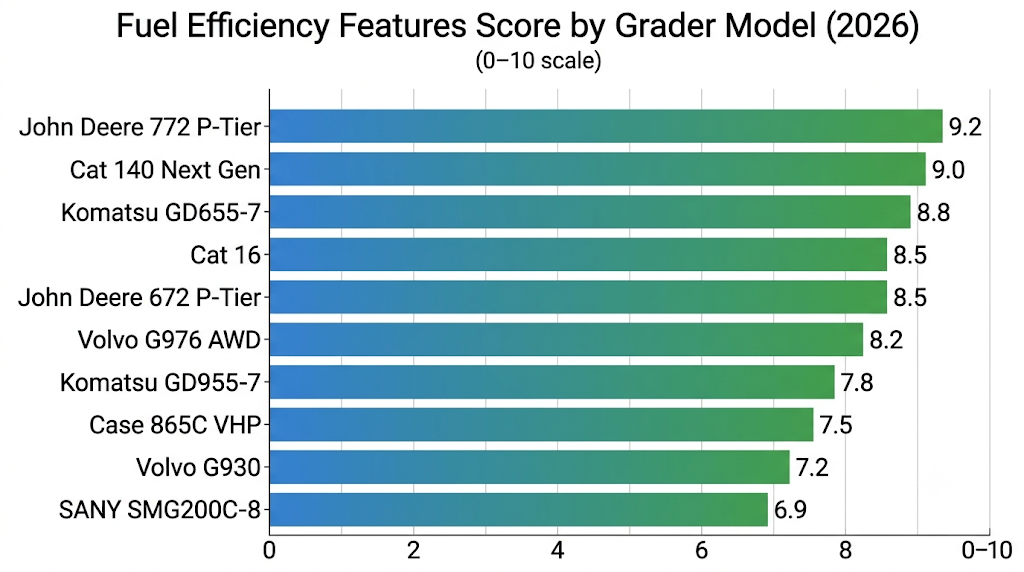
This composite score reflects eco mode capability, transmission efficiency, hydraulic design, idle management, and verified fuel savings claims for each model in 2026. The Deere and Cat platforms score highest due to their factory-integrated automation, reducing passes and engine workload simultaneously.
Does Automation Actually Save Fuel?
The short answer is yes, consistently, but the mechanism matters. Grade control automation reduces fuel consumption primarily by reducing passes. Every grading pass that can be eliminated is diesel not burned, hours not accumulated on the machine, and labor not paid.
Advanced machine control systems equipped in motor graders help reduce fuel consumption and costs by eliminating the need for rework, getting the job done right in the first attempt, thereby saving fuel and time.
Companies using precision grading technologies report 40% productivity gains, even on challenging projects. Smart attachments and grade control systems not only improve efficiency but also lower costs, with fuel savings and reduced labor expenses making them essential for modern grading equipment.
There is also a meaningful difference between fully integrated systems (like John Deere SmartGrade or Cat Grade 3D, which are factory-calibrated and built into the machine’s software architecture) and retrofit grade control systems (which are added after purchase from third-party suppliers). Both reduce rework and passes, but integrated systems tend to work more seamlessly with the machine’s other automation features, auto-pass, blade flip, and intelligent saddle positioning, in ways that retrofits cannot fully replicate.
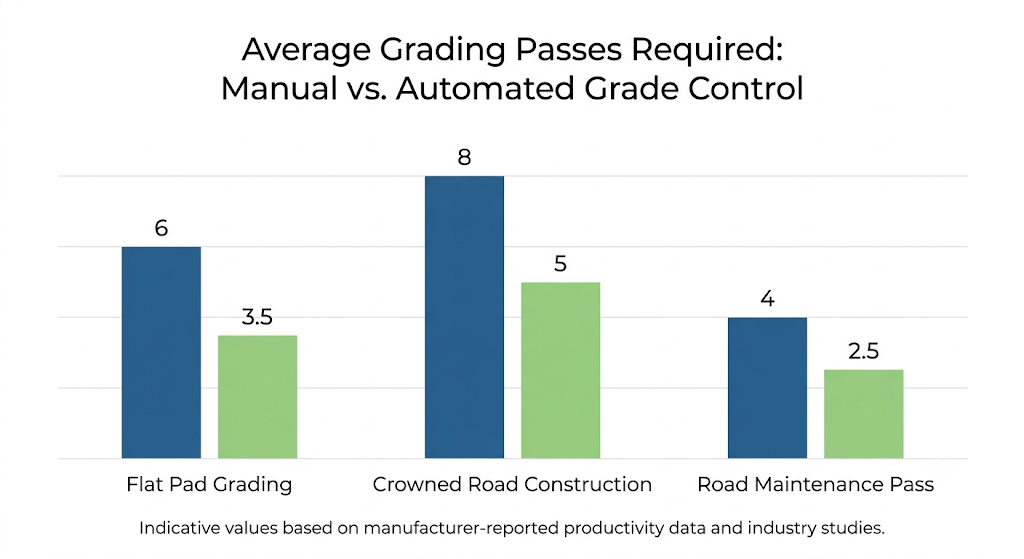
Fewer passes directly translate to less fuel burned per graded kilometer. Grade control automation consistently cuts pass counts by 30–50% across application types, compounding savings across a full grading season.
For contractors thinking about what the next decade of software-defined machine upgrades looks like, the analysis at Best Graders for the Next Decade Will Be Decided by Software Update Cycles is one of the sharpest takes available on where grader ROI is really heading.
The Operator Shortage Factor
Automation’s fuel efficiency benefits are closely connected to another trend: the growing shortage of experienced grader operators. A machine that compensates for operator skill through automatic blade control, auto-pass, and SmartSaddle positioning is not just more fuel-efficient in theory; it is more fuel-efficient in practice, because less experienced operators make more corrections and more passes.
Over 58% of manufacturers have expanded R&D budgets in the last two years to develop fuel-efficient and smart control systems, and fleet modernization programs across Asia-Pacific have led to the replacement of over 6,800 aging graders with new models since 2023.
The connection between AI-driven automation and solving the operator shortage problem is explored in depth in Can AI Help Solve the Growing Shortage of Motor Grader Operators?
2025–2026 Updates That Affect the Ranking
Several significant product events shaped this list:
This year is proving to be a major one for top grader manufacturers, with next-generation models from Caterpillar and John Deere released at ConExpo 2026. Case has also re-entered the 200-plus-horsepower market it exited a decade ago, and China-based LiuGong has released its first motor grader for the U.S. market.
The Cat 140 LVR entering production in Q1 2026 is significant because it brings next-generation cab design, expanded Cat Grade capability, and improved fuel consumption to Caterpillar’s most popular model. The John Deere P-Tier refresh across eight models, announced at ConExpo 2026, represents the most comprehensive grader line update Deere has done in years, with SmartGrade now supporting both Topcon and Leica for the first time.
For Komatsu, the GD655-7 continues its current generation run with no announced successor, but remains competitive through its plug-and-play grade control architecture and Dual Mode Transmission fuel savings.
Caterpillar introduced models with up to 20% improved fuel efficiency and 15% reduced emissions across recent product generations, while more than 33% of new products now integrate cloud connectivity, allowing remote performance monitoring.
Which Brands Have Delivered the Best ROI?
The question of which CAT motor grader, John Deere motor grader, or Komatsu grader delivers the strongest return over a five-year fleet cycle is one that fleet managers ask constantly. The answer depends heavily on application type, resale market, dealer proximity, and how well the machine’s telematics are actually used. The detailed five-year ROI comparison at Which Grader Brands Have Delivered Best ROI Over the Past 5 Years breaks this down across the major brands with real market data.
Final Word
The motor grader market in 2026 is not short of options. But the gap between a well-specified automated grader and a manually operated machine of the same horsepower is wider than it has ever been, in productivity, in fuel economy, and in the ability to put a less experienced operator on a machine and still finish a road to spec.
The John Deere motor grader P-Tier lineup and the next-generation CAT motor grader 140 represent the current state of the art in factory-integrated automation for road construction. The Komatsu grader GD655-7 holds its position as the most flexible and proven mid-size option for contractors who want plug-and-play grade control without replacing a functioning machine. And the SANY SMG200C-8 and Case 865C prove that doing smart work on a budget is a real option.
Find Reliable Automated Graders at usedmotorgrader.com
Running a tighter operation starts with putting the right machine in the field. At our website, you can browse a curated inventory of used motor graders from Cat, John Deere, Komatsu, Volvo, Case, and more, machines with documented service histories, proven automation features, and the fuel efficiency track records that matter for your bottom line. Visit usedmotorgrader.com today and put a smarter grader to work on your next project.
FAQs
Q1: Does automation actually reduce fuel consumption, or just improve accuracy?
A: Both, and the two are connected. Automation reduces the number of grading passes needed to finish a section to spec, which directly lowers fuel burn per project. Grade control also reduces over-cutting and rework, which wastes both material and fuel.
Q2: Is the John Deere SmartGrade system better than Cat Grade with 3D?
A: Both are factory-integrated mastless systems and both deliver strong results. SmartGrade now supports both Topcon and Leica providers, giving more flexibility. Cat Grade integrates tightly with Cat’s telematics and mine-site ecosystem. The best choice depends on your existing grade control provider relationships and fleet management platform.
Q3: How much fuel can a Komatsu GD655-7 save compared to older graders?
A: Komatsu’s own published data shows the GD655-7 uses up to 15% less fuel in Economy Mode compared to the GD655-5. In real-world conditions, the variable displacement pump and Dual Mode Transmission consistently reduce fuel draw during lighter grading cycles.
Q4: Are used graders with automation features worth buying in 2026?
A: Yes, in many cases. Models like the Komatsu GD655-7 and John Deere 672G with SmartGrade hold their value well because the automation systems age gracefully, and plug-and-play grade control means used machines can be upgraded to 3D systems without expensive retrofits.
Tags: Top Performing Graders, Motor Graders With Automation, Best Fuel Efficient Graders