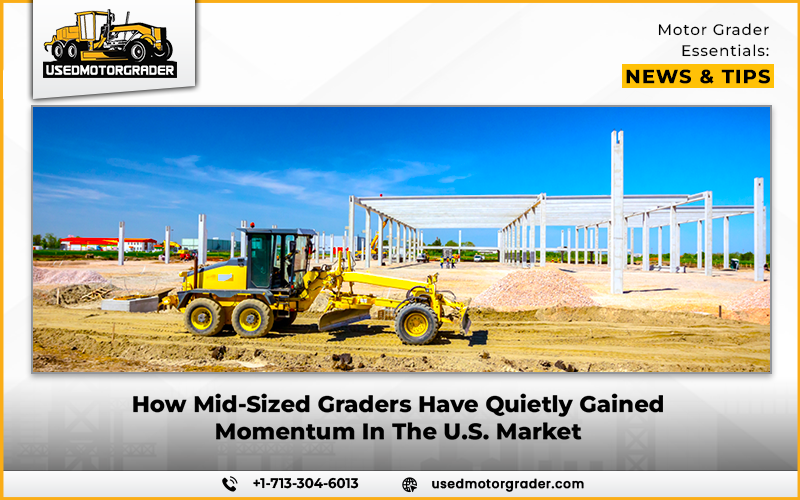
The average used motor grader sold in the U.S. today runs around $221,000, nearly 40% more than the same class of machine would have fetched in late 2021. That’s not supposed to happen to equipment that’s, by definition, getting older every year. But it has, and the segment driving most of that shift is the one nobody spent much time talking about a decade ago: mid-size motor graders.
For years, mid-size units were the compromise pick. Too much machine for a small paving crew, not quite enough for a state DOT running interstate shoulders. Buyers either went small and rented up when a bigger job came along, or bought full-size and ate the fuel bill. Somewhere around 2020, that math flipped. The Cat 140 has spent the last several years as the best-selling new motor grader in North America by financed units, and the Deere 772G has occasionally outsold it outright. Neither is a full-size machine. Both sit squarely in the class this article is about.
What Actually Counts as “Mid-Size”
“Mid-size” isn’t an official SAE class, so it means something slightly different depending on which dealer or spec sheet you’re reading. But look across the models buyers actually cross-shop, the Cat 140M3, John Deere 672G and 772G, Komatsu GD655-6, Volvo G946, and the boundaries get clear fast: net horsepower in the 200-to-280 range, operating weight between roughly 37,000 and 46,000 pounds, and a moldboard between 12 and 14 feet.
Below that sits the compact class, Cat’s 120-series machines, Deere’s 570/670 line, built for subdivision roads, small-site work, and one-operator outfits that don’t need the drawbar pull for heavy cut-and-fill. Above it sits full-size: John Deere’s 872G, Cat’s 16M and 18M, machines pushing 300-plus horsepower and built for interstate corridors, mining haul roads, and airport runways where raw pushing power matters more than maneuverability.
Mid-size sits in the middle of that range for a reason. It has enough blade pull to handle real cut-and-fill work, enough weight to hold a line on compacted base material, and it’s still narrow enough, most run a 12-foot standard moldboard, to work a two-lane county road without shutting down both lanes to do it. That’s the whole appeal in one sentence: enough machine to do the job, not so much machine that you’re paying to move iron you don’t need.
The Timeline: How the Surge Actually Happened
Mid-size graders didn’t take over the market overnight. The shift took the better part of a decade, and most of it wasn’t planned. Buyers reacted to circumstances that had nothing to do with grading itself.
Heading into the mid-2010s, the segment split fairly evenly between Caterpillar’s 12M-series, John Deere’s 670/672G, and a newly aggressive Komatsu. By 2016, Komatsu’s push into mid-size had made the class a genuine competitive battleground rather than an afterthought squeezed between compact and full-size lineups, Cat no longer had the segment to itself.
Then came 2020. COVID-era shutdowns hit equipment manufacturing hard. OEMs reported production cuts and revenue losses across the board, and grading crews that would normally have replaced aging machines on schedule instead held onto what they had.
The Infrastructure Investment and Jobs Act became law in November 2021, allocating roughly $350 billion to federal highway programs alone across fiscal years 2022 through 2026. That money mattered eventually, but federal funding doesn’t hit the ground the day a bill is signed, the lag between apportionment and actual project starts ran well into 2022 and 2023.
That lag overlapped with the real turning point: the 2022–2023 lead-time crunch. Equipment lead times, which averaged about 2.4 months in 2019, stretched to nearly seven months by 2022. Construction equipment prices climbed 13.8% year-over-year. Contractors who needed a grader now, not in eight months, turned to the used market, and mid-size units were the ones sitting on dealer lots and auction blocks in the highest volume, because they’d always been the highest-turnover class. Used motor grader sales jumped 10% in the 2021–2022 period as buyers who couldn’t get new equipment bought used instead.
This table tracks how that pressure showed up in the numbers year by year.
| Year | Key Market Event | Avg. Used Grader Price (FMV) |
| 2016 | Komatsu GD655-6 intensifies mid-size competition | — |
| 2018 | Pre-pandemic pricing peak | $180,023 |
| 2020 | COVID-19 disrupts OEM production | — |
| 2021 | IIJA signed into law (Nov.); ~$350B for federal highways, FY22–26 | $164,866 |
| 2022 | Equipment lead times hit ~7 months; used grader sales +10% YoY | $174,851 |
| 2023 | Used prices hit 5-year high; Deere 772G outsells Cat 140 in new financed units | $204,639 |
| 2024 | Used prices continue climbing; average listed age drops to ~9.4 years | $224,473 |
| Jan. 2025 | Used grader pricing peaks | $230,146 |
| Q1 2026 | Reports higher grader auction volume YoY, steady-to-improving prices | $221,312 (Sept. 2025) |
By 2024 and into 2026, something worth noting happened: even as new-equipment lead times normalized, mid-size graders didn’t lose share back to full-size machines the way a pure supply-chain story would predict. Used prices kept climbing, and Ritchie Bros. reported motor grader auction volumes running higher in Q1 2026 than Q1 2025, with median prices holding steady or improving in both the U.S. and Canada. Buyers who’d been pushed into mid-size by circumstance in 2022 stuck with it by choice in 2026. For a closer look at how that shift unfolded year by year, see this deeper breakdown of the mid-size used market since 2020.
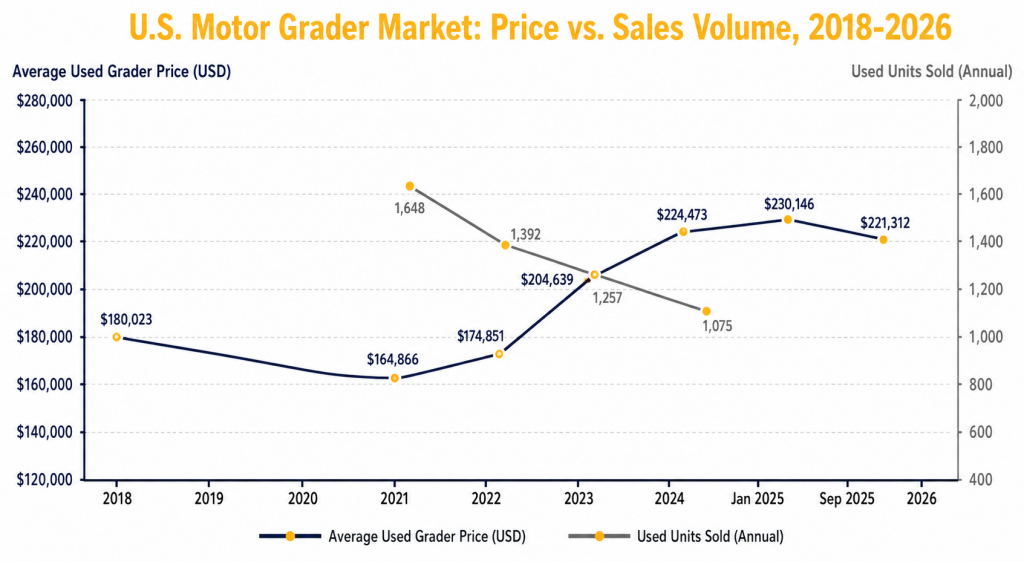
Used motor grader prices climbed nearly 40% since 2021 even as annual unit sales pulled back. Demand outpaced supply, and mid-size models led the shift.
Why Contractors and Municipalities Are Actually Choosing Them
Ask a county road superintendent why they run 140-class graders instead of something bigger, and the answer is rarely about the machine itself. It’s about everything around it.
Start with fuel and maintenance. A 200-hp mid-size grader burns meaningfully less diesel per hour than a 300-plus-hp full-size unit doing the same county-road maintenance pass, and every service interval, filters, fluids, and undercarriage wear scales with engine size and operating weight. For a fleet running a machine 1,200 to 1,800 hours a year on routine grading rather than heavy earthmoving, that difference compounds fast over a multi-year ownership window.
Then there’s the labor problem, which has become impossible to ignore. The Associated General Contractors’ 2025 workforce survey found 92% of firms struggling to fill open positions, with worker shortages now the single leading cause of project delays industry-wide. The Associated Builders and Contractors estimates the industry needs roughly 349,000 net new workers in 2026 just to hold steady. A mid-size grader is simpler to run than a full-size unit, with a shorter learning curve and less time spent training a new hire to feel the blade, and that matters enormously when the operator you have today might not be the one you have in six months.
Financing and resale follow the same logic. A $220,000 mid-size used motor grader is a far easier approval than a $400,000-plus full-size machine, especially for smaller contractors and county fleets working within tight capital budgets. And because mid-size units make up the bulk of both new and used sales volume, they’re also the easiest to sell when a fleet needs to turn equipment over. There’s simply a deeper buyer pool on the other side of that transaction.
Versatility closes the case. A single mid-size grader with a 12- or 14-foot moldboard can handle fine grading, ditch work, gravel road maintenance, and light snow removal without swapping equipment between jobs. This closer look at mid-size grader solutions for small contractors covers that versatility in more depth, one machine covering a wider range of job types means fewer pieces of iron sitting idle between jobs, and that’s real money on a balance sheet.
The Used Equipment Market Angle
The used market is where the mid-size story gets most interesting, because these machines are behaving differently than the standard depreciation curve predicts.
Construction equipment typically loses 20% to 40% of its value in year one and another 5% to 10% annually after that. Motor graders as a category buck that trend, they accumulate hours more slowly than excavators or dozers on comparable jobs, and the buyer base skews toward fleets willing to pay a premium for known-good iron with clean service records rather than chasing the cheapest machine on the lot. Within that already-resilient category, mid-size units are the ones driving the volume.
EquipmentWatch’s fair market value data, the closest thing the industry has to a grader-specific price index, tracked across tens of thousands of resale listings, makes the pattern visible. Public reporting doesn’t break these figures out by size class the way it does for whole-category totals, so Table 3 below reflects the full motor grader category rather than mid-size alone. But given that the Cat 140 and Deere 672G/772G have consistently been the highest-volume new and used models by unit count, mid-size machines are doing most of the work behind these averages.
| Period | Avg. Fair Market Value | Avg. Age of Listed Units |
| Oct. 2021 | $164,866 | 10.5 years |
| Oct. 2022 | $174,851 | 10.9 years |
| Oct. 2023 | $204,639 | 10.8 years |
| Oct. 2024 | $224,473 | 9.4 years |
| Jan. 2025 (peak) | $230,146 | ~9.5 years |
| Sept. 2025 | $221,312 | ~9.5 years |
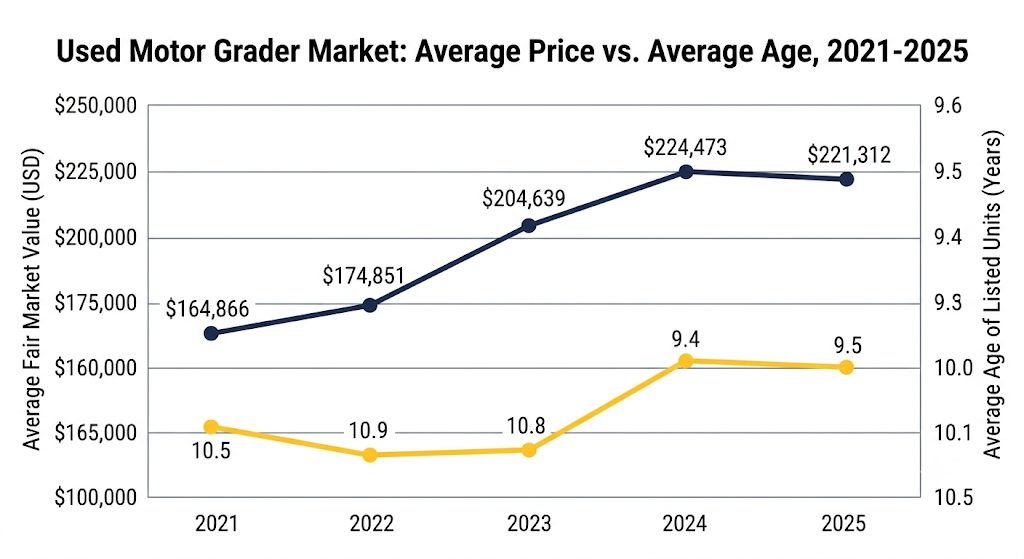
Prices climbed while the average age of listed units dropped, a sign that newer machines are cycling into the resale market faster than usual.
Two things stand out. First, the price run-up isn’t a blip, it’s been mostly one direction since 2021. Second, and more telling, the average age of listed units dropped from roughly 10.9 years to around 9.5 years over that same window. That’s not what you’d expect if demand were flat. A falling average age means newer machines are cycling into the resale market faster, which only happens when buyers are actively pulling recent-model units off active fleets rather than waiting for older machines to age out naturally.
Cat alone accounted for nearly half of all used financed motor grader sales in the most recent reporting period, with the 140 as its flagship mid-size model. When a single size class supplies the majority of both new and used transaction volume, it’s also the class setting the tone for where category-wide pricing goes next.
The OEM Competitive Landscape
Caterpillar, John Deere, and Komatsu aren’t just competing on horsepower anymore. The mid-size fight has become a battle over total cost of ownership, dealer support, and technology packages.
Caterpillar still leads the segment on raw sales numbers, and the 140M3 remains the backbone of that lead. It’s not the newest architecture in the lineup, but Cat’s C9.3-powered 140-series has been the default mid-size choice at enough fleets for long enough that dealer parts availability and used-market liquidity are hard for competitors to match. This look at whether the earlier 12M3 was peak mid-size power for Cat digs into how that earlier M-Series 3 generation still holds up against Cat’s current lineup, which says something about how slowly this class actually ages out.
John Deere has pushed hardest on the technology side. The 672G and 772G both ship with SmartGrade-compatible mastless 3D grade control as an option, and Deere’s PowerTech engine gives the 772G a genuine horsepower edge over the Cat 140M3 at 275 net hp. That extra power, combined with a 14-foot moldboard on the 772G versus Cat’s standard 12-foot board, has made it the go-to pick for municipalities running larger county fleets that still want to stay under full-size territory.
Komatsu plays a different game entirely. This breakdown of how the 2016 GD655-6 challenged Cat’s mid-size dominance covers how the model undercut both Cat and Deere on operating weight while still delivering 218 net horsepower, giving fleets a lighter, more fuel-efficient option for fine-grading work where raw pushing power matters less than precision. Volvo’s G946 rounds out the field with strong AWD traction and up to 245 hp on tap, though it holds a smaller share of the North American fleet than the other three.
This table lines up how the four flagship mid-size models actually compare on paper.
| Model | Net Horsepower | Operating Weight | Blade Width | Typical Use Case |
| Cat 140M3 | 200 hp (200–252 hp VHP Plus) | 43,950 lb | 12 ft (14 ft optional) | County/municipal road maintenance, general grading |
| John Deere 672G | 255 hp | 44,040 lb | 12 ft | Mid-scale site work, utility and subdivision grading |
| John Deere 772G | 275 hp | 45,195 lb | 14 ft | Larger municipal fleets, county highway shoulder work |
| Komatsu GD655-6 | 218 hp | 37,346 lb (41,667 lb w/ ripper) | 14 ft | Fine grading, lighter-footprint mid-size work |
| Volvo G946 | up to 245 hp | 38,140 lb | 12 ft | AWD traction work, rental fleets |
Source: Manufacturer spec sheets, Caterpillar, John Deere, Komatsu, Volvo.
None of these manufacturers is winning outright. Each has carved out a specific reason to be the mid-size default for a specific type of buyer, and that competitive tension is exactly what’s kept the segment innovating instead of stagnating.
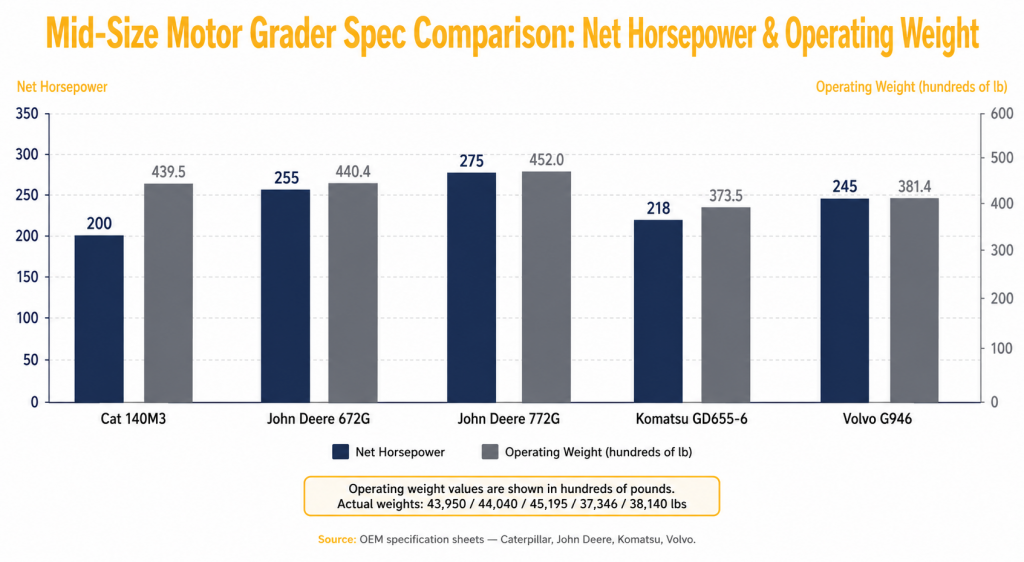
Deere’s 772G leads the class on horsepower and weight, while Komatsu’s GD655-6 stays lightest for fine-grading work. All five sit within the mid-size band.
Technology Creeping Into the Mid-Size Class
Grade control used to be something you added to a full-size machine on a big highway job, not something a county fleet running a 140-class grader would bother with. That’s changed. Mastless 3D grade control systems, Cat Grade with Cross Slope, Deere’s SmartGrade, are now common options on mid-size models, not exclusive to full-size flagship units, because the cost of the technology has dropped faster than the cost of the machines carrying it.
Telematics tell a similar story. Fleet managers running mixed equipment now expect the same remote diagnostics on a mid-size grader that they get on a dozer or excavator, and OEMs have responded by making it standard rather than optional across most current mid-size trims.
Emissions compliance has quietly reshaped the class too. Tier 4 Final requirements pushed every major manufacturer toward selective catalytic reduction and more sophisticated engine management, which added complexity but also improved fuel economy, a real win for fleets running these machines on routine maintenance passes rather than heavy earthmoving.
The net effect: a buyer shopping mid-size today expects features that would have been full-size-only a decade ago, in a package that still costs meaningfully less to buy, fuel, and maintain. That’s part of why the used market for slightly older Tier 4 Final mid-size units, machines built after roughly 2015 but before the newest grade-control-standard trims, has stayed so competitive. They’re new enough to run clean and old enough to skip the premium buyers pay for the latest telematics package.
Where Demand Is Concentrated
Regional demand for mid-size graders tracks two things closely: where infrastructure money is actually landing, and how county and municipal fleets cycle equipment.
The Sun Belt, Texas, Florida, the Carolinas, Georgia, has absorbed a disproportionate share of IIJA-funded road work, driven by population growth that’s outpacing existing infrastructure capacity. That growth means more unpaved and semi-paved county road mileage needing regular grading, which is squarely mid-size territory rather than a job for full-size interstate equipment.
County and municipal fleet replacement cycles matter just as much as new construction. Most public fleets run graders on a 10-to-15-year replacement schedule, and a wave of machines purchased during the pre-2016 buying cycle is now aging into replacement territory simultaneously across multiple states, which partly explains the sales volume even as overall unit counts have pulled back from their 2022 peak.
Rental penetration is the third factor. The American Rental Association’s 2026 forecast put rental penetration at a record high for 2025, as contractors facing project uncertainty leaned on renting instead of owning. Rental fleets skew mid-size almost by default, since it’s the class flexible enough to serve the widest range of customer jobs without dead capital sitting idle between rentals.
What’s Next for the Segment
The realistic near-term picture isn’t explosive growth. It’s steady, structural demand that doesn’t look like it’s going away. Global market forecasts put motor grader industry growth in the mid-single digits annually through the early 2030s, and nothing in the current data suggests mid-size specifically is due for a pullback.
Three things will shape the next few years. First, IIJA funding runs through fiscal year 2026, and whatever follows it, a reauthorization, a scaled-back version, or something else entirely, will determine how much county and municipal grading work actually materializes versus stays on paper. Second, the labor shortage isn’t resolving quickly, which keeps the pressure on simpler, easier-to-operate machines rather than complex full-size fleets. Third, the used-market price run-up can’t continue indefinitely; at some point either new-equipment supply catches up, or buyers get priced out and shift back toward compact units for jobs that don’t strictly need mid-size capability.
None of that points to mid-size losing the ground it’s gained. It points to a segment that’s moved from the compromise pick to the default pick for a large slice of the buyer base, and default positions are hard to dislodge once fleets, dealers, and financing all build around them..
Get the Right Machine, Not the Oversized One
A mid-size grader that’s already on the ground beats one that’s still on order. usedmotorgrader.com carries inspected, dependable used motor graders from Caterpillar, John Deere, Komatsu, and Volvo, priced fairly and built to move dirt on your schedule instead of a factory backlog. Check current inventory and put a machine to work this week, not next quarter.
FAQs
1. What horsepower and weight range counts as a “mid-size” motor grader?
A: Most mid-size models fall between roughly 200 and 280 net horsepower, with operating weights between about 37,000 and 46,000 pounds and a 12- to 14-foot moldboard. Machines like the Cat 140M3, John Deere 672G/772G, and Komatsu GD655-6 all sit in this band.
2. Why are contractors buying used mid-size graders instead of new ones?
A: New-equipment lead times stretched to nearly seven months during the 2022–2023 supply chain crunch, pushing buyers toward the used market, where mid-size units were the highest-volume, most available class. Many stuck with used mid-size purchases even after new-equipment availability improved, since the cost and turnaround advantages held up.
3. What’s the typical price range for a used mid-size motor grader?
A: Used motor grader prices across all size classes averaged between roughly $221,000 and $230,000 through 2025, based on EquipmentWatch fair market value data, though individual mid-size units can run lower depending on hours, age, and condition. A well-maintained Cat 140 or Deere 672G with moderate hours typically prices toward the middle of that range.
4. Do mid-size motor graders hold their resale value?
A: Motor graders as a category depreciate more slowly than most heavy equipment, and mid-size models benefit from the deepest buyer pool on the resale market. That demand has kept used prices trending upward in recent years rather than following the steady decline typical of most construction equipment.
Tags: CAT Mid-Size Motor Grader, Used Motor Grader Market Trends, Mid Size Motor Grader Analysis