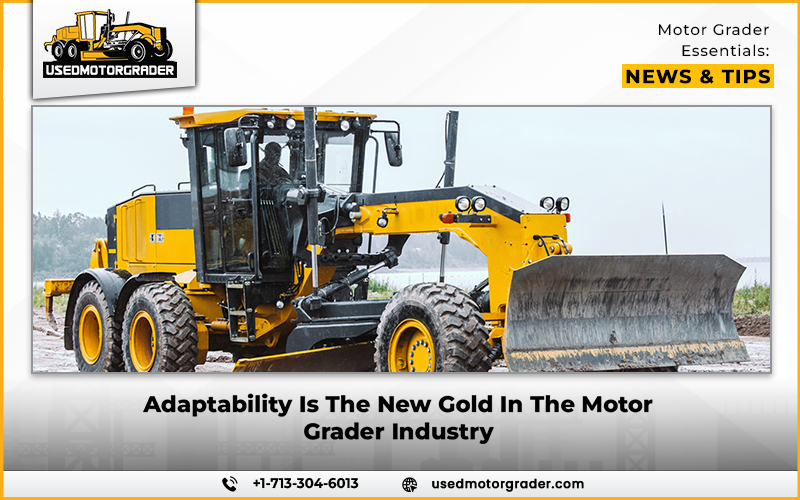
A grader that can only do one thing perfectly is starting to look like a bad investment. In 2026, the machines winning bids, filling rental yards, and holding their resale value aren’t always the biggest or the most powerful, they’re the ones that can shift from a county road repair on Monday to a subdivision pad on Wednesday without missing a beat. Horsepower still matters, but adaptability has quietly become the currency contractors, municipalities, and used-equipment buyers actually spend.
What Does Adaptability Really Mean for a Motor Grader?
Adaptability isn’t the same as versatility or automation, though people use the words interchangeably. Versatility describes what a machine can theoretically do; adaptability describes how easily it shifts between those tasks without a costly reconfiguration, a new operator, or a hit to production.
A grader with adaptive qualities can move between soil types, weather, blade demands, and skill levels while staying profitable the whole time. That distinction is exactly why buyers are paying closer attention to it, as covered in this breakdown of why adaptive qualities matter for used motor graders.
Why Adaptability Is Beating Horsepower as a Buying Priority
The construction industry is short hundreds of thousands of skilled operators, and open equipment-operator roles now take nearly twice as long to fill as they did just a few years ago. That single fact is reshaping how fleets buy machines. Instead of asking “how powerful is this grader,” buyers are asking “how many jobs can this grader profitably run without needing a specialist behind the wheel.”
Other forces pushing the shift:
- Financing costs make oversized, single-purpose graders harder to justify
- Rental fleets, now representing roughly a third of grader transactions, need broadly usable configurations
- Mixed-use fleets can’t afford machines that sit idle once one project wraps
- Contractors working across regions need one platform that handles snow, mud, and dry road grading alike
Is AWD the Real Adaptability Multiplier?
All-wheel drive is the closest thing the industry has to a single feature that expands a grader’s working range. AWD typically adds fifteen to twenty-five percent to the purchase price, but it transforms performance in mud, snow, soft shoulders, and steep grades where a two-wheel-drive machine simply loses traction.
For contractors who stay on dry, packed surfaces year-round, that premium may never pay back. But for anyone working mixed terrain or shifting between regions, AWD is often the difference between a grader that adapts and one that gets parked. Sensor-driven traction and grade-control systems are extending that adaptability further, a trend explored in this look at how sensor technology is transforming the modern grader.
Brand and Model Adaptability, Compared
Manufacturers are approaching adaptability differently, and the gap shows up in how equipped machines feel across applications.
- John Deere graders lean on SmartGrade-style automation and joystick controls that let less experienced operators reach production levels faster
- CAT graders for sale on the used market are prized for broad attachment compatibility and configuration options that suit road work, site prep, and municipal jobs alike
- Komatsu grader for sale listings often highlight smooth hydraulics and stable blade control that hold up across shifting soil conditions
Some of this comes down to what analysts call invisible tech, the telematics, control tuning, and software layers buyers don’t see on a spec sheet but feel in daily operation, covered in this ranking of motor grader brands by their invisible tech. The direction of the whole industry is trending the same way, as laid out in the future of motor graders and technology.
How Does Adaptability Affect Used Grader Resale Value?
Used motor grader prices have climbed as inventory tightens. Buyers are filtering less on brand reputation and more on service history and configuration breadth. A grader that has proven itself across several job types tends to move faster. It holds value better than one built for a single narrow application.
- Mid-size, AWD-equipped machines attract the broadest buyer pool
- Familiar, well-documented control layouts shorten the learning curve for new owners
- Software and firmware currency is increasingly part of that resale conversation, a factor detailed in this piece on software update cycles and grader value
Where Specialization Still Wins
None of this means horsepower is obsolete. Large-scale mining, severe-duty subgrade work, and high-production road building still reward maximum weight, blade size, and raw pulling power over flexibility. Adaptability matters most for mixed-use fleets, municipalities, and contractors juggling varied projects, not every buyer.
Your fleet doesn’t need a machine built for one job, it needs one built to keep earning across many. Shop reliable used motor graders from top brands and put adaptability to work today.
FAQs
1. Does AWD always increase a grader’s value?
A: Not automatically, but it broadens the range of buyers and conditions the machine can handle, which supports resale.
2. Are John Deere graders good for new operators?
A: Their automation and grade-control options generally shorten the learning curve compared to fully manual setups.
3. Is a used CAT grader a safe buy for mixed jobs?
A: Yes, provided service records and hours check out, CAT graders for sale are widely known for broad configuration support.
4. Can too much technology hurt a grader’s adaptability?
A: Yes. Excess complexity can slow training and complicate repairs, offsetting the benefits it was meant to add.
Tags: Used Motor Grader Industry Trends, Used Motor Grader Industry Analysis, Older Vs Newer Motor Graders