The Overlooked Motor Grader Problem: Newly Trained Operators Are Leaving Before They Ever Get Good
Somewhere on a jobsite this week, a newly certified grader operator is sitting in the seat, hands on the controls, quietly counting down the months until they can move to a different trade entirely. Nobody put that thought there on purpose. It built up slowly, through long days, confusing blade controls, a foreman who didn’t have time to explain anything twice, and a paycheck that didn’t match what the recruiter described. By the time that operator walks off the site for the last time, the company has lost more than a warm body. It has lost the training investment, the ramp-up period, and, most expensive of all, the years of skill that never got the chance to develop.
This is the part of the labor shortage conversation that rarely gets attention. Most coverage focuses on the front door: not enough people entering the trade. Far fewer people are talking about the back door, where trained operators quietly exit before they ever become genuinely proficient on a machine as demanding as a motor grader. And for a market built on used equipment, resale value, and long-term ownership cycles, that quiet exit matters more than most contractors realize.
What This Problem Really Looks Like
A motor grader is not a machine you master in a season. Between the blade, the articulation, the circle rotation, the leaning wheels, and the constant feathering of multiple hydraulic functions at once, it’s widely regarded as one of the hardest pieces of heavy equipment to run well. Operators who’ve spent a decade behind the wheel will say the same thing in almost every conversation: the first two years are the hardest, and a lot of people don’t make it through them.
The issue isn’t that people can’t be trained. Training programs, certification courses, and OEM simulator systems have gotten considerably better over the past several years. The issue is what happens after training ends. A freshly certified operator walks onto a live jobsite, gets handed the keys, and discovers that classroom competence and jobsite competence are two different things. Add in a construction industry where the average team rookie ratio sits at 36.4% and climbs to 56.2% on teams of 51 or more people, and there often isn’t a seasoned hand nearby to catch the mistakes before they become expensive ones.
That gap between “trained” and truly capable shows up in the numbers too. According to Bureau of Labor Statistics data, the median annual wage for construction equipment operators was $58,320 in May 2024, with the lowest 10 percent earning less than $39,850. For someone fresh out of a training program, that bottom bracket is often the starting reality, and it’s a hard number to reconcile with the physical and mental demands of learning a grader from scratch.
When the Issue Started and How It Evolved
This didn’t happen overnight. The roots go back to the 2008–2010 recession, when a huge share of experienced operators left the industry and never came back. That created a structural gap in mentorship: an entire cohort of would-be trainers simply wasn’t there anymore. Through the 2010s, contractors patched the gap as best they could, but the informal apprenticeship model, where a green operator spent a year or two shadowing a veteran before touching a grader solo, became harder to sustain as crews got leaner.
The pandemic years accelerated the problem in two directions at once. Demand for construction workers spiked, so companies pushed new hires into machine seats faster than they normally would have. At the same time, wages in other industries rose quickly, giving newly trained operators an easy exit ramp the moment jobsite frustration set in. By the time hiring pressure eased, the habit of rushing people into complex machines without adequate mentorship had already become normalized on a lot of crews.
Today, the picture is a mix of encouraging and concerning signals. On one hand, quit rates hit a nine-year low in mid-2025, suggesting that once people are in a role, they’re sticking with it more than they used to. On the other hand, the pipeline bringing new people in has narrowed. Gen Z’s share of the construction workforce grew from 6.4% in 2019 to 14.1% in 2023, while Baby Boomers declined from 20.6% to 14.2% over the same period, meaning the industry is leaning harder on a younger, less experienced bench right as fewer veterans are left to mentor them. And that bench is under real-time pressure: Deloitte estimates that 41% of the construction workforce will reach retirement age by 2031.
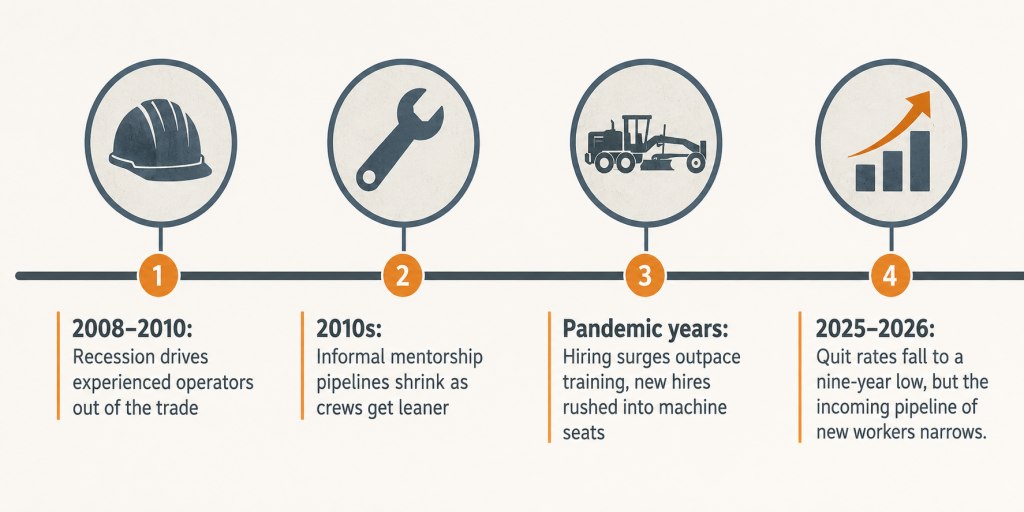
The retention problem didn’t appear overnight, it built up over three distinct eras of the construction labor market. Understanding the timeline explains why mentorship, not just hiring, is now the harder half of the fix.
Why Newly Trained Operators Leave Too Early
Ask ten operators why they walked away from a grader seat in their first year and you’ll hear overlapping answers, but a few themes come up again and again.
Wages don’t match the reality of the work. The nationwide entry point for equipment operators sits well below the median, and grader work in particular comes with a steeper learning curve than most other machines in the yard. When new operators compare their paycheck to the mental load of the job, the math frequently doesn’t feel worth it.
Mentorship is thin or missing entirely. With a shrinking pool of veteran operators and leaner crews, there often isn’t anyone available to sit in the cab, explain why the blade is chattering, or walk a rookie through a tricky slope pass. Operators are frequently expected to learn through trial and error on a live site, which is both slower and more stressful than structured coaching.
Lifestyle friction wears people down. Long hours, travel to remote job sites, exposure to extreme weather, and the seasonal, project-based nature of construction work all chip away at retention. A grader operator who signed up expecting steady, local work can find themselves three states away for a highway job with no clear end date.
The gap between “trained” and “jobsite-ready” is wider than people expect. Simulator hours and classroom certification build real fundamentals, but they don’t fully replicate the pressure of holding grade on a live paving crew or fine-finishing a subdivision street while a superintendent watches from the curb. For a deeper breakdown of what jobsite-ready competence actually requires, this piece on what skills a motor grader operator actually needs lays out the gap in practical terms.
Confidence erodes quickly. Grading is a finesse skill. A few visibly bad passes in front of a crew can shake a new operator’s confidence badly enough that they start looking for an exit before they have had a real chance to improve.
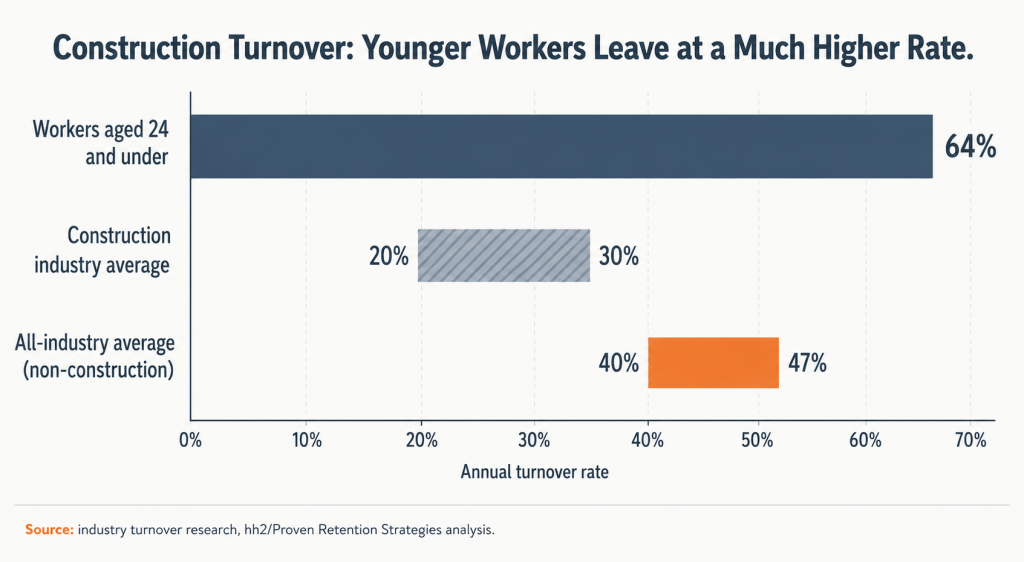
Younger, newer workers leave construction roles at more than double the industry average, a pattern that lines up closely with what contractors report about early-career grader operators.
| Reason Operators Leave Early | What the Data or Industry Pattern Shows |
| Pay doesn’t match job demands | Entry-level equipment operator pay often falls near or below the BLS bottom decile of $39,850/year |
| Weak or absent mentorship | Structured apprenticeship pipelines take 5–7 years to fully develop a skilled worker, and fewer veterans remain to mentor |
| Lifestyle and instability | Seasonal layoffs can remove up to half a project’s workforce at completion, disrupting continuity for new hires |
| Steep, unsupported learning curve | Grader controls (blade, circle, articulation, lean) are widely considered harder to master than most other heavy equipment |
| Loss of confidence early on | Visible early mistakes on a live site, without coaching, push some operators out before their skills mature |
Why This Problem Is Expensive for Contractors and Fleets
Every operator who leaves before reaching full proficiency represents a sunk cost that never paid off. Recruiting, onboarding, safety orientation, simulator time, and supervised hours all cost money before an operator becomes fully productive, and none of that investment is recovered if the person exits in year one.
The replacement math is brutal industry-wide. Replacing hourly workers costs 16–20% of their annual salary, and specialized positions can run as high as 213%, a category that reasonably includes a grader operator, given how much longer it takes to build competence on that machine compared to more entry-friendly equipment. Layer that on top of an industry where 45% of firms report at least one delayed project in the past year because of workforce shortages, and it’s clear this isn’t a soft, background cost. It shows up directly in missed schedules and strained margins.
There’s a fleet-level consequence too, one that connects directly to the used equipment market. When contractors can’t keep operators long enough to build real proficiency, machines get run harder by less skilled hands, more abrupt blade movements, more unnecessary wear on the circle drive and moldboard, more hours logged without the corresponding productivity. That accelerates depreciation and shows up later as increased maintenance flags when a grader eventually heads to resale.
| Business Impact | Why It Happens |
| Higher replacement costs | Specialized-role turnover can run up to 213% of annual salary |
| Project delays | Workforce shortages caused delays for 45% of firms in the past year |
| Increased machine wear | Inexperienced operators put more strain on blade, circle, and hydraulic systems |
| Lower crew productivity | Teams with high rookie ratios take longer to hit grading tolerances consistently |
| Diminished resale condition | Machines run by rotating, undertrained operators often show more inconsistent wear patterns |
How It Affects Used Motor Grader Buying Patterns
Operator turnover doesn’t just cost contractors in labor terms, it quietly reshapes what buyers look for in the used market. Fleet managers who’ve watched inexperienced operators struggle increasingly favor graders with more forgiving controls: joystick systems over dual-lever setups, better sightlines, and cabs that reduce operator fatigue over a ten-hour shift. A machine that’s easier for a green operator to run competently is worth more to a buyer who knows retention is a moving target.
This preference split shows up clearly when comparing what seasoned operators want versus what newer hires gravitate toward. The differences aren’t cosmetic, they affect resale demand, trade-in timing, and which model years hold value longest. A closer look at what veteran and new operators actually prefer in motor graders makes the case for why buyers are paying closer attention to cab ergonomics and control layout than they did a decade ago.
There’s also a rental-market ripple effect. Contractors who can’t guarantee a stable operator bench are leaning more on rental fleets to bridge staffing gaps, which shifts some purchasing decisions from long-term ownership toward flexible, short-term equipment access, at least until a company’s operator roster stabilizes.
What Operators Say vs. What Employers Think
Talk to operators and employers separately about this issue, and the two conversations rarely line up.
Operators tend to describe a job that looked one way in the classroom and felt completely different on-site. They talk about being handed a machine with minimal supervision, being judged on productivity before they’ve had time to build consistency, and feeling like there’s no clear path for feedback or advancement. Many describe the first several months as isolating, long hours alone in a cab, with limited interaction beyond a radio check-in.
Employers, meanwhile, often believe they’re doing more than they actually are. Many point to a certification program or a week of supervised hours as sufficient onboarding, without recognizing that true jobsite competence on a grader takes considerably longer to build. Some employers also underestimate how much culture and management style affect whether a new hire sticks around, a demanding foreman with no patience for a learning curve can undo weeks of good training in a single bad interaction.
This disconnect is exactly why some OEMs have started addressing the shortage from both ends, building better training tools while also encouraging contractors to rethink onboarding pace. Caterpillar’s approach, which blends simulator-based training with structured operator development programs, is a useful case study in how Cat is addressing the shortage of experienced grader operators, and it highlights how much of this problem sits at the intersection of training design and workplace culture, not just labor supply.
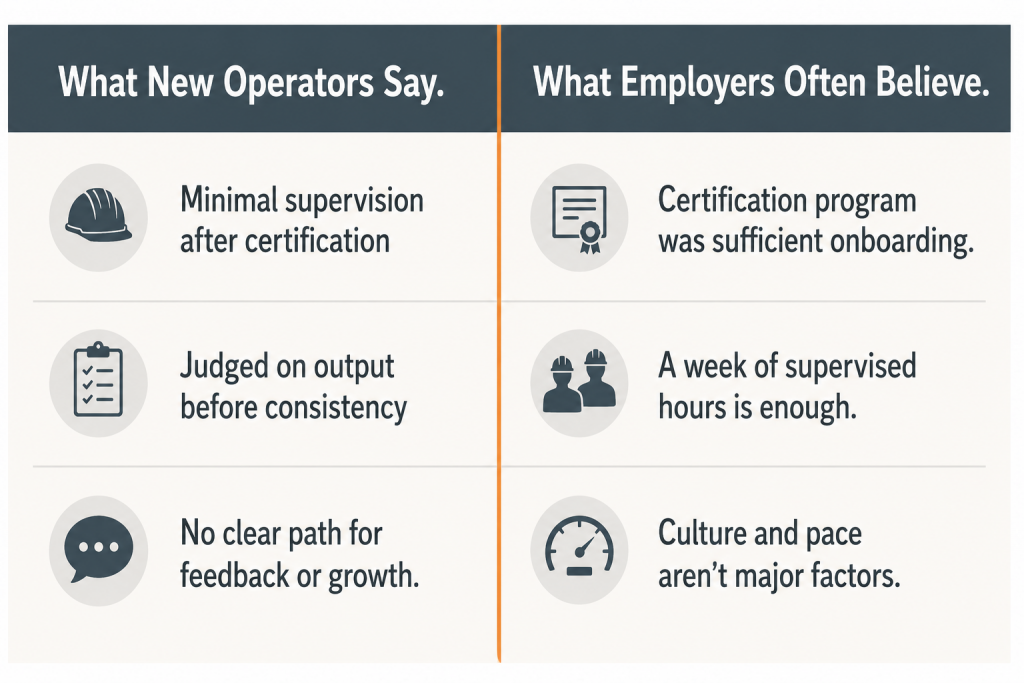
The retention gap often comes down to a perception gap. Operators and employers frequently describe the same onboarding experience in very different terms.
What Machine Design and Technology Have to Do With It
Equipment design plays a bigger role in retention than most people credit it for. A grader with a punishing learning curve, heavy, imprecise controls, poor visibility to the blade, and a cab that beats up an operator’s back over a ten-hour shift makes the first year harder than it needs to be. Conversely, machines with more intuitive joystick controls, grade-assist technology, and improved cab ergonomics shorten the distance between “certified” and “genuinely competent.”
Simulator training has made a real dent here. Caterpillar’s motor grader simulator systems let new hires build muscle memory on authentic controls before ever touching a live machine, and dealers who’ve adopted them report faster, safer ramp-up periods. That said, simulators solve part of the problem, not all of it, they build fundamentals, but the confidence and judgment that come from real jobsite hours still have to be earned on-site, with support.
Automation and assist technology are the next frontier, and there’s active debate about how much they can actually move the needle on retention. Grade-control systems can reduce the skill ceiling needed for certain tasks, which helps new operators produce acceptable results sooner. Whether that translates into people staying in the trade longer, or simply lowers the bar for entry without addressing the deeper mentorship and pay issues, is still an open question, one explored in more detail in this look at whether AI can help solve the growing shortage of motor grader operators.
What Solutions Are Actually Realistic
No single fix solves this. It’s a layered problem, and the layered solutions look different depending on who’s holding the responsibility.
Contractors that have improved retention tend to share a few habits: pairing new hires with a dedicated mentor for the first several months instead of a rotating cast of supervisors, phasing in machine responsibility gradually rather than handing over a full workload immediately, and being transparent about pay progression so new operators can see a path forward instead of guessing at it.
Training organizations and dealers are investing more heavily in simulator-based programs precisely because they compress the riskiest part of the learning curve, the early hours where mistakes are most likely and most costly. OEMs are also funding scholarship and apprenticeship programs aimed at reducing the financial barrier to entry, recognizing that a five-to-seven-year apprenticeship pipeline needs support at both ends to stay full.
| Stakeholder | Realistic Solution |
| Contractors | Assign dedicated mentors and phase in machine responsibility gradually |
| Trainers and Dealers | Expand simulator-based training to compress the highest-risk early learning period |
| OEMs | Fund apprenticeship and scholarship programs; continue improving cab ergonomics and grade-assist technology |
| Industry Associations | Support wage transparency and structured career-path communication for new operators |
Future Outlook
There’s no clean answer to whether this gets better, worse, or stays the same, the honest picture is mixed. On the retention side, there’s real reason for cautious optimism: fewer people are quitting once they’re in a role, and OEM training tools keep improving. On the recruitment side, the picture is tougher. Firms reporting difficulty filling salaried positions sat at 80% in the AGC/Sage 2026 Outlook, and the broader industry needs hundreds of thousands of net new workers over the next two years just to keep pace with demand.
For motor graders specifically, the equipment side of this equation will likely keep evolving toward more forgiving, operator-friendly designs, because that’s one of the few levers manufacturers can pull directly. Expect continued investment in simulator fidelity, grade-assist automation, and cab ergonomics, all aimed at shrinking the distance between a newly certified operator and a genuinely productive one.
Conclusion
The motor grader operator shortage isn’t purely a hiring problem, and it isn’t purely a training problem either. It’s a retention problem hiding inside both. Contractors are certifying people, putting them in machines, and then losing them before that investment pays off, not because those operators couldn’t learn the job, but because the systems around them weren’t built to carry them through the hardest stretch of the learning curve. Fix the mentorship gap, close the distance between wage expectations and jobsite reality, and keep improving machine design, and the industry has a real shot at turning “trained” into “experienced” more often than it currently does. Until then, the used motor grader market will keep feeling the ripple effects, in machine wear, in resale patterns, and in which controls buyers are willing to pay a premium for.
Bring reliable, field-tested used motor graders into your fleet without the guesswork. Every listing on usedmotorgrader.com comes from top brands, CAT, John Deere, Komatsu, and more, inspected, documented, and priced for contractors who need equipment that performs from day one. Add proven capability to your operation and put a machine to work this week.
FAQs
Q1. Why do so many newly trained grader operators leave within their first year or two?
A: A mix of below-median entry pay, thin mentorship, and a steep learning curve on a genuinely difficult machine pushes many new operators out before they build real confidence.
Q2. Does better machine technology actually improve operator retention?
A: It helps. Simulators and grade-assist systems shorten the learning curve, but they don’t replace the mentorship and jobsite support new operators still need.
Q3. How does operator turnover affect used grader values?
A: Machines run by rotating, undertrained operators tend to show more inconsistent wear, and buyers increasingly pay attention to control type and cab ergonomics as a result.
Q4. What’s the single most effective retention fix for contractors?
A: Structured mentorship in the first several months, paired with a gradual, well-communicated path to full machine responsibility and pay progression.
Tags: Grader Operator Shortage, U.S. Motor Grader Market, Motor Grader Value Retention