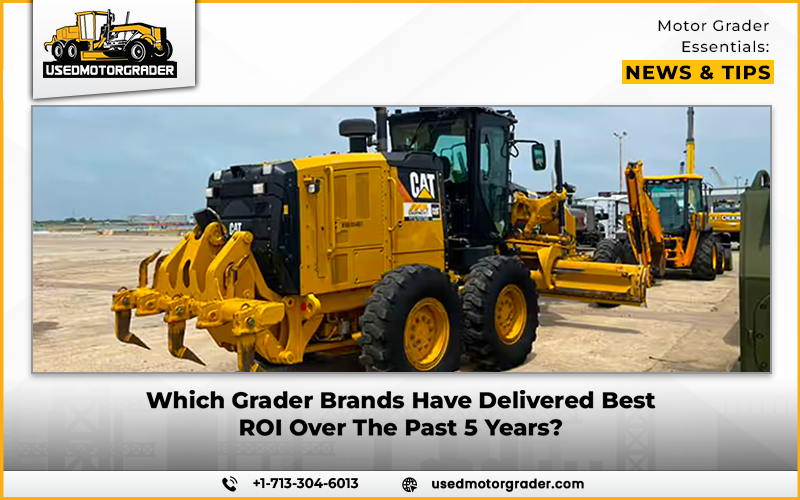
You purchased the machine. You ran it hard. You performed the service at the proper time. Then, when it was time to sell, or when the repair invoice arrived, you discovered the true price of your equipment choice. A smart buy and a big mistake in the motor grader market often aren’t apparent on the day you sign the papers. It appears years later in the auction price, downtime logs, and project margins you barely held on to. Some grader brands have quietly been outperforming the competition on every measure that really counts for a contractor’s bottom line over the last five years, from the supply chaos of 2021 through the credit crunch of early 2026. This is the complete breakdown, based on auction data, fleet-manager feedback, used-market pricing trends, and real-world operator experience.
What “Best ROI” Actually Means for a Motor Grader Owner
It’s helpful to first clarify what ROI really means in this context, as different types of contractors calculate ROI differently.
ROI can be a guaranteed repair price and a resale without hassle for a small contractor with one or two machines. In the case of a large fleet manager, it’s about the lowest cost per productive hour over a 5-year asset cycle. If you are a resale buyer, you are looking for machines that will retain their auction value and sell quickly when they are put up for auction.
The ROI for a motor grader in practice depends on five factors: acquisition cost vs eventual resale value, annual depreciation rate, average cost per operating hour, uptime and reliability of the machine, and the revenue the machine generates per hour of work. The brand that does well in all 5, and not just one or two, is the true ROI leader. Brands that win on purchase price but fail on reliability, or brands that hold value but drain margin through expensive service, fall short when the full math is done.
Five Years of Market Chaos: What Shaped Grader ROI from 2021 to 2026
The last five years were far from normal for the equipment market. Several overlapping pressures affected the definition of “good value” for grader buyers, and it is important to understand this context when interpreting the ROI data:
- New equipment lead times were extended beyond 12 months for some models in 2021 and 2022, resulting in record demand for used equipment and record used prices for all major brands.
- The U.S. Infrastructure Investment and Jobs Act (IIJA) and other infrastructure initiatives in North America, Canada, Australia, and portions of the Middle East led to a significant surge in demand for road-building and maintenance equipment.
- Fuel efficiency and parts cost became much more significant to total ownership cost than in the previous cycle, as inflation increased operating costs throughout 2022 and 2023.
- The rise in interest rates from 2022 and beyond made financing a major challenge, especially for contractors who were heavily leveraged on debt to purchase equipment.
- Tier 4 Final and Stage V vehicles added new and sometimes expensive failure modes, especially in the DEF system, DPF filters, and SCR components, and various brands dealt with these issues in varying degrees of success.
- The speculative premium on used machines has eased since the end of 2023 through 2025 as supply chains returned to normal, while the owners of well-maintained machines have seen their resale velocity and buyer confidence improve.
Which Motor Grader Brands Have Held Their Value Best Over Five Years?
The most tangible and measurable measure of long-term ROI is value retention. A $260,000 new machine that sells for $145,000 at five years is very different from a $260,000 new machine that sells for $95,000 at five years, even though they were both purchased for the same amount of money.
Caterpillar has consistently been the top value retention leader in the motor grader segment based on auction results, dealer used inventory pricing trends, and retained value analysis from EquipmentWatch. The CAT 140, 140 Next Generation, and 160 models have performed best in terms of residual value over several auctions, and offer a significant premium over competitive iron at similar hours and condition levels.
John Deere’s G-Tier and P-Tier models have also proven to have a high retained value, particularly in North America, where the density of dealers and parts availability fosters buyer confidence. In markets with strong dealer networks, such as Australia, Southeast Asia, and some parts of Africa, Komatsu has been able to keep its value up, as the GD655 and GD675 have established a loyal installed base that continues to support auction demand.
Estimated Retained Value After Five Years by Brand and Model (% of Original Purchase Price)
| Brand / Model | Avg. New Price (USD) | Est. 5-Year Resale | Retained Value (%) |
| CAT 140M / 140 Next Gen | $250,000 – $310,000 | $130,000 – $165,000 | 52–55% |
| John Deere 670GP / 770G | $220,000 – $280,000 | $110,000 – $148,000 | 49–53% |
| Komatsu GD655 / GD675 | $210,000 – $265,000 | $100,000 – $138,000 | 47–52% |
| Volvo G940 / G946 | $200,000 – $255,000 | $88,000 – $122,000 | 43–48% |
| CASE 836C / 856C | $180,000 – $235,000 | $78,000 – $108,000 | 43–46% |
| SANY / XCMG / LiuGong | $85,000 – $130,000 | $28,000 – $48,000 | 30–37% |
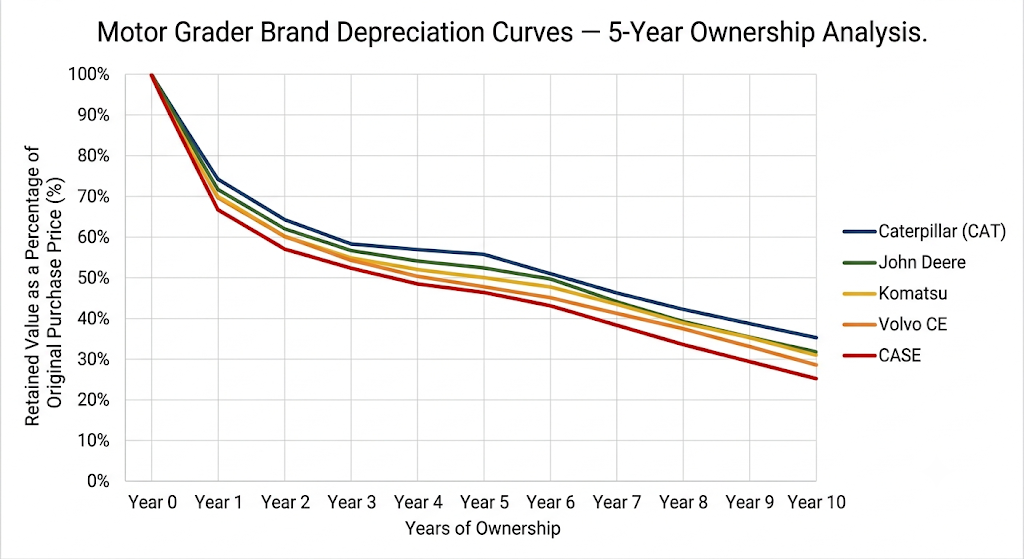
This depreciation curve illustrates how premium brands like CAT and John Deere consistently outperform mid-tier brands in value retention over a standard five-year ownership cycle. The gap widens most sharply after year three, making brand selection one of the most financially significant decisions a contractor can make.
CAT Graders: Still the Benchmark After All These Years
Contractors who are looking for CAT graders for sale always pay a premium, and they don’t hesitate to do so for a reason. Caterpillar’s motor grader family, such as the 140M, 140 Next Generation, 150, and 160, has proven itself to be a strong performer on every return on investment metric that counts.
CAT graders are the most in-demand resale items on all the major auction sites. CAT 140 series machines with 8,000-12,000 hours on them regularly sold for $90,000 to $130,000 across platforms. auctions in 2022-2025, depending on the model year and configuration. Other brand comparable-hour machines were generally priced $20,000 to $40,000 lower, but there was no significant difference in physical condition to account for the price difference. That spread is entirely demand-based; buyers believe in the brand, the parts network, and the serviceability narrative.
When it comes to reliability, the tandem drive system on the 140M, the extensive parts distribution by CAT, and the powerful blade control electronics all make it easier to fix problems when they arise, compared to brands that have longer parts lead times or inconsistent technician skills. If you are in an area where a CAT dealer is reasonably close, you have a significant serviceability edge over nearly any competitor.
The Next Generation CAT 140 and 150, with new joystick controls, improved cab ergonomics, and enhanced Grade Control technology, brought a new level of productivity to the CAT ROI story. Operators change over more quickly, perform fewer passes, and use less fuel per finished lane-mile. For contractors engaged in volume road work, which directly enhances job margin per project.
When considering the purchase of a used CAT motor grader, it’s important to understand the differences between the CAT 140, CAT 140 Next Generation, and CAT 150 models to ensure you’re getting the right machine for the right price point. Caterpillar 140M2 models usually provide reliable and low-cost operation. CAT graders for sale in the used market are still one of the most liquid equipment assets you can own, and that liquidity is a quantifiable part of the ROI.
John Deere Motor Graders: Productivity-Driven Returns That Hold Up
When contractors talk about John Deere motor graders for sale, they tend to begin with the cab comfort, operator feedback, and the intuitive joystick controls that make the G-Tier and P-Tier models so popular on job sites where operator turnover is a significant management issue. However, the ROI argument for Deere is much more complex than ergonomics.
Buyer demand, a robust dealer network, and parts availability that matches CAT’s in most of North America have helped the 670GP and 770G hold up well in the five-year-old market. The P-Tier models with SmartGrade technology and an enhanced powershift transmission brought precision productivity that measurably cut rework on completed roads, directly impacting the cost per lane-mile delivered.
For highway contractors and municipal road departments that are operating graders at high utilization rates, the search for John Deere motor graders for sale in the 670 and 770 classes makes a lot of sense as a total package: competitive acquisition cost, moderate depreciation, strong dealer support, and an operator environment that consistently improves daily output.
See the real-world performance and resale data for the John Deere 670GP and 770G models over the past three years, both at auctions and on private dealer listings.
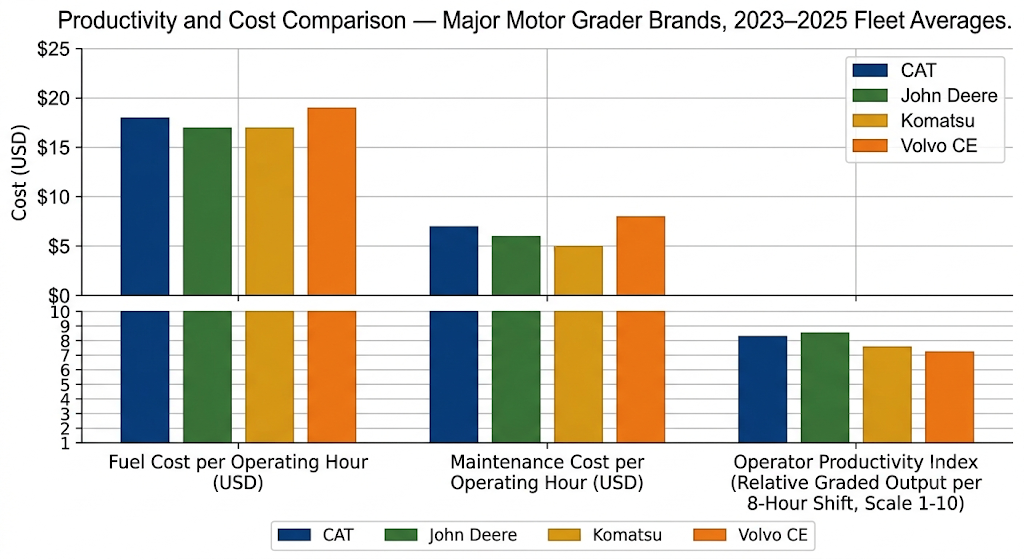
Across both cost efficiency and operator productivity, CAT and John Deere consistently lead the comparison, though Komatsu’s lower maintenance cost per hour makes it a strong contender for high-utilization fleet owners watching every dollar. These figures reflect aggregated fleet-manager data from North American and Australian operations.
Komatsu Graders: The Low-Maintenance Value Case
The Komatsu grader for sale market is a tale of quiet but compelling. The mechanical strength and the relatively easy accessibility for service of Komatsu’s GD655, GD675, and GD755 models have earned a solid reputation for mechanical durability and relatively low maintenance cost per hour over the entire life of the machine, compared to most of its competitors.
Komatsu has a strong installed base in markets such as Australia, where graders operate in remote outback locations, away from the nearest dealer, on haul-road maintenance and station access tracks. Contractors in these areas report fewer downtime events and attribute this to Komatsu’s Australian dealer network as a trusted source of parts and service. The GD675 has demonstrated its durability in demanding, high-hour, high-abuse environments where machines are driven hard on red dirt haul roads. The 2016 Komatsu GD655-6 has often challenged CAT’s dominance in the mid-size segment.
Sticker price is not the only measure of a motor grader for sale, so it’s important to understand the total cost of ownership when fairly comparing a Komatsu grader for sale to CAT and Deere. With lower acquisition cost and lower maintenance cost, the TCO difference between Komatsu and the premium brands is significantly reduced, and in some applications, Komatsu is the clear winner.
The GD675 has also maintained a strong auction demand in the Southeast Asian and Middle Eastern markets, where Komatsu’s reputation for strong, field-repairable machines provides a meaningful export premium. For areas where dealer support is limited, the Komatsu grader for sale, the GD675 and GD755, are worth considering compared to other models that have more complicated emissions systems.
Other Brands in the Mix: Volvo, CASE, and the Value Market Players
Volvo CE and CASE are both competitive in the mid-market. Volvo’s reputation for cab design has a certain charm in markets where operator retention is a management priority, and the Volvo G930–G960 family delivers solid build quality and excellent operator comfort. Municipal contractors who appreciate practical ownership and competitive parts pricing are loyal to CASE’s 836C and 856C.
Value brands from China, mainly SANY, XCMG, and LiuGong, have gained some market share in emerging economies. They have a significantly different ROI profile than the established brands:
- The initial acquisition cost is 35-50% lower than the same model from CAT or Deere, allowing capital-constrained contractors to afford entry-level ownership.
- The 2020-2025 generation has significantly increased reliability and uptime compared to previous generations, reducing but not eliminating the quality gap.
- Resale value and auction liquidity are still significantly lower in developed markets, and the value floors are significantly lower than those of the established brands.
- Home markets in Asia offer better residual values than in North America, Europe, or Australia, when it comes to export demand.
- Availability of parts in North America and Australia is still not consistent, which can lead to unplanned downtime in areas where support infrastructure is not yet in place.
- Dealer networks in other countries and some emerging markets are still in the process of development and are not as deep or as responsive as CAT, Deere, or Komatsu dealer systems.
- Financing programs have improved, but are less competitive than the structured OEM programs offered by CAT Financial or John Deere Financial.
In countries where capital cost is the limiting factor, such as Africa, South Asia, and Southeast Asia, Chinese-brand graders can provide a reasonable ROI. For most buyers, the resale disadvantage is greater than the purchase price savings in North America and Australia.
What Does the Total Cost of Ownership Really Look Like Across These Brands?
Total cost of ownership is where the ROI picture comes into sharpest focus. Purchase price and resale value tell part of the story, but what happens in between, fuel burn, routine maintenance, unscheduled repairs, and downtime, determines whether you actually made money owning the machine.
Estimated 5-Year Total Cost of Ownership per Brand (Based on 1,000 Operating Hours Per Year)
| Brand | Acquisition Cost | 5-Yr Fuel Cost | 5-Yr Maintenance | Est. Resale (Yr 5) | Net 5-Yr Ownership Cost |
| CAT 140 NG / 150 | $285,000 | $90,000 | $60,000 | $150,000 | $285,000 |
| John Deere 770G P-Tier | $265,000 | $85,000 | $55,000 | $138,000 | $267,000 |
| Komatsu GD675 | $245,000 | $85,000 | $50,000 | $122,000 | $258,000 |
| Volvo G946 | $240,000 | $95,000 | $65,000 | $108,000 | $292,000 |
| CASE 856C | $225,000 | $92,000 | $58,000 | $98,000 | $277,000 |
The table reveals something important: Komatsu’s lower acquisition cost, combined with lower maintenance cost, gives it the best net five-year ownership cost in the comparison, despite its lower resale value. CAT and Deere land close behind, with their higher resale value partially offsetting higher upfront and maintenance costs. Volvo shows the weakest TCO performance here, driven by higher fuel and maintenance figures across fleet surveys. CASE is competitive on acquisition cost, but its weaker resale performance pulls the net ownership cost back up.
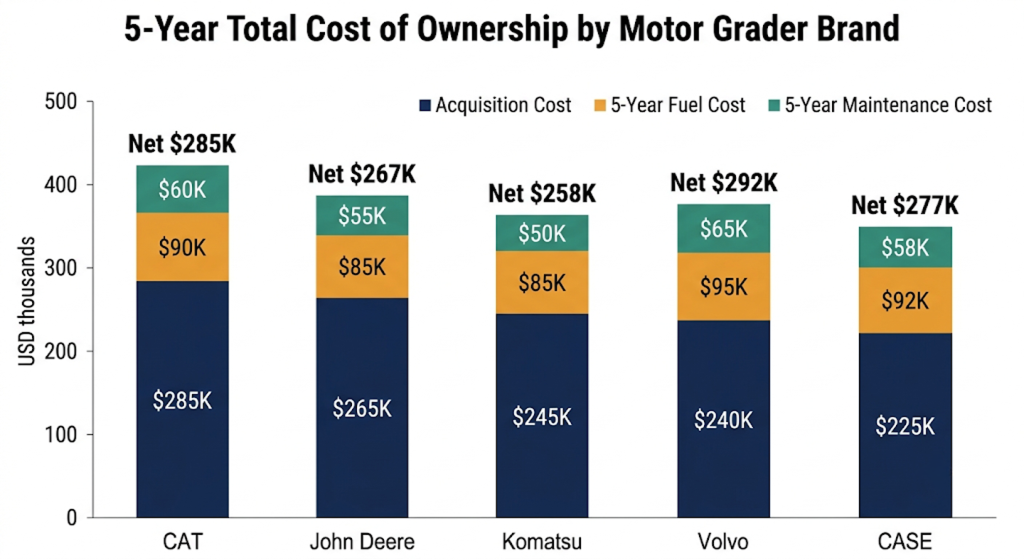
The TCO breakdown reveals that Komatsu achieves the lowest net five-year ownership cost despite a weaker resale value, thanks to lower acquisition and maintenance costs combined. CAT’s strong resale performance closes the gap significantly, making it the better choice when liquidity and capital preservation take priority over minimizing upfront spend.
Does Dealer Support Actually Move the ROI Needle?
The answer is yes, but not as much as most buyers realize when they compare brands on paper. A machine that is idle for three weeks waiting for a part is not only losing working days, but also It is destroying job margin, harming client relationships, and in some cases causing penalty clauses in time-sensitive contracts.
CAT’s global dealer network is the benchmark. CAT ownership in North America, Australia, and much of Latin America is backed by a service safety net that truly and measurably lowers the risk of downtime, with more than 165 dealers across the country and a parts distribution system that delivers same-day or next-day parts for the most commonly used wear and repair parts.
John Deere’s dealer network is also solid in North America, and has grown rapidly in Latin America and portions of Africa during the past decade. Deere’s 24/7 Technical Assistance Center, offered by its dealer network, has been mentioned many times by fleet managers as a valuable service in difficult diagnostic or repair scenarios, especially when dealing with emissions-system issues.
Understanding how financing changes the real cost of owning a motor grader is only part of the equation; the ongoing support you receive after the purchase is what protects that investment. Dealer support can have a direct impact on ROI in the following key areas:
- Field breakdown response time: Hours vs. days of downtime can mean the difference between keeping and losing a contract.
- Parts stocking depth at the local dealer: A local dealer that stocks high-demand wear parts reduces the risk of lead time on the parts you replace most frequently.
- Technician training and skill level: Complex modern emissions systems demand well-trained technicians; inexperienced service personnel increase downtime and often cause secondary failures.
- Warranty processing speed: The time a dealer takes to process warranty claims and arrange field service during the warranty period directly impacts ownership cost in early machine life.
- Dealer-friendly remote diagnostics: CAT, Deere, and Komatsu all have telematics-integrated remote diagnostics, which enable the dealer to detect fault codes and prepare parts before the tech even gets to the shop.
Dealer density in your particular operating area is almost as important as the specifications of the machine when selecting the appropriate motor grader for your fleet size and dealer support requirements. A machine that has a 4-day parts lead time and a 10% better spec sheet will generally be worse than a machine with a slightly lower spec sheet and an hour away from a dealer.
What Do Used Market Prices Tell Us About Real-World ROI?
The results of an auction are never a lie. The clearing price is the market’s unvarnished opinion of the actual value, demand, and trust factor of a machine when thousands of buyers are bidding for it. By examining the market pricing trends for used cars over the past five years (2021-2026) on the top platforms, patterns emerge that are informative and consistent.
CAT graders in the 6,000-10,000-hour range always pass for $90,000-$135,000, depending on the model year, configuration, and condition. Similar Volvo and CASE machines can be sold 25-35% less at these times. That spread has been consistent over several auctions and is a testament to the fact that the CAT premium is not perception-based marketing, but demand-based.
The 770G and 670GP level John Deere motor graders for sale have demonstrated exceptional auction velocity, or days-to-sell, which is defined as the number of days that a machine is listed before it sells. This auction liquidity has ROI value, and it is calculable. A machine that sells in 18 days as compared to 45 days has a lower carrying cost, and also the downward pressure on the price of the machine is significantly less due to the impatience of the sellers.
Used Market Pricing Trends by Brand: 2022 vs. 2025 (Machines at ~8,000 Hours)
| Brand / Model | Avg. Auction Price 2022 | Avg. Auction Price 2025 | Price Change | Avg. Days to Sell (2025) |
| CAT 140M / 140 NG | $108,000 | $96,000 | -11% | 18–25 days |
| John Deere 670GP / 770G | $94,000 | $84,000 | -11% | 22–30 days |
| Komatsu GD655 / GD675 | $88,000 | $75,000 | -15% | 28–38 days |
| Volvo G940 / G946 | $78,000 | $64,000 | -18% | 35–50 days |
| CASE 836C / 856C | $70,000 | $57,000 | -19% | 38–55 days |
The 2022–2025 price normalization was expected as post-pandemic inventory recovered and used supply increased. What matters in the data is the relative spread. CAT and Deere lost the least ground as the market settled, confirming their structural demand advantage over the rest of the field. For anyone actively tracking the used motor grader market and how to find the best deals on quality machines and new technologies, the data consistently points to CAT and Deere as the most liquid and value-stable options available.
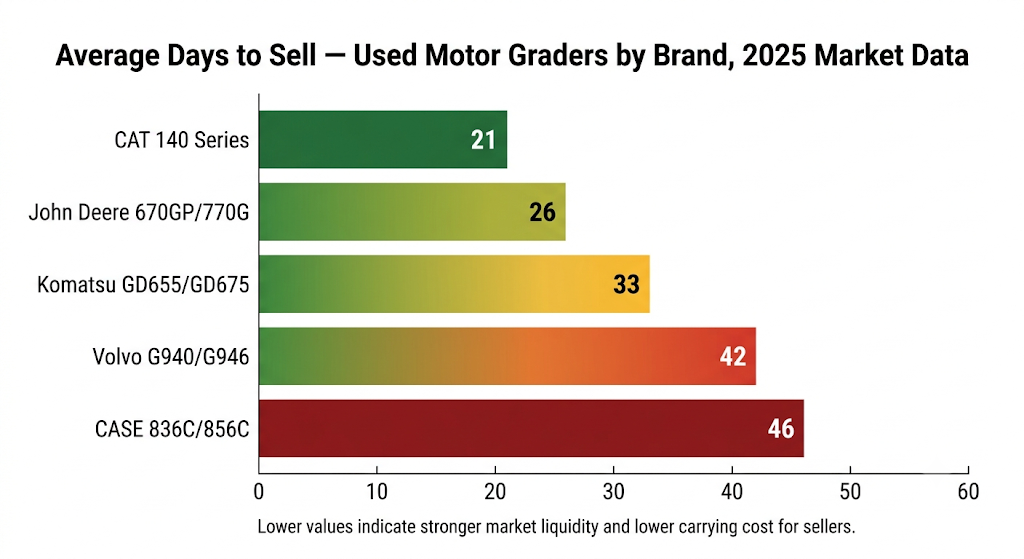
Auction liquidity is a real and measurable ROI component that most buyers underestimate at purchase time. CAT and John Deere sell significantly faster in the used market than Volvo and CASE, reducing carrying costs and protecting net resale proceeds for owners who need to exit or upgrade their fleet.
Best ROI by Machine Type and Job Application
ROI is not the same for every job. What works well on a highway project may not be the most suitable machine for a remote mining haul road or a rural county maintenance program. The key brand and model leaders by application break down as follows:
- Precision Grade Control systems and operator productivity are the backbones of the CAT 140 Next Generation and John Deere 770G P-Tier highway construction and municipal road maintenance systems. The P-Tier SmartGrade platform delivers measurable efficiencies on shoulder work and road resurfacing jobs for buyers considering John Deere motor graders for sale for municipal or DOT applications.
- Site preparation and large area land development: CAT 150 and Komatsu GD755 are suitable for the job; the CAT 150’s long reach blade is ideal for wide area cuts on commercial and industrial site work.
- Rural and agricultural road maintenance: Komatsu GD655, CASE 856C, and older CAT 140H models are popular in this area, where there is less access to local dealers, and lower acquisition costs are more suitable.
- Snow removal and cold-climate road work: Both the John Deere 670GP and CAT 140 series have proven to be effective in snow removal and cold-climate road work, and the cab comfort of the John Deere 670GP is often mentioned as an operator preference in cold-climate fleet surveys.
- Mining support and quarry haul-road maintenance: CAT 16 and Komatsu GD755 dominate this high-duty-cycle, high-hour category where machine durability and ground-engaging tool life are the cost drivers.
- Export resale cycles: CAT graders for sale consistently have the highest export demand worldwide, especially in Latin America, the Middle East, and Southeast Asia, and are the most attractive to buyers who intend to resell abroad.
Regional ROI Performance: Where Does the Best Brand Change?
Brand ROI varies meaningfully by geography, and these differences matter for buyers operating outside the North American core market:
- North America: CAT and John Deere lead on both resale strength and dealer support depth. Komatsu holds a strong position in Canada’s mining and civil construction sectors.
- Australia: Komatsu performs exceptionally well, supported by deep dealer infrastructure and a strong installed base in mining and outback civil work. CAT graders for sale are highly sought after in Australian government infrastructure programs.
- Middle East: CAT dominates, with the most developed dealer infrastructure and the strongest resale demand across the region. A Komatsu grader for sale also performs well, given established regional familiarity with the brand.
- Latin America: Both CAT and Deere command strong premiums, driven by infrastructure investment in Brazil, Colombia, and Chile. John Deere motor graders for sale in the 670 and 770 class have a particularly strong track record in Brazilian road programs.
- Africa: Volvo and CASE have carved out a meaningful share in Anglophone Africa through competitive pricing. Komatsu’s presence in South African mining provides a solid regional resale floor for the GD655 and GD675.
- Southeast Asia and South Asia: Komatsu grader for sale demand is high and well-supported by local dealer networks. Chinese-brand value machines have gained share at the lower price point in markets where capital access is the binding constraint.
What Contractors and Fleet Managers Are Actually Saying
Real-world contractor opinions across industry forums, fleet-manager interviews, Reddit’s r/HeavyEquipment community, and published auction commentary are consistent with what the data shows:
- CAT ownership is repeatedly described as “the safest bet” for contractors where resale is a priority. Owners regularly note that the premium at purchase is more than recovered at the time of sale.
- John Deere operators consistently rate comfort and productivity highest, and fleet managers highlight the dealer network and digital diagnostic tools as genuine differentiators that reduce unscheduled downtime events.
- Komatsu owners report the lowest surprise repair bills over high-hour ownership, particularly with the GD655 and GD675 in demanding conditions, and praise the simplicity of day-to-day maintenance routines.
- Volvo CE earns strong marks for cab quality and build finish, but ranks lower on resale value and parts cost in most contractor surveys.
For practical tips on buying reliable used motor graders at the best price, experienced contractors consistently recommend three things: prioritize documented service history, confirm local dealer support before you buy, and stick with brands that have established resale demand in your specific market.
Make Your Next Motor Grader Purchase Count
The numbers make a clear case. Over the past five years, CAT, John Deere, and Komatsu have outperformed the field on every ROI metric that actually matters: value retention, total cost of ownership, uptime, auction liquidity, and contractor profitability. Whether you’re searching for CAT graders for sale to maximize capital preservation, exploring John Deere motor graders for sale for productivity-led returns, or looking at a Komatsu grader for sale to minimize long-term ownership cost, the right machine is available right now.
Browse the full inventory of quality used motor graders from the industry’s top brands at usedmotorgrader.com. Every machine in the inventory is verified, competitively priced, and supported by expert guidance to help you find the right fit for your operation and your budget. The best ROI decision you make starts with choosing the right machine from the right source. Find your next high-ROI grader today.
FAQs
1. Which motor grader brand has the best resale value?
Caterpillar leads consistently, with the 140M and Next Generation 140 holding auction value best at both five and ten years of ownership. John Deere is a close second, particularly in North American markets where dealer network density drives buyer confidence and purchase velocity.
2. Is a used Komatsu grader a good buy for a small contractor?
Yes, in many cases. The Komatsu grader for sale market offers lower acquisition costs, proven mechanical reliability, and long-term durability that holds up in demanding conditions. For contractors in regions with established Komatsu dealer support, the GD655 and GD675 offer excellent net total cost of ownership over a five-year hold.
3. Are Chinese-brand motor graders worth considering for ROI?
In emerging markets where capital cost is the primary constraint and resale value is a lower priority, brands like SANY and XCMG can deliver workable ROI. In North America, Europe, and Australia, the resale disadvantage remains large enough that most buyers should focus on CAT, Deere, or Komatsu for five-year ownership cycles.
4. Does buying a newer emissions-equipped grader hurt long-term ROI?
Not necessarily, though it requires disciplined maintenance. Emissions-system failures around DEF and DPF components can spike repair costs if serviced improperly. Older Tier 3 machines have attracted a modest premium in some markets for mechanical simplicity, but modern Tier 4 Final machines deliver fuel efficiency improvements that partially offset higher service complexity over a full ownership cycle.
Tags: Top Motor Grader Brands, Best ROI Graders, Reliable Motor Grader Brands