A motor grader that is not operating in a yard is not only a maintenance problem, but it is also a diminishing financial asset with a decreasing window of peak resale value. Fleet managers who take a backseat approach to resale forecasting are quietly losing money, selling machines at the wrong time, market, and price. In 2026, the big players in construction, road maintenance, and infrastructure development are no longer merely asking “how does this grader perform?”
They are asking, “What will this grader be worth in three years, and how can I factor that into my procurement plan today?” The question has become one of the most important decisions in today’s fleet management. This article explains how resale value forecasting works, the factors that contribute to depreciation, and how contractors and fleet managers can ensure that they get the best return on investment from each motor grader they purchase.
What Motor Grader Resale Value Forecasting Actually Means
The process of estimating the future value of a heavy equipment asset at a predetermined time before that time is called resale value forecasting. For motor graders, it involves estimating the value of a machine at auction, at a dealer trade-in, or in a private sale two, three, or five years after it is purchased.
There are several valuation benchmarks that fleet managers and equipment financiers use to run these projections. Fair Market Value (FMV) is the value that a willing buyer and seller would agree to under normal market conditions. Forced Liquidation Value (FLV) is the lower value that a machine can be sold for when it is forced to be sold, usually at auction, where there is not enough time to market the machine. Orderly Liquidation Value is between the two and is a moderately timed sale.
Larger fleet operators are increasingly adopting utilization-based depreciation modeling. These models do not use a fixed annual depreciation rate, but instead use a value loss rate based on the actual machine hours, work conditions, and maintenance compliance. The depreciation of a motor grader logging 1200 hours a year in a municipality, under supervised maintenance, is very different from that of a privately owned machine doing the same in a remote mining corridor, and modern forecasting tools are increasingly able to capture that difference accurately.
Key Factors That Determine Grader Resale Value in 2026
The key to good forecasting is to know which factors contribute to the premium of a resale and which contribute to the depreciation of a resale. These are the variables that will be most important for 2026 for the best motor graders for contractors and fleet operators looking to buy used equipment.
Machine-Related Factors
- Brand reputation and dealer network strength, which directly impact buyer confidence at resale
- Total operating hours as a percentage of age, with mid-size graders generally entering into a major component overhaul concern at 10,000 to 12,000 hours.
- Drivetrain condition, tandem drive, and circle drive wear are costly to rebuild and are heavily reviewed by buyers.
- Hose degradation and pump wear on older machines, and hydraulic system integrity in general.
- The introduction of engine emissions certification, Tier 4 Final now a standard requirement in most U.S. regions.
- Technology packages that provide a measurable resale premium, such as SmartGrade integration, GPS grade-control systems, and all-wheel drive (AWD) configurations
Ownership and Documentation Factors
- Full digital maintenance history and oil analysis data that can be transferred to the buyer and verified as accurate.
- Documentation rebuild with OEM-certified parts verification and torque record compliance
- Telematics data with regular usage trends and no long periods of downtime are identified.
- Third-party inspection transparency reports at the time of sale.
Market-Related Factors
- Regional infrastructure spending levels and active project pipelines are driving contractor procurement.
- The availability of used inventory has also tightened considerably since the early 2020s, and is expected to continue to play a role in 2026 pricing.
- Financing conditions, such as interest rates that impact the buying power of the buyer, and the lease versus buy analysis
- Contractor demand cycles are linked to government highway funding, municipal road maintenance budgets, and the expansion of the energy sector.
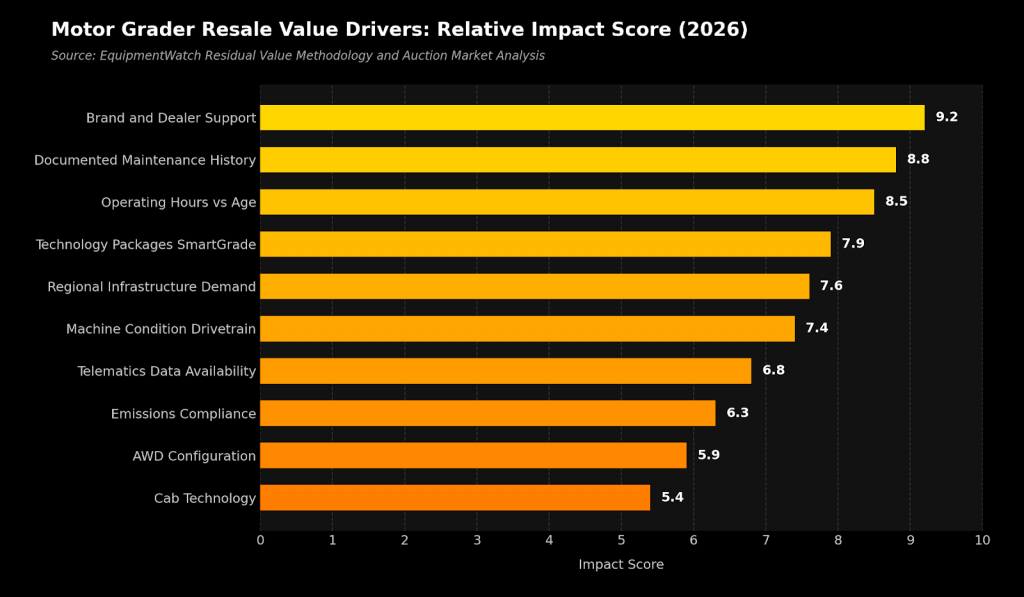
This chart illustrates the relative weight of each resale value driver for motor graders entering the 2026 remarketing cycle. Brand strength and documented maintenance history consistently rank as the most influential factors in determining final auction and trade-in premiums.
Brand Comparison: Which Motor Graders Hold Value Best?
Not all brands depreciate at the same rate. There is a huge difference in residual value performance from manufacturer to manufacturer, and this difference is multiplied over a 5-year ownership period. The table below shows the estimated 5-year residual value retention for the major brands, based on the trends in auction data.
Estimated 5-Year Residual Value Retention by Brand (Mid-Size Class, 2026 Market)
| Brand | 5-Year Residual (% of New Price) | Auction Demand | Dealer Support | Technology Readiness |
| Caterpillar | 58–65% | Very High | Very Strong | Advanced (SmartGrade) |
| John Deere | 52–60% | High | Strong | Advanced (Grade Pro) |
| Komatsu | 48–56% | Moderate–High | Moderate | Moderate (Smart Construction) |
| Volvo | 44–52% | Moderate | Moderate | Moderate |
| CASE | 40–48% | Moderate | Moderate | Basic–Moderate |
| SANY / XCMG | 28–38% | Low–Moderate | Limited | Basic |
Caterpillar graders have the highest resale premiums in the North American market year after year. CAT machines are easier to service and resell due to the brand’s dealer network density, parts availability, and trusted VisionLink telematics ecosystem. The price difference between used CAT graders for sale and similar non-CAT machines with similar hours has been a consistent 8-15 percent premium over the years and in various regions.
The residual value benchmarks are also strong for Used John Deere Motor Graders For Sale. Above-average demand at resale is driven by Deere’s reputation for operator comfort, the broad use of its Operations Center telematics platform, and its large dealer footprint in Midwest and agricultural corridor markets. Deere machines are often a second choice for municipal and county road maintenance fleets, which helps to maintain resale prices even during down economic cycles. Komatsu is in a decent middle ground and has the Smart Construction ecosystem to back it up, while the Chinese-built graders from SANY and XCMG are the ones with the steepest depreciation rates in North America because of the lack of dealer support and the uncertainty of parts availability for the long haul.
How Fleet Managers Use Predictive Analytics to Forecast Resale Value
Depreciation schedules on spreadsheets are a thing of the past in modern fleet management. Today, the most effective motor graders for contractors in connected fleets provide real-time performance signals that are directly fed into residual value projections. The following are the best practices for leading operators in incorporating predictive analytics into resale forecasting:
- Caterpillar’s VisionLink platform combines hourly utilization, idle time, fuel usage, fault codes, and location information to power hour-projection models that predict when a machine will reach a critical depreciation point.
- John Deere’s Operations Center offers telematic monitoring and component health scoring to help pinpoint machines that are nearing the optimal resale window before expensive repairs are needed.
- The Smart Construction dashboard combines job site productivity information with machine health information to give a comprehensive view of asset utilization and real-time asset condition.
- These tools for residual value forecasting use AI to analyse auction price trends, regional demand indices, and macro infrastructure spending data to produce probabilistic resale price bands over rolling time horizons.
- Predictive maintenance algorithms identify potential hydraulic or drivetrain problems 200 to 500 hours ahead of time, enabling fleets to either fix problems before resale or factor them into pricing.
- Digital twin technology involves building a virtual model of each machine that replicates real-life wear patterns and predicts future condition states, allowing for more accurate TCO planning over multi-year fleet cycles.
The overall result of fleet studies and contractor surveys is the same: machines with a documented telematics history sell faster and at measurably higher prices than mechanically identical machines with no telematics history. Not only is connected equipment operationally beneficial, but it can also be a tangible resale premium.
Infrastructure Spending and Regional Market Dynamics
The price of used graders is directly and measurably related to infrastructure investment. As government highway budgets increase, backlogs grow, and demand for new and used graders rises. Used grader values have reached multi-year highs due to supply chain disruptions that slowed new machine deliveries from 2021 to 2023, which have partially continued into the 2025-2026 market.
Infrastructure Demand by Sector and Impact on Used Grader Pricing (2025–2026)
| Infrastructure Sector | Grader Class Most in Demand | Regional Concentration | Estimated Used Price Impact | Supply Availability |
| Highway Megaprojects | 140M–160M class | Southern and Midwestern corridors | +8 to +14% | Tight |
| Municipal Road Maintenance | 120M–140M class | Midwest and Northern states | +5 to +10% | Moderate |
| Mining Access Roads | Heavy AWD configurations | Mountain West, Nevada, Wyoming | +10 to +18% | Very Tight |
| Energy Sector Infrastructure | Mid-to-large AWD class | Texas, Permian Basin, Dakotas | +12 to +20% | Tight |
| Airport Expansion | Mid-size precision class | Coastal metros, Sun Belt | +6 to +11% | Moderate |
| Agricultural Road Maintenance | Small-to-mid class | Midwest and Plains states | +3 to +7% | Moderate–Loose |
AWD-equipped vehicles are seeing the most severe supply constraints in Texas, Wyoming, and Nevada, energy and mining states, where resale premiums are well above national averages. Continued federal funding for highway megaprojects keeps demand for large class graders (140M to 160M) high. In serious residual value modeling, a motor grader in the Permian Basin energy corridor will always be worth more than a similar machine in a less active market with less contractor demand.
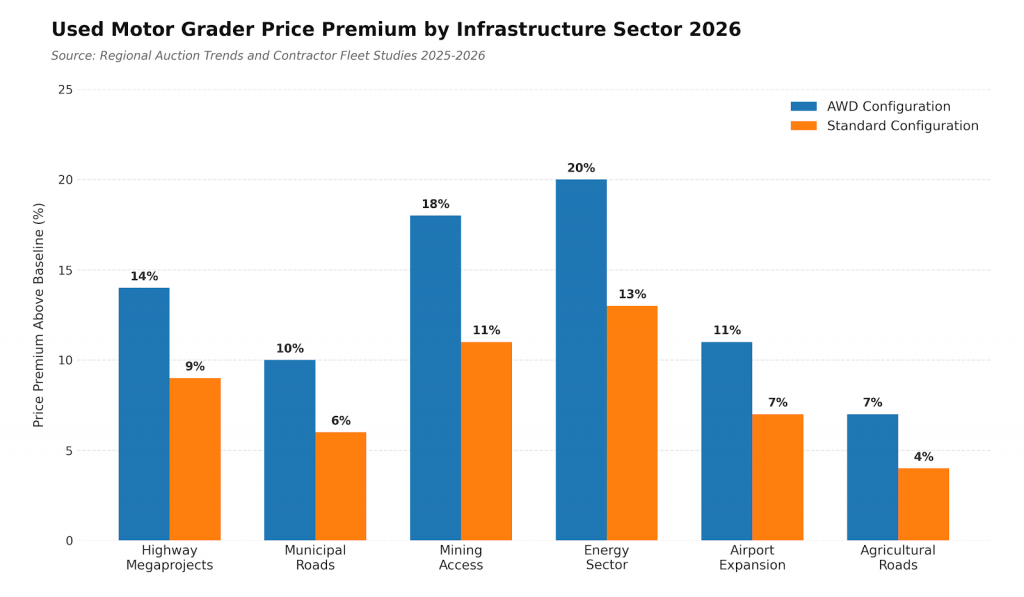
AWD-configured motor graders command consistent price premiums across all infrastructure sectors, with energy and mining segments showing the widest spread between AWD and standard configurations. Fleet managers targeting high-resale-value acquisitions should prioritize AWD machines in regions with active energy or mining activity.
Technology and the Accelerating Depreciation of Non-Digital Graders
Technology compatibility is not just a secondary factor in resale forecasting; it is now as significant as mechanical condition. Even if mechanically sound, buyers increasingly consider motor graders functionally obsolete if they are not ready for grade control, are not compatible with telematics, or lack modern joystick control systems. There are several interrelated reasons why the depreciation rate for non-digital graders is likely to accelerate through 2026 and beyond:
- The expectation of grade-control systems like Trimble, Topcon, and OEM-integrated SmartGrade has become standard on commercial grading projects, reducing the number of active buyers for machines that do not have these systems.
- Telematics compatibility has an impact on insurance, financing terms, and resale transparency, all of which have a direct impact on the price buyers are willing to pay at auction or in private transactions.
- Software support lifecycles lead to a new type of obsolescence risk: machines with discontinued telematics modules can be sold at significant discounts, even if they are mechanically sound.
- Once a luxury, joysticks are now expected to be standard equipment, and systems that are not installed may need to be added on to the machine before it can be sold.
- The number of eligible buyers for older Tier 3 emission-certified machines continues to shrink as the regulations in urban markets and state-level equipment procurement requirements grow more stringent.
On the other hand, smart-ready machines (those that have factory-installed grade control mounting provisions, telematics antennae, and software-upgradeable control systems) are always outperforming the market at resale. Contractors who have focused on technology from the beginning of their fleet planning and purchasing process will get the biggest benefit from the best motor graders that will be available in the 2026 used marketplace.
Maintenance History and Fleet Discipline: The Documentation Premium
Documentation quality is one of the most dependable resale value multipliers in the heavy equipment market, as buyers are now able to access telematics histories and digital service logs before bidding. Fleet managers who operate a disciplined maintenance program reap measurable and cumulative rewards at resale.
Documentation Quality vs. Resale Price Impact (Mid-Size Motor Grader, 5,000–8,000 Hours)
| Documentation Level | Estimated Resale Premium / Discount | Buyer Pool | Avg. Days on Market | Financing Eligibility |
| Full Digital Records + Telematics | +8 to +12% premium | Large | 15–25 days | High |
| Partial Digital + Paper Records | Baseline (0%) | Moderate | 30–45 days | Moderate |
| Paper Records Only | -5 to -8% discount | Moderate–Small | 45–60 days | Moderate |
| Incomplete / Gaps in Service History | -10 to -18% discount | Small | 60–90+ days | Low |
| No Documentation | -18 to -25% discount | Very Small | 90+ days | Very Low |
Auction analysts comment that oil analysis histories that display regular sampling intervals and normal wear metal trends indicate that the buyer is less at risk of internal component failure, resulting in higher bids for complete digital service records compared to mechanically equivalent machines with incomplete documentation, which range from 5 to 12 percent higher. A poorly documented machine will be discounted 10 to 20 percent compared to a well-documented machine in the same condition tier, and this discount will be magnified if financing eligibility is also lowered and the buyer pool is also lowered.
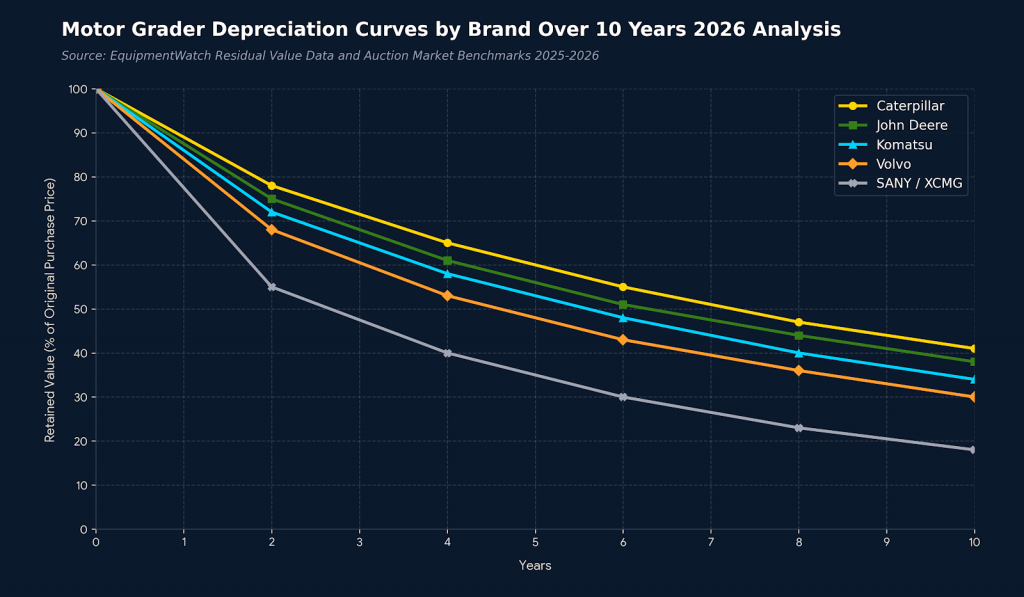
Caterpillar and John Deere graders maintain the steepest retained-value curves across a ten-year ownership window, while Chinese-manufactured brands show significantly faster depreciation after year two. Contractors seeking the strongest long-term total cost of ownership performance should prioritize top-tier branded machines from the outset.
Risks That Could Hurt Future Grader Resale Values
Well-known brands and well-maintained machines are not immune to the forces that can compress residual values out of the blue. For fleet managers predicting resale prices for graders in 2026 and beyond, it is important to consider the following risk categories:
- When large municipal or rental fleets perform synchronized refresh cycles, oversupply of used machines enters the market at the same time, and the hammer prices are compressed, leading to an oversupply of used machines in the region.
- Economic slowdowns that decrease the number of infrastructure contract awards and force contractors to delay equipment purchases, which materially decreases the number of buyers on the market and increases days-on-market timelines
- Changes to emissions regulations that require older machines to be retrofitted or operated under certain restrictions in certain jurisdictions, which will cost the buyer and be built into their bids. Emissions regulation changes that require older machines to be retrofitted or operated under certain restrictions in certain jurisdictions, which will cost the buyer and will be factored into their bids.
- High-tech equipment failures on machines that rely heavily on electronics, such as grade-control systems, telematics modules, or joystick controller repairs, can cost $15,000 to $40,000 and are nearly impossible to recover at resale, are examples of costly failures.
- Battery-electric transition uncertainty, which adds long-term uncertainty about the trajectory of residual value for diesel machines, even as electric graders are commercially immature in 2026
- Lack of dealer support in the secondary markets, where customers outside a robust dealer network have to pay more for parts, wait longer for service, and have less faith in the dealer’s ability to resell their vehicle in the future.
Electrification and the Long-Term Diesel Outlook
The electric motor grader market is at an early and commercially limited stage as of 2026. While there are prototype programs underway at Caterpillar and Komatsu, no major OEM has introduced a fully electric production motor grader for the North American commercial market. Under any plausible infrastructure scenario, diesel graders will be the primary technology for the next 5-8 years, and fleet managers who buy a machine in 2026 and plan to hold it for 5-7 years can reasonably expect the residual value of diesel graders to remain stable. But the end of that ownership period could coincide with the first commercially viable electric alternatives becoming available in the market, which could pose headwinds at the planned resale point, especially in state markets where there are active low-emission procurement mandates and sustainability-driven fleet transition roadmaps.
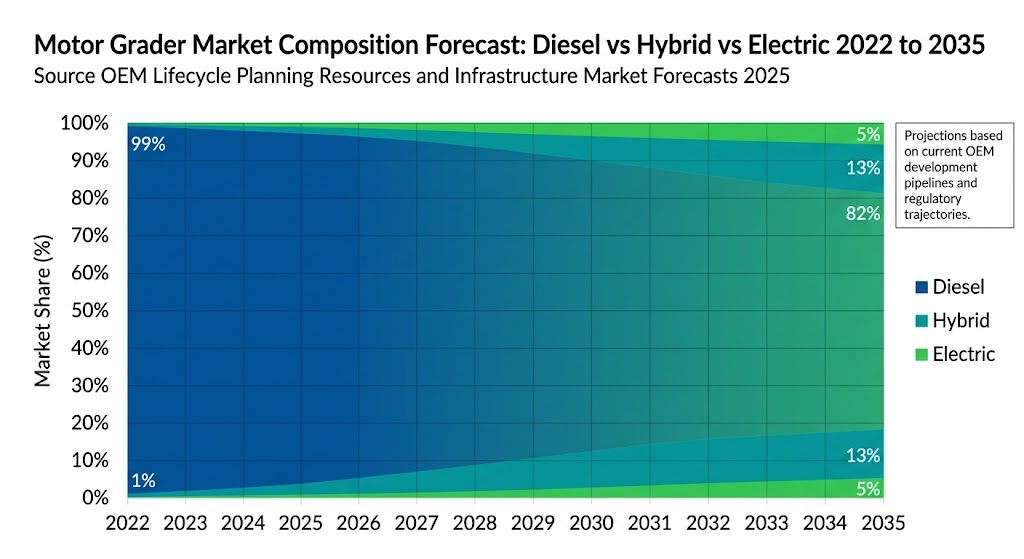
Diesel motor graders are projected to retain dominant market share through 2035, though hybrid configurations are expected to grow meaningfully from the late 2020s onward. Fleet managers planning multi-year acquisition strategies should factor the hybrid transition timeline into long-term residual value models and total cost of ownership projections.
Auction Trends and Remarketing Strategies in 2026
As critical as the condition of the machine is, so is the timing of resale. Auction and remarketing professionals consistently see that the same machines can be sold at different times of the season or the economy for a 10 to 20 percent difference, a difference that can be recouped with proper planning, but never without it.
Here are some of the main points to keep in mind when it comes to auctions and dealership remarketing insights from auction analysts and dealership remarketing specialists:
- Used grader prices are generally best during spring auction cycles in the Northern and Midwestern United States when contractors are completing project bids and looking for machines to deploy in the spring season.
- October and November auctions in the Southern and Southwestern states can be good for AWD-equipped machines as contractors get ready for winter road maintenance and oilfield service work.
- Auction data has always been clear that machines that come with pre-auction inspection reports and telematics printouts sell for significantly more than machines that do not have documentation packages.
- CAT graders for sale and used John Deere Motor Graders For Sale always draw the largest number of bidders at large regional auctions, which means that bidding is more competitive and used prices are higher compared to other brands.
- Fleet managers who work with remarketing specialists 12 to 18 months before they plan to sell their machines can prepare the machines, put together documentation, and place them at auctions for maximum return on each machine.
- The constraints on new machine deliveries from 2021 to 2023 resulted in a deferred replacement backlog that is now starting to come through, which should help to moderate pricing pressure over the 2025 to 2027 period.
AI and the Future of Predictive Resale Forecasting
The next step in heavy equipment fleet management is machine learning residual value forecasting. Predictive models are being developed by equipment finance and fleet technology companies that will use real-time auction pricing data, regional economic indicators, infrastructure contract databases, and individual machine telematics histories to create probabilistic resale price ranges with rolling forecast windows of six to 18 months.
The automated alert that a fleet manager can receive when a particular machine is approaching its ideal resale cycle, thanks to its hours accumulation rate, current regional market demand, and anticipated infrastructure spending, is a game-changer for larger grader fleets. Several OEMs are testing digital twin technology as a lifecycle management tool, with a virtual model of each machine that can be continually updated to simulate future condition states and alert when projected maintenance costs are likely to be greater than the marginal benefit of continued ownership versus early disposition. These predictive capabilities are not futuristic scenarios for contractors to consider for procurement and disposition in 2026, but rather real-world scenarios that are being used today by the most sophisticated equipment operators in the market.
Contractor, Dealer, and Auction Perspectives on Resale Strategy
Practitioners across the remarketing spectrum share consistent themes when discussing motor grader resale strategy in 2026:
- In auction environments, maintenance history has outpaced machine age as the most important factor in determining resale outcome, and well-documented machines have been shown to perform better, even when they have fewer hours on the clock.
- Mechanically similar machines that have been connected with active telematics histories are more likely to sell quickly and at competitive bids than those that do not have data trails.
- Dealer support network strength benefits residual value throughout the ownership cycle, from OEM-certified service while the vehicle is in use, to certified pre-owned designation and dealer support at resale.
- Five years ago, resale pricing decisions were only indirectly affected by technology compatibility, but today it’s a matter of grade-control readiness and telematics integration.
- One of the most actionable levers fleet managers have is timing the resale cycle to sell a machine before it hits its third major service interval and before the demand conditions in the region change.
- CAT graders for sale and used John Deere Motor Graders For Sale remain the preferred choice in the active buyer discussion at major auctions, and remarketers report that brand recognition always leads to quicker sales and better end prices than less well-known alternatives.
Maximize Your Investment: Shop Smart at UsedMotorGraders.com
Every variable discussed in this article, brand reputation, documentation quality, technology compatibility, and regional demand, points toward the same conclusion: the decision made at the moment of purchase determines the resale value recovered years later. Buying the right machine from a trusted source with verified history is not just good procurement practice; it is a long-term financial strategy that separates profitable fleet operators from those constantly chasing recovery on underperforming assets.
If you are searching for the best motor graders for contractors with proven resale strength, exploring CAT graders for sale with fully documented service histories, or comparing Used John Deere Motor Graders For Sale across configurations and hour brackets, UsedMotorGraders.com is built for exactly that search. Every listing on the platform is backed by transparent machine details, and the inventory is curated to help contractors and fleet managers acquire machines that deliver strong total cost of ownership from the first hour to the final auction hammer.
Stop leaving residual value on the table. Visit usedmotorgraders.com today and find the grader that earns its value twice, once on the job, and again at resale.
FAQs
1. What is the single most important factor in motor grader resale value in 2026?
Across all brand tiers, documented maintenance history has proven to be the most significant factor in a buyer’s decision and auction price, consistently beating out machine age.
2. Do CAT graders for sale consistently outperform other brands at auction?
Yes. Caterpillar motor graders have the highest residual values in the North American used equipment market, thanks to dealer network density, parts availability, and the popular VisionLink telematics system that offers buyers machine confidence.
3. How does infrastructure spending affect used grader prices?
Infrastructure demand directly lowers the supply of used graders and raises the competition among bidders at auctions, resulting in higher prices than baseline. The pricing premiums are the highest for AWD-configured machines in energy and mining regions during periods of active infrastructure cycles.
4. Are used John Deere Motor Graders For Sale a strong resale investment?
Yes. In operator comfort road maintenance markets, such as in the Midwest municipal and agricultural markets, John Deere graders are consistently ranked second only to Caterpillar in residual value retention benchmarks, and the brand’s Operations Center telematics platform and operator comfort reputation continue to generate loyal followings of buyers.
Tags: Grader Resale Value, Smart Fleet Management, Resale Value Forecasting