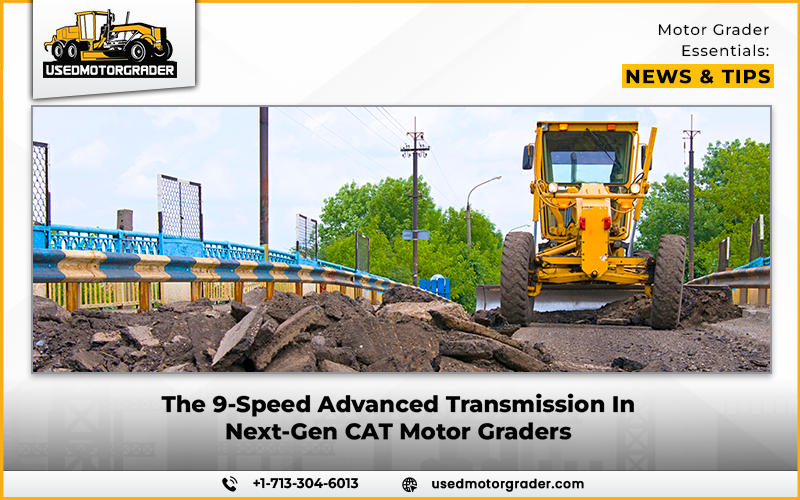
Every grader operator knows the moment: the final pass is nearly perfect, and you gently press the inching pedal to keep the machine slow enough to finish the job correctly. It is effective but inaccurate, causes wear on the drivetrain, and should not be the sole solution. Caterpillar’s next-generation motor grader family tackles just that with a 9-speed advanced transmission with a dedicated finish gear, a new shift format, and full joystick integration. This transmission upgrade is one of the most discussed changes in the motor grader segment in 2026, and it’s not surprising.
The Cat Models That Got the 9-Speed Upgrade
The 9-speed transmission is now available on Caterpillar’s entire Next Generation motor grader platform. Cat 120 entered the market first, and Cat 140, the best-selling motor grader in the U.S., followed in both joystick (JOY) and lever (LVR) configurations, which Caterpillar plans to make available from early 2026. Caterpillar extended the platform to the Cat 150 and Cat 160 at ConExpo-CON/AGG 2026. The 140 features a Cat C7.1 at 248 hp, the 150 has a Cat C9.3 at 261 hp and a 12-foot moldboard, while the 160 is powered by a Cat C9.3 at 276 hp and a 14-foot moldboard. All four models come in tandem and all-wheel drive. To get a complete overview of where these fit into Caterpillar’s lineup, read Caterpillar’s Best Motor Graders Apart From The 140 Series.
What Exactly Makes This Transmission “Advanced”?
The previous generation of Cat motor graders used an 8-speed transmission. The 9-speed isn’t just a number; it’s the gear’s functionality. The 9th gear is a finish gear, a special slow-speed forward gear for final grading passes, between 0.65 and 1.85 mph. In this range, operators do not have to use the inching pedal to maintain a controlled creep. The drivetrain takes over, which is more consistent and puts less strain on the system over long shifts.
The shift format has also been redesigned. The older U-pattern for accessing reverse has been changed to a forward-neutral-reverse pattern and straightforward up/down switching, fewer hand movements, and quicker direction changes with repeated passes.
New features to the 9-speed system:
- 9 forward and 6 reverse gears: Features a dedicated finish gear for slow precision grading.
- Joystick-integrated drivetrain operations: Places transmission, gear shifting, and machine direction control on the left joystick on JOY models.
- Streamlined directional controls: Utilizes a new simplified shift pattern, replacing the old U-formatted pattern.
- Enhanced power management: Delivers better fuel economy and power-to-weight ratio throughout the gear range.
- Automated grading compatibility: Remains 100% compatible with Cat Grade Cross Slope Assist and optional 3D integrated massless grade systems.
How Does the 9-Speed Perform Across Different Job Sites?
The advantage of the finish gear is most apparent in applications where low-speed control has always been difficult. The Cat 9-speed system is especially powerful on a Cat motor grader:
- Executing municipal road maintenance: Managing tight turns and cul-de-sacs where consistent slow-speed creep is required.
- Finishing high-accuracy highway grades: Operating where surface flatness tolerances are very low and allow for no speed variation.
- Clearing low-speed seasonal hazards: Powering all-wheel drive configurations that allow for precision snow removal while minimizing risk on slippery surfaces.
- Rehabilitating rural and gravel infrastructure: Navigating variable ground conditions that demand frequent, seamless gear changes.
- Maintaining heavy haul roads: Grading mining and quarry paths where uniformity at slow working speeds has a direct impact on road durability.
The finish gear, combined with Cat Grade’s automation, can automatically correct the blade while the operator concentrates on direction and positioning, resulting in fewer corrective passes, cleaner results, and reduced fatigue throughout the shift.
Cat vs. Competitors: How the Transmissions Compare
John Deere’s P-Tier motor graders feature an 8-speed PowerShift Plus system with Auto-Shift Plus logic that adjusts gear shifts based on engine load, which is good for material moving, but lacks a dedicated finish gear. This breakdown is worth reading if you want to compare in detail between brands.
Komatsu equips its GD655-7 with a dual-mode torque-converter transmission that operators can switch between heavy-blading mode and fuel-efficient mode, but the system does not offer the same gear range and control as the Caterpillar setup. Meanwhile, manufacturers use Case powershift and Ergopower torque-converter transmissions throughout the range, and they equip all-wheel-drive models with a low-speed creep mode.
The Cat motor grader 9-speed system has an edge over the competition:
- No major competitor has a dedicated finish gear in this motor grader class.
- Full drivetrain control in the joystick, with one control point for gear, direction, and speed.
- Directly connected Cat Grade control automation for coordinated, reduced-pass finishing.
- Integrated asset lifecycle scheduling, with maintenance intervals built directly into the platform rather than added on as an afterthought.
Does the 9-Speed Transmission Change the Ownership Math?
All Next Generation support is equipped with extended and synchronized maintenance intervals, plus centralized service points to reduce daily service time. Cat Product Link and VisionLink telematics are standard. Real-world data supports those extended service interval claims. Because Caterpillar has accumulated more than 40,000 hours of field testing on its Next Generation machines worldwide.
The downside is reliance on electronics. The software-driven controls of the joystick-integrated transmission require electronic diagnostic training along with mechanical skills. That preparation requires real investment for fleets making the switch from older machines. Overall, late-model Cats have maintained their value in the used market, and the 9-speed is further proof. Top Used Motor Graders for Sale in USA with Rising Value illustrates the resale power of that strength over time.
The 9-speed advanced transmission in next-gen Cat motor graders is a practical improvement that is not a spec sheet talking point. But rather a solution to a real operator problem.
Boost your project efficiency and keep jobs running smoothly with a machine you can count on. From individual owner-operators to large fleet managers, usedmotorgrader.com offers a robust inventory of inspected, field-ready graders from top manufacturers like CAT, Komatsu, and John Deere. Find the proven reliability your next contract demands.
FAQs
1. Which Cat motor grader models have the 9-speed transmission?
A: The 9-speed transmission is standard on the Cat 120, Cat 140 (JOY and LVR), Cat 150, and Cat 160 models. It is part of the Next Generation platform.
2. What is the finish gear used for?
A: Operators use the finish gear, the slowest forward gear in the 9-speed system, for final grading passes. Because it allows the machine to travel between 0.65 and 1.85 mph without using the inching pedal.
3. What is the distinction between the Cat 9-speed and John Deere’s transmission?
A: John Deere has an 8-speed PowerShift Plus system. Cat’s ninth finish gear and the inclusion of full drivetrain control in the joystick provide operators with more precise input when finishing work at low speeds.
4. Does the 9-speed transmission affect maintenance costs?
A: The Next Generation platform features longer and synchronized maintenance periods. As well as centralized service points, which decrease daily service time and increase uptime over previous generations.
Tags: Advanced Motor Grader Features, CAT Next Gen Motor Graders, CAT Motor Grader Market