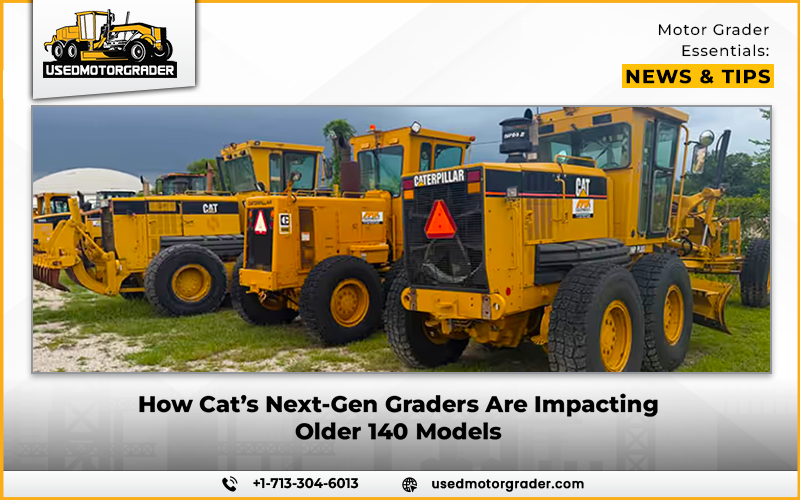
Cat’s Next-Generation graders are altering the motor grader market and changing the way contractors evaluate earlier 140 models. Caterpillar’s increased automation, integrated grade control, improved fuel efficiency, and connected machine technologies have turned the focus away from horsepower and toward overall productivity and operational costs.
As a result, many fleet owners are faced with a vital decision: should they upgrade to a Next-Gen grader or keep their current CAT 140 machine? This article looks at how Cat’s latest grader technology affects the value, competitiveness, and future of earlier 140 models, as well as how it helps contractors make better equipment purchases.
How Are Next-Gen Graders Changing Contractor Expectations?
Productivity Is Becoming More Important Than Horsepower
Contractors are increasingly measuring equipment performance using output rather than engine specifications. Grading cycles that are faster, have fewer passes, and require less rework can considerably increase project profitability. A machine that completes grading correctly the first time often provides more value than one with somewhat more horsepower.
Technology Is Now a Competitive Advantage
GPS-enabled technologies and automation features are becoming common needs for many infrastructure projects. These solutions reduce reliance on highly experienced operators while assisting fresh operators to get consistent results. This tendency affects how contractors evaluate equipment purchases.
Why Are Fleet Managers Prioritizing Total Cost of Ownership?
Fuel savings, decreased downtime, and cheaper maintenance costs are now important purchasing considerations. Fleet managers recognize that long-term ownership costs often outweigh the initial purchase price.
Impact #1: Are Older Cat 140 Models Losing Market Value?
Current Demand for 140H, 140K, and Early 140M Models
Despite improved technology, demand for older CAT grades remains high. Many contractors are still looking for a reliable CAT 140 motor grader for sale since these machines provide proven performance at a cheaper cost.
What Happens to Resale Prices When New Technology Enters the Market?
New technology usually puts downward pressure on outdated equipment values. However, the effect isn’t consistent. Buyers continue to prefer well-maintained computers with verifiable service histories.
Which Older 140 Models Are Holding Their Value Best?
The 140M series often commands the highest resale pricing, followed by late-model 140K machines. Low-hour machines with great maintenance records are still highly valued.
What Buyers Still Love About Older Cat 140 Graders?
Older graders are noted for their dependability, simpler electronics, lower purchasing prices, and easier field maintenance. These benefits continue to attract contractors looking for practical, cost-effective solutions.
Impact #2: Are Older 140 Models Becoming Less Competitive on Modern Jobsites?
The Increasing Demand for Grade Control Technology
Many applications today require tighter tolerances and higher grading precision. Integrated grade control systems allow contractors to achieve these standards more efficiently than previous techniques.
Labor Issues and Operator Skill Shortages
The construction sector continues to experience a skilled operator scarcity. Automated features in contemporary graders help to close this gap by shortening the learning curve.
Where Older Machines Still Compete Successfully
Older Cat 140 versions are nevertheless very useful for road maintenance, municipal projects, quarry roads, and rural infrastructure work where modern automation may not be required.
Can Older CAT 140 Models Continue To Be Productive In 2026 And Beyond?
Yes. Older 140 models can still be extremely productive if properly maintained and matched to appropriate applications. Many contractors continue to look for a CAT 140 motor grader for sale because these machines offer dependable performance without the high expense of newer ones.
Impact #3: The Rising Cost Gap Between Ownership and Productivity
Comparing Operating Costs
Next-generation graders often have higher fuel efficiency and longer service intervals. However, older models frequently benefit from cheaper acquisition costs and more readily available parts.
Productivity Per Hour Comparison
A Next-Gen grader can execute grading jobs faster and more accurately, resulting in more production per hour. This can result in significant savings for major projects.
When A Newer Grader Pays for Itself
The answer is based on utilization rates. Contractors with high-volume operations may recoup the higher purchase price through fuel savings, decreased rework, and greater efficiency. ROI should always be calculated in terms of more than just the initial price.
Why Next-Gen Graders Are Increasing Demand for Specific Older 140 Models
An interesting market trend is forming. As new graders become increasingly expensive, cost-conscious contractors are turning to old equipment. Rental firms are extending their fleets with proven older machines, whilst many developing markets choose simpler mechanical platforms.
As a result, the demand for a premium CAT 140 motor grader for sale remains surprisingly high. In many cases, Next-Gen machines are raising demand in premium used graders rather than completely replacing them.
Should You Upgrade Your Older Cat 140 Grader?
Upgrade If You:
Upgrade if you do high-precision grading, rely extensively on GPS machine control, manage several operators, need the most fuel efficiency, or frequently bid on technology-driven projects.
Maintain Your Existing 140 If You:
Keep your present grader if it has less hours, does maintenance grading, operates in distant places, or fits better into your capital budget.
Is It Worth Replacing An Old CAT 140 With A Newer Model?
The answer is based on your workload. Upgrades are often financially beneficial for high-production contractors. For others, a dependable older grader may continue to produce good results.
It’s worthwhile to examine more closely at the technologies behind this market shift if you’re thinking about upgrading. Our comprehensive guide, Next Gen Cat 140 Motor Grader: Smarter, Safer, and Built for More, demonstrates how improved operator comfort, advanced safety systems, integrated grading technologies, and more visibility are assisting contractors in increasing productivity on modern jobsites.
Final Verdict: The Future of Older Cat 140 Models
Although Cat’s Next-Gen grades are changing consumer expectations, the previous 140 models are still important. Rather, they are reinventing how and where these machines provide value. The best choice is not just based on machine age but also on productivity requirements, operational costs, and project demands. The best grader is ultimately the one that brings in the most money for your company.
Still evaluating the benefits of an older Cat 140 against modern grader technology? Explore our complete selection of Caterpillar used motor graders to locate a machine that will provide the performance, dependability, and return on investment that your projects require.
Whether you are purchasing or renting, we provide job-ready Cat graders at competitive pricing, allowing you to maximize production without the expense of a brand new machine.
Frequently Asked Questions
Do Cat Next-Gen graders use less gasoline than their predecessors, the 140 models?
Yes, they usually increase production while using less fuel.
Are modern GPS systems compatible with older Cat 140 graders?
Aftermarket GPS systems can be used to modify many of them.
What is the best resale value for a Cat 140 model?
The 140M frequently retains its value the best.
Is it still worthwhile to buy a Cat 140M?
Yes, especially for contractors who want additional features without having to pay for Next-Gen.
What is the lifespan of a Cat 140 grader?
Many surpass 15,000 to 20,000 operating hours when handled carefully.
What is the Cat 140 Next Gen’s biggest benefit?
Accuracy and productivity in grading are improved by integrated technology.
Tags: Used Caterpillar 140 Grader, Older vs Newer Motor Graders, Next-Gen CAT Graders