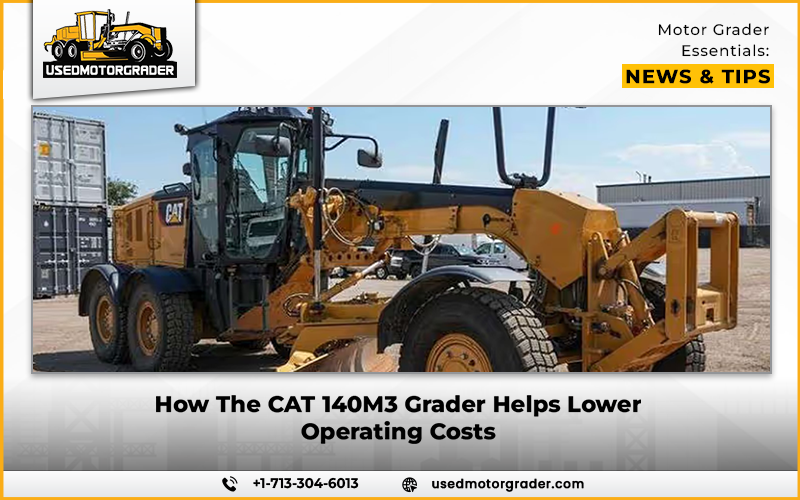
A used motor grader may appear to be inexpensive on paper, but it can quickly become expensive to operate due to fuel costs, maintenance, rework, downtime, and operator productivity. That is why understanding how the Cat 140M3 Grader reduces operating expenses is important for contractors and fleet managers that analyze equipment based on cost per productive hour rather than purchase price.
The Cat 140M3 Grader helps manage some of these costs by combining features like Economy Mode, grading technology, service-friendly components, and machine-monitoring capabilities.
Caterpillar cites fuel efficiency, less maintenance, and increased grading production as primary advantages of their motor grader design. In this article, we’ll explore how these characteristics can help minimize fuel consumption, rework, maintenance expenses, downtime, and total cost of ownership as well as what buyers should look for when purchasing a used Cat 140M3.
How Does the Cat 140M3 Lower Operating Costs?
The Cat 140M3 can reduce expenses by improving fuel efficiency, requiring fewer corrective passes, simplifying maintenance, and providing better fleet information. The practical measure is cost per productive hour, not just purchase price.
1. Economy mode can lower fuel costs.
How Does Cat 140M3 Economy Mode Work
Eco Mode reduces engine speed in appropriate applications. Caterpillar claims that the 140 may save up to 10% on fuel consumption while in Eco Mode. Actual results vary according to application, workload, topography, and idle time.
Why Fuel Savings Are Important for High-Hour Grader Fleets
For high-hour fleets, even minor percentage savings add up. Instead of assuming the maximum advertised savings, consider real gallons per hour, annual utilization, idle time, and diesel price.
2. Stable Blade Technology Can Reduce Rework
Stable Blade senses blade bouncing and automatically reduces engine speed in stages until the machine stabilizes before gradually increasing rpm.
Why Fewer Corrections Lead to Lower Costs
A smoother pass may result in fewer correction passes, less fuel, less wear, and fewer machine hours. On a road project, avoiding one needless finishing pass across a wide area can result in more savings than a minor component-level efficiency gain.
3. Grade Control Helps Reduce Material and Passes
Cat Grade with Cross Slope automatically controls one side of the blade to keep the specified cross slope. Caterpillar claims the technology can grade faster and more correctly, using up to 40% less material in applicable activities.
The hidden cost savings: Less rework
Fewer passes can save fuel and labor hours, while less unneeded material movement can minimize aggregate needs. Buyers of a used Caterpillar Motor Grader should check the installed grade-control configuration because equipment differs.
4. Transmission and Powertrain Features Help Control Fuel and Wear
The M Series employs a Power Shift Countershaft Transmission, computerized controls, and automatic differential functions to ensure effective power delivery and traction.
Why Does Smooth Power Delivery Matters?
Proper gearing and traction can help avoid wheel slide and unneeded drivetrain stress.
5. Maintenance Design Can Reduce Service Costs
Maintenance includes parts, technician labor, and lost production. Service-friendly access and replaceable wear components can keep routine work manageable.
The Lifecycle Advantage of Rebuildable Components
Owners can compare rebuilding a component with replacement or another machine. That is a better lifecycle decision.
6. Product Link Helps Fleet Managers Find Hidden Costs
Product Link and VisionLink, depending on configuration, can give data such as machine hours, fuel consumption, idle time, productivity, location, and diagnostics.
Converting Machine Data into Cost Decisions
High idle time may indicate jobsite delays or operating practices. Rising fuel consumption can need examination. Diagnostic signals sent often can help to expedite service. Low utilization may justify shifting the machine to a different project.
7. Operator Efficiency Can Affect the Cost Per Hour
Caterpillar claims that the M Series joystick controls can reduce hand and wrist movement by up to 78%, hence reducing fatigue. Comfort is not always a labor saver, but it can aid in consistent management.
What Does This Mean for the Total Cost of Ownership?
A practical formula is:
Total Operating Cost = Fuel + Maintenance + Wear Parts + Repairs + Operator Cost + Downtime + Rework
The Caterpillar 140 Motor Grader addresses several categories through Eco Mode, grading systems, serviceability, controls, and monitoring.
Fleet management must consider the Cat 140M3’s long-term performance, including its productivity, maintenance needs, potential for resale, and ongoing utility in today’s fleet, in addition to its lower operating costs. See why the Cat 140M3 AWD still has fleet value in 2026 for a more comprehensive look at these ownership variables.
| Cost Area | Cost-Control Mechanism |
| Fuel | Eco Mode |
| Rework | Stable Blade And Grade Control |
| Maintenance | Serviceable components |
| Downtime | Diagnostics and monitoring |
| Productivity | Joystick controls |
| Drivetrain | Transmission and differential controls |
Is a Cat 140M3 Still Cost-Effective as a Used Motor Grader?
Yes, if the condition and configuration permit the work. A used 140M3 grader can be cost effective if its maintenance history, hours, component condition, and technology match the job.
Don’t Judge a Used 140M3 based on Purchase Price Alone
Examine the transmission, hydraulics, circle, drawbar, moldboard, cutting edges, tires, articulating joint, and electrical systems. Examine service records and hour-meter accuracy. A low-cost machine with deferred repairs can quickly become the more expensive alternative due to downtime.
How Fleet Managers Can Maximize Cat 140M3 Cost Savings
Before beginning operation, inspect the fluids, wear parts, and trouble codes. Use Eco Mode when applicable, reduce idling, use appropriate gears, and apply grade technology correctly. Monitor fuel, idle time, usage, diagnostics, and maintenance trends to identify escalating expenses early.
Is the Cat 140M3 Worth It for Cost-Conscious Contractors?
When use is high and maintenance is disciplined, the 140M3 can make a compelling economic case. The Caterpillar 140 Motor Grader benefits from combining fuel control, productivity, decreased rework, maintenance, and visibility.
Final Takeaway
The Cat 140M3’s fuel-efficient operation, grade-control technology, simpler maintenance, and improved machine monitoring can all contribute to lower operating costs. While replaceable parts help keep maintenance costs under control, features like Economy Mode and Stable Blade can cut down on fuel consumption and needless grading runs.
The machine’s actual value, however, is contingent upon its maintenance and operation. Cost per productive hour, not just purchase price, is the crucial indicator for fleet managers and contractors. To ascertain whether a used equipment will provide long-term value, constantly analyze its condition, maintenance history, working hours, configuration, and anticipated utilization.
Choosing a well-maintained grader is the first step toward lower operating expenses. Take a look at our 2015 Caterpillar 140M3 grader for sale or rental, and use its demonstrated grading performance on your next job.
Do you require an alternative configuration? Find the ideal machine for your project’s needs by looking through our collection of used motor graders, then reserve your equipment right away.
Frequently Asked Questions
Does the Cat 140M3 conserve fuel?
Yes, Caterpillar claims that Eco Mode can save up to 10% on fuel consumption, depending on the application.
What is the fuel-saving characteristic of the Cat 140M3?
Eco Mode is Caterpillar’s principal fuel-saving feature.
Is a used Cat 140M3 inexpensive to operate?
It is possible, as long as the application’s state, maintenance history, configuration, and use are supported.
Tags: Caterpillar 140M3 Features, Motor Grader Operating Costs, Lower Ownership Costs