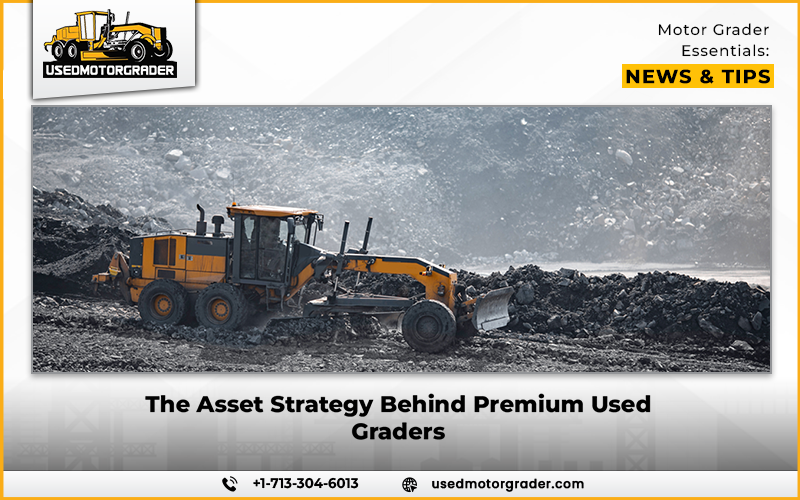
Is spending more for a high-quality used motor grader worthwhile?
Yes, when the premium pays for more productivity, lower ownership risk, dependable support, and better resale chances. The purchase price alone may deceive fleet buyers. The more appropriate calculation is purchase price + productivity + running costs + downtime risk + resale value.
According to industry research, motor graders ranked 14th among new-financed construction equipment types in the United States between March 2025 and February 2026, with key manufacturers introducing new models in 2026. This makes lifespan economics more important than age.
In this article, we will look beyond the sticker price to explain what makes a high-quality used grader a valuable asset. We will also discuss how contractors, rental fleets, and municipal buyers may safeguard their investment throughout the machine’s life cycle.
What Makes a Used Motor Grader a “Premium” Asset?
A premium used motor grader isn’t always the most expensive machine. It combines market need, good mechanical condition, documented maintenance, manageable hours, relevant requirements, and a configuration that contractors can easily implement.
Examine the drivetrain, hydraulics, frame, articulation system, blade circle, moldboard, and maintenance records. AWD, grade control capability, a ripper or scarifier, and the appropriate blade configuration can increase job adaptability.
The test is if the grader can deliver productive hours at predictable prices. If this is the case, the premium is for business reasons.
Why Do Premium Used Graders Often Cost More?
Premium machines cost more because customers frequently pay for less uncertainty. Better condition, attractive model families, solid components, up-to-date technology, complete service records, and established support networks can all help reduce lifetime risk.
Caterpillar claims that a documented service history can boost resale value, and its fluid-analysis guidance emphasizes that condition monitoring can detect wear and help owners get more usable life out of components.
Technology can help. According to John Deere, Smart-Grade combines grade-control technology into the machine, improving grading accuracy and reducing rework. For precision-intensive applications, this capacity may justify a premium price.
How Should You Calculate the Real Value of a Premium Used Grader?
Use an Asset Value Scorecard instead of just comparing asking prices.
Rate five areas:
- Acquisition cost
- Productivity
- Operating cost
- Downtime Exposure
- Resale Possibility
Productivity refers to realistic billable hours and productivity. The operating cost includes fuel, tires, cutting edges, maintenance, and repairs. Downtime exposure calculates lost output and recovery costs. The resale potential takes into account the anticipated buyer pool after you exit.
Purchase Price vs. Cost Per Productive Hour
Let’s say that Grader B costs $150,000 and Grader A costs $200,000. B is not always the better option if A produces 1,200 productive hours annually while B only produces 850 because of repairs and downtime. Take into account revenue per productive hour, utilization, repairs, and finance.
Which Features Actually Protect a Used Grader’s Future Value?
AWD can be useful on tough terrain. Grade-control capability is useful for precise road and site construction. A ripper or scarifier can expand uses. Comfortable controls, telematics, and emissions-compliant powertrains may boost usability and buyer appeal.
Consider technology’s usefulness, support, compatibility, and replacement cost. John Deere said qualifying existing graders can be upgraded with Smart-Grade, demonstrating why upgradeability is important. Don’t pay a premium for technology that your business will never use.
Does Maintenance History Matter More Than Hours?
Hours are important, but they can be misleading when not contextualized. Think about maintenance-adjusted hours. A higher-hour grader with constant servicing may have fewer uncertainties than a lower-hour unit with missing records. According to Caterpillar, frequent fluid analysis can produce a complete condition record that helps with maintenance decisions and resale value.
When Does a Premium Used Grader Make Financial Sense?
- Contractors: Productivity and uptime should be given top priority.
- Rental fleets: Take into account resale liquidity, durability, serviceability, customer demand, and utilization.
- Municipal Customers: Reliability, longevity cost, parts availability, and long-term serviceability must take precedence above short-term resale.
When Is a Cheaper Used Grader the Better Choice?
When utilization is limited, the project is temporary, or your team can manage obsolete equipment, a less expensive machine may be more intelligent. It might also prevail in situations where there is little local demand for a premium setup or when the price difference is quite large.
“Features that your company will never utilize should not be paid for.”
The Overlooked Asset Strategy: Buy for the Next Buyer, Not Just the Current Job
Consider who might purchase a used motor grader in the future. Will its configuration be desired by contractors? Will its technology continue to be beneficial? Can you provide evidence of its maintenance history? Is there a large buyer base for this model?
It may be simpler to resale a grader with desirable features, well-documented repairs, solid records, and identifiable market attractiveness than a less expensive device with an unclear past.
Is a Premium Used Grader Worth the Investment?
Yes, when the premium grader results in improved resale opportunities, increased productivity, stronger utilization, lower ownership risk, and meaningful specifications. Reputation for the brand is helpful, but whether the premium grader is warranted depends on factors including condition, history, configuration, utilization, support, and exit value.
Conclusion: Buy the Asset, Not Just the Machine
Productivity, uptime, serviceability, and future resale value should all be used to support the price of a high-end used motor grader. Acquisition, deployment, maintenance, utilization, and resale are all factors that astute fleet buyers take into account.
Think about what each machine can produce, how much it could cost to maintain, and how confidently you can sell it later before choosing the cheapest listing. That is the distinction between creating an asset strategy and buying equipment.
Choose a grader that protects productivity, uptime, and resale value rather than one based solely on price. Browse our used motor graders for sale and rent to locate the ideal asset for your next project or long-term fleet strategy.
FAQs
Do high-end used motor graders make sense to purchase?
Yes, if productivity, dependability, service history, specifications, and anticipated resale value all support the increased price.
What factors affect a grader’s resale value?
It is important to consider model demand, condition, hours, records, configuration, technology, component health, support, and market demand.
Is it always beneficial to invest in a low-hour grader?
No, a few hours don’t indicate gentle operation or good maintenance. Context is provided by application history.
Tags: Grader Asset Strategy, Premium Motor Grader, Motor Grader Fleet Strategy