
The Used Grader Can Be More Than a Piece of Equipment
Most contractors think about a used motor grader the way they think about a used pickup truck: a way to get the job done for less money than buying new. That framing sells the machine short. A used grader in the yard is not just cheaper capital, it’s a set of capabilities that didn’t exist in your business a month ago. The moldboard doesn’t care whether the work ahead is a subdivision road, a solar-farm access route, or a county gravel road that washed out in the last storm. It just grades. What determines whether that capability turns into real money is what you point it at.
That’s the shift worth making in 2026. The contractors getting the most value out of used motor graders aren’t squeezing one more billable hour out of the machine each week. They’re using it to walk into markets they weren’t in before, private road maintenance, disaster-recovery work, site prep tied to the data-center boom, utility corridor grading, farm and ranch access roads, and building relationships that keep paying long after the first invoice clears. Owning a grader, keeping it busy, and deploying it strategically for new revenue are three different things. Only the third is worth building a business around.
Why New Business Opportunities Are Opening Up for Grader Contractors
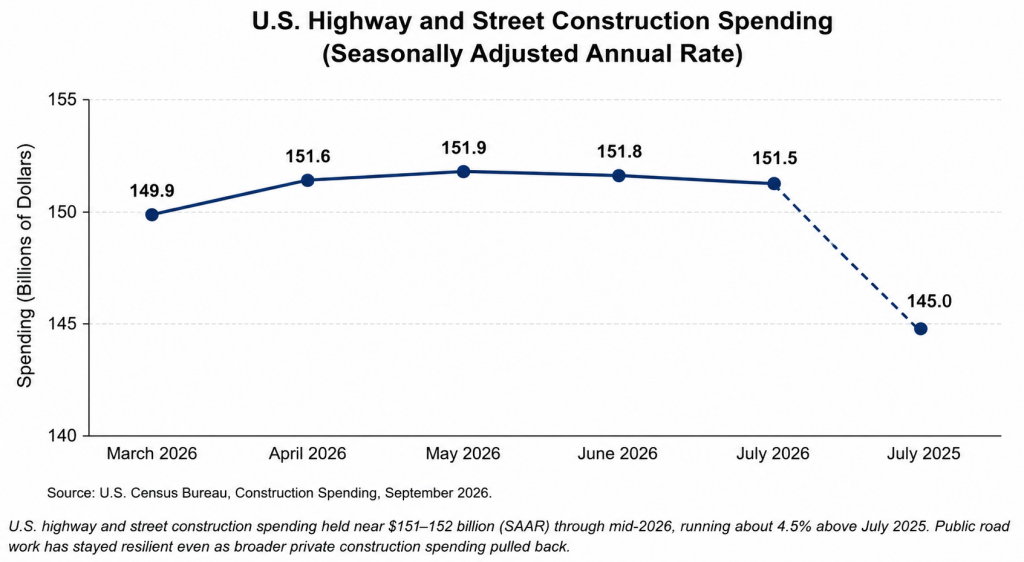
The timing is not coincidental, and it’s part of a broader shift in why contractors across the U.S. are paying more attention to graders generally. Census Bureau data puts highway and street construction spending at a seasonally adjusted annual rate of roughly $151.5 billion in July 2026, up 4.5 percent from a year earlier, even as total private construction spending pulled back nearly 4 percent. While office, retail, and manufacturing construction cooled, public road work kept climbing. The Infrastructure Investment and Jobs Act, a roughly $1.2 trillion package that dedicated $350 billion to highway programs, is still moving through state DOTs ahead of a scheduled 2026 reauthorization, though a GAO review released in July 2026 found thousands of IIJA-funded awards still under agency review rather than guaranteed to proceed.
Data center construction has become one of the few genuinely hot sectors in an otherwise uneven economy, spending topped $81.5 billion through the first half of 2026, already ahead of all of 2025. Add a construction workforce that industry group ABC estimates needs roughly 349,000 net new workers this year just to stay even, and the result is a market where owners and GCs increasingly need flexible subcontractors who show up with working equipment, not firms that own every machine but can’t staff all of them.
Specialized Commercial and Industrial Site Preparation
Warehouses, distribution centers, and manufacturing sites all need extensive rough and finish grading before a pad ever gets poured, access roads, staging areas, drainage swales, and the parking fields surrounding most logistics buildings. Data center and industrial construction is one of the hottest segments in an otherwise mixed economy, with spending topping $81.5 billion through the first half of 2026, according to ConstructConnect, and increasingly landing in secondary markets like the Carolinas, Indiana, and Ohio rather than traditional coastal hubs. A contractor with a mid-to-large used grader in solid structural condition can compete for the surrounding site work without the capital outlay a new machine requires. This is largely volume work, where margin comes from moving through acreage efficiently.
Rural, Farm, Ranch, and Agricultural Road Work
Away from any construction boom, there’s steadier, quieter demand in roads that get almost no public attention: farm lanes, ranch access routes, rural driveways, and field roads connecting working land to the nearest county road. These customers rarely fit a formal bid process, they call because a road washed out, rutted after spring thaw, or needs reshaping before harvest traffic starts. A used grader suits this work well because the jobs are small, tolerances are forgiving compared with commercial site work, and rural customers value a contractor who answers the phone and shows up on a reasonable timeline over the lowest possible day rate.
Recurring Private Road and Subdivision Maintenance
The most commercially interesting opportunity on this list may be the least glamorous. HOAs, gated communities, and private business or industrial parks with privately maintained roads all need periodic regrading, and many currently hire a contractor once, then start the search over from scratch next time the road gets rough. Converting a single grading job into an annual or seasonal maintenance agreement gains something a one-off job never provides: predictable revenue that doesn’t require re-selling the work every time. Our related piece on how successful U.S. motor grader contractors earn repeat business goes deeper on this, but the short version is that consistency, showing up on schedule, documenting conditions, and communicating clearly with a property manager or board, tends to matter more than price at renewal time.
Municipal and Local Government Subcontracting
Cities, counties, and townships own plenty of road-maintenance needs and rarely enough equipment or staff to keep up with it, particularly for gravel-road maintenance, shoulder work, and drainage-related grading outside the primary paved network. That gap creates subcontracting opportunities for grading contractors serving as overflow capacity for public works departments or as a subcontractor to firms already holding municipal contracts. It’s worth being direct about the limits: public work is procurement-driven, often requires bonding thresholds smaller contractors need to build toward, and, as a July 2026 GAO report on infrastructure funding makes clear, even well-funded programs can face administrative delays before dollars reach the ground. This is a real opportunity, not a guaranteed one, and it usually takes time before the first contract lands.
Emergency, Storm, Flood, and Disaster-Related Grading
Weather-related damage has become a larger driver of grading demand. Climate Central, which took over NOAA’s billion-dollar disaster tracking after the agency discontinued the database in 2025, recorded 23 separate billion-dollar weather and climate disasters in the U.S. in 2025, including a record 21 severe storm events and catastrophic flash flooding in the Texas Hill Country. Washed-out roads and eroded access routes are common aftereffects, and the contractors who get called first usually already had a relationship with a municipality, excavation firm, or utility contractor before the emergency happened. Machine availability is the whole value proposition here: a grader ready to mobilize is worth more in the first 72 hours after a storm than almost any other equipment advantage a contractor can offer.
Becoming the Grading Subcontractor for Larger Contractors
General contractors, excavation firms, and paving companies frequently need grading capacity without wanting to own and maintain a grader themselves. Especially with how tight skilled-labor markets have become, the AGC’s 2026 Construction Hiring and Business Outlook, surveying 951 firms across 49 states, found 82 percent struggling to fill hourly craft positions. A smaller company with one well-maintained used grader and a reliable operator can fill that gap, positioning itself as the go-to grading subcontractor for two or three firms rather than chasing prime contracts directly. This works best when a contractor manages those relationships as accounts, with regular check-ins, dependable scheduling, and clear invoicing, rather than a series of unrelated jobs. A grader parked and ready is often more valuable to a larger firm than a fleet that’s already spoken for.
Utility, Renewable Energy, Pipeline, and Infrastructure Projects
The renewable energy buildout is real and, in places, accelerating: the EIA projects a record 86,000 megawatts of new utility-scale generating capacity in 2026, roughly 93 percent of it from solar, wind, and battery storage, with planned utility-scale solar additions up 60 percent year over year. None of that gets built without access roads, laydown yards, and site grading around substations and transmission corridors, work that falls to civil subcontractors well before the electrical trades arrive. A grader doesn’t perform the specialized work on these sites, but it’s often essential to the staging that makes everything else possible. Federal tax credits for new wind and solar projects expired in July 2026, shifting near-term economics, so this is a sector where tracking project-specific timelines matters more than assuming a permanent boom.
Gravel Road Construction and Rehabilitation
Roughly a third of America’s public road network, well over a million miles, per Federal Highway Administration estimates, is unpaved gravel or dirt, concentrated in rural counties that lack the tax base to pave and maintain asphalt. These roads need periodic crown restoration, reshaping, and shoulder work just to stay passable, and the cycle repeats indefinitely. Contractors who build a service specifically around gravel-road rehabilitation, rather than treating it as filler between paving-adjacent jobs, tap into a maintenance cycle that never really ends, competing less on hourly rate and more on reliability and route efficiency across a region.
Specialized Finish Grading and Precision Work
Not every used grader is equipped for tight-tolerance work, and it’s worth being honest about that distinction. Older machines without grade-control systems can still do excellent rough and intermediate grading, but site-development projects with tight elevation tolerances increasingly call for GPS or laser grade control. Later-model used graders equipped with factory or aftermarket grade control can compete for this higher-value finish work, often commanding better rates because they reduce rework and speed up the schedule. The opportunity depends on matching the machine’s capabilities, not just its size or brand, to the target work, a grader’s age matters far less than whether its capabilities fit the job.
Seasonal and Geographic Service Opportunities
Grading demand isn’t distributed evenly across the calendar or the map. Construction activity typically peaks in warmer months, agricultural grading clusters around planting and harvest, and storm-recovery work is inherently unpredictable. Contractors who plan around these cycles, shifting a grader between a summer construction contract and a fall farm-road route, for instance, can push utilization higher without adding a second machine. This takes advance planning and a customer network across more than one segment, but it’s a lower-risk way to smooth revenue than buying more iron and hoping demand fills the gap. A cluster of jobs within a short radius also tends to do more for the bottom line than a wider territory that only looks busier on paper.
Building a Grading-Focused Business Around a Used Machine
For excavation contractors and equipment entrepreneurs, a used motor grader can be the entry point into an entirely new service line rather than just another asset on the balance sheet. An existing excavation business can cross-sell grading to current customers; a standalone operation can start with one machine and one operator and expand only once demand is validated. Our guide on profit strategies for small motor grader contractors in 2026 covers several of these approaches in more depth. The discipline separating entrepreneurs who succeed from those who overextend is patience, proving out a market with the first machine, tracking which job types are actually profitable, and buying a second grader only once sustained demand justifies it.
Opportunity Comparison
| Business Opportunity | Typical Customer Type | Revenue Pattern | Why a Used Grader Can Help | Growth/Potential Factors |
| Commercial/industrial site prep | Developers, logistics builders, GCs | Project-based, mid-to-large jobs | Lower capital entry into large flat-work bidding | Data center and industrial construction boom |
| Rural, farm, and ranch roads | Farmers, ranchers, rural landowners | Small, recurring, seasonal jobs | Right-sized cost structure for small jobs | Underserved by larger contractors |
| Private road/subdivision maintenance | HOAs, business parks, private communities | Recurring seasonal or annual contracts | Predictable utilization once contracted | Shift from one-off jobs to service agreements |
| Municipal subcontracting | Cities, counties, public works departments | Project or on-call basis | Overflow capacity without public capital outlay | Infrastructure funding cycles, though not guaranteed |
| Emergency/disaster grading | Municipalities, utilities, property managers | Urgent, short-notice, often higher-rate | Availability itself is the value proposition | Rising frequency of billion-dollar weather events |
| Subcontracting for larger contractors | GCs, excavation and paving firms | Recurring, project-based | Fills a capacity gap without the GC owning a grader | Persistent skilled-labor shortages |
| Utility/renewable energy infrastructure | Solar and wind developers, utility contractors | Project-based access and staging work | Supports civil work ahead of electrical trades | Record utility-scale buildout in 2026 |
| Gravel road construction/rehab | Counties, rural municipalities, landowners | Ongoing, cyclical maintenance | Matches unpaved-road maintenance economics | Over a million miles of unpaved U.S. roads |
| Seasonal/geographic deployment | Mixed, construction, agriculture, storm response | Blended, smooths seasonal gaps | Increases utilization without a second machine | Diversified customer base reduces risk |
Other Emerging Opportunities Contractors Should Watch
A few adjacent niches are worth tracking. Land developers and data-center site selectors are increasingly drawn to secondary markets with available power and lower land costs, North Carolina, Indiana, and Arkansas rather than saturated hubs like Northern Virginia, spreading site-prep demand into regions that saw less large-project grading work historically. Drainage and conservation-related construction, a small category by dollar volume, posted one of the fastest year-over-year growth rates in Census Bureau data through mid-2026, hinting at rising demand tied to flood mitigation and stormwater management. And excavation contractors with existing relationships with homebuilders or municipal public works departments are often sitting on an easy cross-sell: adding grading to work they’re already winning, rather than chasing new customers.
Why Used Motor Graders Can Make These Opportunities More Accessible
Buying used lowers the financial bar for testing any of these opportunities, and that’s the real strategic case for a used grader over a new one. A used machine gets a contractor into revenue-generating work faster, with less capital tied up and less pressure to keep it running every week just to justify the purchase. Established platforms from Caterpillar, John Deere, Komatsu, and Volvo carry deep aftermarket parts support, which matters when a machine needs to be back in service quickly rather than waiting weeks for a dealer part. Our breakdown of the new ROI formula behind motor grader financing walks through how financing terms interact with utilization to determine real return.
None of this makes every used grader a good buy. The right machine depends on the business model, not just the purchase price: a smaller frame with tight steering geometry suits subdivision and rural road work, while larger-frame machines with more moldboard down-pressure handle commercial site prep and gravel-road rehab better. Hours, undercarriage and blade wear, prior use case, and parts availability all matter more than age alone. Used-equipment acquisition reduces the barrier to testing a new service line, but only when expected utilization actually justifies the investment.
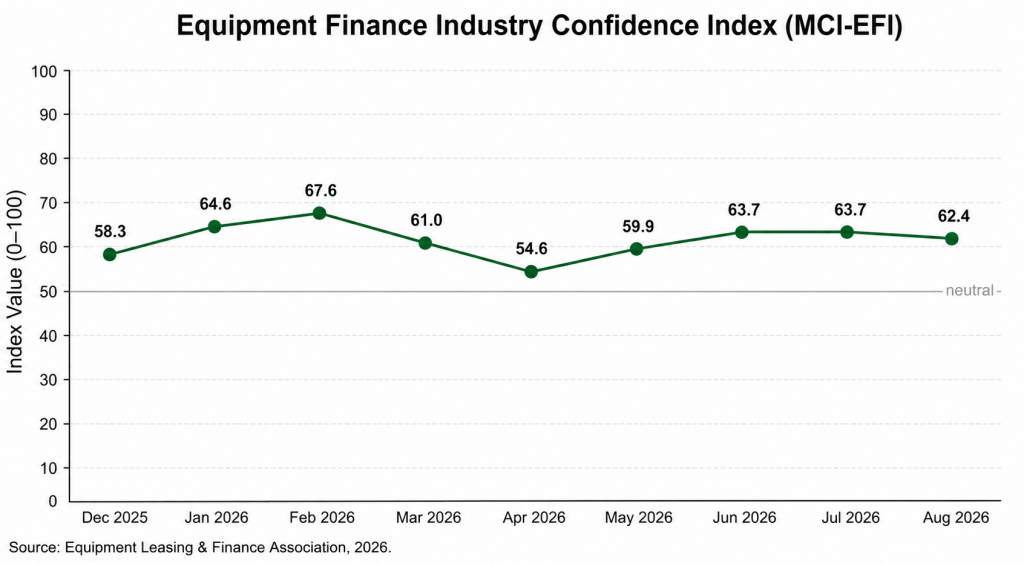
Equipment-finance industry confidence stayed well above the neutral midpoint through most of 2026, dipping briefly in April before recovering. That’s a signal lenders have remained broadly willing to finance equipment purchases across the year. Financing conditions for equipment purchases, tracked monthly by the industry’s own confidence index, stayed generally favorable through 2026, directly relevant to contractors weighing whether and how to finance a used grader.
The Economics: Busy Equipment vs. Profitable Equipment
There’s a meaningful difference between a grader that’s busy and one that’s profitable, and it’s easy to confuse the two. Revenue per machine-hour looks attractive on paper until mobilization costs, travel distance, operator wages, fuel, and downtime get subtracted from it. A job two hours away that pays a strong day rate can net less than a closer job at a lower rate, once travel time and fuel are counted honestly. Financing costs and depreciation matter too, a machine payment doesn’t care whether the grader worked 15 hours or 40 hours that week. Seasonal gaps, project delays, and the lag between a signed contract and an actual start date all eat into the math in ways that are easy to underestimate. Utilization without margin can create the illusion of success. The practical response is tracking profitability by job type rather than total revenue, a contractor who knows which categories of work actually clear a healthy margin is in a far stronger position to say no to low-value work and yes to the jobs worth chasing.
Profitability and Utilization Factors
| Factor | Why It Matters | Effect on Grader-Based Business | Smart Contractor Response |
| Mobilization and travel distance | Fuel, time, and wear add hidden cost to every job | Can turn an attractive day rate into a break-even job | Price mobilization separately; prioritize local job density |
| Operator availability | Skilled operators are in short supply industry-wide | Idle machine time if no operator is available | Cross-train staff and build retention into planning |
| Contract frequency and repeat business | Recurring work smooths cash flow and cuts sales cost | Turns one-off jobs into predictable base revenue | Prioritize maintenance agreements over one-time bids |
| Financing cost and depreciation | Payments accrue whether or not the machine is working | Erodes margin if utilization is inconsistent | Match financing terms to a realistic utilization forecast |
| Seasonal utilization patterns | Demand is uneven across the calendar and by market | Idle periods can offset high-season profitability | Diversify across seasonal and geographic customer types |
| Downtime and parts availability | Breakdowns cost more when parts take weeks to arrive | Extended downtime during peak-demand windows | Favor established brands with strong aftermarket support |
How Smart Contractors Can Enter These Markets
Turning any of these opportunities into an actual business line benefits from a fairly disciplined sequence, and skipping steps is usually where things go wrong.
Identify an underserved local market first, before buying anything. Talk to excavation contractors, public works staff, HOA managers, or farm operators and find out where grading capacity is genuinely thin, rather than assuming demand exists because a machine is available. Often the strongest opportunity is a specific underserved county, not the largest national market.
Match the grader to the opportunity. Size, hours, configuration, and grade-control capability should follow from the target work, not the other way around; a bargain machine that’s wrong for the job isn’t a bargain.
Calculate the minimum utilization needed to justify the purchase, how many billable hours or jobs per month cover the payment, insurance, fuel, and a reasonable operator wage before any of it counts as profit.
Build customer relationships before expanding capacity. A second machine only makes sense once the first has a demonstrated backlog, not a hopeful one.
Sell an outcome, not machine time. A packaged service, seasonal road maintenance, site pad preparation, emergency access restoration, tends to command better pricing than a plain hourly quote. Selling a complete solution builds pricing power in a way that selling machine hours never does.
Build repeatable contracts wherever the work allows it, converting one-time jobs into seasonal or annual agreements.
Track profitability by job type, not just total revenue, so decisions about which work to chase rest on real numbers.
Expand the fleet only after demand is proven, not because the current machine happens to be busy this month.
Contractor Strategy and Entry Framework
| Opportunity | Best Entry Strategy | Equipment Considerations | Customer Acquisition Approach | Repeat-Business Potential |
| Commercial/industrial site prep | Target GCs and developers active in growing secondary markets | Mid-to-large frame, solid structural condition | Direct outreach to developers and GCs; bid on site packages | Moderate, project-based, though GCs often return |
| Rural, farm, and ranch roads | Build local reputation through word of mouth and referrals | Smaller, maneuverable frame | Local advertising, referrals, farm-supply networks | High, repeat seasonal calls from the same landowners |
| Private road/subdivision maintenance | Convert the first job into a maintenance proposal | Mid-size grader for routine reshaping | Direct approach to HOA boards and property managers | Very high, annual or seasonal contracts |
| Municipal subcontracting | Build relationships with public works staff and prime contractors | Reliable machine, ready for on-call work | Attend public works meetings; register as a vendor | Moderate, depends on procurement cycles |
| Emergency/disaster grading | Pre-arrange standby relationships before storms hit | Grader kept mobilization-ready | Network with municipalities, utilities, restoration firms | Situational, recurring only with proactive relationships |
| Subcontracting for larger contractors | Position as dedicated grading capacity for two or three firms | Well-maintained machine, dependable operator | Direct outreach to GCs and excavation firms | High, account-style repeat work |
| Gravel road construction/rehab | Specialize by county or region rather than one-off jobs | Grader with strong crown-restoration capability | Direct contact with county road departments | High, cyclical maintenance never fully ends |
How to Turn New Jobs Into Recurring Revenue
The jump from a single grading job to a recurring relationship usually comes down to unglamorous fundamentals: showing up when promised, communicating proactively about schedule changes, documenting site conditions before and after the work, and pricing accurately enough that estimates hold up. Property managers, public works directors, and general contractors remember which subcontractors made their job easier and which ones created problems, and that reputation compounds over time in ways marketing can’t buy. Renewing a maintenance contract or getting the call for the next phase of a project is rarely about being the cheapest bid, it’s about being the contractor a customer doesn’t have to worry about. Recurring work, even at a modest rate, is often worth more over time than chasing the single highest-paying job on the market.
Where Contractors May Find the Strongest Opportunities
Opportunity isn’t distributed evenly across the country, and it’s worth being specific about where. Texas remains a heavyweight on almost every list in this article, leading the nation in new utility-scale solar capacity additions, closing in on 100 gigawatts of installed clean-power capacity, and home to a deep used-equipment market. Our case study on buying used 140H, 140M, and 12M graders in Houston breaks down what that has looked like for contractors buying and operating used Caterpillar graders in that market. Beyond Texas, states drawing new data-center and industrial site work, North Carolina, Indiana, Arizona, Georgia, and Ohio among them, are seeing site-prep demand grow in markets that saw less large-project grading work historically. Rural states with extensive unpaved road networks and active agriculture offer steadier, if less headline-grabbing, demand for farm-road and gravel-road work. None of this guarantees results in any specific county, local competition and permitting practices still decide outcomes, but it’s a reasonable starting point for scouting where to focus. Geographic concentration often shapes transport economics as much as raw demand does, so a tighter regional footprint can outperform a wider one on paper.
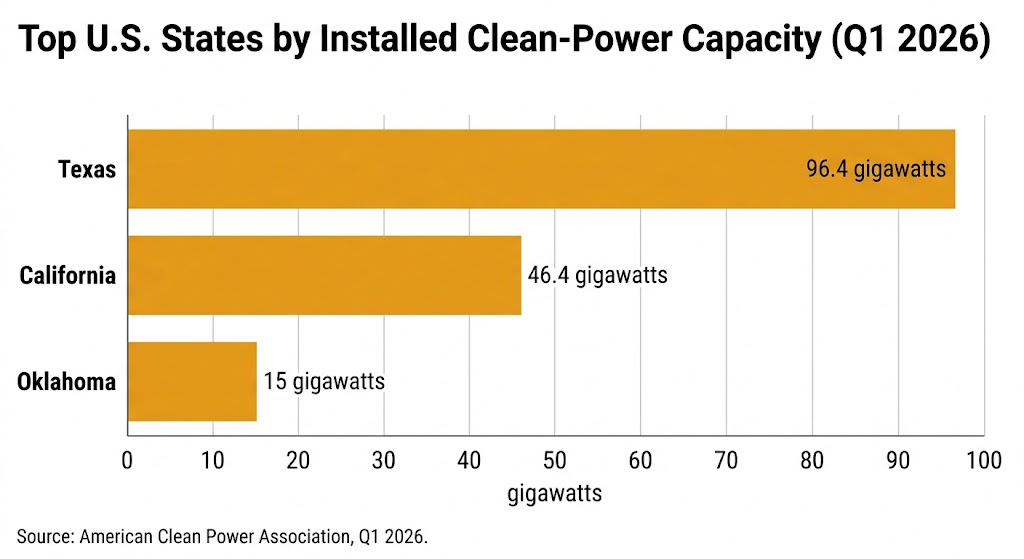
Texas holds a commanding lead in installed clean-power capacity, nearly double California’s total and more than six times Oklahoma’s. States with fast-growing renewable buildouts also tend to see fast-growing utility and access-road grading demand. Grounds the regional-opportunity discussion in verified capacity data, showing where utility-scale renewable construction, and the site and access grading work that supports it, is most concentrated today.
The Strategic Role of Technology and Data
Technology is changing how contractors both operate graders and find the next job. Grade-control systems improve precision and reduce rework on tighter-tolerance work, and telematics can turn utilization tracking from a guess into an actual number a contractor can act on. On the business-development side, our piece on how AI is changing the way heavy equipment traders do business covers how AI-assisted tools are starting to change equipment sourcing and market research for heavy-equipment buyers, helping contractors compare listings, track pricing trends, and evaluate a used machine’s history faster than manually digging through classifieds. None of this replaces judgment. A tool can help a contractor find candidate machines or flag a pricing anomaly faster, but deciding whether a specific grader fits a specific business plan still comes down to the same fundamentals: application, condition, financing terms, and realistic utilization.
Final Takeaway
The opportunity in front of U.S. grading contractors right now isn’t really about the machine at all. Owning a used motor grader doesn’t create revenue by itself, and keeping it busy doesn’t guarantee it’s profitable. The contractors positioned to do well over the next few years are the ones treating the grader as a gateway into private maintenance contracts, subcontracting relationships, disaster-response networks, and underserved rural and regional niches, and building the customer relationships and operating discipline that turn a single job into a recurring one. Strategic deployment, market selection, and controlled expansion are what separate a busy yard from a growing business, not machine-hour volume.
A dependable used motor grader can open the door to new grading contracts, private maintenance work, and subcontracting relationships, but only when the machine matches the job in front of it. usedmotorgrader.com carries inspected used motor graders from Caterpillar, John Deere, Komatsu, and other trusted brands, priced and configured to help U.S. contractors expand into new markets without overextending on capital.
FAQs
1. What are the best new business opportunities for contractors using used motor graders?
A: The strongest opportunities tend to be recurring ones: private road and subdivision maintenance contracts, subcontracting for municipalities or general contractors, and gravel-road rehabilitation. Commercial site prep and utility or renewable-energy grading are attractive too, but they’re more project-based. Combining a steady recurring base with occasional higher-value project work tends to produce the most stable revenue.
2. Can a used motor grader support a profitable new service line?
A: Yes, but only when you deliberately match the machine, the target market, and expected utilization. A used grader lowers the capital required to test a new service line, which reduces risk, but profitability still depends on realistic utilization, honest mobilization costs, and pricing that accounts for financing and operator wages, not just the hourly rate charged.
3. How can small contractors find recurring grading work?
A: Start by converting existing one-off customers, HOAs, farms, small developers, into seasonal or annual maintenance agreements rather than re-bidding every job. Building relationships with property managers, public works staff, and larger general contractors before demand spikes, and being reliably responsive, tends to generate more repeat business than competing purely on price.
4. Should a contractor buy another used grader when the first machine becomes busy?
A: Not automatically. A busy machine isn’t necessarily profitable once you factor in travel, downtime, and financing costs. It’s worth confirming demand is sustained and that the first grader’s utilization reflects genuine backlog, not just a temporary surge, before committing capital to a second machine.
Tags: Grader Export Opportunities, Used Grader Business Trends 2026, Motor Grader Contractors USA