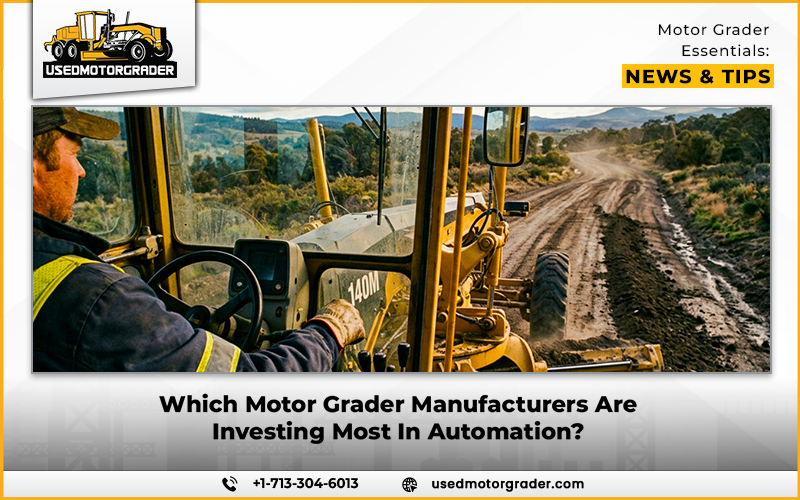
It used to take you years on a motor grader just to feel it out. Operators used 14 levers and constantly made small blade adjustments, relying on skills they developed through thousands of hours in the seat. But that is changing quickly. By the time CONEXPO-CON/AGG 2026 took place, job-site conversations had shifted away from pure horsepower and toward grade control, joystick technology, and connected job sites. The OEMs have placed their bets, and clearly, some are betting far more seriously than others.
What Does Automation on a Motor Grader Actually Mean?
Before breaking down the various brands, it is worth explaining exactly what the term “automation” entails within the motor grader class. This isn’t one specific function, but rather a stacked system of technologies that ultimately reshape how these machines are used and managed. On today’s current production machines, automation can encompass:
- 2D and 3D grade control for automated blade movement
- Auto-articulation features to reduce operator steer fatigue during confined maneuvers
- Joystick controls replacing conventional lever banks
- Auto-shift and intelligent transmission modes that automatically adapt to the workload
- Machine presets that store and recall desired operator configurations
- Cross-slope assist and blade-flip capabilities to minimize manual adjustments
- Machine damage avoidance functions that protect the moldboard and frame
- Connected telematics for remote fleet monitoring and diagnostic analysis
Some of these features, such as auto-articulation, are becoming standard on a wide range of mid-size machines. Others, like comprehensive 3D grade control with live design file updates and remote troubleshooting, are either optional upgrades or require a dealer to install the hardware. The real difference between “automation-ready” and “automation-capable” matters greatly. For a broader look at how modern technology is competing with sheer power in purchase decisions today, an overview of modern tech vs. power demands for 2026 offers more context.
Which OEMs Lead Motor Grader Automation in 2026?
Caterpillar (CAT)
Caterpillar currently represents the OEM investing most heavily in grader automation, based on sheer unit output. At ConExpo 2026, the company debuted the Cat 150 and Cat 160, the latest additions to its rolling Next Generation platform. This redesign effort now covers models ranging from the Cat 120 through the Cat 160, and Cat graders for sale on this platform boast a joystick control option on the 150 (standard on the 160) and a newly designed, more precise, nine-speed transmission. Optional technology packages also include 360-degree camera systems, a People Detection safety alert, automatic blade control, pre-calibrated E-fence, and Cross Slope Assist with an integrated Position Sensing Shift Cylinder.
In terms of a factory-integrated automation package, these next-gen machines line up the broadest offering currently available from a single manufacturer. If you’re curious about how these technologies perform when tackling grading tasks, this analysis on peak automation with Cat graders is a useful resource.
John Deere
John Deere made another substantial jump forward at the show with the full debut of its new P-Tier SmartGrade graders. Now covering eight models from the John Deere 620 through the John Deere 872. The P-Tier graders are designed with their SmartGrade systems as an integral component of the machine’s architecture, not as an aftermarket add-on. An intuitive G5 touchscreen interface handles both 2D and 3D grade control using Topcon or Leica integration and even accounts for non-standard blade positions. Auto-Gain, Auto-Shift Plus, blade-flip features, and machine presets are all included as standard, with an optional Advanced Vision System that adds dual-front alley cameras. A significant benefit of John Deere graders is the Remote Display Access function through the John Deere Operations Center, giving dealers the ability to support customers directly from remote locations and thereby increasing real-world adoption beyond just impressive spec sheets.
Komatsu
Komatsu’s automation strategy fits within its broader Smart Construction ecosystem, which combines machine automation with comprehensive job-site data management. The GD655-7 models feature dual-mode transmission. This allows for both automatic and manual shifting, along with a moldboard control system designed to accommodate a variety of skill levels. These machines are also built with full telematics capability, facilitating fleet management and maintenance scheduling. An undeniable advantage to owning a Komatsu grader with a full IMC (Intelligent Machine Control) integration is the seamless way. It combines 3D design data, drone-captured aerial maps, and as-built telemetry from the machine to provide a unified view of the job site. When fleet managers search for a Komatsu grader integrated into its Smart Construction ecosystem. They gain a level of real-world visibility and control that few aftermarket solutions can match.
Others
CASE stepped back into the 200-plus horsepower market at ConExpo 2026 with its D Series graders. Which feature new electro-hydraulic controls, an improvement, certainly. But still seemingly less focused on deep automation integration than Caterpillar and Deere. Volvo continues to make strides in operator safety and fuel efficiency. But hasn’t recently made grader automation a cornerstone of its offerings.
Does Motor Grader Automation Actually Provide Value on the Job?
The productivity gains are most apparent in tasks requiring a combination of speed and accuracy. Such as road construction, municipal maintenance operations, and large-scale grading projects. Grade control systems can drastically reduce the number of passes required to achieve the desired final grade. Intelligent transmission features lessen operator fatigue and enable newer operators to reach consistent production levels much faster. The driving force behind all of this is quite simple: skilled grader operators are an increasingly rare commodity. Automation offers one of the most practical solutions to address this shortage.
The impact at the job site can be categorized into three distinct benefits:
- Optimized Pass Efficiency: Fewer passes per lane mean reduced fuel consumption and more consistent adherence to tight project schedules. Especially in large-scale road maintenance contracts.
- Workforce Skill Leveling: Automation assistance allows less-experienced operators to reach performance levels close to those of experienced operators. Directly addressing the labor challenges facing the construction industry.
- Minimized Project Rework: More accurate and repeatable blade positioning lowers the overall cost of each project. Especially on sensitive, sloped surfaces or jobs requiring precise drainage angles.
A Cat grader for sale with its top-tier 3D grade control system, much like a Komatsu grader integrated into Smart Construction, is certainly a premium investment from a technology standpoint. On the used equipment market, mechanical condition and hour meter readings still often outweigh automation features. But this is beginning to change as grade control becomes a more common standard rather than an optional extra on new production machines. If you’re looking to balance automation capabilities with the best overall value on the market. A comprehensive look at motor graders based on price, technology, and performance will help you narrow down your options.
FAQs
1. Which motor grader brand currently offers the most advanced automation system in 2026?
A: Caterpillar offers the most comprehensive factory-integrated automation stack currently available through its Next Generation platform. Combining joystick controls, automated blade functions, machine protection features, and operator assistance systems across its entire lineup, from the Cat 120 to the Cat 160.
2. Are John Deere graders compatible with third-party grade control systems?
A: Yes, John Deere graders from the P-Tier SmartGrade lineup support 2D and 3D grade control with both Topcon and Leica systems and can be natively integrated via the G5 touchscreen display. The John Deere Operations Center provides wireless troubleshooting capabilities for remote support.
3. What should I consider when looking at a Komatsu grader for sale with automation?
A: You should confirm the current status and transferability of the Smart Construction subscriptions. Verify whether the machine is IMC-equipped, and determine if the telematics system is currently linked to a fleet management system. These factors greatly impact the practical value of an automated unit.
4. Is the motor grader’s resale value being positively impacted by automation features?
A: Grade control hardware is now regularly appearing on used equipment listings, particularly for Caterpillar and John Deere models. For most buyers in the used market, however, mechanical condition and machine hours still hold greater weight than automation packages.
Tags: Motor Grader Manufacturers, Grader Automation Trends, Used Grader Investment