A Comprehensive Guide
Every Houston Contractor Knows What Happens to Equipment Here
Run a grader through a Houston summer, and you understand the problem immediately. The heat climbs past 95°F and stays there for months. Job sites that were firm yesterday are submerged by a Thursday afternoon storm. The black clay soil grabs at your cutting edges and packs into every joint and cavity on the machine. Then the humidity finishes the job by going after every connector, seal, and exposed surface that the heat and soil missed.
Houston does not go easy on heavy equipment. And right now, it is asking more from motor graders than it has in at least a decade. TxDOT’s Gulf Coast District is executing a multi-billion-dollar roadway program. Harris County has accelerated its drainage reconstruction work. The Port of Houston is expanding logistics infrastructure at a pace not seen in a generation. And suburban corridors in Katy, Pearland, Conroe, and League City are pushing outward with new road and utility work that shows no sign of slowing.
For contractors who own used motor graders, that activity level is an opportunity, but only if the machine under you is maintained, selected, and managed with Houston in mind. This guide covers exactly what that looks like.
Houston’s Construction Environment: Why Grader Demand Keeps Growing
Houston is one of the most consistently active heavy construction markets in the United States, and its grader demand is not tied to any single sector. It runs across infrastructure, flood control, port logistics, highway rehabilitation, and continuous suburban development, which means work does not evaporate when one category slows.
The primary factors driving sustained demand in 2026 include:
- The Gulf Coast District TxDOT program is funding billions in active roadway rehabilitation
- Harris County’s long-term flood mitigation investment following Hurricane Harvey
- Port of Houston terminal and logistics corridor expansion
- Continuous suburban road and utility grading in the outer metro corridors
- Repeated storm recovery demands that generate new project activity after each major rainfall event
- Industrial site preparation work in the Ship Channel and Bayport industrial zones
- Municipal street reconstruction programs in inner-loop and older Houston neighborhoods
That project diversity is what makes the Houston used grader market behave differently from most regional markets. Demand does not drop to zero between peak cycles because the project mix rotates. When highway rehabilitation slows, drainage work is ramping up. When suburban grading winds down seasonally, storm recovery kicks in.
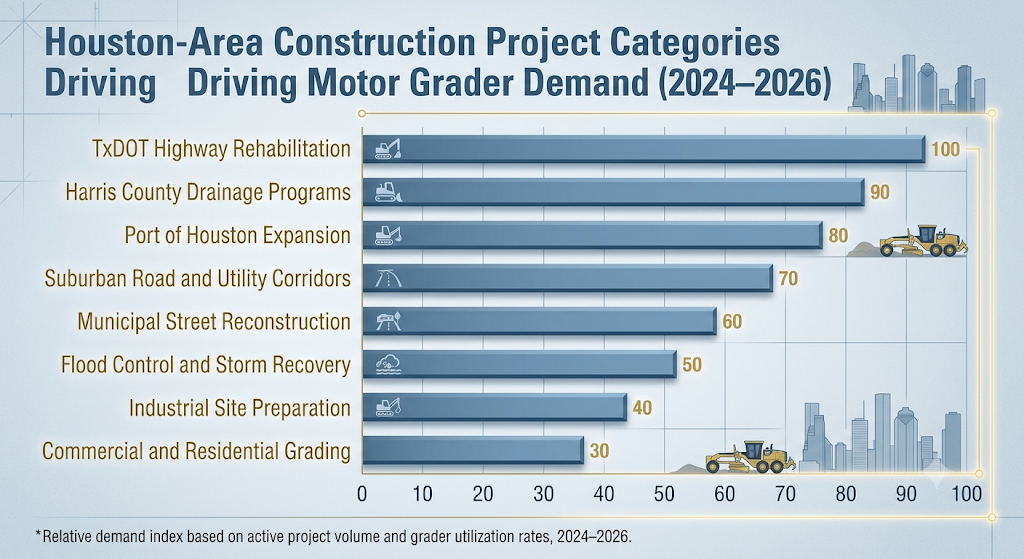
Houston’s grader demand is distributed across eight distinct project categories, each with its own seasonal rhythm and machine requirement. Understanding this distribution helps contractors align fleet decisions to where the work actually is, not just where it was last cycle.
What Project Types Are Actually Driving Grader Hours in Houston?
This is the question every fleet manager should answer before they spec a machine or plan a replacement cycle. Houston’s project mix is broader than most markets, and each project type creates different machine stresses, different operating hours patterns, and different maintenance demands.
Highway contractors working TxDOT rehabilitation jobs typically need highway-class machines, in the 140 to 160 series horsepower range, with strong moldboard capacity and the ability to run long, consistent grades under sustained load. These machines log high daily hours and place significant demand on hydraulics, circle drives, and blade systems.
Drainage and flood-control contractors often work in soft, wet conditions where tire selection, machine weight distribution, and articulation durability become the deciding factors in uptime. Harris County’s ongoing channel improvement programs and FEMA-funded greenway projects are the most consistent sources of this type of work. Machines start and stop frequently as water conditions change, and the cumulative stress on undercarriage and driveline components adds up quickly.
Suburban road contractors grading base material ahead of paving crews in Pearland or Katy deal with Houston’s expansive black clay constantly. That soil swells when wet and cracks into hard chunks when dry, and it is punishing on cutting edges and blade geometry. Operators who do not adjust their technique for changing clay conditions accelerate wear at a rate that surprises contractors coming from other markets.
Municipal street reconstruction in Houston’s older neighborhoods involves tight corridors, utility conflicts, and variable surface conditions. Mid-size graders in the 120 to 130 horsepower range are more practical here than full highway-class machines, and the work style, frequent repositioning, precise trimming, and limited straight-line blade runs, creates different wear patterns than open-road work.
The following project categories represent the core demand drivers for Houston grader operators in 2026:
- TxDOT corridor rehabilitation and highway widening
- Harris County and City of Houston drainage reconstruction
- Flood control channel work and FEMA-funded storm recovery projects
- Port of Houston logistics infrastructure and terminal site preparation
- Suburban utility corridor grading in Katy, Pearland, and Conroe
- Municipal street resurfacing and base repair
- Industrial site preparation in the Ship Channel and Bayport zones
- Land development grading for commercial and residential growth
For a broader view of how Houston’s grader market compares to national trends, this overview of how Houston’s used grader market affects all of the U.S. provides context that matters when you are making fleet decisions with resale in mind.
Houston Project Types: Grader Class, Wear Profile, and Peak Season
| Project Type | Primary Grader Class | Primary Wear Areas | Peak Season |
| TxDOT Highway Rehabilitation | 140–160 HP Highway Class | Moldboard, circle drive, hydraulics | Spring / Fall |
| Harris County Drainage Work | 120–140 HP Mid-Size | Tires, articulation, cutting edges | Year-round |
| Flood Recovery and Storm Work | 130–150 HP, high mobility | Frame, hydraulics, electrical | Post-storm |
| Suburban Road Grading | 120–140 HP | Cutting edges, tires, transmission | Spring–Summer |
| Industrial Site Preparation | 150–180 HP Heavy Duty | Moldboard, cooling system, tires | Year-round |
| Municipal Street Reconstruction | 110–130 HP Compact | Circle drive, blade tips, cab systems | Fall–Winter |
How Does Houston’s Climate Destroy Equipment Faster Than Most Markets?
The short answer is: in more ways than most contractors account for until they have already absorbed the expense.
Houston does not have one difficult season. It has three seasons that are actively hard on equipment and one that is merely unpredictable.
Summer heat in Houston runs from late April through early October, and ambient temperatures on job sites with limited shade and radiant heat from compacted clay or asphalt routinely push past 100°F. Cooling systems on older used graders work at full capacity for months without relief. Machines that have deferred coolant flushes or partially blocked radiator fins begin to overheat under sustained blade load, and those thermal stress events accelerate wear on head gaskets, water pump seals, and bearing surfaces throughout the engine. Engine oil thins at elevated temperatures, and if drain intervals are not shortened or the wrong viscosity is used during summer operation, internal wear rates climb.
Humidity is the quieter threat and often the more expensive one long-term. At 70 to 90 percent relative humidity for much of the year, moisture finds its way into electrical connectors, hydraulic breathers, fuel caps, and any surface where paint has been compromised. Rust develops faster on Houston machines than on comparable units from drier Southwest markets, and corrosion at connector pins causes intermittent electrical faults that are notoriously difficult to diagnose without a systematic harness inspection. This is one of the most important inspection points when evaluating any used motor grader for sale in Houston that has worked locally for more than a few years.
Heavy rainfall, Houston averages over 50 inches per year, creates unstable working surfaces that stress articulation joints and drivelines in ways that dry-climate operation does not. When a grader works in soft, rut-prone soil with the front wheels dragging through wet clay and the rear frame torqued against blade load, articulation pins and bushings wear at an accelerated rate that compounds quickly if grease intervals slip even slightly.
Flooding does not just slow down job sites. It introduces water contamination into hydraulic reservoirs, transmission housings, and differential cases when machines are parked at grade level and not promptly inspected after an inundation event. Any machine that has been through a flood event, even a partial one where water reached the undercarriage but not the cab, requires a complete fluid draw and analysis before being returned to service.
The clay soil adds its own layer of wear. Houston’s expansive black clay is abrasive when dry and adhesive when wet. It accelerates cutting-edge consumption, increases circle drive stress under heavy blade loads, and packs into articulation cavities and heat-sensitive areas in ways that trap moisture against metal surfaces for extended periods.
Component Wear in Houston: What Breaks First and How to Get Ahead of It
Knowing which components fail earliest in Houston’s operating environment is what separates contractors who manage maintenance costs from those who absorb them as unplanned expenses.
The following components require more aggressive monitoring and shorter service intervals under Houston conditions compared to national averages:
- Cutting edges and end bits: Abrasive clay and road base work consume cutting edges 20 to 30 percent faster than national averages. Keep one to two replacement sets on hand at all times.
- Tires: Heat, heavy loads on soft ground, and underinflation in wet conditions accelerate sidewall cracking and internal structural damage. Check tire pressure daily during the summer months.
- Hydraulic system: Seal degradation from heat, moisture contamination from storm events, and high daily duty cycles combine to create hydraulic failures faster than expected. Fluid analysis every 500 hours is non-negotiable.
- Circle drive: Heavy blade loads in clay soil put sustained stress on the ring gear, wear plates, and drive motor. Inspect wear patterns quarterly and plan replacement before spalling becomes a catastrophic failure event.
- Cooling system: Radiators partially blocked by clay dust and debris lose capacity rapidly in summer. Monthly cleaning is the correct interval in Houston, not seasonal.
- Articulation joints and pins: Wet-ground operation accelerates bushing wear at a rate that surprises operators used to drier conditions. Grease every 10 hours during intensive wet-site work.
- Electrical system: Corrosion at connector points, ground straps, and sensor leads causes intermittent faults. Inspect and reapply dielectric grease to all main connectors annually.
- Transmission and driveline: Fluid degradation under sustained heat and load is faster in Houston than in northern or arid markets. Do not extend transmission fluid and filter intervals beyond OEM specifications.
Standard vs. Houston-Adjusted Maintenance Intervals
| Component | Standard Interval | Houston-Adjusted Interval | Key Risk Factor |
| Engine Oil | 250 hours | 200 hours in summer | Heat-accelerated oxidation |
| Hydraulic Fluid | 1,000 hours | 500–750 hours | Contamination, seal wear |
| Transmission Fluid | 1,000 hours | 750 hours | High heat, heavy duty cycles |
| Coolant Flush | 24 months | 18 months | Corrosion, thermal stress |
| Cutting Edges | Condition-based | Inspect every 150 hours | Abrasive clay soils |
| Circle Gear Grease | Per OEM schedule | Every 8–10 hours on wet sites | Wet soil ingestion |
| Articulation Pin Grease | Per OEM schedule | Every 10 hours during intensive work | Soft-ground stress |
| Air Filter | Per restriction indicator | Visual check weekly in clay dust | Clogging, engine stress |
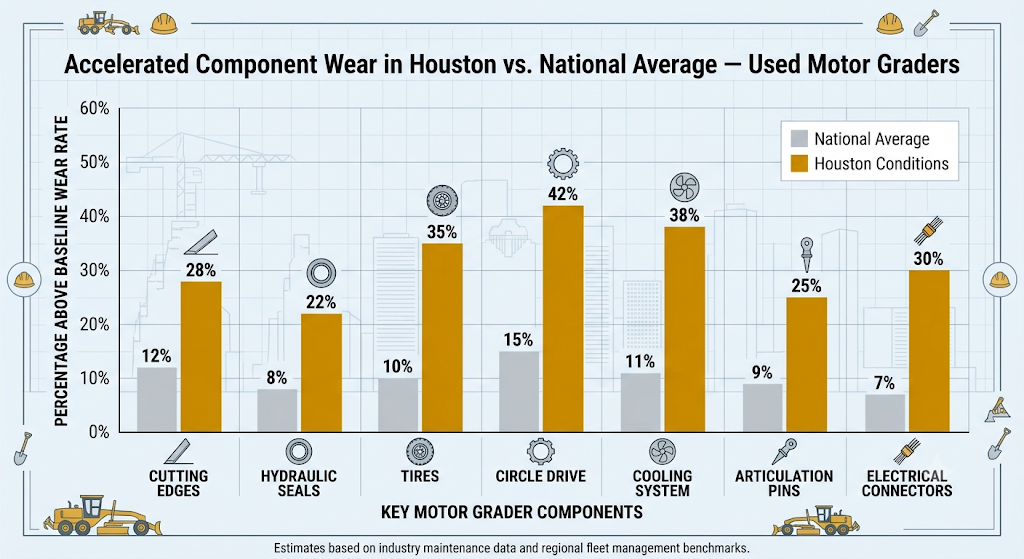
Nearly every major grader component wears faster in Houston than the national average, not because the machines are inferior, but because the operating environment is unusually demanding. Building these accelerated cycles into your budget from day one is the difference between predictable costs and surprise expenses.
Which Used Grader Brands Hold Up Best in Houston’s Environment?
Brand preference in the used equipment market is rarely about abstract quality. In Houston, it is almost entirely about parts availability, dealer proximity, and the density of qualified technicians who know the machine. Those factors have a clear pecking order here.
Caterpillar is the dominant brand in Houston’s used grader market, and it earns that position on practical grounds. The Cat dealer network in Texas is extensive, with multiple locations serving the metro area and strong regional parts distribution. Common wear items are available same-day or next-day, and the number of Cat-certified technicians in Houston, through dealers, independents, and in-house fleet shops, is greater than any competing brand by a wide margin. Cat 120, 140, and 160 series graders have a large installed base in Texas, which means resale channels are deep and auction results are more predictable. If you are searching for a used motor grader for sale in Houston and your primary concern is long-term support and resale depth, Cat is the default choice for most Houston fleets.
John Deere follows closely, particularly among contractors who already run Deere excavators or dozers and want to consolidate dealer relationships. The 670G and 672G series are well-regarded in the Texas market. Deere’s dealer presence in Houston is strong, and the brand’s parts logistics are competitive with Cat for the most common service items.
Komatsu has a solid footing among municipal and county fleet managers who have standardized on the brand across their equipment rosters. The GD655 and GD675 series handle the machine class that most Houston projects demand, and Komatsu’s quality is not in question. Parts availability is slightly slower than Cat on some specialized components, which is the primary reason it trails in the contractor market, where downtime cost is immediate.
CASE graders appear in Houston’s used inventory at a lower acquisition cost and are a reasonable choice for contractors with strong in-house mechanical capability. The trade-off is a thinner dealer support network, which means parts stocking discipline is more critical with a CASE machine than with a Cat or Deere.
Volvo graders appear infrequently in Houston’s used market and carry the highest service complexity for contractors without an established Volvo relationship. They are capable machines, but the specialist support requirements make them a harder long-term ownership proposition in this market.
For a detailed look at how Houston contractors are currently making these decisions, how Houston contractors define best motor graders covers the real criteria driving purchasing decisions in 2025–2026.
Buying a Used Motor Grader for Sale in Houston: What to Look For Before You Commit
Not all used graders look like what they are. Houston’s operating history is hard on machines, and a unit that presents well at auction may have corrosion damage, heat-stressed hydraulics, or circle drive wear that will cost tens of thousands of dollars to correct once it is working on your job site.
Before committing to any used motor grader for sale in Houston, a thorough pre-purchase inspection should cover the following:
- Engine: Check for oil leaks, coolant contamination in the oil, and blowby at the breather. Pull diagnostic codes and ask for service records that cover any overheating events.
- Hydraulics: Cycle all functions at full pressure load and watch for drift, sluggishness, or noise. Pull a fluid sample for lab analysis before purchase if at all possible.
- Circle and blade: Operate the blade through its full range of motion. Listen for ring gear noise or roughness in circle rotation. Inspect drive gear and wear plates for spalling or uneven pattern wear.
- Articulation joints: Rock the machine in articulation and check for detectable play. Any looseness in the pins indicates replacement is overdue.
- Tires: Check for sidewall cracking, shoulder wear, and any signs of internal separation. Houston heat degrades rubber faster than northern or inland markets.
- Electrical: Test all cab functions, lights, sensors, and monitor systems. Look for patched or taped wiring, which often points to flood exposure that was not disclosed.
- Frame: Inspect the belly pan, fuel tank mounting points, and frame rails for rust streaks, weld repairs, or any previous structural repair welding.
- Hour meter history: Cross-reference with telematics records or service logs if available. Machines from municipal or county fleets often have better-documented histories than contractor-owned units.
- Cooling system: Pull the coolant cap and check for oil contamination. Inspect radiator fins for clay and debris accumulation that signals deferred maintenance.
The article on best ROI-focused used motor graders for sale in Houston provides a strong comparison framework for evaluating machines against purchase price and expected return. And before you commit to current market pricing, understanding why acquisition costs are elevated is important. Why Houston’s grader prices are soaring before the new EPA mandates explains the supply dynamics driving prices in 2025–2026.
Long-Term Maintenance Strategy for Houston Grader Owners
Buying the right machine is the first half of the equation. Maintaining it correctly is what determines whether it pays for itself or becomes a liability that grows more expensive every year.
A long-term maintenance strategy for Houston conditions should be built around four core disciplines. First, preventive maintenance scheduling uses the OEM baseline and applies the Houston-adjusted intervals covered in Table 2. Do not treat the OEM schedule as a maximum; in Houston conditions, it is a starting point. Second, oil and fluid analysis, a sample sent to a lab every 250 to 500 hours, is the most cost-effective diagnostic tool available to any grader owner. It catches bearing wear, hydraulic contamination, coolant ingress, and fuel dilution before they escalate to catastrophic failures. Third, parts stocking: keep a minimum inventory of high-consumption items on hand. Cutting edges, air and hydraulic filter elements, fuel filters, and common fittings should not require a dealer run. Fourth, service record keeping, every oil change, filter replacement, and repair logged with hours and date, adds demonstrable money to resale value and simplifies troubleshooting when problems develop.
How you match machine size to project type is part of the maintenance equation, too. Why small-frame graders are winning in Houston’s construction market covers how fleet optimization and machine-to-job matching affect both operating costs and maintenance complexity.
Long-Term Maintenance Action Plan for Houston Used Graders
| Maintenance Action | Frequency | Expected Benefit |
| Engine oil and filter change | Every 200 hours in summer / 250 hours other seasons | Prevents heat-accelerated bearing and cylinder wear |
| Hydraulic fluid sample and analysis | Every 250–500 hours | Early detection of seal failure and contamination |
| Cutting edge measurement and rotation | Every 150 hours | Consistent blade performance, moldboard protection |
| Radiator cleaning and fin inspection | Monthly in summer, quarterly otherwise | Prevents overheating under sustained load |
| Articulation and circle drive greasing | Every 8–10 hours in wet or heavy-load conditions | Extends joint and gear life significantly |
| Full electrical connector inspection | Annually | Prevents corrosion-related intermittent faults |
| Transmission fluid and filter replacement | Every 750 hours | Prevents accelerated clutch and gear wear in high-heat conditions |
| Tire pressure and sidewall inspection | Daily during summer and wet-ground operations | Prevents internal structural damage from underinflation |
| Complete service record entry | After every service event | Improves resale value, supports warranty claims, simplifies troubleshooting |
What Should a Long-Term Operation Plan Actually Include for Houston Contractors?
A long-term operation plan is not a maintenance schedule. It is a business document that covers the complete ownership lifecycle, from pre-purchase evaluation through resale, and it has to account for Houston’s specific operating conditions at every stage.
A complete plan for a Houston used grader owner should be built around the following framework.
Purchase criteria: Define the machine class, age ceiling, hour limit, required brand support network, and any technology requirements (grade control, telematics) before you start looking. Resist pressure to make exceptions for a deal. The wrong machine at a good price is still the wrong machine, and Houston will expose every one of its weaknesses within the first year.
Pre-purchase inspection protocol: Use the checklist from the previous section as a non-negotiable gate on any serious purchase. For high-value units, hire an independent third-party inspector with Houston-market experience who knows what flood exposure and heat damage look like in practice.
Year-one baseline: In the first 500 operating hours after purchase, sample all fluids, document all wear measurements on cutting edges and circle components, and identify any deferred maintenance the previous owner left behind. This baseline tells you the machine’s true condition, not what the listing said.
Maintenance calendar: Build a 12-month rolling schedule aligned to Houston’s seasonal patterns. Plan for elevated hydraulic and cooling system workloads in summer. Schedule articulation and frame inspections during and after storm season. Use the Table 2 intervals as your starting point and adjust based on your actual operating conditions.
Operator management: The operator is the first line of defense against premature wear. Pre-trip inspection habits, proper blade loading technique, and disciplined hydraulic cycle practices all affect component life in ways that maintenance alone cannot compensate for. Operator training is a maintenance expense, not an overhead cost.
Downtime risk management: Identify your most likely single-point failure risks based on machine age, operating history, and fluid analysis trends. Know which repairs your in-house capability can handle and which require dealer support. Have a contingency plan for extended downtime that includes either a rental arrangement or a machine in the fleet that can cover critical work.
Resale planning: Used grader values in Houston are supported by strong and consistent demand, but timing within that demand cycle matters. Machines in the three to seven year, 3,000 to 7,000 hour window typically achieve the best balance of depreciation absorbed and buyer confidence at sale. Plan your replacement cycle around resale timing, not just machine condition.
Replacement trigger definition: Build a formal replacement threshold into the plan before you need to use it. Define the hour threshold, cumulative repair cost threshold, or market condition that tells you it is time to move the machine rather than continue investing in it. Without a defined trigger, replacement decisions become emotional rather than financial, and that almost always costs money.
For context on where used grader supply is heading in the Houston market, the upcoming biggest supply shift since 2019 is essential reading for any contractor planning a replacement cycle in 2026.
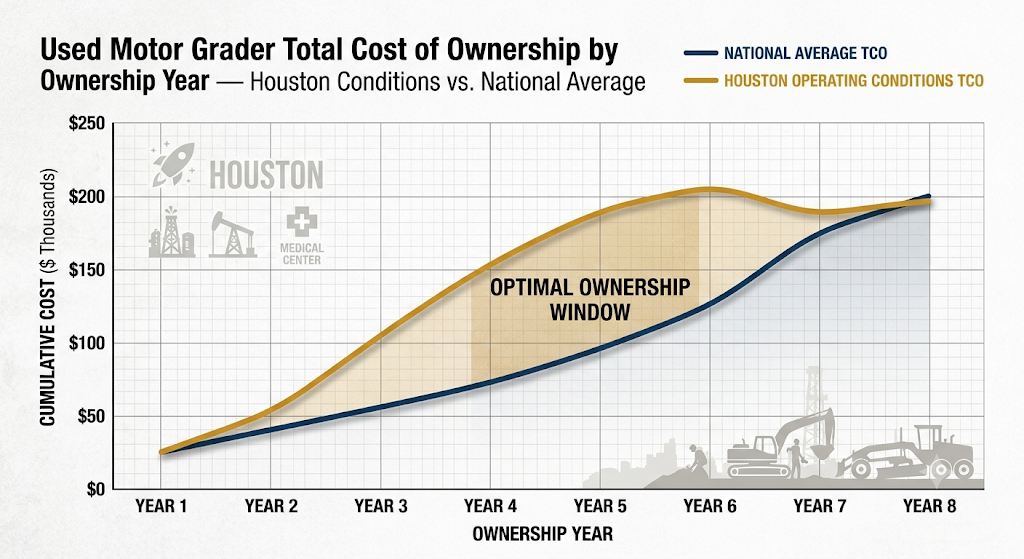
Houston’s accelerated maintenance demands push total cost of ownership above the national average through the first four years, but strong local resale values and sustained demand narrow that gap for owners who maintain their machines well and time their exit within the optimal ownership window.
Pricing, Resale, and Downtime Risk in the Houston Market
Houston’s used grader market is tighter than most contractors realize until they try to buy or sell. The combination of sustained infrastructure demand, a large population of active contractor fleets, and regular auction activity through IronPlanet, Ritchie Bros., and regional Texas dealers creates a market with real price depth, but also real risk for buyers who overpay during peak demand periods or who acquire machines without understanding local operating history.
Key pricing and resale dynamics Houston contractors should understand include:
- Late-model, low-hour Cat and Deere graders under 5,000 hours and less than five years old trade at or above national book value in Houston due to strong contractor and rental demand.
- Older machines with 7,000 or more hours trade at meaningful discounts unless they carry documented service histories and recent component rebuilds.
- Grade control systems, particularly 2D and 3D GPS systems, add $8,000 to $25,000 in market value on otherwise comparable machines, and on TxDOT and Harris County contracts, they are increasingly a job site requirement rather than an option.
- Flood-damaged machines that have been partially repaired without full disclosure appear in the Houston auction channel more frequently than in most other markets. Third-party inspection before any significant auction purchase is not optional, it is insurance.
- Downtime costs in Houston are elevated because contractor schedules are tight and weather windows are limited. A grader out of service during a critical drainage project window can cost far more in delay exposure than the repair itself.
- Houston’s active exporter and reseller market, driven by buyers sourcing for Central American and Latin American markets through Houston-area auctions, provides a floor under resale values that benefits every contractor planning an eventual sale.
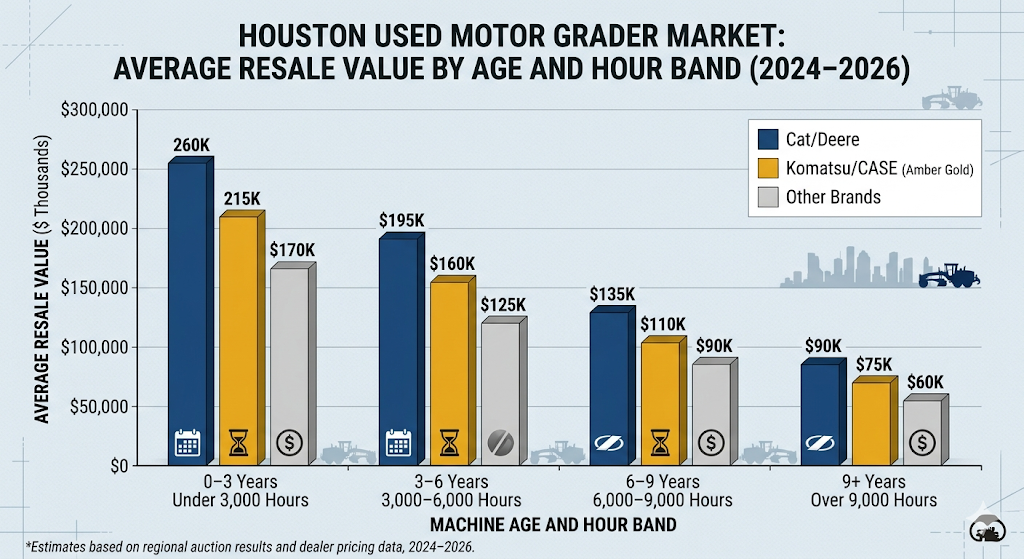
The spread between top-brand and lesser-known resale values narrows in the early machine years but widens significantly as machines age, which is why brand selection at the point of purchase has a compounding impact on long-term fleet economics.
How Houston Contractors Are Making Smarter Fleet Decisions in 2026
The contractors running the most cost-efficient grader fleets in Houston are not necessarily the ones with the newest machines or the largest budgets. They are the ones who treat used equipment as a managed asset with a defined lifecycle, not a consumed tool that gets replaced when it stops working.
The practical decisions that separate well-run Houston grader fleets from costly ones are consistent across fleet sizes:
- Standardizing on one or two brands to consolidate parts inventory, technician knowledge, and dealer relationships, which reduces both cost and complexity across the fleet
- Buying a late-model used rather than new to absorb initial depreciation without sacrificing the reliability and support availability that a used motor grader for sale in Houston from a reputable source provides
- Using telematics, OEM systems, or aftermarket GPS hour trackers to monitor machine utilization, location, and idle time, and to catch operators who are running machines hard without logging pre-trip inspections
- Scheduling blade rebuilds and circle drive service proactively at known wear thresholds, using fluid analysis data as the trigger rather than waiting for symptoms
- Timing fleet additions to coincide with periods of high auction supply, typically October through January, when year-end equipment cycling increases available inventory and moderates prices
- Making rebuild-versus-replace decisions based on fluid analysis trends and documented repair cost history, not gut feel or attachment to a particular machine
- Planning operator rotation and training as part of the fleet management program, not as an afterthought, because operator technique is the single most controllable variable in component wear rates
Houston’s construction market rewards contractors who own the right machines and manage them well. The framework in this guide gives you the foundation; now the next step is finding a machine that meets it.
Browse the current inventory of top-brand used motor graders for sale in Houston, including Caterpillar, John Deere, and Komatsu, at usedmotorgrader.com. Every machine is ready to work. Find yours today.
FAQs
1. What is the best-used motor grader size for Houston contractors?
A: For most Houston project types, drainage work, road grading, and site preparation, a mid-size machine in the 130 to 155 horsepower range offers the best balance of versatility and operating cost. Highway contractors running TxDOT rehabilitation jobs will typically need a 160-class machine.
2. How much more does it cost to maintain a grader in Houston compared to other markets?
A: Maintenance budgets for Houston grader operations should run 15 to 25 percent above the national average for equivalent machine classes, accounting for accelerated cutting-edge consumption, more frequent fluid changes, and higher cooling system and articulation servicing demands.
3. Is grade control worth the premium on a used grader in Houston?
A: In most cases, yes. Grade control adds measurable production value on drainage, subgrade, and highway work, and it adds $8,000 to $25,000 to resale value. On TxDOT and Harris County contracts, it is increasingly a requirement rather than an option.
4. When is the best time to buy a used motor grader for sale in Houston?
A: Late fall through early winter, October through January, is typically when auction supply peaks and pricing is most competitive as contractors cycle machines out before year-end. Avoid buying during or immediately after major storm events, when short-term demand surges drive prices above normal market levels.
Tags: Optimize Grader Operations, Motor Grader Maintenance Plans, Motor Grader For Sale Houston