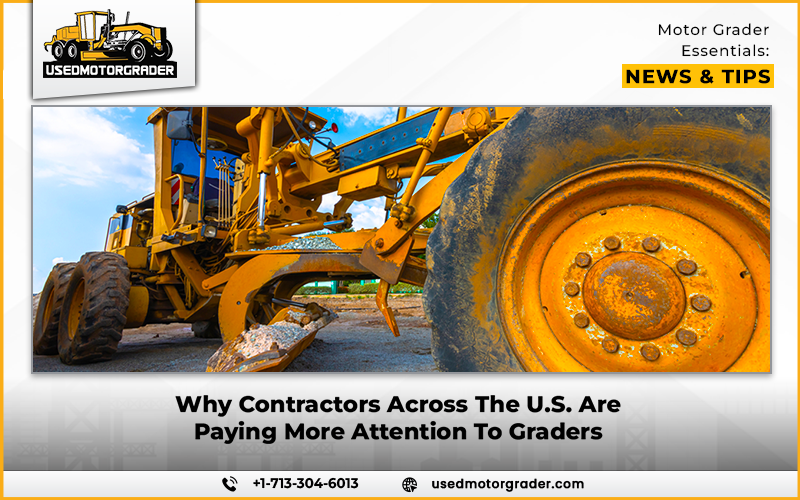
Equipment managers used to keep a motor grader in the equipment yard, call it up only when a road needed smoothing, and send it back once the work was finished. That time is over. The question that is top of mind for contractors today is whether they have a grader and whether it’s smart enough, when bidding on jobs, building fleet budgets, and making long-term equipment decisions. Billions of dollars in federal legislation and the growing shortage of skilled operators are driving this measurable shift.
Federal Money Changed the Game
The Infrastructure Investment and Jobs Act injected $1.2 trillion into the national economy and directly allocated a large share of that funding to roads, bridges, highways, and rural connectivity projects. By mid-2024, agencies had already distributed more than $454 billion across over 56,000 projects in all 50 states. That kind of commitment doesn’t just fill project pipelines; it makes contractors think about what’s in their yards. Almost immediately, road construction motor graders were a priority because any new highway base, any reconstructed rural road, and any access road to a bridge begins with a precise grading operation that no other machine can do as efficiently.
Demand surged the most in states with large infrastructure backlogs, such as Texas, the Midwest, and Western mining corridors. Municipal fleets followed, with federal dollars used to purchase new equipment and expand their fleets for road maintenance and snow removal. The money was there. The question was whether contractors had the machines and the people to use them.
Technology Turned Heads
The modern motor grader is hardly recognizable as the grader that was used by contractors 20 years ago. The introduction of GPS-guided blade control, mastless GNSS systems, automated cross-slope management, and telematics platforms has transformed the capabilities of the machine and who can use it. The Smart Construction 3D Machine Guidance system increased by more than 37% in 2024 alone, according to Komatsu. Caterpillar now controls data from over 1.5 million connected assets to help optimize fleet performance.
Here’s what that means on the ground for road construction motor graders:
- Less experienced operators can obtain grade tolerances that were previously only possible with years of hands-on experience.
- Rework rates decline due to the faster response of automated blade systems to any manual correction.
- Telematics provides real-time performance data to fleet managers, minimizing downtime.
- Fuel efficiency improvements of up to 20% on newer models reduce operating costs on long projects.
These aren’t small upgrades. They are a radical shift in the capabilities of a grader and the people who can be in the seat and get it done.
The Labor Shortage Made Automation Necessary
If you ask most highway contractors today why they’re investing in smarter machines, you’ll soon find yourself talking about people, or the lack of them. In 2024, 94% of construction companies reported having open craft jobs, and almost all of those companies indicated that they were difficult to fill. The number of experienced finish-grade specialists that the operator pipeline once produced has been reduced to a trickle. The industry is not attracting young workers at the rate it requires, and the aging operators that are still in the business are reaching retirement age.
This is where smart grader technology became more than a luxury and became a survival strategy. A contractor that used to require a veteran operator with 15 years of blade experience can now hire a less experienced operator and still achieve project specifications with a machine that has automated grade control. Some 29% of construction firms cite project delays directly related to operator shortages, making any technology that helps fill the skills gap a direct revenue protection tool.
The overall fleet strategy change is as follows:
- Contractors are keeping their well-maintained graders longer instead of rotating them out.
- Contractors are using rebuild programs to replace older machines with strong structural integrity instead of purchasing entirely new units.
- Companies are purchasing smart motor graders to increase workforce productivity and reduce pressure on limited manpower.
- Rental providers currently handle approximately 34% of all grader transactions, giving smaller contractors access to equipment without the cost of full ownership.
The Market Reflects the Demand
The figures support contractors’ sentiment. In 2024, the global motor grader market was valued at approximately $6.8 billion, and is expected to grow to $9.9 billion by 2035. North America represents approximately 28% of the global volume, and the U.S. has an overwhelming share of that. The industry has already decided where advanced telematics and blade control systems are on the priority list. More than 70% of the new graders entering the market come equipped with these systems.
Road construction motor graders are not going through a quiet upgrade cycle. They are becoming more of a core asset. That shift is not only logical, but it’s also necessary. Given the infrastructure funding, precision grading requirements, and a labor force that can’t keep up with demand. If you’re a contractor who has not given it much thought recently, the market is making it difficult to look away.
FAQs
1. Why are road construction motor graders suddenly in high demand?
A: Grading has become a key component of today’s project execution, and not just a support machine. Thanks to federal infrastructure investment, labor shortages are driving automation and stricter grading specifications.
2. What is the benefit to motor grader operators using GPS?
A: It can enable less experienced operators to achieve accurate grade tolerances automatically. Minimizing rework and material waste without requiring years of experience in manually controlling the blades.
3. Is it still worth purchasing used motor graders?
A: Yes, properly maintained used graders have good resale value. With new machine lead times increasing, many contractors are upgrading older machines instead of waiting for new machines.
4. Which areas of the U.S. have the highest grader demand?
A: Texas and the Southwest are the top states for highway and energy-sector jobs. While the Midwest is heavily dependent on rural road maintenance. Western states are responsible for the demand from large-scale mining and infrastructure projects.
Tags: Best Motor Grader For Contractors, Motor Grader Demand USA, Heavy Machinery For Contractors