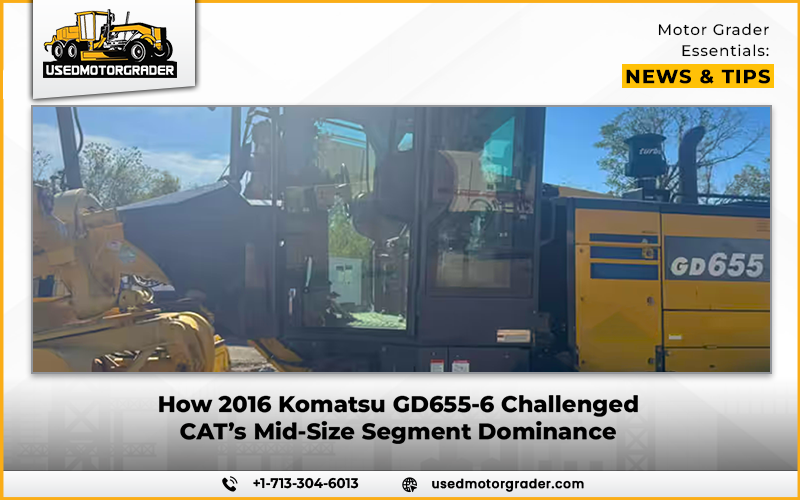
It was almost a certainty that, in the United States, the motor grader with the greatest workload on it wore the yellow and black of Caterpillar. The Cat 140 series was not a machine per se, but a part of the industry. It was trusted by contractors, known by operators, and the foundation of whole purchasing strategies by fleet managers. Next came a competitor that did not attempt to outmuscle Caterpillar’s legacy. Rather, it just quietly undermined it with something much more convincing: lower prices, smarter design, and an operator experience that earned them genuine respect on the job site. The 2016 Komatsu GD655-6 did not just compete with the Cat 140M. It forced the entire mid-size grader market to reconsider what value really looked like.
Caterpillar’s Grip On The Market
Caterpillar has established its dominance in the motor grader segment based on decades of dealer investment, brand loyalty, and resale confidence. Even as late as 2024, Caterpillar still controlled over 61 percent of all new financed motor grader models sold in the United States. Such a market share does not occur randomly. It was the result of an unsurpassed dealer network, a thorough familiarity with the operators, and the long-established reputation that Cat machines retained their value better than the competition. To contractors with large fleets, the ability to sell off older Cat equipment without incurring substantial depreciation losses was a financial benefit that was hard to overlook. Caterpillar machines are also known to have a very high resale value, but their spare parts and maintenance are also known to be very expensive compared to other competing brands.
This high-price structure, however, created a vacuum, and Komatsu was about to plug it.
How The GD655-6 Differed
The 2016 Komatsu GD655-6 was designed with a very simple concept: provide everything that a contractor really needs, at a lower cost to purchase and operate. The most notable aspect of the machine was its industry-exclusive dual-mode transmission, which was a torque converter with a direct-drive lockup clutch. When pushing material at lower speeds, the torque converter provides better tractive effort and fine control; at higher speeds, the transmission delivers high travel speeds and lower fuel consumption.
Fuel efficiency was among the most competitive advantages of the GD655-6. The Tier 4 Final powertrain reduced fuel consumption by up to 5% in power mode. Up to 15% in economy mode compared with the previous GD655-5 generation. To contractors operating machines on long shifts or on several projects, the savings accrued rapidly into significant annual cost savings.
The competitive advantages that the 2016 Komatsu GD655-6 added to the mid-size segment were:
- A dual-mode transmission with anti-stall technology that had no power loss during heavy pushing operations.
- Selectable Power and Economy settings that enabled operators to adjust engine output to the task demand, eliminating unnecessary fuel consumption.
- The largest wheelbase in its category, offering outstanding fine grading performance with a tight 24-foot, 3-inch turning radius to do road work and cul-de-sac operations.
Operator Comfort & Visibility
The cab design of the 2016 Komatsu GD655-6 was a response to a long-standing frustration with the conventional cab design of a grader: blocked sightlines. The hexagonal cab design has a smaller center section with large, clear door panels. This removes the traditional cab posts from the operator’s field of view. It also gives a direct view of the moldboard and front tires. To operators working long days on the finish grade work. This directly translated into fewer corrections, less fatigue, and shorter cycle times.
The comfort and productivity features that are standard on the GD655-6 include:
- An air-suspension seat that adjusted to the weight of the operator and damped the vibrations of the machine during long shifts.
- A 7-inch LCD to adjust machine settings, view fuel consumption data, and read diagnostic information.
- Standard equipment includes a rear-view camera mounted above the front windshield. The Equipment Management Monitoring System of Komatsu allows rapid troubleshooting and tracking of equipment maintenance.
Cost of Ownership & Simplicity Of Maintenance
In the overall cost of ownership, perhaps the best argument that Komatsu could have against Cat is the cost of ownership. The GD655-6 was supplied with free scheduled maintenance within the first three years or 2,000 hours. Two exchanges of diesel particulate filters were also covered during the first five years. The availability of ground-level fuel and DEF made daily servicing easier. The time and labor spent on routine maintenance checks were minimized.
The ownership and maintenance benefits that led to fleet diversification towards the GD655-6 were:
- Reduced acquisition price compared to similar Caterpillar models, minimizing initial capital exposure.
- Less complexity of service with available daily checkpoints and a simplified hydraulic system layout.
- Komatsu KOMTRAX remote monitoring system, which provides fleet managers with real-time data on equipment performance, fuel consumption, and service alerts.
From Dominance to Competition
The power of Caterpillar did not break under the pressure of the GD655-6. Its dealer network is still wider, its resale values are still higher, and familiarity with Cat controls by the operator still influences buying decisions in much of the country. The only difference was the purchasing pattern surrounding it. Contractors who previously purchased Cat exclusively started to construct mixed fleets. Retaining Cat machines in high-visibility projects where resale was important, and adding Komatsu units where operating cost and uptime efficiency were the bottom line. Komatsu was becoming an increasingly popular option among contractors who cared more about financial results than about brand loyalty. (ProfitDig)
The 2016 Komatsu GD655-6 failed to push Caterpillar out of the mid-size grader discussion. It merely established that the dialogue now consisted of more than one voice. Whether you are breaking ground on a highway or finishing a site grade, the right machine makes all the difference, and contractors worldwide trust Usedmotorgrader.com to find it. Shop top brands like CAT, John Deere, Komatsu, and Volvo, and put proven hydraulic performance to work on your next project today.
FAQs
1. Why is the 2016 Komatsu GD655-6 fuel-efficient?
A: It has a dual-mode transmission with Power and Economy modes. Which save up to 15 percent of fuel in economy mode over its predecessor.
2. What is the operating cost of the GD655-6 compared to the Cat 140M?
A: The GD655-6 generally has a lower acquisition price and lower fuel and maintenance costs. But the Cat 140M generally has a higher resale value.
3. Does the GD655-6 support grade control systems?
A: Yes. The machine is pre-set to install ripper and grade control systems, and is compatible with GPS and 3D grading technology.
4. Why do contractors continue to prefer Caterpillar over Komatsu?
A: Caterpillar has strengths in resale value, dealer coverage, and long-term operator familiarity, which continue to be significant considerations in many fleet purchasing decisions.
Tags: 2016 Komatsu GD655-6 For Sale, Komatsu Grader Price 2026, Komatsu Used Equipment