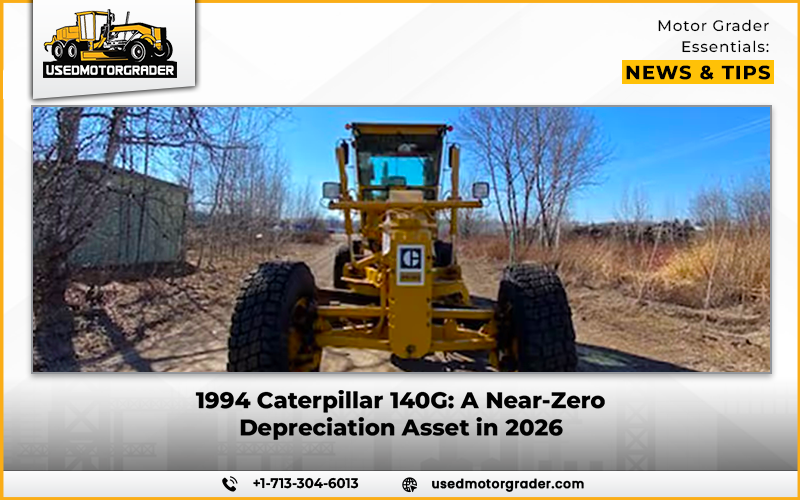
The value of most heavy equipment decreases as soon as it leaves the lot. The Caterpillar 140G is the exception. The 1994 Caterpillar 140G is over 30 years old, but still trades in the $40,000 to $55,000 price range at major auctions and dealer listings in 2026. It’s not just a coincidence. That’s a pattern, and it reveals what this grader really means in the current market.
A Platform Built to Last
Cat 140G came out during one of the most mechanically advanced periods in Caterpillar history. Caterpillar produced the model until around 1996, and the 1994 version represented the peak of its production run. Caterpillar powered the machine with the 6-cylinder 3306 turbocharged diesel engine, a proven powerplant that the company installed in dozens of machine types for more than 25 years. Mechanics and equipment owners still rebuild, resell, and source that engine worldwide. Replacement parts remain widely available worldwide.
The transmission, hydraulics, and frame are designed for field repair. No proprietary diagnostic dongles, no DEF systems, no emissions aftertreatment components to fail. With just a few tools and a parts manual, a mechanic in a remote location can diagnose and repair nearly anything that can go wrong with a 140G. Such simplicity does not get old; it gets better with age.
What “Near-Zero Depreciation” Actually Means
In heavy equipment markets, most machines depreciate at a high rate in the early years of their life, and then level off as they get older. A machine eventually reaches a depreciation floor, where the remaining value is no longer based on age, but on utility, scarcity, and rebuild potential, as buyers see it.
That’s the bottom of the 1994 Caterpillar 140G. According to auction data from sites such as Purple Wave and MachineryTrader, 140G units in 2024 and 2025 consistently sold between $40,700 and $50,600, a remarkably stable price over the past 11 years. This is not a normal characteristic of a machine this age.
If you’re looking to learn more about the reasons behind the value of certain motor graders beyond brand reputation, the 140G is the textbook example.
Why Buyers Still Pay Premium Prices for a 30-Year-Old Grader
Several factors have helped keep demand (and prices) steady:
Mechanical Advantages:
- Elimination of aftertreatment failures: No DPF, SCR, or DEF systems that can fail and cause expensive shutdowns.
- Highly rebuildable engine platform: The Cat 3306 remains one of the most popular diesel engines to be rebuilt on the planet.
- Serviceable mechanical transmission: Built with internal components that can be repaired at a known and reasonable price.
- Standardized hydraulic systems: Engineered to be serviced by any qualified technician without special electronic equipment.
Operational Advantages:
- Lower upfront capital layout: Reduced acquisition cost compared to a modern grader with no electronics-dependent downtime.
- Simplified diagnostic processes: Faster troubleshooting that is completely independent of third-party service diagnostics.
- Familiar operator interface: A method that is widely known by experienced operators to minimize training time and error risk.
Market Advantages:
- Strong global export demand: High demand for pre-emissions machines in Africa, Latin America, the Middle East, and Southeast Asia, where no regulatory restrictions apply.
- Continued government fleet reliance: Municipal and county road departments are still operating and rebuilding them for rural maintenance.
- Favorable ownership economics: A worldwide aftermarket parts supply that really makes ownership economics appealing.
This is precisely the type of equipment that small contractors return to year after year for their road construction needs, as it is durable and cost-effective.
The Emissions Factor Nobody Talks About Enough
The post-2010 emissions rules have established a two-tier equipment market without anyone knowing. Manufacturers equip today’s motor graders with Tier 4 Final engines that use complex aftertreatment systems. Those systems can fail in dusty or remote environments while costing as much as a clean used car to repair. The 140G’s pre-emissions architecture is not a burden for contractors who don’t have to deal with strict emissions controls. Or for export buyers shipping machines abroad. It’s a selling point.
That’s one of the reasons the Caterpillar 140G of 1994 has turned into a capital preservation machine for smaller fleet owners. You purchase it at a minimum price, run it profitably, and sell it years later for about the same amount you paid for it. Or more if you maintained it properly.
A Smarter Used Equipment Market in 2026
Demand for equipment has been rising since 2021 as infrastructure spending in the U.S. has increased. Putting pressure on the supply of reliable used iron and driving up prices on proven older platforms. With inflation, equipment shortages, and the higher cost of new machines, the need for older mechanical graders is even more compelling.
The 140G platform is consistently one of the most valuable used motor graders for sale in the USA, and it is a platform that is increasing in value. This sort of reputation is not a fluke.
The 1994 Caterpillar 140G is not simply old iron; it is a proven, dependable piece of equipment that has stood the test of time. When you are ready to put a machine like this to work, visit our website to browse available options. Including reliable motor graders from top brands like John Deere, Komatsu, and Volvo that companies build to handle demanding jobs while fitting real-world budgets.
FAQs
1. What is the typical 2026 resale price for a 1994 Caterpillar 140G?
A: At auction and through private dealers, well-maintained units sell for $40,000 to $55,000, depending on hours, condition, and configuration.
2. Why does the 1994 Caterpillar 140G hold its value so well?
A: Its simple operation, wide parts availability, global export demand, and proven Cat 3306 engine keep it useful, affordable to own, and consistently in demand.
3. Is the Cat 3306 engine still supported with parts?
A: Yes. Manufacturers produced the 3306 engine in massive numbers and installed it in a wide range of machines. This created a huge global supply of rebuilt engines and replacement parts.
4. How does the 140G compare to newer graders in operating cost?
A: Lower acquisition cost, no emissions system failures, simpler diagnostics, and lower insurance costs are the 140G’s advantages. While fuel efficiency and operator technology are superior in modern machines.
Tags: CAT 140G Maintenance Cost, Motor Grader Depreciation, Best Motor Graders 2026