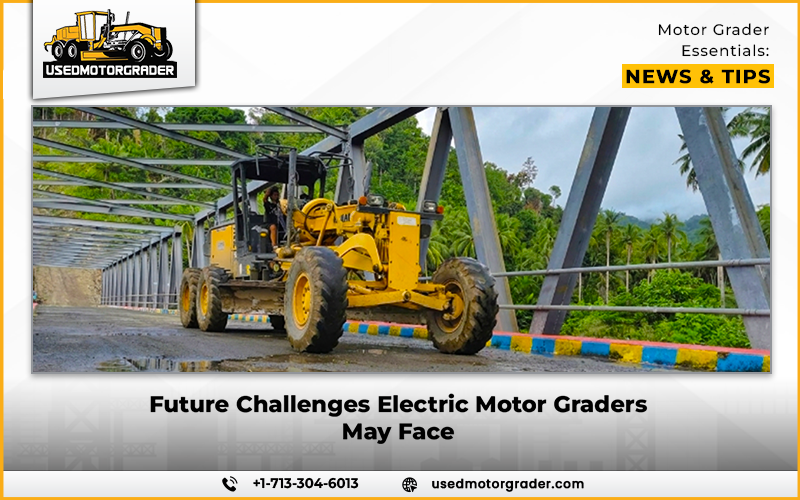
The building industry is undergoing a revolution. The reality of electric motor graders, however, is that the journey to complete electrification is far from smooth, a reality often glossed over in product brochures. Battery-powered machines are gaining significant momentum in the industry. Still, for anyone looking to buy a motor grader for sale today, it’s clear that diesel remains king, and it’s not without reason. What are the challenges that electric graders are going to encounter in the future? Let’s break it down.
The Battery Limitation Problem
Motor graders have no easy jobs. These machines operate long, hard shifts, continuously loading the blades, making deep cuts, and grading steep slopes. High-demand hydraulic operations deplete battery capacity faster than forecasted. A diesel grader can work a 10- to 12-hour day and then refuel and get back to work. Electric graders just can’t guarantee the same reliability when fully loaded currently, and power derating, which is when the machine automatically cuts back to preserve battery life, can happen at the most inconvenient time on a challenging site.
In various climates, thermal challenges exacerbate the problem:
- Cold Performance: Lithium-ion batteries lose effective capacity, charge more slowly, and consume power to maintain the pack at a functional temperature in freezing conditions.
- Heat Management: During hot desert conditions, battery cooling systems must operate at full capacity, making them more mechanically complex and potentially causing performance to drop during extended grading periods.
- Contamination: Thermal management components are exposed to extra contamination hazards at road construction and mining sites, which increase maintenance needs in the dusty environment.
These real fears are based on practical performance factors that any contractor thinking about buying a motor grader for sale should take into account before making the decision to purchase an electric grader.
The Charging Infrastructure Gap
When approaching a remote road construction site or a mining site, inquire about the location of the nearest charging station. Chances are, the answer won’t be reassuring. The majority of serious grading operations are located away from a reliable power grid, and many construction sites are temporary, making the installation of permanent charging stations impractical and costly.
The industry is working on solutions, but there are complications with each one:
- Mobile Chargers: High-capacity charging systems are beginning to appear on the mobile market, but they can be expensive and burdensome in the already complicated jobsite environment.
- Generator Backup: Charging from a generator reduces the emissions benefits of going electric in the first place, but it does keep machines running off the grid.
- Battery Swapping: Battery swapping is still in its infancy for these types of machines and is not yet ready for widespread use in heavy fleet operations.
While there are workarounds that can be implemented, charging downtime can never be as fast or convenient as diesel refueling. That’s a blow to shift planning, productivity, and project timelines, and it’s the smaller contractors who feel it the most.
Ownership Economics and Workforce Readiness
That’s where the electric grader argument gets really uncomfortable. Electric machines are much more expensive than diesel machines of similar specification. That initial expense is a real challenge for small and mid-sized contractors operating on a narrow profit margin. Then factor in the cost of battery replacement over the life of a machine, which is exposed to rough terrain, vibration, temperature extremes, and more, and the ownership equation quickly grows complex.
That’s why so many fleet managers are still choosing diesel for their motor grader for sale. The value proposition is difficult to beat: predictable maintenance, proven durability, and field repairs that an experienced mechanic can perform without specialized training. Unlike mechanical graders, electric graders present a whole new set of service challenges:
- Skill Shortage: High-voltage technicians qualified in heavy equipment are in short supply, and most field crews are not trained or equipped to do electric grader diagnostics safely.
- Network Gaps: Dealer service networks for electric heavy equipment are still being developed, and if a problem occurs on a remote site, the downtime could be long and expensive with no quick solution nearby.
- Digital Complexity: The increased use of diagnostic software and telematics systems introduces electronic complexity that can be a major weakness in extreme construction applications.
Hybrid Systems May Be the Smarter Bridge
With all these challenges, is it worth considering whether hybrid systems are more practical for transition technology? The industry response is becoming increasingly positive. Hybrid graders can be used without the need for charging infrastructure, provide meaningful fuel savings, significantly lower emissions, and operate reliably in the extreme conditions that test battery-only graders. Until full electric operation is feasible, they combine the best of both worlds in heavy grading applications.
This is already evident in the major manufacturers’ roadmaps. At the heavy end of the market, hybrid development is picking up pace faster than full electrification. The takeaway for anyone considering buying a motor grader for sale today is simple: fully electric graders are not ready to supplant diesel in challenging infrastructure, mining, and remote applications. There are significant gaps that need to be addressed in battery technology, charging infrastructure, and training the workforce for full electrification to be a viable option at scale.
FAQs
1. Can electric motor graders handle a full shift under heavy loads?
A: Not consistently yet. Under sustained, heavy grading, battery capacity is depleted more quickly than anticipated, and charging downtime negatively impacts productivity in a manner that diesel refueling does not.
2. Which jobsite conditions are the best fit for electric graders?
A: Light municipal maintenance, urban low-emission zones, and short shift regulated environments are best. The problem of remote sites, mining operations, and all-day heavy grading is still far more difficult.
3. Are hybrid graders likely to become more popular than fully electric ones?
A: In demanding applications, it is very likely. Hybrids reduce the infrastructure costs of full electrification but still provide genuine efficiency and emissions benefits where it matters without range anxiety.
4. What’s the biggest barrier to electric grader adoption right now?
A: Contractors and fleet managers cite high purchase prices, restricted access to remote charging, extreme weather performance issues, and a lack of trained service technicians as the top concerns.
Tags: Future Motor Graders, Best Motor Graders 2026, Certified Used Motor Graders USA