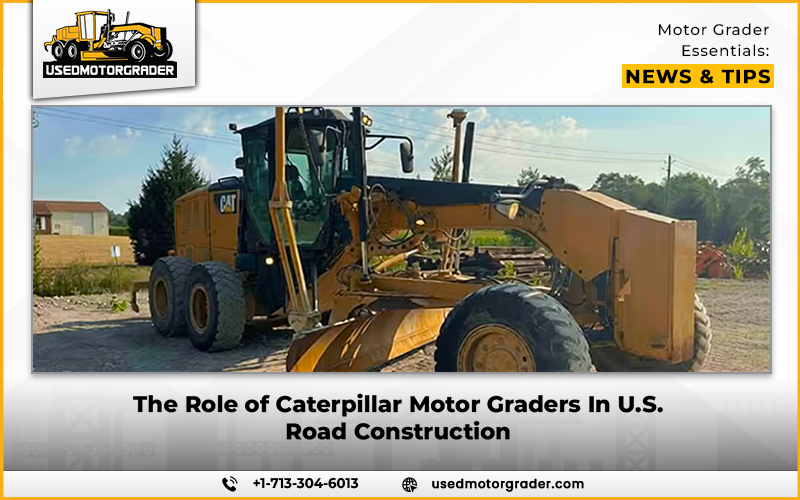
A machine that almost no one outside the construction industry can recognize by sight, but without which, virtually every road, highway, airport runway, and county lane in the United States would not exist in its present form. It moves slowly. It doesn’t sound like a drama. The motor grader, however, and, in particular, the Caterpillar motor grader, is perhaps the most significant piece of rolling iron in the history of American infrastructure. Whether it’s the dirt farm roads of the 1930s or the laser-guided, GPS-equipped asphalt roads of the 2020s, the Cat logo has been the focal point of all the action. Cat graders are not only equipment; they are an institution for contractors, fleet managers, county road departments, and operators who have spent their careers behind the blade.
This article looks at the history of this institution, its continued survival, and its future direction. It also details why the secondary market for Used Motor Graders For Sale In USA is among the most active and competitive in the entire heavy equipment resale market.
A Machine Born from Mud and Ambition: The Historical Roots
The tale of Caterpillar’s motor grader dominance doesn’t start in a boardroom; it starts with an acquisition that most industry outsiders have never heard of, in 1928.
Road grading in the early 1900s was accomplished by horse-drawn equipment and subsequently by primitive self-propelled machines, which were little more than an engine mounted on a frame with a blade beneath.
Among the early pioneers of motorized grading equipment was Russell Grader Manufacturing Company of Minneapolis, which was acquired by Caterpillar in 1928, not only for its product line, but for its philosophy of precision earthmoving.
Caterpillar’s first specific motor grader, the Auto Patrol, was introduced nearly as soon as the Russell acquisition was made, and the pattern was set for the category for decades. It was constructed to be rebuilt, not thrown away, and had a dealer network that was, even then, unmatched in the industry.
The timing was almost perfect. In just 10 years, the United States began the largest road construction project in history.
The Highway Building Boom and Cat’s Central Role
In 1956, the Federal Aid Highway Act was passed, creating the Interstate Highway System: 41,000 miles of controlled-access highways that linked all major American cities. The next twenty-five years saw a sustained investment in infrastructure on an unprecedented scale, changing the face of the nation. Motor graders were used at all phases: clearing right-of-way, shaping subgrade, providing drainage slopes, cutting ditches, and fine grading to ensure pavement would not heave or hold.
A large part of the machinery that did that work was provided by Caterpillar. In the 1960s and 1970s, the 12-series and early 14-series graders were adopted as standard equipment on large highway projects. Contractors chose Cat for a simple reason: The machines worked, parts were delivered quickly, and when a contractor’s grader broke down on a federal highway project with penalties looming on the schedule, “the dealer had a guy there in four hours,” something contractors rarely said about their competitors.
Another huge demand driver was added after WWII with the rural development. All-weather roads were introduced to farm communities in the Midwest, South, and Plains states through USDA rural road programs. One of Cat’s most loyal customer groups was the county road departments, which in many states are responsible for maintaining more lane-miles than the state DOT. Many of those departments purchased Cat graders in the 1970s and 1980s and continued to operate the same machines, well rebuilt, well into the 2000s. That’s why High-Quality Used Graders for Sale has always been strong with Cat iron as the core of the market.
Why Cat Became the Standard: The Pillars of Dominance
Caterpillar’s grader dominance was not a coincidence and was not just a marketing ploy. It was won by a blend of machine qualities and support that opponents rarely were able to duplicate at the same time.
Machine Quality
Cat graders’ main case has always begun with the blade work. Those who have used more than one brand have all reported that Cat machines are more predictable under load, the hydraulics react smoothly, the moldboard stays at the correct angle when the ground changes, and the circle drive (the mechanism that rotates the blade) is precise and doesn’t develop the slop that cheaper machines do over time.
Contractors and fleet managers often mention the following key machine-quality factors:
- Strong drive and drawbar to resist lateral deflection during heavy cutting passes.
- Architecture of a hydraulic system with a higher flow capacity, which allows for quicker response of blades
- Transmission designs (the 16-speed powershift that debuted in the H-series machines became legendary) that allowed operators to remain in the power band by shifting gears.
- High tensile steel frame with articulated geometry designed for stability, not flexibility.
- Ergonomics and visibility that decrease the fatigue of the operator during extended periods of use.
Rebuild Economics
Rebuild economics was the most important factor in determining Cat’s position in fleet purchasing. A Cat 140H bought new in 1998 could be rebuilt, engine, transmission, circle, hydraulics, blade, for about 40 to 50 percent of the new-machine price and be back in service with another 15,000 hours of life. That math was good for contractors. It was even more effective for county road departments that had to do more with less, with little or no authority to spend capital funds.
Cat’s standardized component architecture fostered the rebuild ecosystem. Reman programs at Caterpillar dealers enabled worn parts to be replaced with factory-rebuilt parts that offered new machine warranties, without the uncertainty of local rebuilds. This led to a machine population that was very slowly aging in terms of usefulness, but was very heavily aging in terms of calendar age.
Dealer Network
By almost any standard, Caterpillar’s dealer network is the most extensive in the business. A Cat customer in rural Montana or coastal Georgia has about the same access to parts, service technicians, and application support as a customer in the heart of the state. Caterpillar’s competitors haven’t been able to match that level of support. In some areas, Komatsu’s network is strong. Volvo and CASE have good dealerships in their home markets. Historically, though, Cat has enjoyed national uniformity on all geographies and all machine types.
What Graders Actually Do: The Technical Reality
To know the importance of caterpillar graders to American infrastructure, one must know what motor graders do that no other machine does.
Road Base Shaping and Crown Formation
The process of shaping and forming a road base.
One of the most important operations of a motor grader on a highway project is to determine the exact cross-section of the road base before paving. The crown, or slight convexity from edge to centerline, dictates the way the finished road surface drains. Too little crown and water pools, too much, and lanes feel unstable. This geometry is cut into the base material to tolerances of hundredths of a foot by a grader blade controlled by a skilled hand (or now, GPS automation).
Drainage and Ditch Work
Motor graders are used almost exclusively to cut and maintain roadside ditches that remove stormwater from the pavement. The blade can angle horizontally and vertically, and can be positioned outboard of the machine’s wheel track, allowing operators to cut precise ditch profiles that a bulldozer or excavator can’t do as efficiently.
Gravel Road Maintenance
An estimated 1.36 million miles of unpaved roads exist in the United States, the large majority of them in rural counties. These roads need to be bladed periodically, which is the process of redistributing the gravel that has moved to the shoulders back towards the center of the road and smoothing out the washboard. This is done by cat graders in practically every county in the country.
Subgrade Preparation and Finish Grading
The subgrade should be graded and cross-sectioned before any paving work is done. This is good work, and it’s where the distinction between an average grader and a great one is most evident. Cat machines, especially the newer M-series and Next Gen machines with cross-slope automation, consistently maintain tighter tolerances than the operator can do on his own.
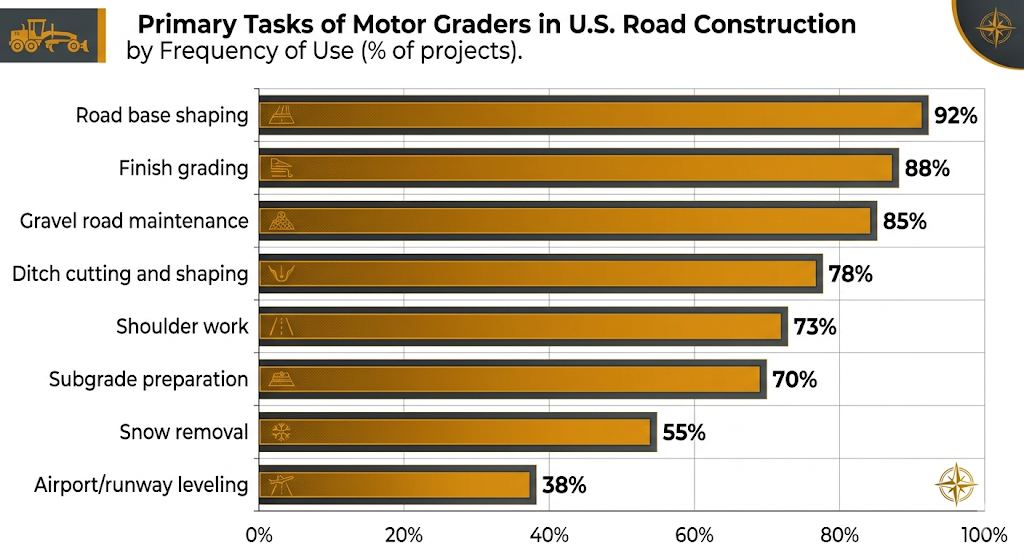
This chart illustrates the distribution of motor grader applications across U.S. infrastructure projects, with base shaping and finish grading leading all use categories. The breadth of applications explains why Used Motor Graders For Sale In USA remain in consistent demand across all market cycles.
Influential Models That Defined an Era
Cat graders aren’t all the same in the eyes of the contractor. Some models became legendary beyond the standard of equipment loyalty, and knowing about those models is a lot of the reason for Cat’s enduring market success.
The Cat 140H: The Machine That Set the Standard
The 140H was introduced in the mid-1990s and was the benchmark Cat grader for many years. It featured a streamlined version of the 16-speed powershift transmission, better hydraulics, a larger cab, and, as operators put it, a “confidence-inspiring” weight-to-capacity ratio. The 140H was the standard for the rest of the late ’90s and 2000s.
The 140H is in a strange place in the equipment market today. Twenty-five to thirty-year-old machines are still selling at auction for $50,000 to $85,000, and in some cases, even more than six figures. Many contractors are interested in purchasing High-Quality Used Graders for Sale that are not equipped with electronics.
The 140M and 140M3: The Electronic Transition
The M-series was Caterpillar’s breakthrough into electronic controls and telematics. The 140M was introduced around 2007, and featured joystick steering, a new cab platform, and the beginnings of Cat’s Grade technology integration. The 140M3 also featured additional enhancements to the automated cross-slope system and fuel economy.
These machines divided the industry in a way that the H-series never did. The reduced fatigue in joystick controls was welcomed by experienced operators. Older operators and fleet managers expressed concerns over the complexity of electronic components, the maintenance of the emissions system, and the cost of emissions system failures. The balance between capability and complexity is one of the key issues in the grader market today.
The Cat 12 Series: The Workhorse
The 12-series falls into the middle size segment, which is the highest volume size for most contractors’ fleets. The Cat 12 is rated at approximately 185 hp and 14-foot moldboard and is suitable for municipal street maintenance, smaller highway projects, and rural county road work. The 12H was a staple in county road department fleets from the mid-1990s to the 2010s, and the 12M and current 12 are no exception.
The 160 Series: Large Projects and Mining
The 160-series is the top of Cat’s conventional grader line, designed for large-scale highway construction, mine haul road maintenance, and airport grading. The 160 is available in moldboards up to 24 feet and horsepower ratings of more than 300 in some models, which puts it in a performance range where cost premiums are justified.
Market Share, Resale Value, and the Auction Floor
The best way to see how strong Caterpillar’s grader market share is isn’t a factory-supplied number; it’s what happens on the auction floor at Ritchie Bros. and IronPlanet, where sentiment is not a factor, and equipment is sold based on what the buyer is willing to pay.
Cat graders have a higher residual value retention compared to other brands. Cat graders have been ranked in the top three in the motor grader category by data from the EquipmentWatch residual value rankings for several years. The premium is not marginal; it is usually 10 to 25 percent higher than similar-hour, similar-age machines from other manufacturers, and higher for machines more than 10 years old.
Estimated Auction Resale Value Comparison: Motor Graders by Brand (2024 Averages)
| Brand | 5-Year-Old Machine (Avg. Resale) | 10-Year-Old Machine (Avg. Resale) | 15-Year-Old Machine (Avg. Resale) | Residual Value Index vs. New |
| Caterpillar | $185,000–$240,000 | $95,000–$145,000 | $55,000–$90,000 | 58–72% |
| John Deere | $155,000–$205,000 | $78,000–$118,000 | $42,000–$72,000 | 50–65% |
| Komatsu | $140,000–$195,000 | $72,000–$110,000 | $38,000–$65,000 | 46–60% |
| Volvo | $125,000–$175,000 | $65,000–$100,000 | $32,000–$58,000 | 42–55% |
| CASE | $110,000–$160,000 | $58,000–$90,000 | $28,000–$50,000 | 38–50% |
This resale premium is a vicious circle. When it comes time to liquidate, redeploy capital, or upgrade, contractors who purchase Cat graders know that their Cat will bring more money. That confidence affects the initial purchase, which helps to keep Cat’s market share, which helps to keep parts and dealer investment, which helps to keep the resale premium. Competitors have known this for years, but they have been unable to get a foothold in the market because they need to fill the gap in the support infrastructure before they can fill the gap in the residual value. And that infrastructure took Cat generations to develop.
This dynamic translates to Cat Iron being the most active on many platforms. auctions for buyers actively looking for Used Motor Graders For Sale In USA. Caterpillar High Quality Used Graders For Sale are a disproportionate percentage of actively traded graders in each size class.
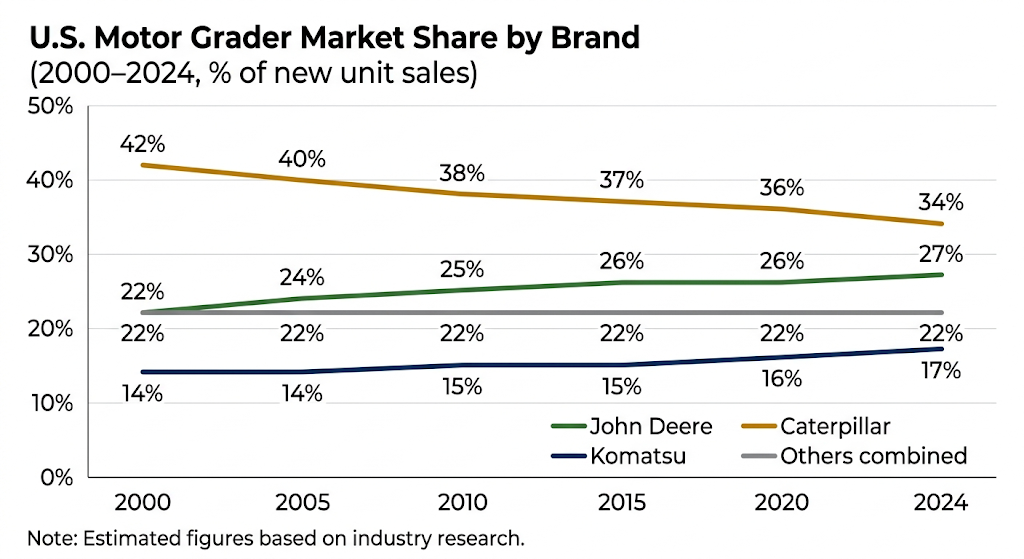
While Caterpillar’s market share percentage has gradually compressed as competition intensified, the brand has retained clear plurality leadership across all measured periods. The sustained demand for Used Motor Graders For Sale In USA follows this distribution, with Cat iron dominating secondary market volume.
Caterpillar Motor Grader Model Evolution: Key Technical Milestones
| Era | Key Model(s) | Horsepower Range | Notable Technology | Infrastructure Context |
| 1930s–1950s | Auto Patrol, No. 12 | 40–100 HP | Mechanical levers, basic hydraulics | Rural road development, early highway programs |
| 1960s–1970s | 12E, 14E, 16 | 100–200 HP | Improved hydraulics, torque converter | Interstate Highway System expansion |
| 1980s–1990s | 120G, 140G, 160G | 130–275 HP | Full powershift, enclosed ROPS cab | Urban infrastructure, resurfacing programs |
| 1993–2007 | 120H, 140H, 160H | 145–275 HP | 16-speed transmission, Cat Monitoring System | Highway rehabilitation boom |
| 2007–2016 | 120M, 140M, 160M | 155–300 HP | Joystick steering, Cat Grade cross-slope, telematics | Post-recession infrastructure investment |
| 2016–present | 120, 140, 160 (Next Gen) | 174–354 HP | Full 2D/3D GPS integration, Cat MineStar, semi-auto blade | Infrastructure Investment and Jobs Act projects |
Technology Evolution: From Levers to Laser Precision
One of the most interesting engineering stories in the construction equipment industry is the evolution of Cat grader technology over the past 90 years. It goes from mechanical systems that need the operator to be extremely skilled to semi-autonomous systems that use GPS to guide the blade with precision.
The Mechanical Era
Early Cat graders had to operate a confusing array of mechanical levers at the same time as they steered and controlled ground speed, blade angle, blade tilt, circle rotation, and wheel lean for each wheel. The skill of the grader operators was a premium and was in short supply. A competent grader operator might feel the ground action and react to it before the grade deviation is reflected in the finished surface.
The H-Series: Power and Reliability
The H-series machines of the 1990s and early 2000s were the culmination of pre-electronic grader technology. The 16-speed powershift transmission provided operators with fine control of ground speed in relation to blade load. Better hydraulic circuits made the blade response more linear. The machines were more powerful and heavier than previous models and could cut harder materials and maintain grades in challenging terrain. The 140H in particular was so popular on U.S. highway projects that it became the benchmark for the whole class.
Cat Grade Technology and GPS Integration
The move to electronic controls started in earnest with the M-series and has been stepped up in the current Next Gen line. Cat Grade technology includes several integrated systems:
- Automation of the cross slope that keeps the blade at a programmed angle and requires no constant operator correction.
- Optimization of blade load to avoid stalling in variable ground conditions by adjusting hydraulic pressure.
- Trimble, Topcon, and Cat’s own AccuGrade 2D and 3D GPS grade control systems integration
- Cab display systems that provide real-time cut/fill relative to design grade
The benefits of productivity have been substantial. Research conducted by equipment manufacturers and independent sources has shown that GPS-guided graders can achieve final grade tolerances in fewer passes than conventional graders, which can save fuel, blade wear, and project time. In big highway projects where grading is a significant cost line, those efficiencies are directly competitive advantages.
Telematics and Fleet Management
Fleet managers can remotely track machine health, location, utilization hours, and fault codes with Cat’s VisionLink and Product Link telematics systems. This visibility has revolutionized maintenance planning for large contractors that operate many machines at many job sites. Predictive maintenance alerts warn of a component that is operating at a higher temperature or pressure than normal, before it fails, which can save expensive emergency repairs and schedule disruptions.
Regional Importance: How Geography Shapes Grader Markets
The use of cat graders is highly variable across regions, depending on the terrain, climate, nature of the road network, and infrastructure spending priorities.
Texas and the Southwest
Texas has the largest state highway system in the nation by lane-miles, and the Texas Department of Transportation has long been one of the biggest consumers of motor graders in public fleet operations. Sustained grader demand is the result of the combination of extreme heat, caliche soil conditions, and the sheer number of rural road networks. Texas has long been one of Cat’s most loyal large-fleet customers, with private highway contractors leading the way.
Midwest and Plains States
The agricultural Midwest is motor grader country in the truest sense. Iowa, Illinois, Kansas, Nebraska, and the Dakotas have hundreds of thousands of miles of gravel roads that need to be bladed seasonally by their county road departments. Many of these counties have been using Cat graders for decades, with older machines being used for most routine maintenance and newer machines being used for reconstruction projects. This area has a strong year-round market for High-Quality Used Graders for Sale, with counties replacing older machines and smaller private contractors buying up used machines.
Western Mining and Infrastructure
Motor graders are a critical piece of equipment for haul road maintenance in Nevada, Wyoming, Montana, and the Southwest. A 400-ton truck haul road should be maintained to exacting cross-section and surface smoothness requirements; the costs of tire wear, fuel usage, and vehicle damage are far greater than the cost of the grader. In most mining fleets, the Cat 160 and 18M3 series of graders are standard.
Snow Belt Municipal Operations
In northern states, motor graders are used twice as snow removal equipment, cutting windrows from rural roads and keeping access roads open that would otherwise be impassable. The most popular machine for this application is the Cat 140 series, which is usually fitted with a snow wing at the front and a push plate. Cat graders have been a part of the fleet history in Minnesota, Wisconsin, Michigan, and New York municipalities and counties for winter operations.
The Infrastructure Investment and Jobs Act: A Demand Catalyst
The Infrastructure Investment and Jobs Act (IIJA) of November 2021, which allocates $1.2 trillion in total spending, $550 billion of which is in new infrastructure investment, has generated the largest sustained demand rise for road construction equipment in a generation. The total for highway and bridge funding was $110 billion over five years, and the money was channeled through state DOTs to highway contractors throughout the country.
The effect on the demand for graders, new and used, has been significant. Equipment distributors said they were seeing longer lead times for new Cat graders, even in 2022 and 2023, due to manufacturing lagging behind orders. The spillover effect on the used market was immediate: prices for Used Motor Graders For Sale In USA jumped significantly as contractors, unable to find new machines, scrambled to secure used machines. The prices for well-maintained Cat machines, especially those with documented service histories, were comparable to those of 10 years ago on the same machines.
The IIJA funding pipeline continues through 2026, with continued high demand for grading equipment during this period. The act is the main reason that many highway contractors have been able to increase their fleets beyond mere replacement of worn equipment.
Impact of IIJA on Motor Grader Demand: Selected Indicators (2021–2026)
| Indicator | Pre-IIJA (2019–2021 Avg.) | Post-IIJA (2022–2024 Avg.) | Change |
| New Cat Grader Lead Time (weeks) | 8–14 weeks | 28–52 weeks | +250–370% |
| Used Cat Grader Avg. Auction Price (140M class) | $115,000 | $148,000 | +29% |
| Used Cat Grader Avg. Auction Price (140H class) | $58,000 | $75,000 | +29% |
| Highway Contractor New Equipment Orders (YoY) | +3–5% | +18–24% | +13–19 pts |
| State DOT Grader Fleet Expansion (approx. units) | Flat | +8–12% | +8–12% |
| Secondary Market Listing Volume (USA) | ~3,200/quarter | ~4,800/quarter | +50% |
Challenges & Honest Criticisms
It is important to take into account the legitimate complaints that contractors and operators have about Caterpillar graders, especially newer models, when evaluating the company’s dominance in the market.
Ownership Cost and Parts Pricing
Cat OEM parts are always more expensive than aftermarket parts, and more expensive than some competitors’ equivalent parts. A Cat dealer will charge more for a circle drive gear set, a set of blade cutting edges, or a hydraulic cylinder seal kit than an aftermarket supplier. Often, fleet managers calculate the life cycle cost of a Cat machine and a well-supported competitor and find that the gap is closing in recent years.
Electronic Complexity
The transition to electronic controls has brought with it a lot of new technology capabilities, but it has also added failure modes that the older H-series machines didn’t have. Specialized diagnostic equipment and trained technicians are needed for DEF systems, NOx sensors, DPF regeneration cycles, and electronic throttle and transmission controls. In a remote location or when time is of the essence on a project, a mechanical problem could turn into a multi-day machine downtime.
Emissions System Concerns
Tier 4 Final emissions compliance, which began for new machines in 2014-2015 based on horsepower, brought new maintenance needs and reliability issues with aftertreatment systems. Low load operation, DEF quality problems, and regen cycle management during continuous duty grading operations have been reported as pain points. Contractors looking to avoid these complications are the most active market for High-Quality Used Graders for Sale.
Dealer Dependency
Cat’s dealer network is its biggest selling point and its biggest market power, and it is one that some contractors don’t like. If the owner needs to have a major repair done by a Cat dealer for authorized programming or certified parts, the owner’s negotiating power is limited. In many parts, aftermarket parts can compete with the original parts, but in others, where proprietary software is used, it is not possible.
Yet, these criticisms are not stopping the market from voting with its dollars. Yellow machines are still in great supply on the auction floor, in the dealer lots, and in the county road department garages of America.
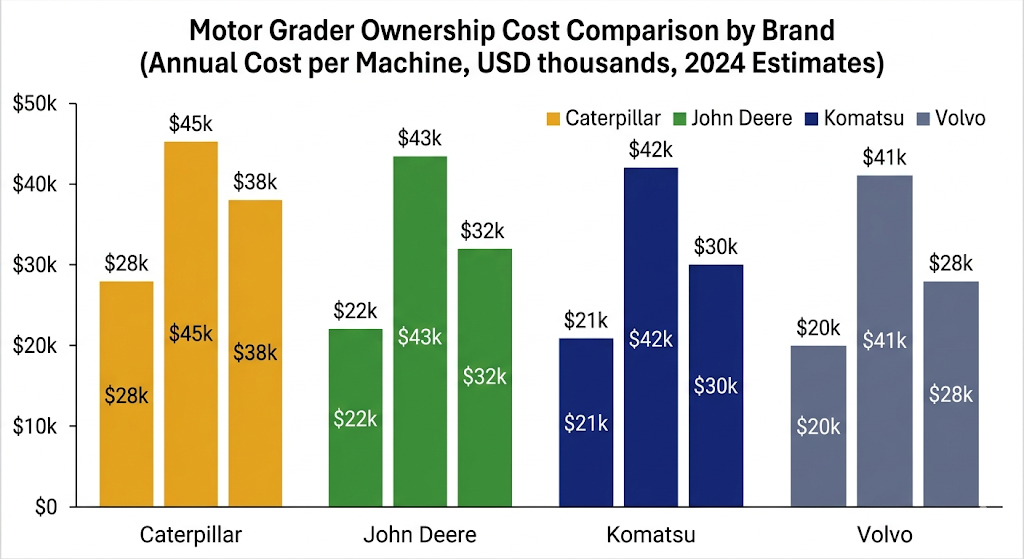
Caterpillar’s higher ownership cost is partially offset by superior residual value and reduced downtime, but the gap in parts and maintenance cost is real and acknowledged by Cat’s most loyal customers. Buyers exploring Used Motor Graders For Sale In USA should factor the total lifecycle cost into their analysis, not just the acquisition price.
The Secondary Market: Where Loyalty Gets Tested
For each contractor purchasing a new Cat grader, there are several people looking at Used Motor Graders For Sale In USA, considering the price of the purchase versus the condition, service history, generation of technology, and long-term support. The secondary market for Cat graders is massive, and it shows the brand’s virtues and its conflicts.
When purchasing a used Cat grader, there are several factors to take into account:
- The H-series machines (120H, 140H, 160H) are mechanically simple, have known rebuild costs, and have known service intervals. They are the preferred choice of buyers who want High-Quality Used Graders for Sale without electronic complexity.
- M-series machines provide additional technology, but buyers must be careful when evaluating the condition of the electronic components, emissions systems, and DEF infrastructure.
- Newer calendar year machines are coming to the used market, but may have more financing balances and need dealer diagnostics for fault resolution.
- Documentation matters enormously. A Cat machine that has full service records from a dealer or verified owner will be priced accordingly, and will get that price. 12,000+ hours with unknown service history is a big risk.
The number of High-Quality Used Graders for Sale has never been higher, as a result of upgrades to the fleet funded by the IIJA, contractor consolidations, and the natural replacement cycles of large contractor and municipal fleets. If you know what to look for, the market is a good place to buy.
The Future: Automation, Electrification, and Cat’s Next Chapter
Caterpillar’s technology roadmap for graders is a reflection of the overall construction equipment industry trends, and also a focus on technology that the grader platform provides in a way that is unique to the grader.
Semi-Autonomous and Autonomous Grading
A system called Cat’s Command for Grading system was introduced into commercial testing in recent years that enables a grader to follow GPS-guided cut commands with little operator input, letting the operator monitor and intervene when conditions call for human judgment. The system is being rolled out slowly, in part because grading is a complex terrain-reading job that benefits from experience and in part. After all, union and labor agreements in many markets demand an operator in the cab. However, the path of technology is evident.
Electric and Hybrid Powertrains
Caterpillar has announced roadmaps for the electrification of several equipment categories. Unlike lighter equipment, motor graders have practical challenges to full electrification due to their relatively high continuous-duty power needs and limited charging infrastructure on job sites. In the grader segment, hybrid configurations (diesel + electric drive on the wheel motors) are more near-term realistic. The trials are closely watched by contractors and fleet managers at Caterpillar.
AI-Assisted Grade Management
The next step up from rule-based GPS guidance is machine learning algorithms that learn from the experience of the operator and apply those patterns automatically when using the grader blade. Systems that can predict material changes, adaptively adjust cut depth, and optimise pass patterns for efficiency are true productivity gains. This is a significant investment by Cat and will put the company in a strong position for the next 10 years of infrastructure projects.
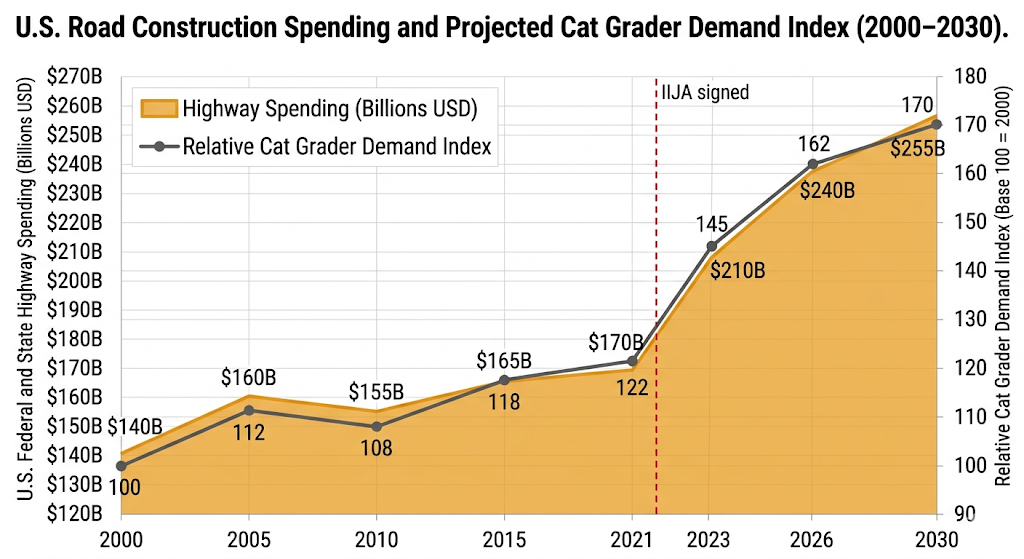
Infrastructure investment directly drives grader demand, and the IIJA’s sustained funding pipeline projects elevated demand through the late 2020s. For buyers and sellers of Used Motor Graders For Sale In USA, this demand environment supports continued strong pricing for well-maintained Cat iron through at least 2026.
Contractor, Operator, and Municipal Fleet Perspectives
The best way to judge Cat graders is not by spec sheets or auction data, it’s from those who operate them for a living.
The support network is the key differentiator for highway contractors who use Cat graders on a large scale, as they often say. The response time of the dealer to a machine that’s down on a paving job with a $50,000 per day liquidated damages provision is more important than the cost of the original machine. The parts in stock, the trained technicians available, and the customer service priority placed on the large fleet customers have won the loyalty of CAT that no competitor can match in terms of full price.
Midwest county road superintendents frequently refer to their Cat graders almost as if they were personal friends. Twenty or thirty-year-old machines that have been rebuilt many times over the years by the same mechanics and used by the same group of operators are well known. The case for switching brands isn’t only about the economics; it’s also about institutional memory and comfort.
Operators often say that they prefer Cat because of visibility and blade feel. The cab position on Cat graders is engineered to provide a clear view of the blade’s leading edge and the bottom of the ditch, which directly impacts the quality of work. The joystick controls on existing machines minimize operator fatigue, especially as the workforce ages and experienced grader operators are becoming scarce.
Conclusion: The Yellow Standard
Caterpillar motor graders are the most prevalent machine in American road construction by nearly any measure, market share, resale value, and contractor preference. It’s a dominance that was achieved over the years with consistent machine quality, unprecedented investment in the dealer network, and a recognition that an infrastructure contractor isn’t just buying machines, they’re buying the confidence that the machines will perform when they need them.
It has come a long way from the mechanical Auto Patrol to the GPS-guided Next Gen 140. The problems in the industry, high ownership costs, electronic complexity, competition from Asia, and lack of labor, are very real and will influence the future of the industry. However, the pipeline of infrastructure needs that has been fueled by the IIJA and supported by the fundamental need of America’s roads to be built and maintained is still generating the environment in which Cat graders flourish.
Whether you are looking for Used Motor Graders For Sale In USA or considering a High-Quality Used Graders For Sale for fleet additions or project use, the advantages of Cat iron are clear: It works, it’s supported, and it’s resold. That mix has been America’s road-maker for almost a century, and it looks like it’s not going away anytime soon.
FAQs
1. What makes Cat graders more expensive than competing brands, and is the premium justified?
A: The premium is derived from several sources: higher specification components, a more costly dealer support system, and the brand equity accumulated over decades. It is debatable whether it is justified or not, depending on the application. The premium usually pays off for contractors who are operating in remote locations, pushing machines to their limits, or depending on quick dealer response to keep on track. If the application is not as demanding, and the cost of parts is more important than downtime, the premium is more difficult to justify.
2. Why do older Cat graders like the 140H still sell for so much money?
A: The mechanical simplicity, proven durability, and the well-established parts and rebuild service network make the 140H a long-lasting value. When buyers are looking for high-quality used graders for Sale that they don’t want to be bogged down with electronic complexity, they are always looking for H-series graders, which keeps prices higher than the pure depreciation curves would indicate.
3. How has the Infrastructure Investment and Jobs Act affected the used grader market?
A: The IIJA spurred a tremendous surge in demand for all road construction equipment, including motor graders. Machine lead times were extended to almost a year at peak, forcing contractors to turn to the used market and driving up Used Motor Graders For Sale In USA prices in all age groups. The price of used Cat graders increased by 25–35 percent from 2021 to 2024 and started to level off because of the better availability of new machines.
4. Will autonomous graders replace traditional operator – driven machines?
A: Not completely, not in the near future. Autonomous and semi-autonomous technology will decrease the amount of skill needed for routine grading tasks and increase the consistency of large, well-defined projects. However, the complexity and variability of real-world grading – irregular terrain, buried obstructions, unpredictable material changes, intricate ditch geometry – will ensure that skilled operators will remain in the cab for the foreseeable future. The technology is not meant to replace the operator, but to enhance his/her skills.
Tags: Heavy Road Construction Grader, Motor Grader For Road Construction, Used Caterpillar Graders