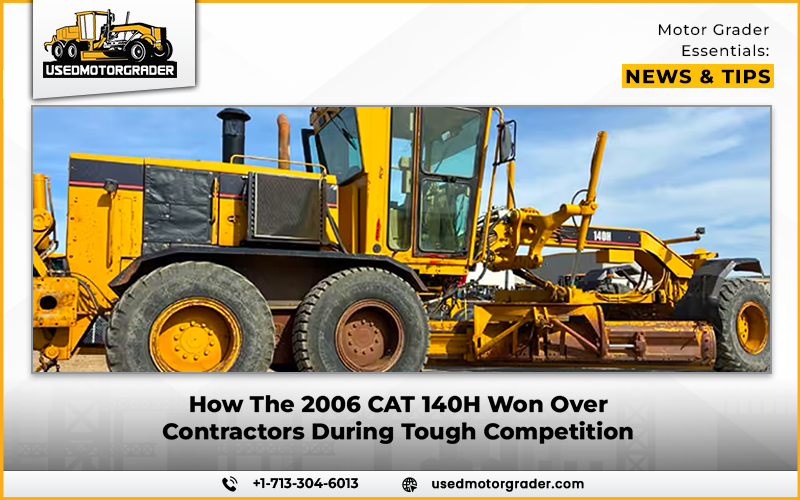
There is a machine that contractors still search for by name, not because it is the latest or the most technologically advanced, but because once you have used one, you never forget it. The 2006 Caterpillar 140H motor grader is that machine. Twenty years later, auction houses still sell it, contractors still use it on job sites around the world, and many operators still regard it as the standard against which they measure all other machines. This sort of loyalty is not a coincidence.
The Market It Had to Fight Through
Caterpillar’s days as a motor grader manufacturer weren’t easy in the mid-2000s. John Deere was marketing aggressively, offering better operator comfort and competitive pricing. Komatsu had established a good reputation in the mining and heavy construction sectors for its hydraulic strength. Volvo was talking about cabin ergonomics and safety. Both Champion and CASE were reaching cost-conscious municipal buyers. But on top of that, international manufacturers were beginning to penetrate some markets with low-cost options.
Demand was high during that period of the world’s construction boom, but so were contractors’ expectations. Buyers had more information, more options, and more financing choices than ever before. In that environment, manufacturers had to earn customer loyalty day by day on the job site.
What Contractors Actually Cared About
The 2006 Caterpillar 140H failed to win hearts with its paper specs. It was a day-by-day effort that led to real money saved and real deadlines met, and it won that loyalty.
These are the reasons for contractors to return:
- Mechanical simplicity that allows field mechanics to actually work on it without a laptop full of diagnostic software.
- The Cat 3176 and 3306 powerplants were already proven workhorses before the introduction of the H-Series, and they have delivered long engine life.
- A load-sensing hydraulic system that provided smooth and responsive blade control without unnecessary fuel consumption from excess pressure.
- The performance and reliability of the Powershift transmission enabled operators to shift with confidence and consistency when operating under load.
- High structural durability that endured through many thousands of hours in the frame, circle drive, and articulation joints.
Engineering That Held Up Where It Counted
The 140H’s output was between 165 and 185 horsepower, depending on the model, with the VHP Plus variant offering more power in higher gears for road use. The power-to-weight ratio was ideal for a variety of uses, including rough-cut road work, site preparation, precision finish grading, and municipal maintenance. The machine didn’t feel like it was being pushed at either end of the job spectrum.
The hydraulic system is a special highlight. Operators commented on the blade responsiveness, which was a constant feature, particularly in comparison to other blades that had hydraulic lag or inconsistent float in transition from hard surface to dirt. The Cat responded immediately, which was very important for productivity and finish quality.
The Sweet Spot Before Electronics Got Complicated
One of the biggest things that the 2006 Caterpillar 140H had going for it was what it didn’t have. It hit the market at a time before Tier 4 emissions regulations and the proliferation of ECM-driven control systems started to introduce electronic complexity that field mechanics were unable to resolve without the use of specialized tools and software. Manufacturers designed the H-Series machines with electronic controls to improve efficiency and modernization, while still keeping them mechanically straightforward enough for skilled technicians to diagnose and repair most problems on-site with standard tools.
This is a practical issue. Downtime is money. A field mechanic can fix it on-site, rather than sending it back to the dealer for electronic diagnostics every time something goes wrong. This hands-on fixability was a key element of the 140H’s reputation, especially in developing markets and remote job sites where dealer support was not always available.
Caterpillar’s Dealer Network Closed the Deal
The machine itself was great, but so was the support system that Caterpillar had around the machine. During this time, Cat’s worldwide dealer network enjoyed a competitive edge over almost all other parts logistics competitors. Cat dealers had the advantage if a component had to be obtained in a remote area in a hurry. Rebuild programs, availability of field technicians, and interchangeability of parts throughout the H-Series fleet provided fleet owners with a degree of ownership confidence that was difficult for competitors to match.
Resale Numbers That Still Tell the Story
The secondary market has proven the long-term economics of the 2006 Caterpillar 140H time and time again. Buyers still trade units with 10,000 to 16,000 hours at prices that reflect genuine demand rather than desperation. Well-maintained examples regularly achieve strong auction results, and major equipment platforms continue to list the model as it appreciates in ways that many newer, more electronically complex machines do not. The rebuildability of the machine (engines, transmissions, hydraulic systems) means that high hours do not necessarily indicate the end of life.
Good resale values also helped to build loyalty among contractors in a very practical way. It was easier to justify the purchase at the front end when contractors knew that they would be able to sell an H-Series Cat and receive real money back.
Why the Competition Couldn’t Unseat It
Cat’s durability advantage in high-utilization fleets was due to its heavy-duty construction and longer overhaul cycles, while John Deere’s competitive operator comfort and dealer network provided a benefit in other fleets. Komatsu performed well in the mining markets, but failed to match Cat’s contractor-level parts availability in all markets. Volvo introduced precision and cab quality, but operators pointed out some criticisms about blade responsiveness. Champion and CASE competed primarily on price, but they lacked the support base and resale confidence of Cat.
A Legacy That Still Earns Its Keep
If contractors are looking for H-Series graders years after newer models have been released, it speaks for itself. The 2006 Caterpillar 140H was not only a winner in a competitive time; it was a winner that won over the competition it faced. It’s a machine that was designed to last, and it did. It’s something that’s becoming rare in heavy equipment. Modern graders offer more technology, better emissions compliance, and improved creature comforts, but they still have not entirely replaced the Cat 140H. In many ways, it was the last of a generation that prioritized durability and mechanical honesty above everything else, and contractors have never forgotten it.
FAQs
1. Why do contractors still prefer the 2006 Caterpillar 140H over newer models?
A: Its mechanical simplicity is appreciated by many contractors as it makes field repairs faster and easier. The fewer the electronic systems, the less downtime if something goes wrong in the field compared to more modern, sensor-heavy machines.
2. What engine does the 140H use, and is it reliable?
A: Usually equipped with the Cat 3176 or 3306 engine, which are both reputable and easy to maintain. These power plants delivered proven long-term durability and had already established a strong reputation before manufacturers introduced the H-Series.
3. Does the 140H hold its resale value well?
A: Yes. Well-maintained units with strong secondary market demand consistently sell at high hours for strong prices, reflecting their reputation for rebuildability.
4. How does the 140H compare to the Komatsu and Deere graders of the same era?
A: The Cat had benefits in parts availability, structural durability, and hydraulic responsiveness of the blades. While Komatsu was a good performer in heavy mining applications, Deere provided good operator comfort. Neither could match Cat’s overall ownership economics for high-utilization contractors during that specific era.
Tags: CAT 140H Fuel Efficiency, Best Motor Grader For Contractors, Grader Market Competition