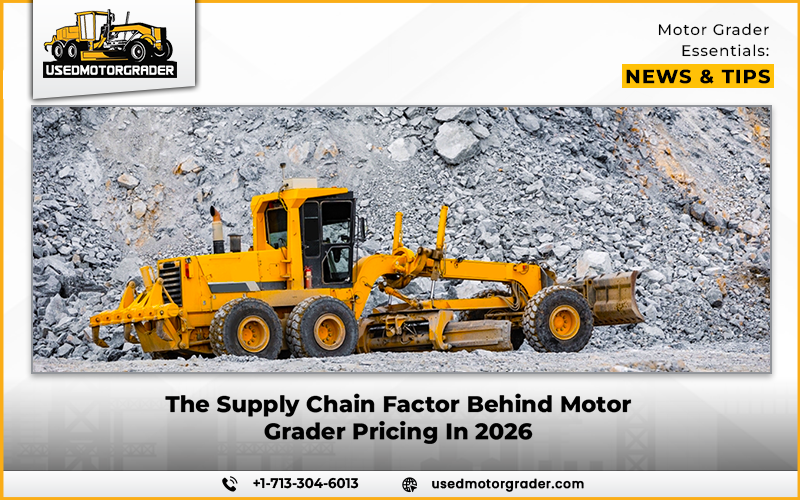
For many years, customers assessed motor graders primarily based on resale value, horsepower, fuel efficiency, and blade performance. The purchasing method has evolved in 2026. Grader pricing is increasingly affected by supply chain disruptions nearly as much as machine specs.
When making decisions about what to buy, contractors, dealers, procurement teams, and fleet managers increasingly research lead times, parts shortages, freight volatility, steel pricing, electronics costs, and tariffs. Because supply chains are still unpredictable, prices are high even in areas where demand decreases.
The most significant modification is that downtime risk, repair delays, logistical exposure, and future parts availability are now included in the “real cost” of a grader. In 2026, the machine’s value now includes the strength of the supply chain.
Because manufacturing, shipping, and technology costs are still high worldwide, motor grader prices are rising. Production and equipment availability are nevertheless impacted by shortages of steel, electronics, hydraulic systems, freight charges, and semiconductors.
The Hidden Supply Chain Costs Buyers Rarely Consider
Freight and Logistics Costs Behind Every Motor Grader
Logistics and freight will be major factors in pricing in 2026. A motor grader must be shipped by ocean freight, inland transportation, oversized transport permits, customs processing, and dealer delivery coordination.
The cost of transportation varies by area:
- North America: Greater labor and trucking expenses
- Middle East: Growing demand due to large-scale initiatives
- Africa: Customs delays and reliance on imports
- Southeast Asia: Unpredictable but competitive freight conditions
This leads to a frequent problem where imported graders seem less expensive at first but end up costing more when duties and logistics are considered. Because transportation costs have a significant impact on resale value, buyers of used motor graders are also observing this trend.
Lead Times Are Quietly Raising Prices
Another hidden expense that many purchasers overlook is lead times. Delivery delays are still caused by OEM production backlogs and dealer inventory shortages. It may actually take 90 to 120 days for a machine that is listed with a 60-day lead time to start working.
There is significant financial strain as a result of these delays. Contractors frequently depend on rentals, incur project fines, or experience productivity losses due to idle personnel.
“The Delay Cost Per Week”
Sometimes it’s more expensive to wait two more months for a grader than to pay more up front. Any savings from selecting a less expensive machine might be swiftly offset by rental costs, personnel downtime, and project delays.
How OEM Supply Strategies Are Changing The Market
Manufacturers Are Prioritizing High-Margin Models
Many OEMs are focusing production on premium grader configurations that include telematics, automation packages, and advanced operator-assist systems because they create better profits. As a result, low-spec graders are becoming more difficult to locate, while technology-heavy ones dominate dealer inventories.
Regional Assembly vs Imported Equipment
Regional manufacturing is becoming more important. Nearshoring and localized assembly enable firms to reduce freight risks and enhance part availability.
Buyers are shifting to brands with strong local dealer support since they frequently provide:
- Faster fixes
- Improved parts access
- Reduced downtime exposure.
- Reduced logistical hazards.
This tendency is also influencing the used motor grader market, where dealer support has become almost as important as machine condition in determining resale value. Imported equipment does not always cost less in 2026. Lower purchase pricing might quickly evaporate when freight charges, tariffs, customs delays, and restricted parts support are included in.
The Used Motor Grader Market Is Also Affected
Why Used Grader Prices Remain High
Inventory is limited, thus used grader prices remain high. Contractors are keeping machinery longer, and fewer late-model units are reaching the resale market. Buyers seek to eliminate factory lead times, which is driving up demand for low-hour equipment. This has resulted in fierce competition for high-quality used motor graders with proven maintenance records.
The Supply Chain Impact On Parts Availability
Parts availability has become one of the biggest purchasing concerns in 2026. Buyers now carefully evaluate:
- Parts lead times
- Dealer support quality
- Engine component availability
- Service network strength
A cheaper grader with weak parts support can quickly become the most expensive machine in the fleet because downtime losses often outweigh purchase savings.
Regional Pricing Differences Buyers Need To Understand
Why Does The Same Motor Grader Cost Different Amounts Across Regions?
Currency fluctuations, tariffs, freight conditions, and infrastructure demand cycles are all factors that influence motor grader pricing around the world. Emerging markets may face higher ownership costs despite lower base pricing because logistics and import dependency incur considerable expenses later on.
Which Regions Are Seeing The Biggest Pricing Pressure In 2026?
- North America: Infrastructure spending and demand for new equipment continue to raise expenses.
- Middle East: Megaprojects are driving up grader demand in the region.
- Africa: Import dependency and logistics concerns continue to have an impact on pricing.
- Southeast Asia: Competitive manufacturing exists, but supply volatility remains a concern.
Because of high infrastructure demand and logistics costs, grader prices in North America and parts of the Middle East are currently among the highest.
Will Motor Grader Prices Go Back to Normal Anytime Soon?
Not really, at least not for a while.
The good news is that after 2026, things like computer chip supplies and transportation should improve. However, don’t expect prices returning to their pre-2020 levels. Why? because the cost of manufacturing these gadgets continues rising. Businesses must pay higher wages, stick to more strict pollution regulations, implement more sophisticated technology, and handle challenging international trade scenarios. That all adds up.
After 2026, prices may gradually cease rising, but a significant decline? That is highly improbable. Consider it similar to gas costs, which may cease rising but rarely return to their initial level.
Conclusion: In 2026, Supply Chain Strength Is Part Of The Machine’s Value
Motor grader pricing in 2026 is determined by raw material costs, electronics shortages, freight volatility, lead times, and dealer support quality. Buyers can no longer evaluate machines only based on horsepower or upfront cost. The best grader investment nowadays is not always the cheapest machine. It is the machine supported by the most robust supply chain environment, a dependable support network, and long-term operating stability.
Tags: Motor Grader Pricing Trends, Motor Grader Supply and Demand USA, Motor Grader Technology 2026