Caterpillar is frequently mentioned when contractors begin looking for motor graders. Decades of dependability, high resale value, and a nearly global dealer network all contribute to the reputation’s earning. It felt like settling for a long time to think about anything else.
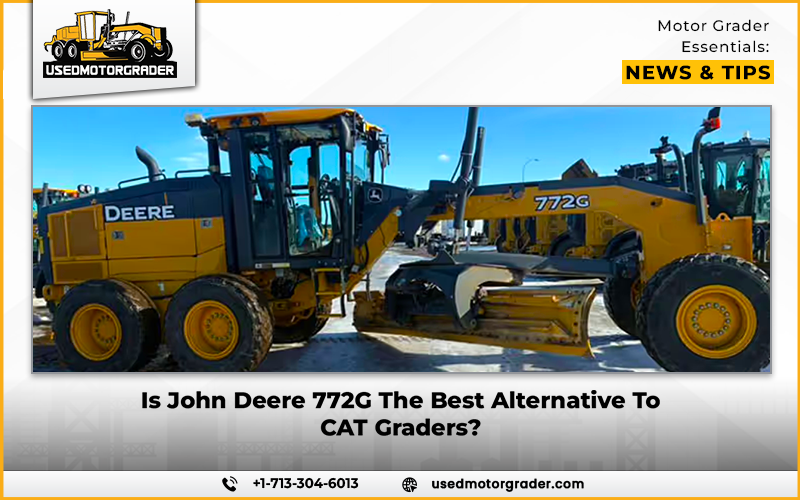
That is evolving. Contractors who have taken the time to look past the badge have been paying close attention to the John Deere 772G. It is now in serious competition thanks to its operator-focused technology, competitive specs, and contemporary cab experience. Depending on what your organization requires, it may or may not be the best CAT option, and it’s important to consider that.
Quick Comparison: Deere 772G vs. CAT Motor Graders
| Feature | John Deere 772G | CAT 140 Series |
| Net Power | 275 hp | 180–248 hp |
| Blade Pull | 22,453 kg | Slightly lower |
| Grading Capability | Strong for production and heavy site work | Balanced for general grading |
| Operator Technology | Auto-Shift, advanced automation, joystick controls | Stable Blade, Cat Grade with Cross Slope |
| Reliability | Solid uptime on production-focused jobs | Renowned long-term durability |
| Support Network | Growing but thinner globally | Extensive worldwide coverage |
Performance: Power, Torque, and Terrain
The 772G’s 275 horsepower advantage over the CAT 140 series appears substantial on paper. In actuality, this translates to shorter cycle times when moving material over longer runs, fewer passes on production operations, and a more stable blade draw under load. On the proper jobs, that horsepower turns into actual production.
CAT counters with something different: a driveline feel that many seasoned operators perceive as more controllable, as well as constant, sophisticated torque delivery. The 140 is tuned differently rather than being underpowered. That balance is really important for tasks that require consistent surface finishes over raw speed.
This is more about matching the machine’s features to the kind of job you do most of the time than it is about which machine is stronger.
Technology and Operator Experience
This is where John Deere’s case is strongest. The 772G is usable by operators of all skill levels thanks to Auto-Shift Plus, joystick controls, and a circle management system that minimizes human corrections. More recent operators are more productive. Long shifts don’t wear out experienced workers as much.
Stable Blade and Cat Grade with Cross Slope are two examples of Caterpillar’s technological suite, which is actually capable and built to allow precision grading even under load. Operators who have spent time mastering the system are rewarded, but this is a trade-off. It’s strong, but not every fleet has the time or resources to successfully negotiate the learning curve.
For contractors evaluating a John Deere 772GP for sale and dealing with mixed operator experience levels, Deere’s lower barrier to productivity is a practical advantage worth putting real weight on.
Reliability, Durability & Maintenance
The 772G was developed with simple service access in mind. The cooling system is meant to withstand harsh circumstances without continual attention, and everyday service locations are easily accessible. Strong uptime figures are reported by contractors operating production-focused operations.
In this case, Caterpillar’s advantage isn’t so much about the machine itself as it is about its surroundings. Parts and technicians are accessible when and where you need them thanks to a dealer network that serves outlying areas and foreign markets. That support infrastructure can actually offset any initial cost reductions for fleets that operate far from main centers.
Location and usage patterns affect maintenance costs. Deere’s parts are reasonably priced and easily accessible in many areas. Others tip the scales back due to CAT’s denser network
Real‑World Feedback
You can learn something valuable from the true mixed field feedback on both machines. The hydraulic smoothness and ergonomics of the cab are often praised by Deere operators. Under specific circumstances, CAT operators frequently characterize the machine’s feel as more predictable and controllable.
The most common theme in real-world comparisons is that there is not a clear winner; instead, performance depends on the particular task and the operator’s familiarity with the machine.
Final Verdict
For many contractors, the John Deere 772G for sale is a good and attractive substitute for CAT graders. If productivity, sophisticated automation, and operator experience are your top concerns, you should give them careful thought rather than a cursory scan.
If your company depends on worldwide parts availability, maximum resale value, or a solid service connection in a remote location, Caterpillar still has benefits that are hard to dispute.
To be honest, neither machine is better in every situation. The kinds of projects you work on, your workplace, the competencies of your team, and how you strike a balance between short-term capabilities and long-term assistance all influence the best option. If you make your decision based on your real needs rather than brand familiarity, you will select the best computer.
FAQ’s
Is the 772G as reliable as CAT?
Both are strong, but in severe long-term situations, CAT has an advantage due to its larger components and service network.
Does it match CAT in heavy grading?
The 772G is competitive in terms of power and blade pull, especially while working on production-oriented tasks.
How do maintenance costs compare?
In many markets, Deere can provide easier access and low parts prices, but in this case, local service availability is crucial.
Which is more fuel-efficient?
It differs depending on the application. Over time, Deere’s automation capabilities can lower cycle counts, increasing productivity on the appropriate tasks.
Tags: Best Used John Deere Motor Graders, John Deere 772g Motor Grader, Used Caterpillar Graders