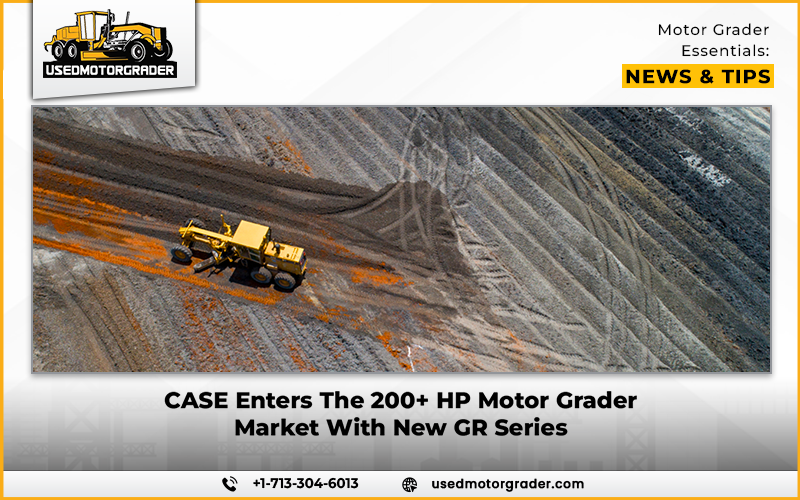
Entering the 200+ horsepower grader market is a big step for a company that established its reputation in mid-range equipment. Early in March 2026, CASE officially announced the launch of its new GR Series, a series designed for heavy-duty grading tasks and targeted directly at contractors and fleet operators who have traditionally relied on Caterpillar and Komatsu for this type of equipment.
The timing is not coincidental, and knowing why CASE took this action at this time reveals a lot about the direction the used motor grader market is heading.
What Are the New CASE GR Series Motor Graders?
The amount of money spent on infrastructure worldwide makes it extremely difficult to find high-horsepower graders. Infrastructure development has received nearly $1 trillion from the United States alone, with similar investments taking place throughout Asia and the Middle East. used motor grader that can cover ground effectively, making fewer passes, using less fuel, and maintaining grading precision under continuous load are necessary for large-scale mining and road construction projects.
According to most industry estimates, the heavy motor grader market has been expanding at a rate of about 6 to 8 percent per year, mostly due to the expansion of mining and infrastructure. CASE didn’t have a competitive answer for that demand until now. A significant void in their portfolio that was restricting their appeal to the biggest contractors and fleet buyers is filled by the GR Series.
Key Features of CASE GR Series
Power and Fuel Efficiency
The GR Series exceeds 200 horsepower, which is a suitable minimum for major highway and mining grading operations. Early indications suggest gains in fuel efficiency over earlier models, which might eventually reduce operating costs by roughly 10%, a figure that should be taken into account for high-hour machines.
Blade Control and Precision
Precision is crucial in today’s grading tasks, and CASE has concentrated engineering resources in this area. The goal of advanced control systems is to minimize the amount of adjustments an operator must make, which has a direct impact on daily output and material waste. More productive hours result from less rework.
Cab Design and Operator Comfort
Long grading shifts reveal all of a cab’s ergonomic flaws. Improved visibility, ergonomic controls, and less cabin noise are all features of the GR Series that may seem insignificant on a specification sheet but add up significantly over the course of a ten-hour shift. Grading quality is impacted by operator fatigue in ways that are difficult to quantify but readily apparent in the final product.
Durability and Service Intervals
Low downtime is the goal of heavy-duty frame construction and optimal servicing intervals. One of the most costly things that may happen to contractors with tight project timetables is unexpected maintenance. Uptime is obviously being positioned by CASE as a competitive argument.
CASE vs Competitors: How GR Series Compares
| Feature | CASE GR Series | Caterpillar 14/16 Series | John Deere Large Graders |
| Market Position | New entrant | Industry leader | Strong competitor |
| Pricing | Competitive / value-focused | Premium | Mid-to-premium |
| Performance | High (new entry) | Proven | Reliable |
| Fuel Efficiency | Expected to be optimized | Good, varies by model | Efficient with smart controls |
| Technology | Modern, emerging | Advanced, well-established | Operator-friendly |
| Operator Comfort | Improved cab and visibility | High comfort standard | Known for ergonomics |
| Durability | Promising, unproven long-term | Industry benchmark | Strong and dependable |
| Resale Value | Uncertain | Excellent | Good |
The honest picture here is that CASE enters this segment with competitive specs and likely attractive pricing, but without the track record that Caterpillar and John Deere have built over decades in this power class. That’s not a disqualifier, It’s just the reality of being a new entrant, and buyers should weigh it accordingly.
Who Should Consider the CASE GR Series?
The GR Series is best suited for highway and infrastructure contractors working on large-scale projects, mining and quarry operators requiring high-output grading, rental firms expanding into heavy equipment categories, and government contractors overseeing public works programs.
If your tasks do not require consistent high-load grading, the 200+ HP category is definitely overkill. But if they do, this series is worth considering, especially for those who have been priced out of luxury options.
Expected Pricing & Availability Of CASE GR Series
Official pricing has not been established, however industry norms place 200+ HP graders between $350,000 and $600,000, depending on configuration. Availability is planned to spread gradually across North America and select other markets until 2026. Early adopters will most certainly suffer limited supplies, which is usual for any new product introduction on this scale.
Market Impact: What This Means for the Industry
More competition in the high-horsepower market benefits purchasers. If CASE positions itself aggressively on pricing, established players may be compelled to refine their own offerings.
There IS also a secondary effect to consider: as new machines join the market, existing high-horsepower models from CAT and Komatsu may see price modifications, opening up buying opportunities in the used equipment market for contractors who don’t require the most recent technology.
Should You Wait or Buy Now?
If your present projects can handle the delay, waiting allows you to have access to real-world performance data from early deployments, which is always useful when working with a new platform. If project timelines do not allow it, purchasing proven equipment now is a lower-risk option.
New machines carry uncertainty, particularly in terms of long-term reliability. The GR Series is promising on paper, but it lacks the field hours required to instill genuine trust. Every buyer must address the honest issue of how to strike a balance between opportunity and risk for themselves.
The Bottom Line
CASE’s entry into the 200+ HP grader market represents a truly major breakthrough. It won’t transform the industry overnight, and existing brands aren’t in immediate danger. However, if the GR Series performs consistently in the field, it will become a real contender among the best used motor grader available, providing large contractors with a credible alternative to the luxury brands that have dominated this category for many years. It’s worth keeping an eye on early deployments as they begin to generate meaningful data.
FAQ’s
What is the horsepower of the CASE GR Series?
200+ HP, designed for heavy-duty applications.
When will it be available?
Initial rollout through key markets in 2026.
How does GR Series compare to Caterpillar?
CASE likely offers better pricing; Caterpillar leads on proven long-term reliability.
Are GR Series graders suitable for mining?
Yes, It’s built specifically for heavy applications including mining and quarry work.
What is the expected price of GR Series graders?
Between $350,000 and $600,000 depending on configuration.
Tags: Case Motor Graders, Global Motor Grader Market, Grader Market Insights