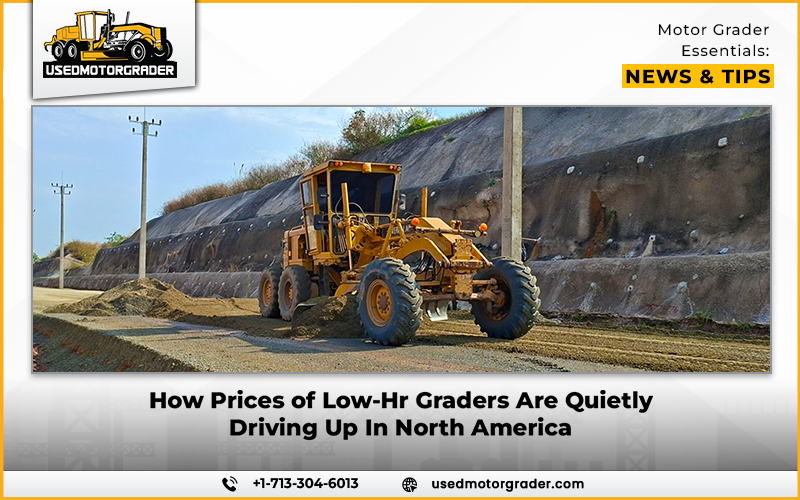
A Hidden Force Behind Rising Prices
If you have been following the market for low hrs motor grader for sale in North America, you might have noticed something amiss, in that prices continue to rise, even in cases where the domestic market seems to be stable. The real driver? Export markets.
In the developing economies around the world, contractors and governments are competing directly with North American purchasers of the same machines. This silent transformation is changing the pricing, constraining supply, and making low-hour graders much more expensive than they were in the past.
Global Demand: Who Is Buying North American Graders?
The demand is not arbitrary; it is concentrated in rapidly developing areas that spend a lot of money on infrastructure.
- Africa: Road-building and mining industries are driving strong demand.
- Latin America: Highway development, agricultural development, and urban development.
- Southeast Asia: The fast urbanization and infrastructure are supported by the government.
- Middle East: Continued building and diversification beyond oil economies.
India, Indonesia, South Africa, and Chile are some of the leading importers of motor graders in the world due to massive development projects. Exporters are aggressively looking at these markets and usually position North American machines as high-end, dependable assets.
Why Low-Hour Machines Command a Global Premium
Not every grader is the same in the international market. The North American machines with low hours are considered to be the best assets.
- Reliability: Lighter history of use perceived to be more reliable.
- Standards: Adherence to more stringent emissions and quality.
- Brand Power: Good brand reputation for manufacturers like Caterpillar, John Deere, and Komatsu.
- Longevity: Extended service life compared to the local alternatives.
- Resale: Increased resale value in the secondary markets.
To foreign customers, a low-hour grader is not merely equipment, but a long-term investment. That is why they are ready to overbid local consumers.
Exporters vs Domestic Buyers: Who Gets Priority?
In most instances, exporters and dealers focus on international purchasers, and rightfully so.
- Volume: Export buyers are usually bulk buyers.
- Cash Flow: Payments are often quicker or in cash.
- Profitability: Higher margins due to currency advantages.
- Lower Overhead: Fewer expectations of after-sales service.
This produces a subtle yet meaningful shift: domestic customers are no longer the major customers; rather, they compete in an international market where global demand dictates prices.
Supply Constraints in North America
With the increasing number of machines leaving North America, home supply becomes tight. This has a direct effect on pricing.
- Limited Inventory: Fewer low-hour machines remain in the neighborhood.
- Holding Patterns: Dealers are holding inventory longer, waiting for better export offers.
- Auction Scarcity: Premium units are less supplied in auctions.
- Retention: Replacement cycles are sluggish because contractors are retaining equipment.
Even websites with extensive stocks indicate that machines are distributed worldwide, and significant numbers of machines are already located in export centres such as Dubai, South Africa, and ports across Southeast Asia. The outcome is straightforward: the decreased supply + the world demand = increased prices.
Auction Dynamics: Where Global Competition Becomes Visible
This competition is most evident on auction sites.
- Remote Participation: North American auctions are attended by international buyers remotely.
- Bidding Wars: These tend to drive prices above the expectations of the domestic market.
- Intermediaries: Export brokers are mediators, and they push aggressive bids.
- Tier 1 Targets: The machines with the fewest hours are the most competitive.
Contractors often complain that they lose bids at an auction to a buyer they have never met because he is overseas. This has essentially altered the behavior of auctions, particularly of high-quality equipment.
Logistics, Currency, and Arbitrage Opportunities
Why then, with shipping costs, are exports profitable? Global price differences are the answer.
- Forex Benefits: Currency exchange rates can favor international buyers.
- Arbitrage: Reduced buying prices in North America compared to local markets overseas.
- Value Offset: The cost of shipping is compensated for by an increase in the resale value abroad.
- Market Gaps: Price gaps between regions create profitable arbitrage opportunities.
Export experts go as far as to promote customized shipping services to Africa and other destinations, noting how lucrative this business has grown. In some cases, a grader bought in the U.S. can be resold overseas at a significant markup, even after logistics costs.
Infrastructure Booms Driving the Cycle
The demand boom is not short-lived, but it is connected to the long-term development of infrastructure.
- Government Funding: Road and transport projects funded by the government.
- Industrial Growth: Development of mining and energy industries.
- Urbanization: The process of urbanization in third-world economies.
- Global Finance: Funding and development at the international level.
The motor grader market in the world is also expanding at a steady rate and is projected to grow from $4.56 billion in 2025 to $6.21 billion by the year 2031. Demand for imported equipment will not decrease as long as these projects are ongoing.
Real-World Pricing Differences: Domestic vs Export Markets
The domestic and export market price gap can be wide.
- The Export Premium: A low-hrs motor grader for sale can fetch 10–20 percent higher when sold abroad.
- Ready to Work: Clean, refurbished, and low-hours machines are export-ready and fetch a high price.
- Residual Stock: Domestic buyers are usually left with older and high-hour machines.
- Inventory Control: Dealers can hold back high-quality units for foreign customers.
This introduces an apparent imbalance: local consumers are usually charged more to purchase inferior quality stock.
The Bigger Picture: Why Prices Keep Rising
When you put the dots together, the trend would be obvious:
- The world is growing at a higher rate than the supply.
- Buyers of exports will offer higher prices.
- Dealers focus on more profitable international transactions.
- Auctions increase international competition.
- Long-term demand is perpetuated by infrastructure development.
Simply put, North America is no longer a closed market; it is a world supply hub.
Competing in a Global Market
The purchase of a low hrs motor grader for sale in North America today is an international contest. Pricing dynamics have shifted in the export markets without much noise but with great impact, with high-quality machines becoming more difficult to locate and costly to obtain.
To local consumers, it is all about awareness. Knowing these forces can guide you on when to buy, help set expectations, and lead to better decisions in a market that is no longer local but global.
FAQs
1. Why are low-hour motor graders more expensive than before?
A: Due to the rising competition and prices in North America, due to the increasing demand in the world market, particularly in the developing markets.
2. Which regions are importing the most graders?
A: The key purchasers are Africa, Southeast Asia, Latin America, and some parts of the Middle East because of the development of infrastructure.
3. Do export buyers really outbid domestic contractors?
A: Yes, particularly at auctions where foreign buyers tend to pay a premium price on low-hour machines.
4. Is it still possible to find good deals domestically?
A: Yes, but it takes timing, good dealer relations, and occasionally, higher-hour machines or other brands.
Tags: North America Motor Grader Market 2026, New Motor Graders 2026, Top Motor Graders