When the Clock Lies, Everything Downstream Does Too
The used motor grader market US is experiencing a silent crisis that is not covered by the media but costing buyers tens of thousands of dollars annually. It is not a shortage of supply. It is not a parts problem. It is a figure, a single digit, placed on a dashboard, which has become one of the least reliable data points in the transactions of heavy equipment.
The hour meter.
It appears to be a mere and objective measurement on the surface. What number of hours has this machine worked? The response must be simple. In practice, however, the hour meter on a used motor grader has become a figure that can be reset, slowed, replaced, or just disregarded in favor of a more appealing figure. And the problem is growing. With the demand for Used Motor Graders For Sale In USA ever-increasing, the monetary incentive to falsify the operating hours has never been greater.
In this article, let’s highlight the reasons behind hour meter manipulation, the distortion of the whole market, the current verification environment, and what can and should be done about it by buyers and industry professionals.
The Financial Logic Behind Hour Meter Fraud
To understand why this happens, you have to understand what an hour meter reading does to the price of a used motor grader. In the used heavy equipment industry, the most important variable in the depreciation of machines post-age is the operating hours. The value of a grader with 4,000 hours is meaningfully better than that of the same model with 8,000 hours, usually by a factor of $15,000 to $40,000, depending on the brand, configuration, and year.
The motive is that gap.
A seller who is able to reduce the reading of a machine by 2,000 to 3,000 hours is not merely cleaning up a figure. They are rebranding the machine in a whole new price range. Within an auction setting where buyers can place bids in real time with limited time to look at the item, the repositioning hours are directly converted into higher hammer prices. When the deal is between a private party or dealer, distorted hours decrease the negotiation pressure, increase the pool of interested purchasers, and remove the concern regarding the remaining component life.
There is no standard in the market to check hours at the point of sale. It is that lack of accountability which makes our manipulation so tenacious.
How Hour Meters Actually Work & Where They Fail
An engine run time is recorded by an hour meter in a motor grader. The majority of contemporary machines have an electronic hour meter built into the ECM (engine control module) or instrument cluster. Mechanical meters were widespread on older machines and were infamously simple to tamper with; to physically stop, reverse, or replace the meter needed only basic tools and access to the cab.
The introduction of electronic meters added more complexity, but failed to eradicate the issue. The ECM stores the operating hours, whereas the display cluster reads a possibly different module. Removing or changing the display cluster on most machine models will reboot the visible reading but not the ECM log. In certain older electronic systems, the ECM hours themselves may be modified using aftermarket diagnostic tools originally intended to be used in a legitimate recalibration.
Most of the modern manipulation is done in the gap between the data that the ECM stores and the data that the dashboard displays.
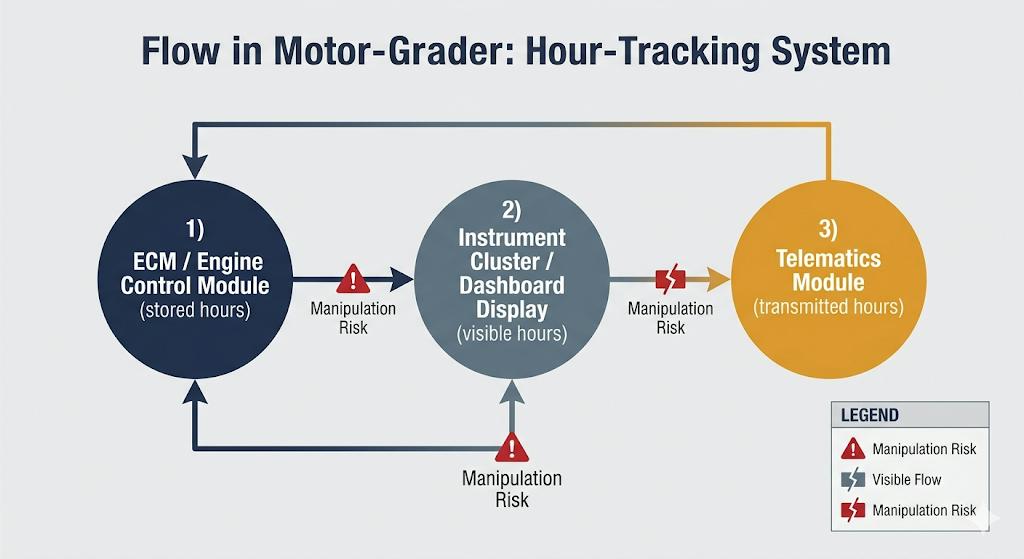
Diagram showing the data path between ECM-stored hours, instrument cluster display, and telematics output, and the three common manipulation points along that chain.
Who Manipulates Hours & Through What Channels
The honest answer is that manipulation occurs across every category of seller, though the methods and motivations differ.
Private sellers are often individual contractors or small construction firms offloading equipment that has been worked hard. The temptation to roll back hours is high because private transactions have almost no accountability structure. There is no dealer reputation at risk, no institutional paper trail, and often no inspection requirement.
Dealers operating in gray areas will sometimes acquire machines with already-altered hours and simply move them on without investigation. Some dealers will document whatever hours are displayed without independently verifying the ECM data, a practice that creates plausible deniability without actually confirming accuracy.
Auction houses present a unique vulnerability. The speed of the auction format means that inspection is compressed into a short pre-auction window, and hour meter verification is rarely part of the standard condition report. Auction listings frequently state hours “as displayed”, a phrase that politely sidesteps the question of whether those hours are accurate.
Fleet liquidators and rental companies are generally more trustworthy because they maintain detailed service records, but even institutional sellers are not immune. Equipment transferred between subsidiaries or returned from long-term rentals can have documentation gaps that obscure true usage.
| Seller Type | Hour Manipulation Risk Level | Documentation Quality | Buyer Verification Leverage |
| Private Seller | High | Low to None | Minimal, informal transaction |
| Independent Dealer | Medium-High | Variable | Moderate, can request ECM pull |
| Franchise / OEM Dealer | Low-Medium | Generally Strong | High, history is often accessible |
| Auction House | Medium | “As-Displayed” Standard | Low, compressed inspection window |
| Fleet / Rental Liquidator | Low | Usually Strong | High, service logs are often available |
| Broker / Reseller | High | Often Incomplete | Low, a broker rarely holds records |
Risk profile of different seller types in the used motor grader market by hour meter reliability.
Telematics: The Promised Solution That Has Not Delivered Yet
Telematics was supposed to fix this. Most motor graders manufactured after 2012 have factory-installed or dealer-installed telematics systems, Caterpillar’s Product Link, John Deere’s JDLink, Komatsu’s KOMTRAX, that transmit machine data, including hours, location, idle time, and fault codes, to a remote server.
In theory, a buyer could simply pull the telematics history and compare it against the displayed hours. Discrepancies would be obvious. Manipulation would be impossible to hide.
In practice, it is more complicated than that.
First, telematics data is owned by the original equipment owner, not the buyer. When a machine changes hands, the telematics subscription frequently lapses or gets transferred without the historical data. A buyer asking to review the telematics log is asking the seller to hand over records that the seller may not want shared, and the seller has no legal obligation to provide them in most private or auction transactions.
Second, telematics systems can be disabled. Disconnecting the telematics antenna or module produces gaps in the data record. If those gaps align with periods of heavy use, they represent exactly the kind of information a manipulative seller would want to hide. A machine with six months of missing telematics data is a significant red flag, but it is a red flag that many buyers either miss or discount.
Third, many machines in the used motor grader market US are old enough that they predate telematics entirely, or were built for markets where telematics was not standard equipment. For these machines, there is no remote data at all.
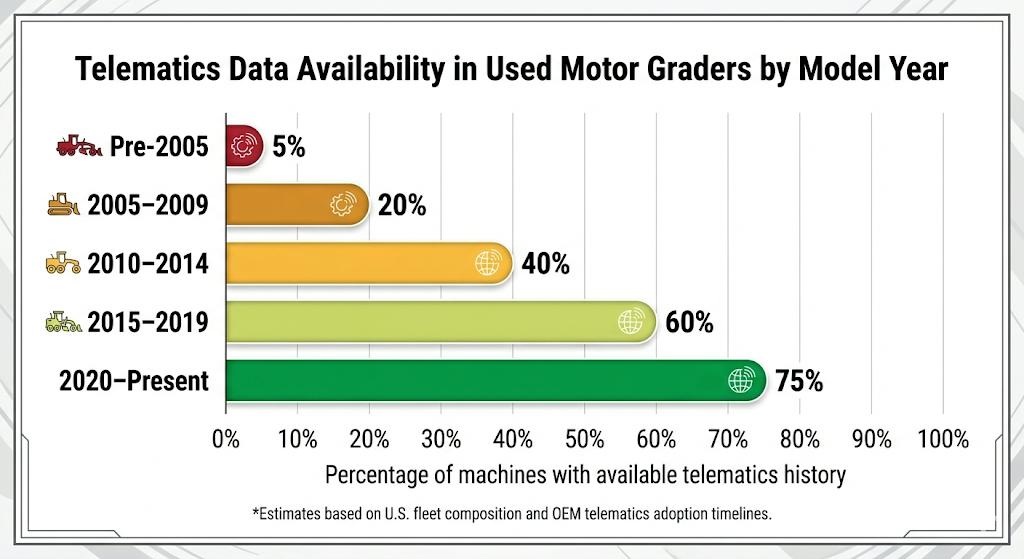
Bar chart comparing telematics data availability across model years of used motor graders currently listed for sale in the U.S. market, showing the significant gap for pre-2012 equipment.
The Maintenance Record Problem
If the hour meter reading and the telematics data are both unreliable, the next line of defense is the maintenance record. Oil change logs, filter replacements, hydraulic fluid service, and major component overhaul records all carry timestamps and hour readings. If the records show a hydraulic pump replacement at 6,200 hours and the current meter reads 4,800 hours, something does not add up.
This is a powerful cross-referencing method, but it only works when records actually exist.
The reality in the Used Motor Graders For Sale In USA secondary market is that maintenance documentation is inconsistent at best. Small contractors often service their machines informally, without written records. Equipment that has changed hands multiple times frequently arrives at the point of resale with a partial or absent service history. Even when records do exist, they can be fabricated; a typed service log with no dealer stamps or part numbers is trivially easy to produce.
The most reliable maintenance records come from machines that were serviced exclusively at OEM dealerships throughout their working life. These records are stored in the manufacturer’s dealer network system and can be pulled by an authorized dealer. But the majority of used motor graders have not lived that clean a life.
| Hour Range (Displayed) | Typical Resale Price Range | Price if True Hours Are 30% Higher | Price Difference | Estimated Manipulation Incentive |
| 2,000 – 4,000 hrs | $180,000 – $240,000 | $145,000 – $195,000 | $35,000 – $45,000 | Very High |
| 4,000 – 6,000 hrs | $130,000 – $180,000 | $100,000 – $145,000 | $30,000 – $40,000 | High |
| 6,000 – 8,000 hrs | $85,000 – $130,000 | $65,000 – $100,000 | $20,000 – $30,000 | Moderate-High |
| 8,000 – 10,000 hrs | $55,000 – $85,000 | $40,000 – $65,000 | $15,000 – $20,000 | Moderate |
| 10,000+ hrs | $30,000 – $55,000 | $20,000 – $40,000 | $10,000 – $15,000 | Lower but Still Present |
Estimated price impact of hour inflation across commonly used motor grader price tiers in the U.S. market. Figures represent approximate market ranges, not guaranteed valuations.
How Manipulated Hours Break the Pricing Ecosystem
When hour meter data cannot be trusted, the damage ripples outward far beyond any individual transaction.
Depreciation models collapse. Appraisers and valuation guides use reported hours as a core input. If the hours feeding those models are systematically underreported, the guides themselves drift toward inflated benchmarks. Buyers who check their purchase against a published guide may think they are getting a fair deal when they are actually overpaying for a machine that is further along in its wear cycle than the guide assumes.
Financing becomes distorted. Lenders who finance used heavy equipment typically factor hours into collateral valuation. A machine financed at $160,000 based on 4,500 displayed hours may have a true component-life-adjusted value of $115,000. If the borrower defaults, the lender recovers less than the loan balance from the auction. Over time, systematic hour manipulation raises default losses industry-wide and contributes to tighter lending standards that hurt legitimate buyers.
Buyer confidence erodes. This may be the most insidious long-term effect. When buyers in the used motor grader market US start to assume that hours are unreliable, they respond by pricing in a skepticism discount, bidding lower to compensate for unknown risk. That discount punishes honest sellers alongside dishonest ones. It creates a market-wide trust deficit that drives transaction friction upward and genuine value discovery downward.
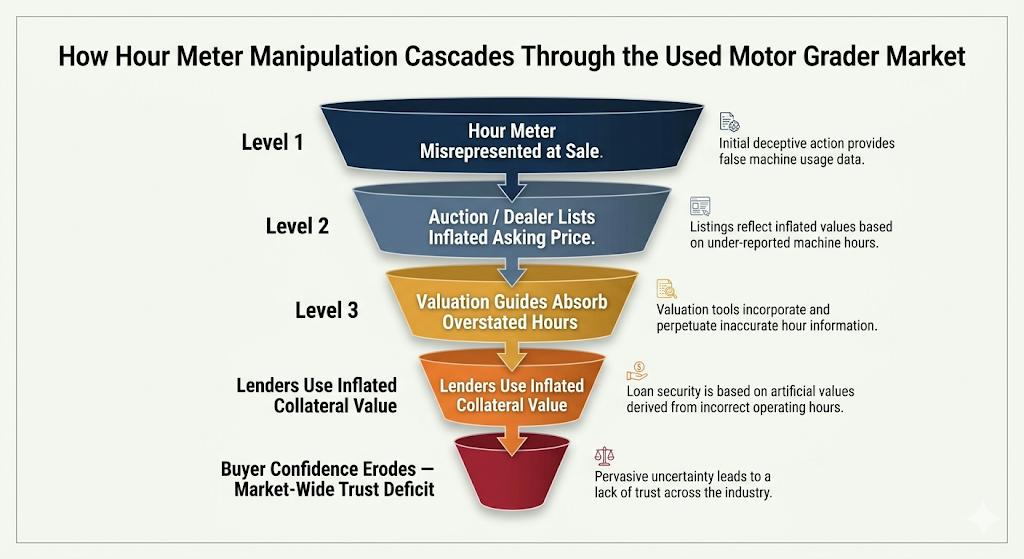
Funnel diagram showing how hour meter manipulation cascades through the used motor grader pricing ecosystem, from initial misrepresentation at the point of sale through to downstream effects on appraisals, financing, and buyer confidence.
The Idle Time Factor: Hours Are Not All Equal
One layer of complexity that buyers often miss is that not all hours on a motor grader represent equivalent wear. A machine that has logged 6,000 hours doing light finish grading on a municipal road project has experienced meaningfully different stress than one that spent 6,000 hours doing heavy cut work on a mining access road.
Idle hours, time when the engine was running but the machine was not under load, are also recorded by the hour meter and are treated identically to working hours in most valuation calculations. Some telematics systems break out idle time separately, but that data is rarely surfaced in a standard used equipment listing.
This creates a secondary layer of potential misrepresentation that does not require any tampering at all. A seller who emphasizes that their grader “only did light work” is making a claim about hour quality, not just hour quantity, and verifying that claim is even harder than verifying the raw number.
Verification Methods That Actually Work
Despite all of these challenges, there are practical methods that experienced buyers and appraisers use to pressure-test hour meter data. None of them is foolproof individually, but together they create a meaningful verification framework.
ECM diagnostic pull. An authorized OEM dealer or qualified heavy equipment technician can connect directly to the machine’s ECM and pull the stored hour data independently of the display cluster. If the ECM hours and the display hours disagree, that is an immediate red flag. This is the single most reliable single-point check available for modern machines.
Component wear analysis. A thorough inspection of high-wear components, blade cutting edges, circle drive gears, front axle kingpins, tandem housing seals, gives a physical cross-reference for machine usage. Experienced technicians can estimate whether wear patterns are consistent with the stated hours, though this requires genuine expertise and is not a substitute for documented data.
Fluid analysis history. Oil analysis labs process fluid samples and return reports that include timestamps and hour readings. If a machine has a continuous oil analysis history, those reports create an independent timeline that is very difficult to falsify retroactively.
Dealer service record pull. For machines with OEM dealer service history, an authorized dealer can access the digital service record with timestamped entries. This is one of the cleanest verification methods available when the data exists.
Cross-referencing auction history. Several data services aggregate auction results for used heavy equipment, including historical listings that often include the hours reported at previous sales. If a machine appears at auction with 4,200 hours today and appeared at a different auction 18 months ago with 5,800 hours, that discrepancy is impossible to explain legitimately.
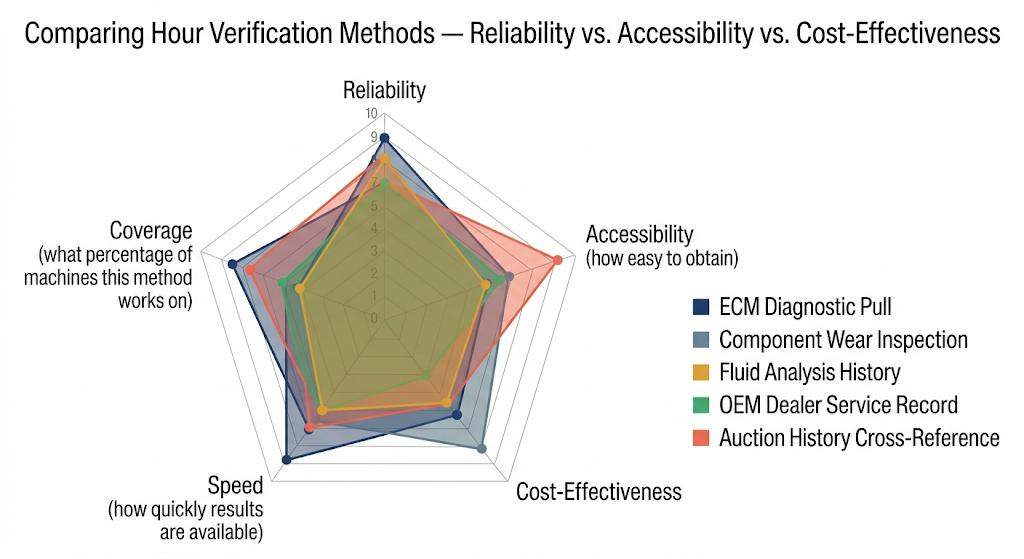
Radar chart comparing the reliability, accessibility, and cost-effectiveness of five key hour meter verification methods for used motor graders.
The Dealer’s Role: Gatekeeping or Passing the Problem On
Dealers occupy the most influential position in the used motor grader transaction chain because they are simultaneously the most trusted and the most capable of either catching or perpetuating manipulation.
A reputable dealer who pulls ECM data before listing a machine, cross-references service records, and discloses any discrepancies is providing genuine value that justifies a premium over private-party pricing. That premium is not just about convenience; it reflects genuine risk reduction.
But dealers who list machines based solely on displayed hours, without independent verification, are effectively laundering manipulated data through an institutional veneer of credibility. The buyer sees a dealer listing and assumes due diligence has been performed. In many cases, it has not.
The most transparent dealers in the Used Motor Graders For Sale In Usa space are increasingly providing inspection reports that explicitly state whether ECM hours were verified and whether they match the display. Some are including telematics data snapshots in their listings. This kind of transparency is the direction the market needs to move in, but it is not yet standard practice.
| Verification Method | Reliability | Cost to Buyer | Availability | Best Used For |
| ECM Diagnostic Pull | Very High | $150 – $450 | Requires OEM dealer or specialized tech | All modern machines (post-2000) are used to verify “true” hours. |
| Component Wear Inspection | Moderate-High | $300 – $900 | Third-party inspector or local mechanic | Machines with missing records; identifies “hidden” repair costs. |
| Fluid / Oil Analysis | High (if historical) | $30 – $100 | Dependent on the prior owner’s records | Detecting internal engine/hydraulic wear before failure. |
| OEM Dealer Service Record | Very High | Free – $100 | OEM dealer access (requires Serial #) | Confirming major overhauls and consistent maintenance. |
| Auction Cross-Reference | Moderate | Free – $50 | Digital platforms (Ritchie Bros, IronPlanet) | Identifying if a machine was recently flipped for a quick profit. |
| Telematics History Review | High | Subscription/Request | Standard on most post-2012 models | Tracking idle time vs. working hours and geographic history. |
Practical comparison of hour meter verification methods by reliability, cost, and applicability in U.S. used motor grader transactions.
What Financing and Insurance Markets Say About the Problem
The financing side of the used motor grader market US offers a revealing signal about how seriously institutional players are taking this issue. Several equipment lenders have quietly tightened their underwriting requirements over the past several years, requiring third-party inspection reports that specifically address hour meter verification for loans above certain thresholds.
Insurance underwriters have followed a similar trajectory. Agreed-value policies on used motor graders, policies that pay out the full insured value in the event of a total loss, are increasingly scrutinized at origination. Underwriters are asking harder questions about how hours were verified, and policies written on machines with unverified hours sometimes carry exclusions or reduced payouts that buyers discover only after a claim.
The message from both markets is clear: hour meter credibility is not just a buyer’s problem. It is a systemic risk factor that the institutions providing capital and coverage for these transactions are beginning to price explicitly.
What Buyers Should Actually Do
For anyone actively searching for Used Motor Graders For Sale In USA, the practical takeaway from all of this research is not to stop buying used equipment. The used market remains the most economical way to acquire a motor grader for most buyers. The takeaway is to change how the due diligence process is structured.
Before making any significant purchase, buyers should treat the displayed hour meter reading as a starting hypothesis, not a confirmed fact. Every serious transaction should include, at a minimum, an ECM diagnostic pull by a qualified technician. For machines above a certain price threshold, roughly $80,000 and up, a full third-party inspection that includes component wear assessment and record cross-referencing is worth the investment.
The inspection fee almost always costs less than the risk it mitigates. A $500 inspection that catches a 3,000-hour discrepancy on a $150,000 machine is one of the best returns on investment in the heavy equipment business.
Trust Has to Be Earned, Not Assumed
The hour meter problem in the used motor grader market is ultimately a trust problem. The number on the dashboard has always carried an implicit promise: this is how much this machine has been used. For most of the equipment industry’s history, that promise was backed by nothing more than the seller’s honesty and the buyer’s faith.
That arrangement worked tolerably well when the equipment market was smaller, more local, and more relationship-driven. It works poorly in today’s environment of national auction platforms, cross-state private sales, and buyers who may never lay eyes on a machine before purchasing it.
The solution is not to stop trusting sellers. It is to build verification into the standard transaction process, the way the automotive market has built Carfax and independent inspections into car purchases. The used motor grader market US is large enough, and the dollar values are high enough that the infrastructure for systematic hour verification already exists. ECM pulls, telematics history reviews, and OEM dealer record access are all available today.
What is missing is the expectation that these steps will be taken. Until buyers demand verification and sellers compete on documented transparency, the hour meter will remain the most manipulated number in the market, and the buyers who skip due diligence will keep paying the price.
FAQs
Q1. Can an ECM hour reading ever differ from the display for legitimate reasons?
A: Yes, ECM replacements, instrument cluster swaps during legitimate repairs, and software recalibrations can cause minor discrepancies. The key is whether the difference is documented and explainable, or large and undocumented.
Q2. Are auction houses legally responsible if the hours turn out to be inaccurate?
A: In most cases, no. Auction house terms typically disclaim all warranties on listed hours, describing them as “as-displayed.” Buyers bid at their own risk, which is why independent verification before an auction is so important.
Q3. Do newer telematics systems make hour manipulation impossible?
A: Not impossible, but significantly harder. Modern integrated telematics with cloud-stored histories are much more difficult to alter without detectable gaps. However, they still depend on continuous connectivity and active subscription, both of which can lapse.
Q4. How much should a buyer discount a machine with no verifiable hour documentation?
A: A reasonable approach is to assume hours are 20 to 35 percent higher than displayed and negotiate price accordingly, while also budgeting for earlier-than-expected component service intervals.
Tags: Buying Low Hour Grader, Low Hour Motor Grader Prices, Motor Grader For Sale