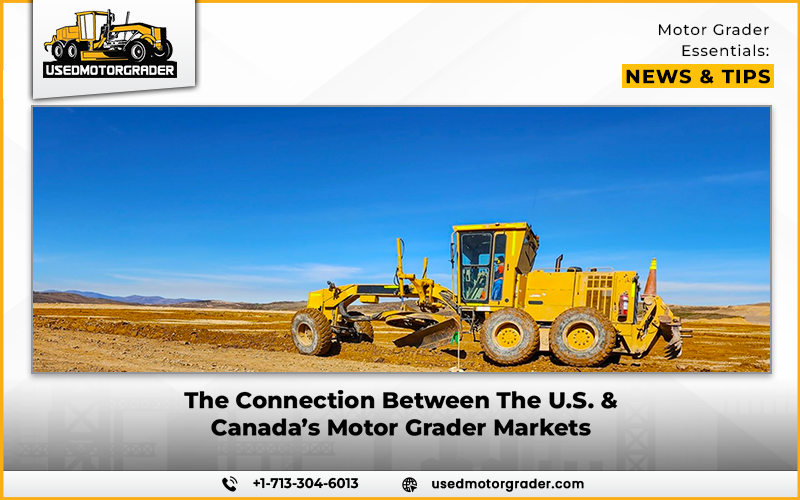
The U.S. and Canadian motor grader markets are not only regionally related but also highly integrated. A common North American ecosystem unites the two countries, characterized by similar supply chains, OEM strategies, pricing patterns, and infrastructure-driven demand cycles. This relationship is particularly evident in the used motor grader market in the USA and its impact on cross-border availability, pricing, and fleet choices.
A Shared North American Market Structure
The U.S. and Canada are the two countries that control the world motor grader market as part of North America, which accounts for more than 30 percent of the world market. The United States is the volume and investment leader, and Canada is a smaller but strategically significant extension of the same system.
- The U.S. stimulates demand with huge infrastructure spending, such as more than $110 billion on roads and bridges.
- Canada provides a steady demand for road maintenance, mining, and snow management.
- The two nations share the same manufacturers, dealer networks, and equipment standards.
- The used motor graders for sale in the USA tend to set the trend for the whole region.
This market structure renders Canada less of a closed market and more of a dependent yet integrated extension of U.S. action.
Cross-Border Trade and Equipment Flow
Movement of used equipment across borders is one of the most powerful connections between the two markets. The used motor grader market in the USA is at the center of providing inventory to Canadian consumers.
- Canada is one of the major export destinations for U.S. motor graders.
- As the U.S. inventory is tightening, Canadian buyers are experiencing reduced supply and increased prices.
- When U.S. fleets offload machines, Canada takes up the surplus.
- Cross-border purchases are usually motivated by price arbitrage.
Practically, used motor graders for sale in the USA serve as a source of supply not only to local customers but also to the whole North American market.
OEM Networks and Supply Chain Integration
The relationship is also enhanced through common manufacturing and distribution systems. Large OEMs are working smoothly in both nations, which strengthens the alignment of the market.
- Leading brands such as Caterpillar and John Deere dominate the two markets through integrated dealer networks.
- The distribution of equipment, supply of parts, and servicing systems is cross-border integrated.
- The U.S. supply chain disruptions directly affect the Canadian supply.
- The changes in production in North America affect the two countries at the same time.
It shows that both nations do not act in isolation; changes in production or the supply chain affect the entire region.-
Infrastructure Spending and Demand Spillover
Canadian motor grader demand is directly affected by U.S. infrastructure investment. The magnitude of U.S. expenditure generates regional demand cycles that affect the two nations.
- The high construction activity in the U.S. increases the demand for new and used graders.
- This decreases the supply of used motor graders for sale in the USA, restricting supply in the region.
- This tends to increase the prices to Canadian contractors.
- High demand in the U.S. can postpone equipment entering Canada.
Meanwhile, the demand in Canada is influenced by various factors:
- High dependency on road maintenance and snow removal.
- High mining and remote infrastructure projects.
Despite these differences, both markets move in sync due to shared supply constraints and procurement patterns.
Pricing, Inventory, and Rental Market Linkages
The U.S. and Canada have very similar pricing trends, which is mainly because of the common inventory pools and the behavior of the rental market.
- In North America, tight inventories have increased the price of used graders.
- The used motor grader market in the USA is fed by rental fleet turnover in the U.S., and has an impact on Canadian supply.
- While dealers operate locally, pricing remains competitive and aligned across borders.
- Used motor graders for sale in the USA are usually followed by buyers in Canada to compare prices.
Here, the rental market is important. With the U.S. rental fleets cycling equipment, the equipment finds its way into the used market and often relocates north.
Is Canada a Spillover Market or Independent Player?
Canada is a spillover market and an autonomous demand center, but with closer connections to the U.S.
- It is a spillover market in taking up excess U.S. inventory.
- When the U.S. demand is high, it turns into a supply-constrained market.
- It is a stand-alone demand center because of distinct industries such as snow management and mining.
Nevertheless, the prevailing force is evident: the used motor grader market in the USA is to a large extent the determinant of availability, pricing, and timing throughout the region.
Wrap Up
The motor grader markets in the U.S. and Canada are highly interdependent in terms of trade, supply chains, and common demand drivers. The United States is the largest in terms of scale and investment, and Canada is a follower of the U.S. inventory, pricing, and infrastructure cycles. The used motor graders for sale in the USA segment are key in balancing supply across borders, and the two markets become one integrated ecosystem and not two distinct entities.
FAQs
1. Why does the U.S. motor grader market influence Canada so strongly?
A: Because the U.S. controls supply, infrastructure expenditure, and inventory, which directly influence the availability and prices in Canada.
2. Do used motor graders frequently move between the U.S. and Canada?
A: Yes, cross-border trade is not uncommon, particularly when customers want to get a better price or supply.
3. Are pricing trends similar in both countries?
A: Yes, there is a close alignment in pricing because of common inventory pools and dealer networks.
4. Is Canada dependent on the U.S. supply?
A: Partially. Canada has its demand drivers, but is very dependent on U.S. inventory, particularly in the used equipment segment.
Tags: Canada Motor Grader Market, Motor Grader Market Trends, U.S. Motor Grader Market