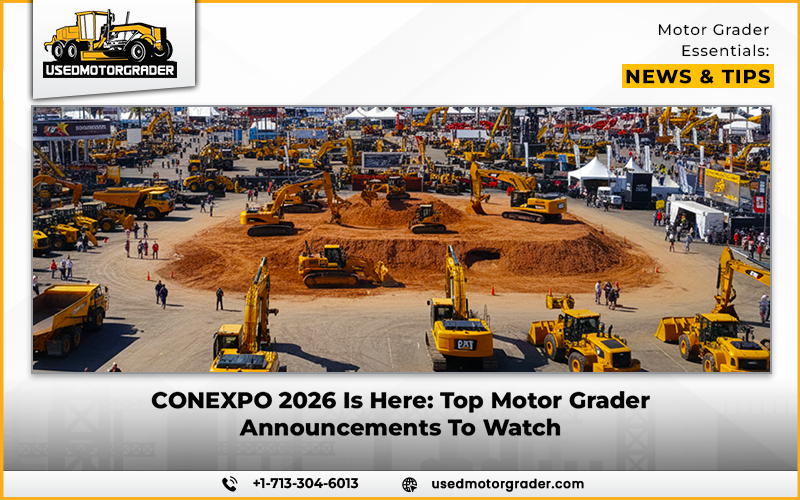
CONEXPO 2026 has again demonstrated why it is the largest stage in the construction industry. For contractors looking at the top motor grader brands, the show this year provided more than just a few improvements; it provided a clear look at the direction grading technology will take over the next 10 years. From increased-horsepower models to smarter automation systems, manufacturers have made it clear that graders are more interconnected, efficient, and operator-friendly than ever before.
We will deconstruct the most significant announcements and their implications for fleets, operators, and buyers who are closely monitoring the market.
Why CONEXPO 2026 Matters for Graders
CONEXPO is not just a trade show; it is a glimpse into the future of the industry. In the case of motor graders, it implies the replacement of mechanical upgrades with digital ones.
- Manufacturers used the event to launch next-generation models that had improved cabs and controls.
- Automation and built-in grade control systems were in the limelight.
- Connectivity platforms demonstrated real-time fleet monitoring and jobsite optimization.
- The themes of sustainability, such as fuel efficiency and low-emission engines, dominated almost all the reveals.
To contractors considering the top motor grader brands, the announcements of this year provided a very clear message: data integration is now as vital as raw horsepower.
Caterpillar’s Next-Gen Push
Caterpillar came to CONEXPO 2026 with a larger presence and heavy technology integration. Although Caterpillar has traditionally been the benchmark for motor grader discussions, this year saw a shift to smarter operations instead of just bigger machines.
- Formal launch of the Next Gen 150 and 160 models with 10-inch touchscreen interfaces.
- The new 140 LVR (Lever) was showcased, bringing traditional controls to the Next Gen platform.
- Increased VisionLink connectivity solutions showed more fleet performance analytics.
- Future grading applications were previewed with AI-supported workflows and semi-autonomous capabilities.
To the contractors who are loyal to one of the leading motor grader brands, the strategy of Caterpillar strengthened its high-end positioning. The company is not merely polishing hardware; it is creating digital ecosystems for its machines.
CASE Expands into High-Horsepower Territory
The bold move taken by CASE Construction Equipment was to enter the heavy production grading market. Through a strategic partnership with Bell Equipment, CASE debuted the new GR Series to compete with the industry’s largest machines.
- Launch of the flagship GR935, which produces a massive 325 horsepower for large-scale infrastructure.
- This move targets high-production contractors who previously had to look elsewhere for 300+ HP machines.
- Electro-hydraulic controls are offered alongside traditional manual levers to provide operator flexibility.
- Improvements in transmission that provide smoother power and fuel consumption.
This growth enhances competition among the leading brands of motor graders, particularly in the heavy-duty segment, where productivity per hour is a significant factor.
John Deere’s SmartGrade Evolution
John Deere concentrated on automation and operator support, which strengthens the role of technology in transforming the grading processes.
- Updated P-Tier graders featuring the new G5Plus CommandCenter displays.
- The debut of SmartGrade 3D as a more seamless, factory-integrated solution on existing platforms.
- Combined sensor packages offering more accurate 3D positioning.
- Operator-assist to minimize fatigue and training time.
To several contractors, the updates of Deere emphasize one of the trends in the industry: accuracy is as precious as power. The top motor grader brands are not only competing based on the durability of the machine, but on the ease with which the operators can attain consistent results.
Machine Control and Positioning Technology
In addition to OEM booths, technology partners such as Topcon demonstrated more sophisticated machine control software that is compatible with grader platforms.
- Machine control systems that provide real-time blade positioning information in 3D.
- Better grade responsiveness with faster processing speeds.
- Improved jobsite awareness through safety-focused enhancements like 360-degree cameras.
- Project coordination data sharing on the cloud.
These inventions demonstrate that grading is no longer an independent procedure. It is becoming more and more connected to online site models and real-time feedback loops. Contractors evaluating top motor grader brands must also consider the technology ecosystems that underlie them.
Alternative Power and Engine Developments
Although complete electrification of large graders might be a distant goal, engine manufacturers focused on fuel efficiency and compliance with emissions.
- Platform engines that are flexible to changing emissions requirements.
- Better fuel management systems to reduce operating costs.
- Preliminary deliberations regarding hybrid support systems.
This is important since engine technology can be the determinant of long-run ownership expenses. The increased purchase prices can be compensated for by efficiency gains, especially in the case of fleets with graders that operate on a daily basis.
What It Means for Contractors
The general message of CONEXPO 2026 is integration. The leading brands of motor graders are no longer competing in terms of frame strength or moldboard performance. Instead, they’re offering:
- Complete factory-grade control systems.
- Productivity operator environments that can be customized.
- Remote diagnostics and monitoring fleet connectivity.
- Decision-making data-driven tools.
To the buyers, this makes the process of evaluation a more complicated one. The selection of a grader now includes the comparison of software features, service support systems, and upgrade options in addition to the traditional specifications. A practical conclusion: automation and connectivity options launched during CONEXPO-CON/AGG tend to influence resale values over the next several years. Grade control and telematics installed on machines by the factory are more likely to maintain a competitive edge in the market.
Industry Outlook After CONEXPO 2026
The lesson of this year’s event is that graders are changing rapidly. Technology that was only used by high-end machines is becoming common. Contractors that do not comply with these changes will lag in efficiency and competitiveness in bidding. Meanwhile, conventional durability is still a necessity. The competitive advantage of the top motor grader brands in the future is the balance between established mechanical reliability and new digital tools.
FAQs
1. Which were the largest grader announcements at CONEXPO 2026?
A: High-horsepower models were featured by CASE via the Bell partnership, next-generation 150/160 models by Caterpillar, and G5Plus display integration by John Deere.
2. Are automation features becoming standard on graders?
A: Yes. Grade control and operator-assist systems are becoming more and more factory-fitted, particularly with major manufacturers.
3. Do these new technologies increase equipment costs?
A: The cost of initial purchase can be increased, but enhanced productivity, less rework, and fuel efficiency can be justified in the long run.
4. How should contractors evaluate new grader releases?
A: In addition to horsepower and blade size, contractors must consider connectivity tools, machine control compatibility, service support, and long-term operating efficiency before investing.
Tags: 2006 Caterpillar 140H, Budget Motor Graders, CAT 140 Grader for Sale