The Crisis Hiding in Plain Sight on Every Jobsite
On more construction sites than you might think, there is a piece of equipment waiting for someone to use it. It is not broken, it does not need fuel, and it is not waiting on parts. It is waiting for an operator. The motor grader, one of the most complex pieces of machinery in civil construction, demands a skill set that is learned over years, even decades. And the generation of workers who learned that skill is leaving the workforce faster than new workers can be taught.
The lack of skilled road graders for construction operators is not a looming crisis. It’s already causing schedule delays, increased labor costs, and contractors to push back grading stages on road construction, site development, and infrastructure renewal projects. Motor graders for construction are critical to almost every aspect of civil construction, but the talent pool has thinned to a trickle.
To address this, the construction technology sector has brought to market a range of technologies: GPS and GNSS grade control, 2D and 3D machine control, AI-powered blade control, predictive telematics, semi-autonomous, and remote control. The question is whether these technologies will address the problem or merely stem the flow of blood as the workforce problem worsens.
The truth, as we’ll explore in this article, is more complicated than either the optimists or pessimists would have you believe. AI doesn’t replace the seasoned blade hand. But it does transform the role of the grader operator, and in doing so, it may be the best solution the industry has at its disposal today.
The Scope of the Operator Shortage Crisis
The shortage of road graders for construction operators is structural. It is not a short-term shortage due to project work or local labour markets. It is a consequence of years of attrition, lack of apprenticeship training, and a cultural bias that office jobs are more prestigious than trade jobs. The effects are now inescapable.
The shortage is defined by several interrelated factors:
- The average age of a proficient motor grader operator in North America is over 50, so a large percentage of the most experienced operators are within 10 years of retirement.
- Skilled trades programs that once supplied a steady stream of operators have been chronically underfunded for decades, forcing contractors to pay for and wait for on-the-job training.
- The skill of operating a motor grader involves simultaneous adjustment of the blade angle, tilt, pitch, side shift, and articulation, which is much more complex than other heavy equipment operations.
- Operators with basic training on excavators or dozers find it difficult to adapt to the grader, which requires tactile and spatial skills that can’t be accelerated by cross-training.
- The overall decline in enrolment in construction trades is common, but the grader operator shortage is more severe because even when contractors are willing to pay higher wages, they can’t find candidates with any relevant experience.
- Construction schedules that rely on operator availability are increasingly being adjusted in mid-project, increasing costs and throwing off other trades.
The cumulative impact of these factors is that road graders for construction are increasingly underused, not due to the capabilities of the machine, but due to the capabilities of the operator.
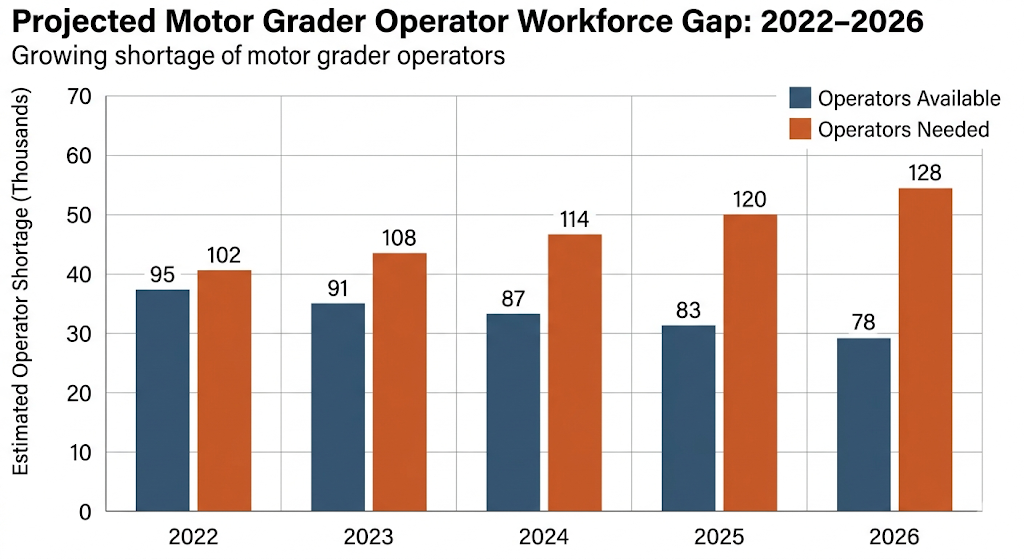
This chart illustrates the widening gap between available skilled motor grader operators and industry demand between 2022 and 2026. The accelerating divergence underscores why technology-led solutions have become strategically urgent for contractors and OEMs alike.
Why Grader Operators Are Among the Hardest Workers to Replace
Some heavy equipment operators are harder to train than others. An excavator operator has a single stick and boom to operate in a fairly straightforward push-pull action. A dozer operator controls blade height and angle on relatively forgiving passes. A motor grader operator must manage up to 14 mechanical controls – or, in newer machines, a still-complex set of joysticks and electronic controls – while interpreting the grade, predicting the behavior of the material, and making adjustments on the fly across a moving blade edge that can be more than 12 feet wide.
This level of control is only part of the reason that road graders for construction operators are so rare. The other part is judgment. Skilled operators learn to feel their machine as if it were an extension of their own body, interpreting the vibration of the machine to understand the ground conditions, adjusting the pressure of the blades to account for the moisture content of the material, and making drainage decisions that impact the performance of the pavement for years to come. This knowledge is not written down. It is embodied in the muscles and minds of ageing workers, and it is incredibly hard to teach.
Skill Complexity Comparison Across Heavy Equipment Categories
| Equipment Type | Control Inputs (Approximate) | Average Training Time to Proficiency | Judgment Complexity | Shortage Severity |
| Excavator | 4–6 primary inputs | 6–12 months | Moderate | Moderate |
| Bulldozer | 4–6 primary inputs | 6–18 months | Moderate | Moderate |
| Motor Grader (Traditional) | 8–14 control inputs | 2–5 years | Very High | Severe |
| Motor Grader (with Grade Control) | 4–6 effective inputs | 6–18 months | High | Moderate-High |
| Compaction Equipment | 2–4 primary inputs | 3–6 months | Low-Moderate | Low |
| Skid Steer | 2–4 primary inputs | 3–6 months | Low | Low |
The table above makes the core challenge visible. The traditional motor grader demands more time to develop than nearly any other construction equipment category. Grade control technology effectively reduces the active input count, shortening the learning window, but it does not eliminate the need for judgment.
Grade Control Technology: Bridging the Skill Gap
The most disruptive technology to grader operation in the last ten years has been the introduction of GPS and GNSS grade control systems. These systems offer real-time positioning information with respect to a digital terrain model, enabling the machine’s control system to automatically adjust the blade height and cross-slope to the design.
The impact of grade control on productivity is significant for contractors using road graders for construction on large civil works. A less experienced operator using a 3D grade control system can produce tolerances that would take years to develop through hand skills. The key benefits include:
- Blade height adjustment based on GNSS positioning, eliminating the need to check string lines or regularly measure the grade rod.
- Automated cross-slope control to achieve desired road crown and drainage gradients without constant operator intervention, allowing them to focus on steering and positioning.
- Cut-fill displays in the cab that help operators manage material distribution, rather than relying on visual and experiential cues.
- Reduced the number of passes required to achieve design tolerances, with grade control systems enabling operators to achieve design tolerances on the first or second pass, rather than the third to fifth passes.
- Reduced operator training time, with contractors reporting that new operators are productive within weeks, not months, when grade control systems are well set up and supported.
- Support for third-party design file formats, allowing project engineers to send grade designs directly to machines without on-site interpretation, minimising errors.
The efficiencies offered by these systems are significant. Recent industry reports demonstrate how grade control can increase productivity by 30-50 percent for complex grading, and the fact that contractors are no longer reliant upon highly skilled operators allows contractors to schedule their work more flexibly.
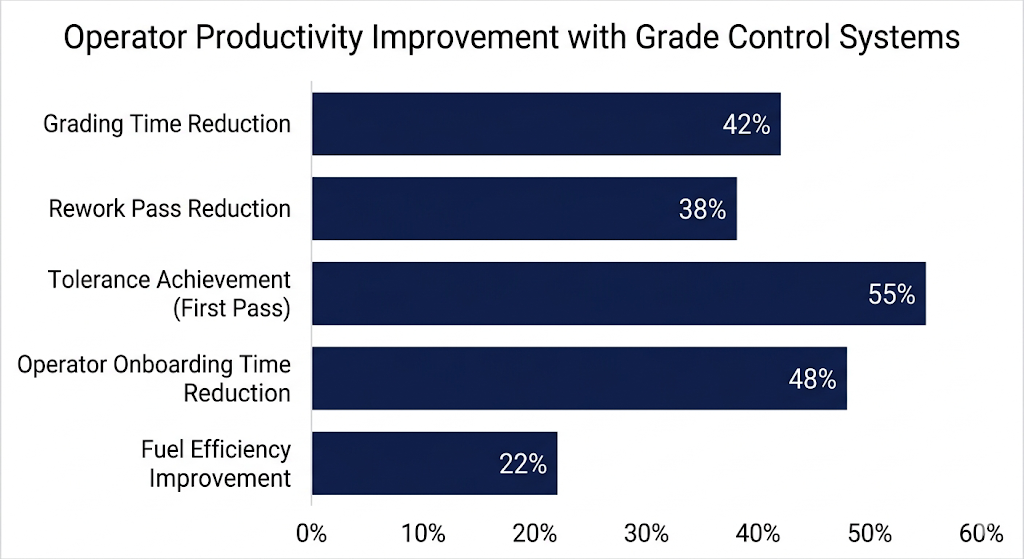
Grade control systems deliver measurable productivity gains across multiple performance categories, helping newer operators close the output gap with experienced veterans. Tolerance achievement on the first pass shows the most dramatic improvement, directly reducing project timelines.
AI vs. Blade Skills: Reimagining the Expertise
The argument between traditional operators and technology proponents often pits AI grading against the “traditional” skills of operators. This is a misunderstanding of the change. AI is not simplifying grader operation in the same way that automation simplifies factory work. It is redefining the skills needed, from hands-on machine control to supervisory control and management.
There are many differences between traditional and AI-assisted grader operation:
- Tactile vs. Digital Feedback: Blade hands feel the material through the blade and vibration to assess its hardness; AI-assisted operators read sensor displays and override warnings to make the same judgements.
- Visual vs. Interpreted Grading: Experienced operators learn to read grades through visual scanning and experience; machine control operators interpret digital cross-sections and correction prompts.
- Manual vs. Integrated Controls: Skilled blade hands manipulate multiple levers through muscle memory; machine control operators work through joystick controls that reduce multiple levers to fewer inputs.
- Expedited Skill Building: Conventional skill building requires years of mentorship and experience across multiple seasons and project types; machine control skill can be expedited through simulation and in-cab coaching programs.
- Judgment and Improvisation: Experienced operators improvise to cope with unexpected soil conditions; AI operators have a greater challenge when system advice fails, and pure Judgment is needed without the foundation of experience to draw from.
Traditional Operator Skills vs. AI-Assisted Operator Skills
| Skill Category | Traditional Operator | AI-Assisted Operator | Technology Dependency |
| Grade Judgment | Experiential/Visual | Display-guided | High |
| Blade Angle Control | Manual/Tactile | Auto-adjust capable | Medium-High |
| Cross-Slope Maintenance | Continuous manual input | Automated with override | High |
| Material Behavior Reading | Tactile/Sensory | Sensor-assisted | Medium |
| Drainage Decision-Making | Judgment-based | Partially system-guided | Low |
| Equipment Fault Response | Experience-based | Diagnostic alert-driven | Medium |
| Adverse Weather Adaptation | High | Moderate | Low |
This comparison reveals that AI does not produce a universal replacement for skilled operators. It transfers specific technical skills to the machine while leaving human judgment requirements concentrated in the areas where technology cannot yet reach, particularly around dynamic conditions, drainage planning, and equipment response under unusual circumstances.
Autonomous and Semi-Autonomous Grading Systems
Fully autonomous motor grader operation is still a vision for the future rather than a reality today. But the line between full and semi-autonomous operation is less important to contractors than the question of how much work can be done with minimal operator intervention. In this regard, semi-autonomous grading has already come a long way.
Existing semi-autonomous features being used today in the construction industry include:
- Automated blade height control, based on GNSS, enables the machine to maintain the desired elevation without constant operator intervention during long grading runs.
- Automated cross-slope control that keeps road crown slopes to design specifications while the operator steers and controls speed.
- Multi-pass automation that advises operators of the best sequence of cuts and blading passes for a particular material type and design criteria.
- Automatic articulation correction that automatically adjusts the machine’s articulation to keep the blade on the desired track on curves.
- Automatic turnaround that can reverse and reposition the machine for the next pass on straight-line passes.
- Obstacle avoidance systems that warn the operator or reduce machine speed in proximity to hazards.
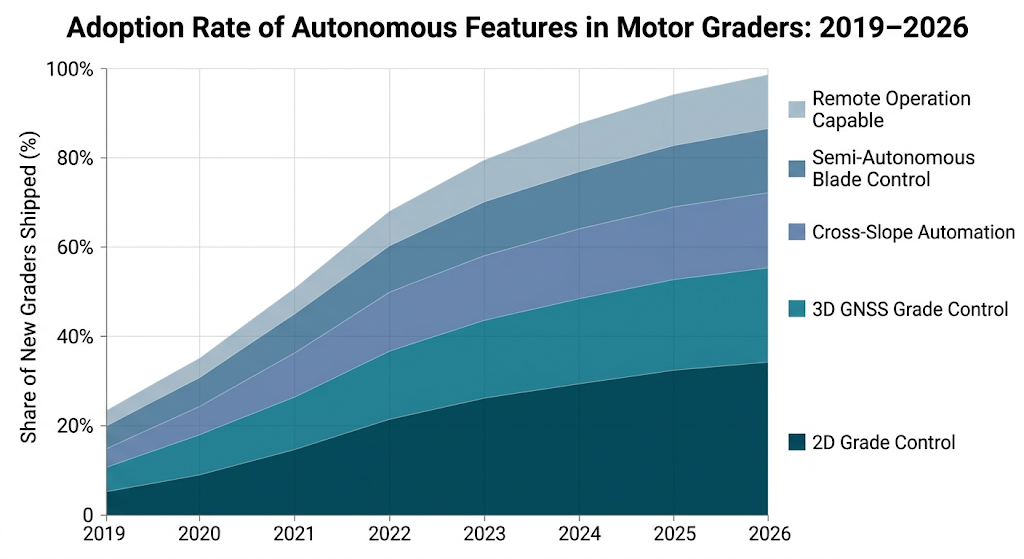
Autonomous and semi-autonomous feature adoption in new motor grader shipments has grown steadily since 2019, with 2D and 3D grade control becoming near-standard on new machines. Higher-order capabilities such as semi-autonomous blade control and remote operation are following the same adoption trajectory with a lag of several years.
OEM Strategies: How Caterpillar, John Deere, Komatsu, and Trimble Are Responding
The big original equipment manufacturers (OEMs) have been clear about their business rationale for developing grader automation: the lack of operators is a business-threatening issue. Without operators, contractors can’t buy equipment. Ultimately, OEMs’ long-term viability depends on enabling equipment to be productive with a leaner, less skilled workforce.
The major players have adopted different strategies to address this, but share the common consensus that automation needs to reduce the skill threshold without limiting performance potential:
- Caterpillar has built its Cat Grade suite into its machines, offering 2D and 3D guidance as standard equipment on its G-Series graders. The goal is to address the incompatibilities that existed with third-party systems and make grade control available to operators from the start.
- John Deere has developed SmartGrade as a factory-integrated system designed to simplify grader operation by reducing operator interaction with other complex systems. The user interface is the result of research into the learning challenges faced by new operators.
- Komatsu has heavily invested in smart machine control and has been most explicit in identifying the operator shortage as the key reason for developing autonomous equipment. It has stated publicly that its autonomous solutions are a response to customers who cannot keep machines operating due to a lack of personnel.
- Trimble, as a third-party technology provider, has developed software and positioning technologies that can be used across multiple OEM platforms, enabling contractors to use the same grade control systems across diverse fleets.
Across the board, the move from multi-lever control setups to joystick controls has been strategic. Today’s construction road graders have dramatically reduced the number of control interfaces compared to machines from just 10 years ago, effectively reducing the physical and cognitive demands on the operator.
OEM training programs have also shifted to include simulation training that enables operators to gain experience with grade control in a safe environment before operating machines on the job. The underlying theme here is that selling the machine is no longer sufficient; OEMs must help contractors address the human capital issue that would otherwise limit the machine’s productivity.
Remote Operation & Predictive Telematics
Two other technology categories are changing the operational dependency model in ways that are less visible than grade control but have important long-term implications.
Remote operation, the ability to operate a motor grader from an off-machine location, has evolved from concept to reality in certain applications. The impact on managing operator shortages is clear:
- Theoretically, a single remote operator can manage multiple machines on a project, allowing expertise to be pooled rather than spread across multiple locations.
- Remote operation is especially applicable to hazardous environments, such as unstable slopes, active mining haul roads, and disaster recovery sites, where operator safety is compromised in the cab.
- Advancements in latency reduction have overcome the lag that prevented early remote grading systems from being practical; they are now requisite for precision grading.
Predictive telematics offers a second layer of value:
- Telematics that track machine health and predict failure points help avoid unplanned downtime, which is particularly expensive when operator time is in short supply.
- Artificial intelligence (AI) diagnostic systems can notify operators of emerging mechanical problems that an inexperienced operator would not detect through traditional haptic or auditory feedback.
- Fleet management systems enable supervisors to determine which operators are most effective in their use of grade control systems and coach those who are not.
Table 3: Technology Solutions Mapped to Operator Shortage Impact Areas
| Technology | Primary Function | Shortage Impact | Adoption Barrier | OEM Integration Level |
| 2D Grade Control | Elevation guidance | High, reduces manual skill requirement | Low, mature technology | Standard on most new machines |
| 3D GNSS Grade Control | Full terrain model guidance | Very High, enables near-novice operation | Medium, requires site preparation | Available as a factory option |
| Auto Blade/Cross-Slope | Automated blade angle management | High, reduces continuous input demand | Low, software-driven | Increasingly standard |
| Semi-Autonomous Passes | Automated multi-pass sequencing | Medium, reduces repetitive workload | Medium, operator trust barrier | Emerging on premium models |
| Remote Operation | Off-machine control | Medium, concentrates scarce skill | High, infrastructure required | Limited, specialist deployments |
| Predictive Telematics | Machine health monitoring | Medium, reduces downtime impact | Low, subscription model | Standard on current fleets |
| Operator Simulation Training | Skill development acceleration | Medium, shortens onboarding time | Low, standalone platforms | Offered by major OEMs |
The Contractor Economics: Is Automation Cheaper Than Hiring Skilled Operators?
For the majority of contractors, the choice to adopt machine control technology is a financial calculation. Is the cost of grade control and automation systems a better use of capital than continuing to compete for a diminishing supply of skilled operators at high wages?
Technology investment is increasingly attractive. In competitive markets, premium grader operators demand wages and benefits that increase project costs. The cost of a single operator may, over a project season, be equal to the cost of a full 3D machine control system. Furthermore, the cost of unfilled operator positions is high. The lost productivity of a machine sitting idle is much greater than the cost of automation technology.
There are counterarguments. Control system failures can immobilize a machine as effectively as a mechanical failure, as troubleshooting software-based systems requires expert assistance. Overall, though, the case for automation has improved as the cost of operators rises and the cost of systems falls.
How are you planning to use this article? I can help you tailor the tone if it’s for a specific trade magazine or an internal strategy brief.
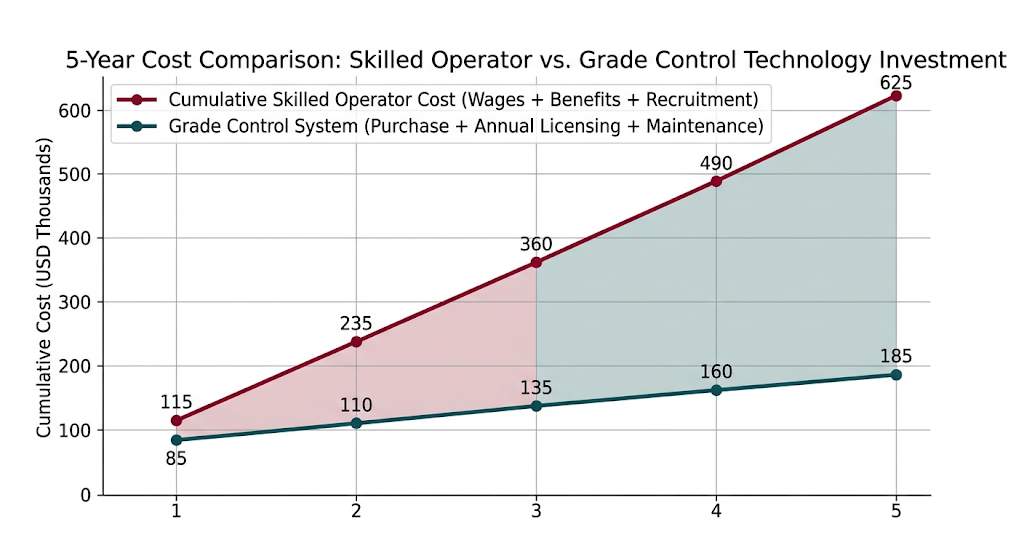
Over a five-year horizon, cumulative skilled operator costs significantly outpace the total cost of a grade control technology investment, including annual licensing and maintenance. This divergence strengthens the business case for automation as a primary response to the ongoing operator shortage.
What AI Still Cannot Replace
The argument for AI grading should not be oversold. The track record of technology proponents in construction is to set expectations that lag behind reality by several years. A sober recognition of the limitations of AI is critical to understanding the continued need for human operators in the short- to mid-term.
The current shortcomings of autonomous and semi-autonomous grading systems fall into categories that are dynamic, variable, and site-specific:
- Unanticipated terrain conditions, such as buried utilities, uncharted fill areas, material transitions, and subsidence, require on-the-spot human judgment that is not available from current systems without human intervention.
- Moisture and weather affect material properties in ways that sensors can only partially detect. A skilled operator responds to varying tactile feedback from wet clay and dry gravel by adjusting the pressure, angle, and speed of the blade; automation responds only to what sensors can detect.
- Drainage design decisions remain human decisions. The interplay of blade geometry, material displacement, and long-term drainage performance includes factors not fully represented in digital terrain models.
The Future: Operator Plus AI, Not Operator Versus AI
The notion that AI will replace motor grader operators is misleading. The more accurate description is augmentation, AI making fewer operators more effective, efficient, and productive.
Construction road graders will become more capable as machine learning and sensor technologies evolve. The future involves machines that perform technical aspects of blade control independently, while the human operator oversees, manages safety, and makes decisions that the machine cannot.
The takeaway for contractors is that investing in grade control and operator-assist technology is not an investment at the expense of personnel. It is a way to maintain production during a structural shortage of skilled workers. The industry possesses better tools for addressing the shortage than ever before.
Conclusion
The shortage of road graders for construction operators is one of the most important workforce issues in civil construction. Artificial intelligence and machine control do not eliminate this problem, but they certainly mitigate it.
The most effective response is not to wait for a workforce that is not returning. It is to create teams in which AI takes on the measurable, repeatable tasks, while human operators bring judgment, flexibility, and supervisory intelligence.
Construction road graders are not going to drive themselves any time soon. But they will be more capable in the hands of skilled operators. That transformation, from machine mastery to human-AI partnership, is already taking place.
FAQs
Q1. Will grade control systems eliminate the need for skilled operators?
A: No. They lower the skill level required for basic tasks, but cannot substitute for the judgment and dynamic response to terrain that an experienced operator brings.
Q2. How long does it take to train a new operator to use grade control?
A: New operators can be productive within specification-compliant tolerances in a matter of weeks to a few months.
Q3. Are autonomous motor graders available?
A: Many machines have semi-autonomous features, but full autonomy is not yet commercially deployed for most grading work.
Q4. Is grade control affordable for small contractors?
A: Yes. Low-cost 2D systems and leasing options for 3D systems have increased availability for contractors regardless of their initial capital.
Tags: Grader Operating Tips, Motor Grader Supply Shortage, Grader Operator Tips Fuel Saving