
In 2026, there will be greater demands than ever on road quality, development speed, and cost effectiveness. Contractors and governments around North America are being forced to reconsider how earthmoving work is carried out due to aged roadways, extensive urban expansion, and severe labor shortages.
At the heart of this problem are graders and levellers. These days, they are more than just large machinery; they are productivity instruments that influence infrastructure results, project costs, and schedules. Let’s examine the current state of the North American grader and leveller market, its projected trajectory by 2026, and the factors that producers, investors, and consumers should be focusing on.
Market Size and What the Numbers Tell Us (2024–2026)
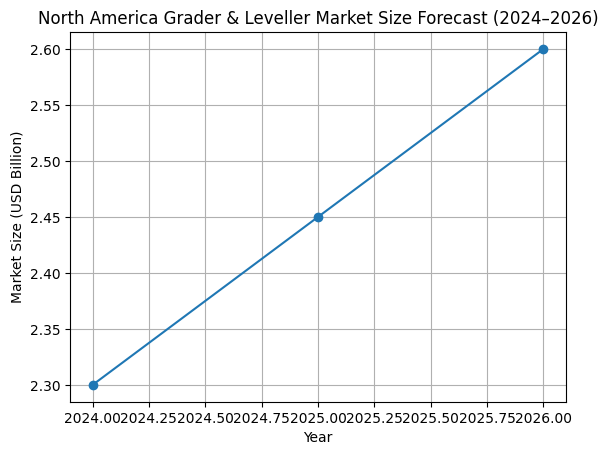
Source: Indexbox
In 2024, the North American grader and leveler market was estimated to be worth USD 2.3 billion, with the United States accounting for the majority of that value. According to industry projections, the market should approach USD 2.6 billion by 2026 at a compound annual growth rate of about 4.5%.
That growth is steady and resilient but not explosive. Even when orders for new equipment slow down, replacement purchases, rental fleets, and the consistent need for used motor graders for sale in the USA keep things stable. Overall, rather than a boom of any kind, we are anticipating stable development.
Key Growth Drivers
Initiatives to Update Roads and Infrastructure
Government spending remains the cornerstone of market demand. Funding is provided by the U.S. Infrastructure Investment and Jobs Act and similar Canadian programs for road maintenance, bridge replacement, and interstate improvements.
Increased Automation as a Result of a Skilled Labor Shortage
Because of labor shortages, automation is developing faster than anyone could have predicted a few years ago. GPS-guided graders, machine control systems, and telematics are no longer optional extras but rather standard equipment.
Urban Development and Commercial Construction
Logistics hubs, industrial parks, and mixed-use complexes are becoming more common in metro regions. These assignments are best suited for graders that can deliver accuracy in more limited, high-precision contexts.
Market Challenges and Risk Factors to Watch
High upfront equipment expenses are still a big problem, especially when borrowing rates are still high. Many purchasers are turning to rentals or used motor graders for sale in the USA as a wiser investment because financing has become more restrictive.
The amount of work that can be accomplished is still constrained by a lack of skilled operators, and operating margins are being squeezed by fuel prices and maintenance downtime. Delivery schedules are still being impacted by supply chain unpredictability, especially in the electronics and hydraulics industries.
As contractors protect themselves from unpredictable project pipelines, leasing solutions are becoming more popular. When you don’t know what work you’ll have in 18 months, why commit to ownership?
Technology & Innovation Trends Redefining Graders & Levellers
Autonomous and Semi-Autonomous Grading Systems
Accuracy, consistency, and speed are all increasing with AI-assisted grading. Particularly for large road projects where accuracy at scale is crucial, semi-autonomous technologies reduce human error and shorten project schedules.
Sustainability and Low-Emission Equipment
Prototypes of electric or hybrid vehicles are beginning to get into pilot stages, and Tier 4 Final compliance is already the norm. Fleet replacement cycles are being impacted by sustainability goals; whether they want to or not, contractors are retiring older equipment earlier to comply with emissions regulations.
What This Means for Buyers and Investors
Contractors are increasingly considering the duration of projects and the true cost of finance when making buy-versus-rent decisions. These days, cash flow management is more important than the machine alone.
Because graders are strongly linked to public spending, which is typically more reliable than private construction, investors view them as a steady, low-volatility segment.
To remain competitive, manufacturers must prioritize automation, high-quality services, and value-based pricing. When buyers are concerned about the overall cost of ownership, selling based only on specifications is insufficient.
Final Thoughts: Where Things Stand Heading Into 2026
The grader and leveller market in North America is strong, It is becoming more and more tech-driven, and changing in response to consumer behavior. Acquiring decisions are being reshaped by automation and sustainability, and the consistent demand for used motor graders for sale in the USA indicates a practical shift away from simply acquiring the newest item and toward value and adaptability.
To remain competitive through 2026 and beyond, decision-makers, whether they are manufacturers, contractors, or investors, must understand these dynamics.
FAQ’s
Is the market expanding?
Indeed, steadily. Infrastructure developments and replacement cycles are driving it.
What is the main source of demand?
Government-funded road projects are at the forefront of construction and mining.
Which technological trends are most important?
Over the coming years, adoption will be dominated by automation and telematics.
Are there any electric graders?
Although they are not yet widely available commercially, they show promise. The majority are still in the pilot stages.
Tags: Motor Grader Comparison 2026, Road Motor Grader, Used CAT 140 Grader for Sale