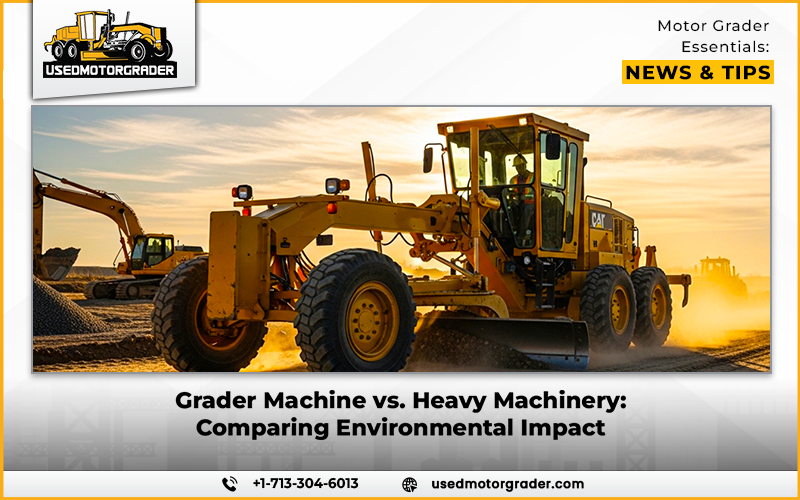
When we consider construction equipment, we tend to discuss power, performance, and durability. In the modern world, environmental impact is equally significant, though. Models of Grader machine and heavy machinery like excavators, bulldozers, and loaders are all important in a project, and their environmental footprint is vastly different. Whether it is fuel consumption, emissions, noise, or lifecycle costs, every kind of equipment has its consequences. Comparing these factors allows contractors to make smarter and sustainable decisions and still deliver the job effectively.
Fuel Consumption and Emissions
Fuel use is one of the biggest contributors to environmental impact.
- Graders usually use less fuel since they are lighter and are meant to accomplish specialized tasks such as leveling and finishing surfaces. Their smaller engines generate fewer emissions and, therefore, are efficient when they are engaged in light work.
- On the other hand, heavy machinery consumes much more fuel because they have big engines, and it often runs for long periods. Excavators and bulldozers, among others, tend to operate long hours, leading to increased greenhouse gas emissions.
- New emission legislation, especially Tier 4 in the U.S. and EU counterparts, has compelled manufacturers to build cleaner engines, although heavy machinery remains a greater challenge than graders. Essentially, graders are ahead in fuel efficiency, yet the two types require continued innovation to reduce their carbon footprint.
Noise Pollution in Operations
Another factor that is not given much attention regarding the environment is noise.
- The noises produced by graders are moderate. Their work can be carried out more easily in urban areas, as it does not cause too much disruption due to less digging and lifting.
- Heavy machinery is normally noisier. Bulldozers and loaders are disruptive to residential areas or sensitive areas such as schools and hospitals.
- Manufacturers are also developing noise-cutting technologies, including better engine insulation and quieter hydraulics. Nevertheless, graders have an inherently less noisy footprint, which makes them more versatile in noise-controlled areas.
Energy Efficiency and Usage Patterns
How the machine is used contributes so much to the environmental effects.
- A grader normally has a specific purpose, which is to prepare the surface. These processes do not require as much energy as excavation or hauling, and therefore, graders do not require much power on the whole.
- Heavy machinery usually handles multiple tasks, digging foundations, moving loads, or shifting earth, each requiring bursts of energy. What it all boils down to is that it is more efficient to match equipment to an appropriate task. Using heavy machinery for a task such as grading would be meaningless when a grader could do the same task at a much lower environmental expense.
Maintenance and Environmental Sustainability
Proper maintenance not only results in reliability but also reduces environmental damage. Grader machine:
- Require frequent maintenance of blades, tires, and engines.
- Maintenance also becomes easier, and the equipment generates fewer waste materials compared to larger machines. Heavy machinery:
- Requires more complicated maintenance, such as hydraulic systems, transmission parts, and bigger oil or fluid changes.
- The disposal of wastes is more complex, since the old fluids, filters, and worn-out parts accumulate more. With maintenance schedules kept up to date, operators are able to reduce emissions, increase the life cycle of the machine, and minimize the amount of waste that goes to landfills.
Carbon Footprint in Manufacturing and Lifecycle
Beyond operations, the production and end-of-life phases of equipment are also important.
- Graders have a less significant carbon footprint in the manufacturing process because they use fewer materials and components.
- There is more steel, hydraulics, and electronics involved with heavy machinery, which means that they release more carbon during production.
- Recycling and reuse will allow both graders and heavy machinery to minimize their long-term footprint. The salvaging of steel, the reuse of parts, and the proper treatment of fluids are all part of sustainability.
Technological Advances for Greener Operations
Fortunately, technology is keeping pace with environmental requirements.
- Hybrid and electric-powered machines are also starting to find their way into the construction industry, providing an alternative to diesel-powered machines.
- Telematics (a system for monitoring vehicles) enables the operators to monitor the idle time, fuel use, and performance information to prevent unnecessary environmental impact.
- Other alternative fuels such as biodiesel and renewable natural gas are also under consideration, and this would bring both graders and heavy machinery a clean future.
Long-Term Environmental Trade-Offs
Although it may seem that graders are the better choice, there is a bigger picture to it.
- Graders cannot be used in all functions, but are only restricted to particular functions.
- Heavy machinery is more resource-intensive but can also accomplish big jobs fast. This productivity sometimes offsets the extended emissions that using several smaller machines would otherwise cause.
The trick is in well-balanced fleet management to select the optimal combination of graders and heavy machinery and remain sustainable.
In Summary
When the environmental impact of a grader machine is compared to that of heavy machinery, it can be seen that graders, in most cases, are cleaner than heavy machines in terms of emissions, noise, and lifecycle costs. Nevertheless, large and complex projects still require heavy machinery, where productivity matters more than the space a machine occupies. To make construction more sustainable in the future, contractors, project managers, and operators should pay attention to adequate equipment choice, regular maintenance, and the introduction of more environmentally friendly technologies.
FAQs
Q1. Which is more fuel-efficient, graders or heavy machinery?
A: Graders are usually more fuel-efficient as they need less power to perform their specialized roles, whereas heavy machinery burns more fuel as they have larger engines.
Q2. How do emission regulations affect the use of construction equipment?
A: Such emission standards as Tier 4 make manufacturers develop cleaner engines, which have decreased the level of pollutants in both graders and heavy machinery.
Q3. Can electric or hybrid graders and heavy machinery significantly reduce environmental impact?
A: Yes. Hybrid and electric models can cut fuel consumption and emissions dramatically, making them a promising option for sustainable construction.
Q4. What role does maintenance play in lowering environmental harm?
A: Correct maintenance means that engines will perform effectively, use less fuel, and less oil, filters, and other parts will go to waste.
Tags: Grader Machines for Highways, Heavy Machinery for Sale, Used Grader Machines