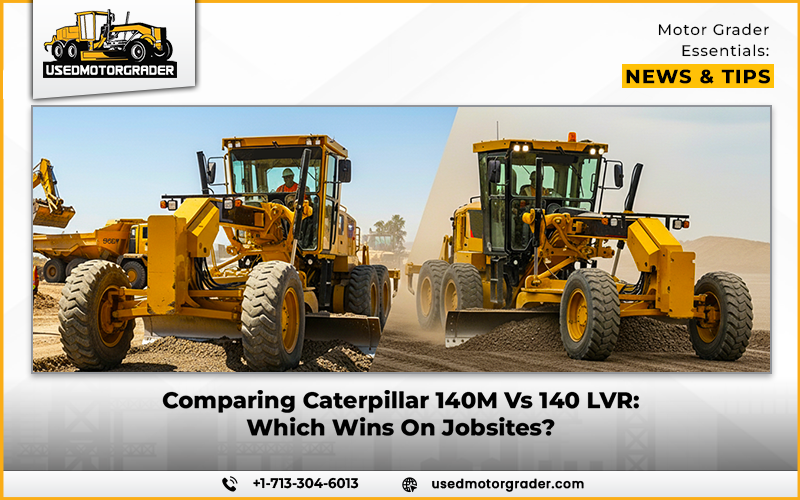
The problem with motor graders is that they can either keep your project on track or gradually reduce productivity in ways that are not noticeable until you are looking at your fuel expenses and wondering why you are behind schedule. You are looking at more than just equipment when contrasting the Cat 140M with the more recent 140 LVR, attempting to determine which machine will generate revenue.
For years, the 140M built a solid reputation by consistently turning up and completing tasks. Caterpillar’s next-generation upgrade, the 140 LVR, promises improved operator support and efficiency. So, which one wins on real job sites?
Understanding the Series
The 140M: Built to Last
Most operators have operated a 140M because it has been in production for a long time. You might expect 200–250 horsepower with a Cat C7 or C9 engine. These devices just continue operating, have simple controls, and have well-known mechanics. Units that receive regular maintenance routinely surpass 10,000 operating hours.
The 140M Cat motor grader for sale lives in base preparation, highway grading, and rural road construction. Because it encourages expertise, seasoned operators prefer it.
The 140 LVR: The Updated Version
The 140 LVR represents Caterpillar’s transition to more intelligent machinery, improved visibility, grade-ready technology that is truly integrated, and improved hydraulics. Although efficiency and control mechanisms have been improved, horsepower remains competitive in the 200+ range. It is intended for contractors that desire more smooth controls and more efficient operation when accuracy is crucial.
Side-by-Side Comparison of 140M vs 140 LVR — Key Specs
| Category | Cat 140M | Cat 140 LVR | Practical Jobsite Impact |
|---|---|---|---|
| Power & Performance | Up to 250 hp, powershift transmission, optional AWD | Similar horsepower range with improved fuel optimization and smoother transmission response | Both deliver strong grading power; LVR feels more refined and fuel-efficient in daily operation |
| Operating Weight & Handling | Approx. 20,000–23,000 kg | Optimized weight distribution for improved balance | Both maneuver well in tight spaces; LVR offers slightly better stability and balance |
| Blade & Moldboard | 12–14 ft moldboard, strong down pressure | 12–14 ft moldboard, strong down pressure | Similar cutting capability; LVR provides smoother blade control for finish grading |
| Hydraulics & Controls | Reliable, mechanically intuitive controls | Enhanced electro-hydraulic system with smoother modulation | 140M performs reliably for heavy cuts; LVR delivers greater precision for fine grading work |
Operator Experience — Comfort & Technology
Cab Comfort
Larger windows, greater sightlines, and enhanced ergonomics are all improvements made to the LVR cab. On 10-hour shifts, lower vibration and noise levels have an impact. Although the 140M cab is quite comfortable, it adheres to outdated design norms.
Technology Integration
The 140 LVR does not require aftermarket retrofitting to offer integrated grade control and camera displays. It matters when there is a shortage of trained operators. GPS integration on the 140M feels like adding features to an outdated platform.
Jobsite Performance — Real-World Perspective
Both machines work well for heavy cuts and harsh grading. Maintaining constant slopes during final grading is made simpler by the LVR’s sophisticated hydraulics. You will see the difference if you are working on tight-tolerance tasks.
What is best for where?
- LVR outperforms on urban locations in terms of visibility and maneuverability
- Extended highway travel – 140M’s proven tolerance delivers
- Confined spaces: Both are effective, although LVR’s sightlines are superior
Machines that reduce errors are more important as skilled operators become more scarce. Performance is improved by the LVR’s improved controls. Operator experience is more important for the 140M.
Cost Breakdown — Ownership Economics
Purchase Price
There are several used 140M versions available on the market at affordable costs. Because it is more recent, the 140 LVR has a higher initial cost.
Fuel Efficiency
Caterpillar said the upgraded platform has improved fuel optimization. That adds up to actual money over hundreds of hours.
Maintenance
The centralized service points in the LVR make daily checks easier. Every dealer has extensive knowledge of these machines, therefore the 140M benefits from established parts availability.
Lower acquisition cost? 140M wins. Lifecycle efficiency and long-term cost? The LVR makes a better case.
Pros & Cons Snapshot
| Model | Pros | Cons |
|---|---|---|
| Cat 140M | ✓ Proven reliability ✓ Strong resale market demand ✓ Lower upfront purchase cost |
✗ Older cab design ✗ Limited integrated technology features |
| Cat 140 LVR | ✓ Enhanced visibility and operator comfort ✓ Integrated grade-ready systems ✓ Smoother electro-hydraulic controls |
✗ Higher initial purchase price |
Common Buyers Concerns
- Which is easier for new operators?
The LVR’s modern controls reduce the learning curve.
- Which holds value better?
The 140M has had strong resale demand. As fleets modernize, LVR models might command premium value.
- Which is better for rentals?
The LVR’s user-friendly interface reduces misuse risk.
Unique Insights
Different machines prefer different types of work:
- Municipal Maintenance – The 140M’s affordability aligns with public works budgets
- High-spec Infrastructure – Tighter tolerances are supported by the LVR
- Agriculture Land Leveling – Both function well for agricultural levels, but the LVR minimizes rework
Future-proofing is important. Grade automation and telematics are increasingly commonplace. The 140 LVR is in line with current trends.
So Which One Wins? 140M or 140 LVR
Anyone who tells you otherwise is oversimplifying the situation; there isn’t a clear winner here.
- Choose the 140M if you require a product with a known resale market, cost-effectiveness, operators with a lot of experience, and proven durability
- Choose the 140 LVR if you want integrated technology, you care about long-term efficiency rather than simply upfront cost, operator comfort impacts productivity, and precision matters in your work
The cat motor grader for sale with the best specs on paper is not necessarily the best grader. It’s the one that fits your cost structure, operators, and task. Purchase wisely rather than cheaply.
FAQ’s
What distinguishes these two machines from one another?
The 140M is renowned for being rough and uncomplicated; it simply works. Newer technology and a more pleasant cabin are features of the 140 LVR. Compare a new update with a tried-and-true workhorse.
Which is superior, 140 LVR or 140M, for accurate grading?
Smoother hydraulics and integrated technology that helps maintain tight tolerances let the 140 LVR to handle fine grading more effectively. You’ll see the difference if you’re working on finishing tasks.
Does the 140 LVR really use less fuel than the 140M?
Indeed, it usually uses less fuel. Over a few thousand hours, the improved engine control results in significant savings.
Tags: 2008 Caterpillar 140M, Cat 140M Grader for Sale, Buy Used Motor Grader USA