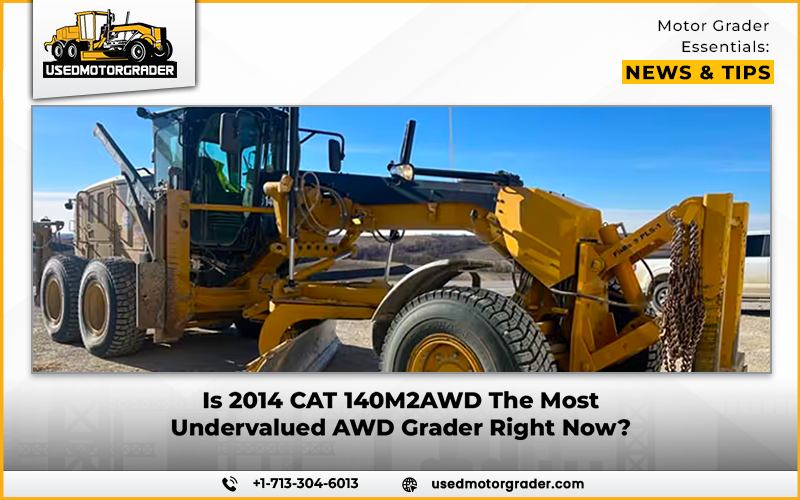
The current market of used motor graders does not necessarily equate price with capability. This gap is best exemplified by a few machines like the 2014 Caterpillar 140M2 AWD.
Although AWD-equipped models provide substantial performance benefits over their conventional drive models, the difference in prices between these models is usually very slight, or even almost the same, as compared to non-AWD models. The market clearly undervalues a high-potential machine, creating an evident inefficiency. The reason is not technical. It is behavioral.
What AWD Actually Changes in a Motor Grader
The 140M2 is not just an all-wheel drive, but it is a fundamental change in the way the machine communicates with the ground.
The system uses:
- Dedicated left and right hydraulic pumps, one per side, for precise front-wheel control.
- Infinitely variable torque allocation.
- Precise work mode hydrostatic drive.
- The system automatically boosts power by up to 45 kW (60 hp) above base output when AWD engages.
It also adds steering compensation, which automatically speeds up the outside front tire by up to 50% relative to the inside tire during turns, giving the operator better control in unfavorable conditions.
Operational impact:
- Greater power was passed to the ground.
- Less wheel slip in loose or wet material.
- Increased control in fine grading.
Better traction and torque control → less variable blade performance → increased grading accuracy and efficiency. This is the point at which AWD starts to be more efficient than standard configurations in quantifiable terms.
Productivity Gains That Are Often Overlooked
AWD not only concerns mobility but also has a direct impact on productivity. The hydrostatic front-wheel assist permits:
- Low-speed, smooth, controlled movement.
- Improved stability of the blade during finish work.
- Less interruption due to loss of traction.
What this translates to:
- Minimized efforts in rugged terrain.
- Fewer passes to achieve the target grade.
- Greater productivity on an hourly basis.
Stable traction + controlled movement → reduced corrections and delays → increased job completion performance. These are real gains that are not necessarily indicated in pricing.
Why Warm-Climate Markets Undervalue AWD
Geographic bias is the largest cause of undervaluation. In regions such as Texas, the Southwest United States, and the Middle East, the conditions at the jobsite are normally dry, hard-packed, and predictable.
Mentality of buyers in these markets:
- AWD is seen as unnecessary.
- Price is the major decision factor.
- Standard drive models are regarded as good enough.
Perception of low necessity → reduced demand for AWD units → pressure on resale price downwards. This brings about a mismatch between real ability and perceived worth.
Pricing Inefficiency Between AWD and Standard Models
In a perfectly competitive market, graders with AWD would have an obvious premium since they are more efficient.
But present pricing practice indicates:
- Very little dispersion between AWD and non-AWD 140M2 units.
- In other instances, close price parity based on location.
- Quickened price bargaining on AWD units in dry markets.
What drives this:
- Lack of buyer awareness of AWD benefits.
- Regional demand imbalance.
- Increased supply visibility as compared to demand.
Poorly valued feature set → weaker buyer competition → non-performance advantage pricing. And this is where the 2014 140M2 AWD will be underestimated.
Regional Demand Imbalance Creates Arbitrage Opportunities
Whereas warm areas underestimate AWD, other areas rely on it. Where the market is colder or variable (such as the Northern U.S. or Canada):
- Snow and ice need regular traction.
- Thaw and mud cycles decrease the stability of the ground.
- Operational risk is heightened by seasonal variability.
Result:
- The demand for AWD is much greater.
- Customers are very active in front-wheel assist.
Strong demand in certain areas + low demand in others → pricing gaps across markets. This creates an opportunity: machines underestimated in one place command firmer pricing in another. The 2014 140M2 AWD is right in this imbalance.
Lifecycle Cost Advantages That Buyers Often Miss
In addition to the purchase price, AWD has an effect on long-term economics.
Key benefits:
- Less downtime due to traction delays.
- Reduced chances of on-site disruptions.
- Increased regular output.
Additionally:
- Increased traction decreases rear tandem stress.
- Better control reduces surface damage during operation.
Better operational consistency → reduced number of delays and corrections lower cost per completed job. Buyers in the used market typically overlook these lifecycle advantages.
Operator Perspective: When AWD Becomes Critical
According to the operator conversations and industry sentiment, AWD is not always a necessity but when the conditions vary, it is.
Consensus:
- Normal drive is suitable in dry and stable environments.
- AWD becomes critical in wet subgrades, loose aggregate, and snow and ice.
Practical takeaway: Operators don’t use AWD every day; however, it significantly improves performance when needed. Situational necessity → perceived value inconsistency → unstable pricing pattern. Such inconsistency leads to undervaluation.
Export and Secondary Markets Value AWD More
AWD commands stronger demand outside warm-climate regions. In most foreign markets:
- The conditions of the terrain are less predictable.
- There is a wide difference in infrastructure.
- Equipment should be able to cope with a broader environment.
Result:
- Operators regard AWD as a necessity rather than a choice.
- Customers attach more importance to versatility.
Higher functional reliance → increased demand for AWD units → improved resale in the long-term. This supports the notion that the existing prices are not fully representative of the global demand.
Why the 2014 140M2 AWD Is Undervalued
The 2014 Caterpillar 140M2 AWD is not undervalued because of any lack of capability; the market simply fails to recognize its benefits regularly.
It offers:
- High-quality traction and torque distribution.
- Greater output under adverse circumstances.
- Reduced lifecycle inefficiencies.
- Greater attractiveness in particular regional and export markets.
Yet:
- The demand in warm climates lowers prices.
- The buyer’s perception is more concerned with cost rather than capability.
- Value is distorted by supply-demand imbalances.
The result: a machine that performs better than its cost indicates. That puts it at the top of the list of overlooked opportunities in the existing used grader market.
In need of high-capability machines that have been neglected and offered at competitive costs? Before the market adjusts the value of its products, visit usedmotorgrader.com to monitor listings such as the 2014 Caterpillar 140M2 AWD.
FAQs
1. What makes the 140M2 AWD different from standard models?
A: It has hydraulic front-wheel drive to enhance traction, control, and grading performance in adverse conditions.
2. Why is the 140M2 AWD undervalued in the used market?
A: Most customers in hot weather are not concerned with AWD, and this decreases demand and keeps the prices below the projected price.
3. When is AWD most beneficial in a motor grader?
A: On mud, snow, loose material, and unstable ground, where traction is very important to sustain productivity.
4. Does AWD improve long-term operating costs?
A: Yes, it will save time, decrease rework, and increase the efficiency of the job in general, reducing the cost of a completed task.
Tags: 2014 Caterpillar 140M2, Caterpillar 140M2 Motor Grader, Used Motor Graders for Sale in USA