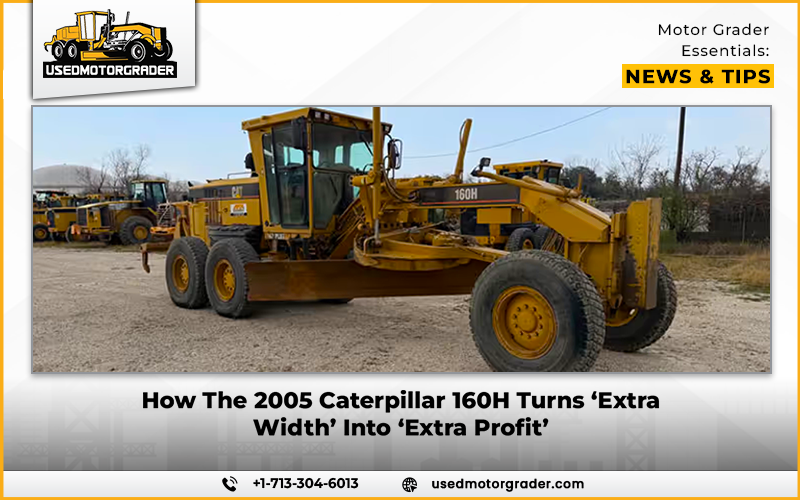
Why Moldboard Width Matters in Grading Profitability
The 2005 Caterpillar 160H has gained a reputation as one of the most reliable motor graders of its time, although there is one aspect that contractors discuss when it comes to productivity, and that is its generous 14-foot moldboard. That additional width may not appear revolutionary on paper. Practically, it may translate into reduced passes, quicker job turnover, and increased margins. In grading, width is not merely a measure; it is a multiplier of efficiency. The more material that a machine moves in one pass, the more value each hour on the meter adds to your bottom line.
To the contractors who are weighing the fuel prices, labour costs, and the strict deadlines in the project, that additional width may silently translate to additional profit.
Technical Overview of the 2005 Caterpillar 160H Grader
It is best to know the machine before getting into profitability. The 160H was intended to be used in heavy road work, site preparation, and large-scale grading.
- Cat C9 engine with ACERT technology providing 180 to 200 Variable Horsepower (VHP).
- Standard 14 ft (4.3 m) moldboard, with optional specifications based on market.
- Typical operating weight ranging from 37,000 to 41,000 lbs based on equipment.
- Direct drive powershift transmission to shift gears smoothly and efficiently.
- Advanced load-sensing hydraulics for accurate blade articulation and load response.
These specifications place the grader in the middle-to-large category of specifications, strong enough to be used in demanding operations, but agile enough to complete tasks.
The “Extra Width” Advantage: How a Wide Moldboard Drives Efficiency
It starts with the story of profit with the 14-foot blade. On long roads or broad pads of construction, the width of the blade is a direct factor in production.
- Surface Coverage: The larger the surface coverage per pass, the fewer the grading cycles.
- Material Volume: The broader moldboard allows a larger volume of material to be cast effectively.
- Fuel Consumption: Reduced overlap minimizes wasted movement and lowers fuel consumption.
- Consistency: Greater consistency in the finish grading on wide surfaces.
- Output: Increased hourly output on highway and infrastructure projects.
Suppose you were grading a mile of country road. A smaller machine, like a 140H with a 12-foot blade, might need more passes to cover the same area. The additional passes would translate into large fuel and labor expenses over hundreds of projects. That redundancy is minimized by the 2005 Caterpillar 160H’s broader moldboard.
Operator Feedback: Real-World Productivity Insights
Veteran operators often mention how well the 160H maintains its balance despite its size. They use the machine’s visibility, hydraulic responsiveness, and precise blade control to fully take advantage of that additional width.
- Fewer Maneuvers: Lots of operators have fewer repositioning maneuvers on wide roadbeds.
- Windrow Control: Large windrows can be controlled effectively because of smooth articulation.
- Comfort: The cab is designed to minimize fatigue during extended grading shifts.
- Stability: The stability of the blade facilitates accuracy in work.
- Speed: Production is significantly faster on open sites than on smaller graders such as 120-class models.
Skill still matters. A broad moldboard in the hands of a greenhorn will not necessarily bring in profit. However, when combined with a skilled operator, the machine’s physical dimensions maximize output per pass.
Cost Savings Through Fewer Passes and Fuel Efficiency
Operators usually measure the profitability of heavy equipment by calculating the cost per hour and the cost per cubic yard moved. The additional width is a direct contribution to both.
- Project Hours: Reduced passes reduce the total engine hours per project.
- Fuel Economy: Less fuel is burned to travel over the same distance.
- Tire Maintenance: Reduced cyclic wear of tires due to reduced repetitive cycles.
- Labor Allocation: Reduced labor costs, reduction of job time.
- Bidding Power: Better competitiveness in bidding as a result of increased production rates.
Contractors are able to redeploy crews to new jobs earlier when the projects are completed faster. The higher the use of equipment enhances the yearly returns on investment.
Resale Trends and Market Value
The 160H remains a force to reckon with in the used equipment market despite being two decades old. This long-term demand is caused by a number of factors.
- Reliability: Good reputation for mechanical reliability and durability.
- Serviceability: Basic electronics versus more modern, highly computerized ones.
- Parts Network: Regular supply of parts due to the global network of Caterpillar.
- Demand: The developing markets are in need of powerful, mid-sized graders.
Well-maintained units typically command strong resale prices compared to competitors of the same age. Buyers are aware that the 14-foot moldboard is a productivity advantage years later.
Comparison with Other Grader Models
You can best appreciate the width advantage when you compare the machine with narrower models.
- 140 vs 160: A large number of 140-class and 120-class graders have 12 ft moldboards.
- Pass Reduction: Two additional feet can decrease the number of passes by a significant amount on large jobs.
- Subgrade Work: Extended coverage facilitates rapthe id accomplishment of road subgrade work.
- Urban vs Rural: Smaller machines can be more agile in the crowded city, while the 160H is faster in open rural road construction.
The 2005 Caterpillar 160H is commonly faster than smaller graders in open construction in terms of area covered per shift.
Best Practices for Maximizing Profit with a Wide Blade Grader
The possession of a large moldboard grader is not the entirety of the equation. To maximize its potential:
- Blade Angle: Keep the blade angle at the optimum to minimize drag and fuel wastage.
- Pass Management: Excess overlap of passes should be avoided.
- Sharp Edges: Always keep edges sharp to remain efficient.
- Tire Maintenance: Check tire pressure and alignment to reduce wear.
- Training: Train operators in windrow management and material flow methods.
Turning Extra Width Into Extra Profit
Blade width might appear to be another specification on a brochure at first. As a matter of fact, it affects productivity, fuel consumption, and the time required to complete the job in a concrete manner. The Caterpillar 160H of 2005 illustrates the effectiveness of careful machine sizing to create efficiency in various cost categories.
Contractors who aim to maximize profit for every hour of moldboard operation can turn the additional two feet of width into fewer passes, lower fuel consumption, and faster project completion. That’s how extra width quietly turns into extra profit.
FAQs
1. How does blade width affect grading productivity?
A: The width of the blade will dictate the amount of surface area that can be graded at once. A broader moldboard (like the 14-foot version on the 160H) will decrease the number of passes needed, which results in a higher efficiency rate and reduces the fuel and labor expenses.
2. Is the 2005 Caterpillar 160H still a good investment today?
A: Yes, its durability, high mechanical design, and resale value are appreciated by many contractors. It is competitive in road construction and large grading projects when in good condition.
3. What types of jobs benefit most from a 14-foot moldboard?
A: The most beneficial projects include highway construction, rural roads maintenance, airport runways, and large commercial site preparation projects because of the expansive open surfaces.
4. Can a wider moldboard ever be a disadvantage?
A: Operators may experience slightly reduced manoeuvrability compared to smaller graders when working in crowded urban areas or confined job sites. A thinner blade may provide more flexibility in such situations.
Tags: CAT 140H grader for sale, CAT 140M motor grader, Caterpillar 12M for sale