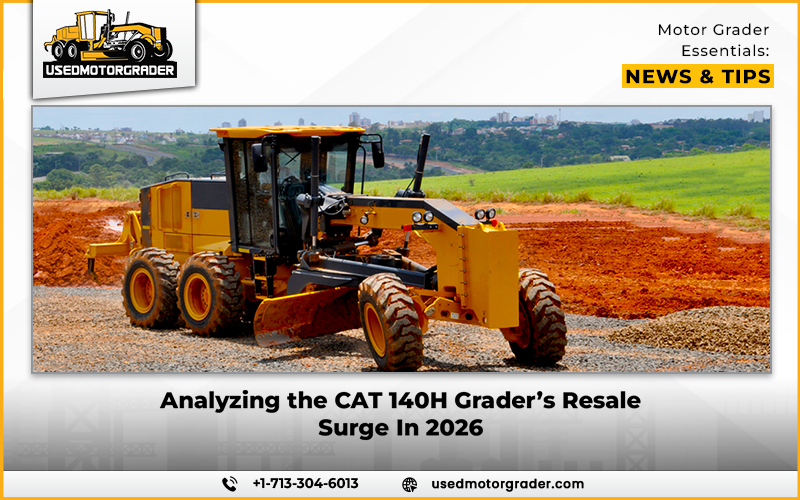
In 2026, there is something strange occurring in the used equipment market. Contractors are paying good money for machines that are almost twenty years old, and the CAT 140H is right at the center of this trend. Well-maintained Used CAT 140H graders are frequently fetching higher relative prices than newer, technology-intensive graders that are full of sensors and software. It might sound counterintuitive, but it is indicative of a rising trend in the way fleets place a premium on reliability, simplicity, and predictability in long-term operations.
This isn’t nostalgia. It’s a strategy. The 140H has become a refuge for those contractors who want iron that operates without digital headaches as emissions standards get stricter and machine electronics get more complex.
Why the 140H Still Commands Attention
The CAT 140H was known as a workhorse long before emissions laws changed equipment design. Its fundamentals still resonate with working fleets today.
- Established structural stability from decades of grading work.
- Refined hydraulic systems with a focus on tactile operator feel.
- Good familiarity for operators across multiple generations.
- Superior availability of parts, even though it is an older model.
- An extended history of road construction, maintenance, and site preparation.
For many buyers, the 140H represents proven performance instead of the theoretical efficiency advertised by newer platforms.
Engine Design as a “Safe Haven”
The engine is at the core of the Pre-Tier 4 premium. Caterpillar typically equipped the 140H with engines like the 3176C or the 3306, which do not require the complex aftertreatment systems found in modern machines.
- None of the DEF systems needs to be checked or refilled.
- No DPF filters that need to be regenerated.
- No SCR systems connected to sensors and software logic.
- Electronic Unit Injection (EUI) systems that are reliable and well-understood.
- Less challenging troubleshooting without proprietary, vendor-specific diagnostic tools.
These engines are a welcome relief as Tier 4 Final and newer standards continue to push complexity upward. The fact that the Used CAT graders 140H are highly predictable is one of the primary reasons the product remains popular among buyers who value uptime.
Why Newer Graders Aren’t Always the Better Investment
Contemporary graders are not out of place. Blade control, built-in GPS, and data tracking can be effective tools. However, those advantages have their tradeoffs.
- Emissions hardware adds extra layers of maintenance and potential failure points.
- Machines may be brought to a standstill due to software bugs.
- Diagnostics that are dependent on dealers increase the cost of service.
- Both operators and technicians face increased training requirements.
These extra layers do not necessarily translate into value, especially when the work does not require millimeter-level precision. Conversely, a 140H is purely about grading performance.
Resale Market Dynamics in 2026
The resale boom is not a coincidence. Regulation, infrastructure investment, and fleet risk management influence this market behavior.
- Graders continue to work longer on infrastructure projects rather than being sold.
- Owners prefer to keep good machines instead of upgrading.
- Low availability of clean, low-hour units drives prices up.
- Buyers are competing to acquire machines with solid maintenance records.
Well-maintained Used CAT graders 140H are sold fast, usually before they are even advertised. Such scarcity supports the premium.
Lifecycle Costs Tell the Real Story
Purchase price is not the only reason the 140H is so appealing in 2026. Lifecycle cost is where it really works.
- Reduced electronic breakdowns during extended service periods.
- Lower costs for diagnosis and labor.
- None of the emissions consumables to plan for.
- Ability for units to be maintained by independent shops or in-house.
- Regular maintenance rather than unexpected downtimes.
In the calculation of cost per hour over 10 or 15 years, the math usually favors older, simpler machines.
Regional Demand and Job Type Fit
Automation is not equally applicable to all projects, and that is where the 140H fits perfectly.
- Maintenance of rural roads where speed is less important than consistency.
- Gravel and haul road grading.
- Seasonal and snow removal services.
- Mixed fleet secondary grading positions.
- Areas with limited dealer or software support.
The 140H works precisely as anticipated, day in and day out, without the need for digital infrastructure.
Operator Preference Still Matters
Technology does not take over experience, and most veteran operators are fond of machines they know how to run by feel.
- Recognized control patterns lessen exhaustion.
- Enhanced tactile feedback and manual control.
- Increased focus on the job rather than monitoring digital screens.
- Experienced operators can be onboarded faster.
Fleet managers tend to underrate the direct relationship between operator confidence and productivity.
Comparing Inflation Resistance
The 140H is an excellent investment in uncertain economic times. Newer machines have a steep depreciation curve due to rapid changes in technology, whereas older mechanical-heavy graders have a flatter value curve. This makes a clean 140H nearly inflation-resistant against fast-changing technology platforms.
A Machine That Refused to Become Obsolete
The rise of the Pre-Tier 4 premium is not a rejection of progress. It is about using the right tool for the job. The CAT 140H did not get valuable again; it never lost its value. The market simply caught up. The Used CAT graders 140H are one of the most logical acquisitions a contractor can make in a market where everything else is digital.
FAQs
1. Why are older CAT 140H graders increasing in value?
A: Their lack of complex emissions hardware and their predictable maintenance requirements make them highly desirable as newer machines become more complicated and dealer-dependent for service.
2. Are Pre-Tier 4 machines still legal to operate?
A: Yes, in the majority of areas they are legal, particularly in off-road and construction applications, though specific local air quality regulations may apply in certain metropolitan regions.
3. Do 140H graders cost more to maintain due to age?
A: Not necessarily. While older machines need routine part replacements, most owners record reduced total costs due to fewer electronic and emissions-related failures that typically cause expensive downtime on newer units.
4. Is the 140H a good long-term investment in 2026?
A: A well-maintained 140H can be a powerful long-term asset for contractors who are concerned with uptime and resale stability, as these machines tend to retain a high percentage of their value in the current market.
Tags: 140H price guide 2026, 2001 CAT 140H, 2008 Caterpillar 140M