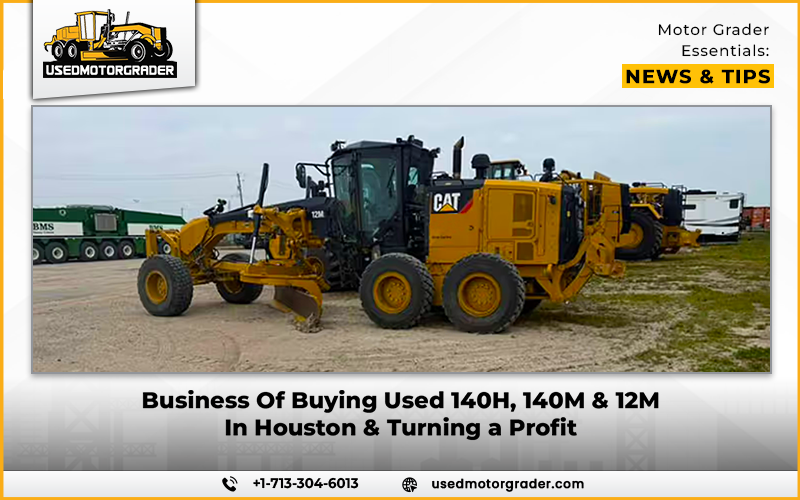
Why Flipping Used Motor Graders Is a Profitable Niche
The flipping of used heavy equipment is a reliable small-business model when it is done with discipline. The increased cost of new equipment, the tightening of capital budgets, and the desire of contractors to use tested machines in particular make used motor graders particularly appealing. Graders are tough, serviceable, and in many cases have a long service life, features that retain resale value longer than many other machines. In the case of refurbishers and small shops, this brings about predictable margins when you purchase right, fix intelligently, and sell openly.
On road building, site preparation, drainage, and utility projects, grader machines are necessary. Their main parts, such as engines, transmissions, hydraulics, and steel structure, are rebuildable, and this makes the refurbishment expenses within a range that allows resellers to charge competitively, and still make a significant profit. Brand recognition is also important: the machines of well-known manufacturers bolster buyer confidence, reduce perceived risk, and increase sales. That is why Caterpillar machines are so demanded.
A Strategic Guide to the Houston Caterpillar Market
The local market forces are important to any person flipping graders in or around Houston. The graders are in constant demand due to the graders being used in the steady construction pipeline in Houston, the municipal maintenance programs, and the energy-related projects. That liquidity matters: a listing for a “Caterpillar motor grader for sale in Houston” will attract significantly more traffic than a distant listing, shortening holding time and cutting carrying costs.
This guide covers the entire process, how to find a Caterpillar motor grader for sale, how to inspect and trial it, a tight refurb workflow, parts-sourcing tactics, model-by-model profit scenarios for the 12M, 140M and 140H, and proven resale strategies that work for listings such as “motor grader for sale in Houston” and “Caterpillar (12M, 140M, 140H) for sale in Houston.” This is a useful playbook to think of as small refurb shops, entrepreneurs, and used-equipment dealers that seek repeatable profit instead of guesswork.
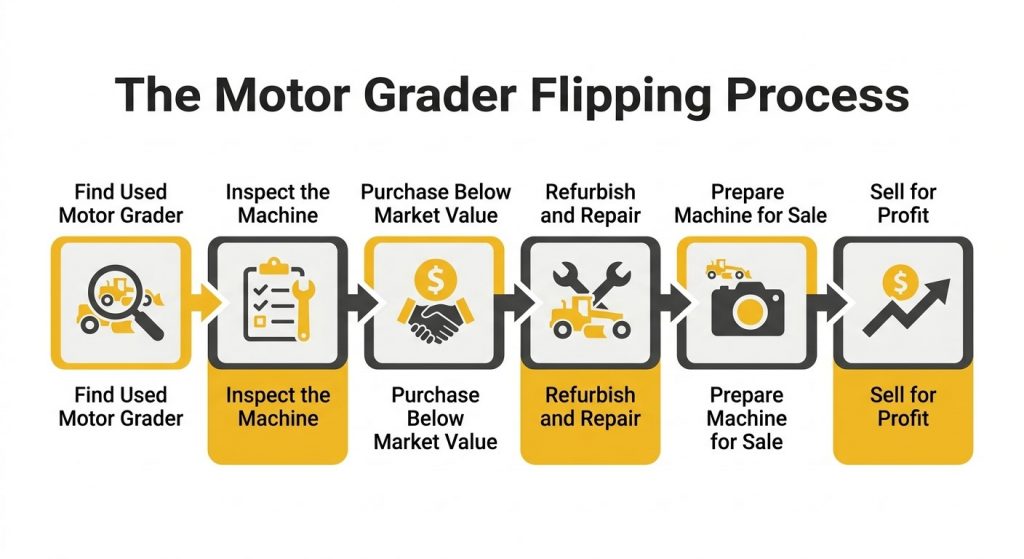
Houston’s Used Motor Grader Market: Demand and Opportunities
The construction and infrastructure cycle in Houston provides the repetitive need for motor graders. Grading work is required on major highways, neighborhood streets, commercial pads, and stormwater projects. Big civic projects such as road widening, drainage retrofit, and airport repairs are a regular occurrence that boosts local demand for machines that can be delivered and deployed within a short time. Periodic spikes of demand are also caused by heavy energy and site-prep work in adjacent industrial corridors.
The major purchaser groups in the Houston metro are:
- Small and intermediate contractors who want to get reliable and ready-to-work machines.
- City fleets and road maintenance departments that favor established platforms.
- Rental houses that include graders in their mid-size and specialty fleets.
- Agricultural and land-development companies plowing acreage or constructing access roads.
- Energy and site contractors on pads, pipeline access roads, and reclamation.
Buyers normally browse in three categories of conditions:
- Ready-to-work: machines that are in good condition and can be deployed at any time; such machines will appeal to contractors who require minimal downtime.
- Refurbished: those that have mechanical repairs done and have lighter cosmetic work to do; this middle band is favored by the mid-size fleets.
- Core units: machines are sold as-is and need mechanical care; these are the main targets of refurbishers and flip businesses.

Market signals to watch:
- Inflation of prices in construction booms and highway funding cycles.
- The seasonal demand is high because of projects that are active in spring and fall.
- A consistent demand in the mid-size graders, such as the 140 series and the all-purpose 12M, to do specialized site work.
When you schedule buys and listings to fit these cycles, particularly in a market as dynamic as Houston, you minimize holding time and maintain margin. When a well-prepared grader appears as a “motor grader for sale in Houston” during a demand uptick, you’ll typically see stronger offers and a shorter days-on-market window.
How to Find a Caterpillar Motor Grader for Sale in Houston
The most effective location to find graders to flip is a specialized marketplace that deals with motor graders. To the buyers and sellers in Houston, the listings on UsedMotorGrader.com would be a good starting point since the site will be able to consolidate listings of models, pictures, hours, and location information that directly responds to the intent of buyers.
The reason why a niche marketplace is effective:
- Graders have curated listings, which reduces the clutter of heavy-equipment.
- It is easy to compare similar model years, hours, and prices.
- Serial numbers and sets of photos are usually listed.
- The location filters enable one to easily locate machines within or around Houston.
Common buyer search phrases:
-
- “Caterpillar motor grader for sale”
- “Caterpillar motor grader for sale in Houston.”
- “motor grader for sale in Houston”
- “12M Caterpillar for sale in Houston”
Filtering tips:
- To remove irrelevant listings, narrow to model and series (12M, 140M, 140H).
- Filter through your target buy band with hours and price sliders.
- Listings with service history and good photos of the circle, blade, engine bay, and cab should be given priority.
Pre-Travel checklist:
- Hour meter reading and recorded service history.
- Images of blade, circle, articulation, and engine bay.
- Any apparent structural damage or intensive welding.
- Chain-of-custody and UCC searches for ownership verification.
- The reason of sale and the timeline of the sale by the Seller.
Communicating with sellers: direct, clarifying questions before going to inspect. Example starter questions:
- Have there been any major repairs or engine work done on the machine lately?
- Is there any known leakage of hydraulics or transmission symptoms?
- Please give the serial number and maintenance records.
- Is the machine in operation on a short field trial?
Apply a standardized screening process. The most successful flips begin with disciplined purchasing: put bids on machines that match your price formula as opposed to your wish list.
Pre-Purchase Inspection: Avoiding Expensive Mistakes
The most important thing during the flip process is buying the correct machine. An astute pre-purchase inspection and a planned field trial can provide insight into the issues you can address within your budget and problems that are likely to exceed your margin.
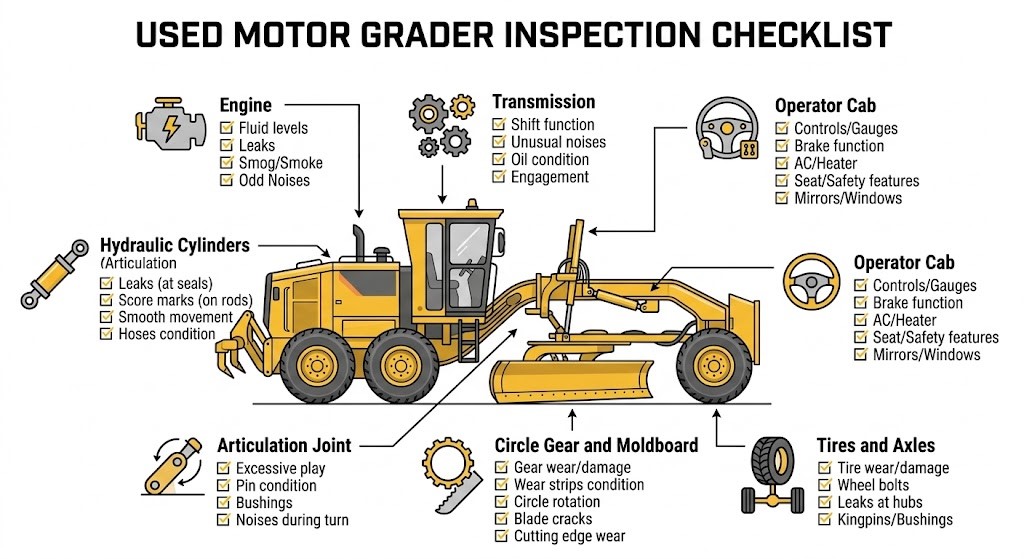
Important points to check and look at the engine
- Cold start: a clean and quick start shows the state of the compression and fuel system.
- Smoke: The smoke during start-up may be normal light white smoke, but continuous blue or black smoke under load is an indication of oil burning or fuel problems.
- Oil condition: metallic shine or sharp burning odor is evidence of internal wear.
- Cooling: radiator status, coolant cleanliness, and a leakage of coolant.
Transmission
- Shifting: gears must not slip under load and must have a smooth range.
- Listen for unusual noises; grinding or excessive whining under load usually indicates gear wear or bearing failure.
- Temperatures: overheating on the short load cycles may indicate internal issues.
Hydraulics
- Cylinder rods, pitting on rod surfaces increases seal failure; light pitting is easy to manage, serious pitting is costly.
- Hose condition: broken or chafed hoses are prone to future leakages.
- Pump response: a weak or slow response may be a sign of pump wear.
Articulation and frame
- Welds and cracks around the joint of the articulation and frame junctions.
- Frame straightness: significant in assessing the travel of blades and tandem alignment.
- Look for irregular, non-factory welds as an indication of structural repairs; clean factory welding is the standard.
Circle and moldboard
- Circle gear wear: excessive or noisy circle rotation will most likely indicate a gear or bearing replacement.
- Moldboard flange and cutting edge: check wear and examine worn mounting points, which may be bent or broken.
- Scarifier/ripper teeth: worn teeth are a low-cost solution; broken assemblies are more expensive.
Operator cab and controls
- Controls: Test the mechanical “piano bar” levers on the 140H or the joystick responsiveness on the M-series models.
- Gauges and warning lights: ensure hour meters and service reminders.
- HVAC and visibility: comfort characteristics have an impact on perceived value among contractors.
Checklist of inspection (bring to the site)
- Check the engine compartment, oil, filters, and belts.
- On a cold start, record the smoke, idle, and oil pressure.
- Perform a short load test and verify transmission engagement.
- Response and visible leaks. Check hydraulics.
- Check the circle and moldboard.
- Assess frame and articulation for cracks or welds.
- Check tires, tandem alignment, and axle condition.
- Check the serial number and check the service record.
- Record time-stamped photographs and a short video of the operation.
7-Day Field Trial Plan (what to measure daily)
- Day 1 — Cold start, idle behaviour, visual inspection, baseline photographs, and oil sample.
- Day 2 — Light grading: blade response and preliminary fuel burn estimates.
- Day 3 — Medium load operations: log shift behavior, temperatures, and any noises during moderate load.
- Day 4 — Intensive cutting activities: press the engine and transmission; observe slipping or smoky combustion.
- Day 5 — Hydraulic stress test: full-circuit running of blades to show any leak or heat accumulation.
- Day 6 — Continuous operation endurance: 3-4 hours of running to ensure thermal stability and fluid leakage.
- Day 7 — Final inspection: comparison of oil analysis results (where applicable), completion of operator feedback, and review of cost-to-repair decisions.
Typical lurking issues that murder margins.
- Worn circle drives: costly to fix and would be overlooked during the short-term test.
- Hydraulic pump failure: the reman or new pump costs and lead times may blow holding costs.
- Frame misalignment or concealed cracks: these may be found upon excessive use.
- Complex electrical faults: intermittent sensors or wiring issues, which are expensive to track.
- Rebuilds on transmission: may be the most expensive one-time cost and a deal-killer when unanticipated.
Step-by-Step Refurbishment Workflow
A profitable flip presupposes a typical workflow; work on each machine as a project with milestones, rather than a sequence of improvisations.
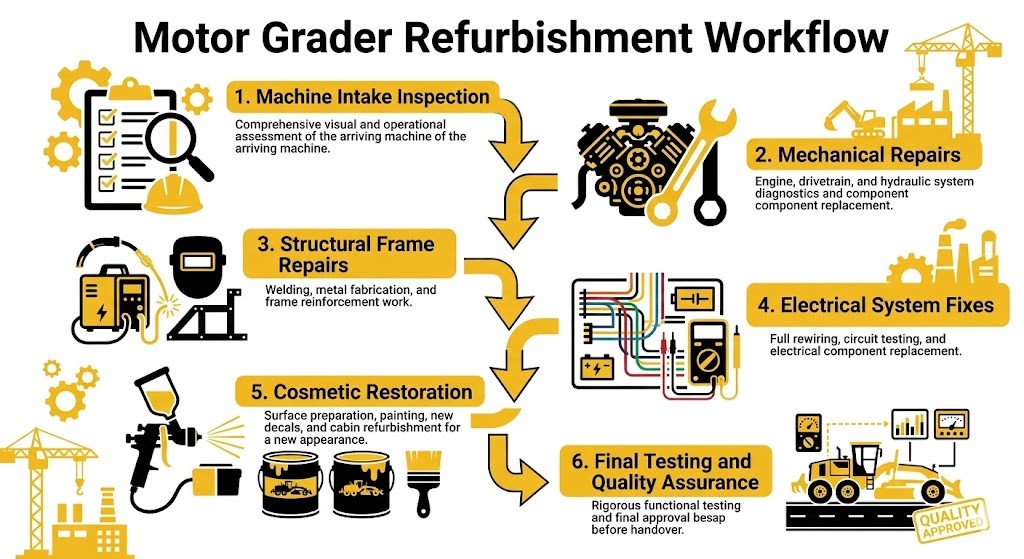
Step 1—Intake and documentation.
- Photo set: nine stock shots, front, rear, left, right, blade close up, circle close up, engine bay, cab interior, hours plate.
- Prepare a work order: enumerate observable defects, observable mechanical symptoms, and a signature of acceptance of the machine state by the owner.
- Baseline testing: document the hours of initial operation, sample the oil, and record the initial fuel burn where possible.
Step 2 — Triage and cost estimation.
- Separate work into mechanical (must-fix) and cosmetic (value-add) buckets.
- Use this simple buy formula: Maximum Purchase Price = Target Resale, (Expected Repair + Holding + Transport + Fees + Desired Profit).
- Do the repairs that unlock the greatest value: engines, transmissions, and major hydraulics are the highest on the list.
Step 3 — Mechanical repairs (priority of highest importance)
- Engine service: filters, injectors, turbo services, valve services, and leak repairs.
- Transmission: diagnose slipping or noise; minor work to the control valves may cost less than a rebuild.
- Hydraulics: reseal cylinders, reman pumps where it is required, replace broken hoses, and recondition control valves.
- Steering and brakes: essential to the safety of the operator and confidence of the buyer.
Step 4 — Structural repairs
- Frame welding: hire someone who has experience in welding cracks and stress points instead of making micro fixes.
- Articulation pins and bushings: replace worn-out pins, resleeve journals where needed.
- Blade mounts and cutting edges: position, fit new pieces of edges, and clearances.
Step 5 — Electric and controls
- Dash and gauge check: adjust failing gauges and replace faulty switches.
- Sensor checks: make sure that engine and hydraulic sensors are operating during test runs.
- Replacement of chafed or brittle wiring looms.
Step 6 — Cosmetic refurbishment (priority spending list)
- Clean the machine using a power wash.
- Paint only visible, high-impact areas; consider partial repaint, which concentrates on hood, cab, and moldboard.
- Replacement of seat cushion or cover; washing or replacing of rubber mats.
- Install and repair glass and lights.
- Apply fresh decals and a professional service sticker, noting the current machine hours and the most recent maintenance date.
ROI ranking for common tasks
- Hydraulic repairs — High impact (restores functionality and customers’ trust).
- Engine servicing — High impact (has direct performance and inspection implications).
- Transmission fixes — High impact but variable cost.
- Cosmetic repaint — Medium impact (enhances value fast).
- Upgrades to cabin comfort — Medium impact (impacts operator perception).
Step 7 — Final QA and sale preparation.
- Operate the machine for at least two hours under load.
- Finish a QA log: temperatures, fluid, and post-repair noises, control functionality.
- List a brief repair list and attach invoices and parts information with the sale packet.
- Make a final professional photo set and a short video presentation of the operation.
Parts Sourcing and Cost Control Strategies
Good parts sourcing differentiates profitable shops from the rest. Know what elements you need to source OEM/reman and which ones you can accept aftermarket.
Parts tiers
- Critical OEM / reman: engine components, turbochargers, key transmission parts, and hydraulic pumps are sometimes necessary to be remanufactured or OEM in order to be reliable.
- Wear: cutting edges, pins, bushings, and filters can be aftermarket to save money.
- Cosmetic: glass, lights, and seats are usually cheap, used, or aftermarket parts.
Channels and tactics of sourcing.
- Have a connection with the dealer parts counters in the local area when needed for rare or expensive items in order to reduce lead time.
- Get good remanufacturers of pumps and big components; reman units are usually offered with small warranties, which minimizes risk.
- Keep on hand a small toolkit: typical seal, hose, filter, cutting edges, and fasteners. Parts kit of 2k-5k hastens turnaround.
- Offer bulk discounts on other items that can be anticipated, such as cutting edges and seal kits.
Cost control techniques
- Rebuild when the labor/parts math is in favor of rebuilds.
- Look up part numbers of suitable alternatives in the aftermarket that won’t impair resale value.
- Track lead-time and incorporate it into holding-cost estimates.
- Maintain an easy inventory and re-order trigger list to minimize emergency procurement premiums.
Examples of representative part costs (illustrative).
- Cutting edge: $300–$700
- Hydraulic pump reman: $1,500–$4,000
- Cylinder seal kit: $200–$600
- Seat replacement: $200–$800
Caterpillar 12M vs 140M vs 140H: Key Specifications Buyers Should Know
Know how the models are different in terms of their technicality before purchasing, since specifications determine the level of repair and resale value.
| Specification | 12M | 140M | 140H |
|---|---|---|---|
| Engine Power | ~190 hp | ~200 hp | ~185 hp |
| Operating Weight | ~41,000–43,000 lb | ~42,000–46,000 lb | ~42,000 lb |
| Blade Width | 12 ft | 14 ft | 12–14 ft |
| Transmission | Electronic Powershift (Joystick) | Electronic Powershift (Joystick) | Direct Drive Power Shift |
| Hydraulic System | PPPC Load Sensing | Advanced PPPC Load Sensing | Standard Load Sensing |
| Technology Level | Modern electronic controls | Advanced machine controls | Mostly mechanical |
| Ease of Repair | Moderate | More complex | Easier |
| Typical Applications | Road grading, site prep | Heavy construction | General grading |
The reason behind such specifications during flipping of a grader.
- Machines with greater horsepower are likely to fetch greater resale value.
- PPPC hydraulic systems are highly efficient but require precise maintenance.
- Electronic systems enhance performance and augment diagnostic complexity.
- The width of a blade can influence the machine to be used in particular jobs in grading.
The importance of specs to flippers.
- Resale value may be greater because of increased horsepower and sophisticated control systems, but the diagnostic and repair costs may be expensive.
- Less complex mechanical systems reduce the uncertainty of repairs and can be turned over more quickly.
- The width and weight of the blade will influence the contractors who will choose the machine to do their work.
Quick Reference: Refurbishment & Demand
This chart provides a high-level overview of the logistical and market factors for common motor grader models.
| Model | Refurbishment Complexity | Resale Demand |
|---|---|---|
| 12M | Medium | High |
| 140M | High | High |
| 140H | Low | Medium-High |
Model-by-Model Profit Potential
Three exemplary flip scenarios are illustrated below. These figures are templates reflecting the 2026 Houston market reality.
Profit formula: Profit = Resale Price -Total Investment. Total Investment = Purchase Price + Repair Costs + Cosmetic and parts + transport and holding + Fees and Misc.
| Cost Category | CAT 12M (Mid-Hours) | CAT 140H (Solid Frame) | CAT 140M (Project) |
|---|---|---|---|
| Purchase Price | $115,000 | $110,000 | $125,000 |
| Mechanical Repairs | $22,000 | $25,000 | $35,000 |
| Cosmetic & Parts | $8,000 | $6,000 | $9,000 |
| Transport & Holding | $4,500 | $4,000 | $5,500 |
| Fees & Misc | $3,000 | $2,500 | $3,500 |
| Total Investment | $152,500 | $147,500 | $178,000 |
| Expected Resale | $190,000 | $175,000 | $235,000 |
| Gross Profit | $37,500 | $27,500 | $57,000 |
Sensitivity and margin leverage
- Buy price discipline: the largest single lever. Decreased purchase price by $5k directly impacts profit by 5k.
- Repair efficiency: part and shop labor negotiation minimizes items in repair lines.
- Timing: resale prices can be increased by several percentage points by listing during times of peak local demand.
- Cosmetic vs mechanical spend: it is worth spending on repairs to restore functionality and safety, prior to spending on paint.
Reselling Strategy: Turning the Machine into Profit
To transform a refurbished grader into a sale, it is necessary to clean the grader, have clear records, and work on the optimization of the listing strategy.
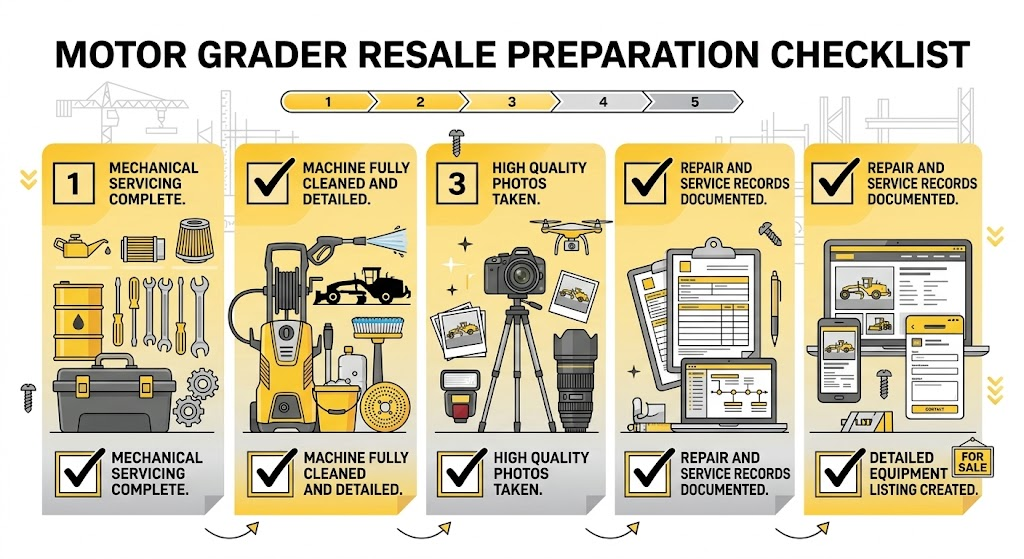
Prepare the machine
- Last mechanical examination: There should not be any leaks, the fluid level should be proper, and starts should be dependable.
- Clean and paint: pressure-wash, degrease, and remove visible heavy rust or oil stains on visible panels.
- Photo and video: take 9 professional photos and a short walk-around video that illustrates hot-start, idle, and a short working pass.
- Documentation packet: enclosed are invoices of parts and labor, summaries of oil analysis, and the QA log.
Enlisting the best practices in the market.
- Use clear, keyword-rich titles: e.g., “12M Caterpillar for sale in Houston, Fully Refurbished, 6,200 hours.”
- Be honest in the description: list of repairs done, parts changed, of which the machine is known, and strengths.
- Post inspection checklist PDF and field-trial summary to show that buyers have seen your due diligence.
- Scheduling of viewing: Viewing by appointment and even short demonstration runs with serious buyers (where feasible).
Pricing strategy
- Base your listing on target resale with a minor negotiation margin (5–10 per cent).
- In case the listing sticks around, use a time-decay discount schedule: small, periodic discounts at 30 days and 60 days.
- Think about limited warranties: a 30-90 day limited mechanical warranty will add buyer confidence and, in some cases, will enable you to charge a little premium.
Transport, Documentation & Legal Considerations
Paperwork and logistics should be perfect before the final sale is completed.
Required documents
- Clear buyer and seller details of the bill of sale.
- Check the serial number and VIN.
- History packet service and repair.
- UCC search and Certified Bill of Sale to verify ownership.
Transport planning
- Hire heavy-equipment haulers who are familiar with graders; they understand angles of loading, tie-down locations, and ramp operations.
- Check loading/unloading schedules on both sides and any permits required on oversize loads.
- Transport the machine to prevent risks during transportation by ensuring it is transported.
Key Takeaways for Profitable Motor Grader Flipping
- Buy disciplined: bid with your head, not your heart.
- Fix functional: mechanical reliability generates confidence and minimizes warranty.
- Refurbishment control costs using parts kits and reputable suppliers.
- Turnover Houston is in high demand: Target 12M, 140M, and 140H.
- Sell through reputable channels clearly to save time on the market, and never leave out documentation to justify your asking price.
Find Your Next Motor Grader Opportunity
If you are looking to either get into the refurbishment business or to increase your equipment inventory, the first thing that you need to do is to locate the appropriate machine at the appropriate price. Buyers and dealers searching for a Caterpillar motor grader for sale or a motor grader for sale in Houston can browse dedicated grader listings on UsedMotorGrader.com.
The site is dedicated to grader equipment, and it is more convenient to compare such models as the Caterpillar 12M, 140M, and 140H and find machines with high refurbishment opportunities. Whether you are searching for a Caterpillar motor grader for sale in Houston or evaluating a 12M Caterpillar for sale in Houston, a specialized marketplace can help streamline the buying process and connect you with listings that match your budget, hours range, and refurbishment goals.
FAQs
Q1. Is flipping a used Caterpillar motor grader profitable?
A: Yes, average gross margins are 15-25% when you purchase reasonably and manage repair expenses.
Q2. Which grader model is easiest to resell?
A: The 12M and 140M tend to fetch a higher resale; the 140H will sell fast to customers who prefer mechanical simplicity.
Q3. What is the most expensive repair in grader refurbishment?
A: The most common single costs are rebuilding transmissions and replacing hydraulic pumps.
Q4. Where can buyers find a Caterpillar motor grader for sale in Houston?
A: List and browse units on UsedMotorGrader.com that specialize in motor grader listings and usually feature machines based in Houston.
Q5. What is the average duration of refurbishment?
A: The majority of refurbishment works require three to eight weeks, depending on the availability of parts and the extent of repairs.
Tags: CAT 140H Grader For Sale, CAT 140M Motor Grader, Used Motor Grader For Sale Houston