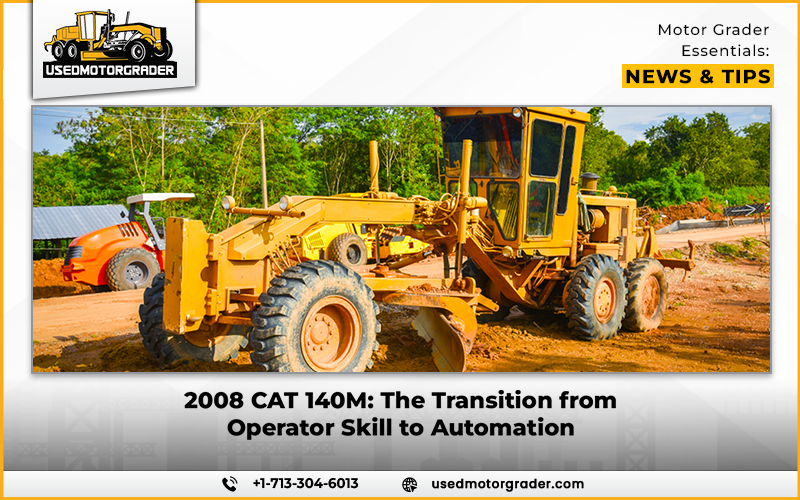
A Silent Revolution in the History of Motor Graders
For decades, motor grading relied on operator skill, seat time, muscle memory, and an instinctive sense of material. Then came a wave of machines, which started to tip that balance. The 2008 Caterpillar 140M did not come with glitzy claims of full automation. It quietly slipped under the carpet and altered the way operators graded work, combining the traditional feel of control with early electronic aids. It is that balance that has made it a turning point to many experienced operators, and not merely an update to the model.
The State of Grading Before the 140M
Productivity in the past generation was heavily dependent on the person being in the cab.
- Manual hydraulic controls controlled the workflow.
- Blade reaction was dependent on machine condition and operator input.
- Long passes were hard to be consistent with.
- The results of two operators on the same machine might be very different. It was more about skill than technology, and the great operators did well, whereas the less skilled operators could not provide the same finishes consistently.
What Made the 2008 Caterpillar 140M Different
This model presented electronics in a manner that favored operators and not to substitute them.
- Manufacturers replaced traditional levers with electronic joysticks without deadening the response.
- Control systems did not override movements but smoothed them.
- Hydraulic performance was straightforward and predictable.
- Automation supported workflow, but not operator authority. The design ideology was careful and deliberate. Caterpillar realized that adopting automation too slowly would drive away old-school operators who trusted feel over software.
Control Feel: Where Manual Skill Still Dominated
Although it was electronic, this grader did not feel out of touch with the ground.
- Joystick control was proportional to blade movement.
- Machine response could still be used to feel cutting resistance by operators.
- Minor adjustments were still intuitive when grading the finish.
- Long-term operators easily transferred older graders to muscle memory and often described them as refined rather than automated—machines that listen, not dictate.
Early Electronic Assistance That Changed Workflow
The electronics did not usurp control, it minimized unnecessary effort.
- End-of-pass transitions were made smoother.
- In the long grading runs, overcorrection was minimized.
- Without additional focus, consistency was enhanced.
- The fatigue of operators decreased significantly during long shifts. These minor shifts did not seem revolutionary at that time, but in the long term, they transformed the way operators went about grading work.
How the 140M Changed Grading Workflows
The most significant change was in the way work was carried out on a jobsite.
- The number of corrective passes required to hit grade was lower.
- Finishing work was easier to switch to rough grading.
- Manufacturers kept the setup time to a minimum, unlike in subsequent automated graders.
- Manufacturers raised productivity without altering the operators’ habits.
Operators did not acquire new systems, but merely worked more effectively with the same instincts that they already had confidence in.
Operator Learning Curve: Old Skills, New Tools
The most interesting thing about this model was which one adapted the fastest.
- Old operators seized at once the smoother controls.
- Good technique was not disguised.
- Bad habits were not so hidden and could be corrected.
- Reduced reliance on software calibration or sensors. Instead of reducing the skill ceiling, the machine increased the floor and maintained mastery.
Why Some Operators Still Prefer the 140M Over Newer Models
With the development of automation, not all people believed that it was a better thing.
- Subsequent machines are more dependent on sensors and software.
- Control feel may be dull or lagging for certain operators.
- Changing ground conditions sometimes confuse automated systems.
- Reliance on mechanical feedback is important for complicated tasks. These reasons are why a lot of operators still prefer the 2008 Caterpillar 140M, particularly in those projects that need judgment and not repetition.
Reliability and Simplicity Compared to Later Automation
This was also a long-term payoff concerning the hybrid nature of this generation.
- The number of electronic components was smaller, which implied the number of failure points was also less.
- In the field, troubleshooting was still easy.
- Without specific diagnostics, downtime was less complex to handle.
- The fleet managers could maintain predictability in ownership costs. Such a compromise between electronics and hydraulics allowed the machine to age gracefully in comparison with more software-reliant successors.
The 140M’s Legacy in Modern Grader Design
This transition era taught the industry a lot.
- Electronics were welcomed by operators when they increased feel.
- Complete automation was most effective when there was trust.
- Subsequent designs were based on this hybrid.
- The 140M was used as a point of reference to balance. Manufacturers are still pursuing the same objective today, which is productivity without compromising the confidence of the operators.
The Human–Machine Balance
The 2008 Caterpillar 140M is one of those times when technology came out and did not force people out of the way. It maintained the art of grading and, in the process, enhanced efficiency, consistency, and comfort. Contractors, fleet managers, and operators see it as a reminder that observing experience achieves progress best. The reason why the 2008 Caterpillar 140M remains a special part of jobsites and discussions of how grading should feel is that balance.
FAQs
1. Why do experts consider the 140M a transition model?
A: It brought about electronic controls that assisted operator skill and did not eliminate it, and it was a compromise between manual grading and complete automation.
2. Do experienced operators really prefer it over newer graders?
A: A lot of them do, particularly those who treasure the sense of control and mechanical response as opposed to software-based correction.
3. Did the designers intentionally limit automation in this model?
A: Yes. The designers geared the design toward slow adoption so operators could adapt without losing confidence or productivity.
4. Is the 140M still relevant in today’s grading work?
A: Absolutely. It is simple, reliable, and controllable, which makes it an excellent fit in projects where judgment is more important than precision.
Tags: 2010 Caterpillar 140M, 2014 Caterpillar 140M2, 2018 Caterpillar 140M3