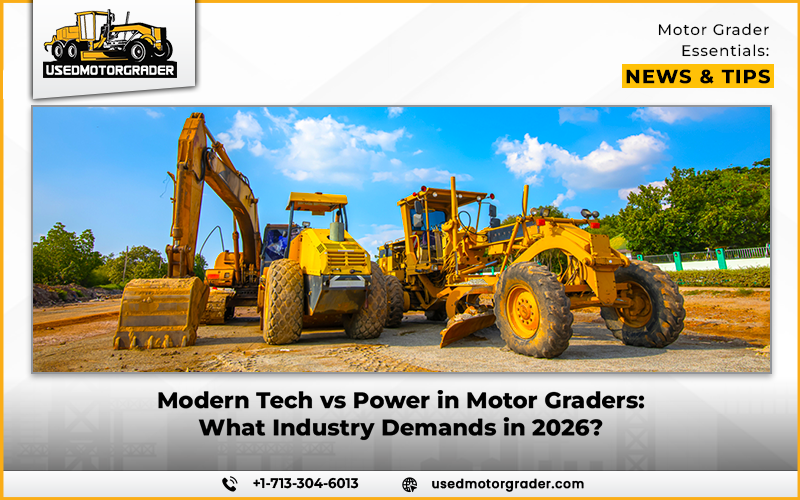
The best motor graders available in the market in 2026 are no longer defined by horsepower alone. The industry is juggling the traditional demands of tough, dependable power with an increasing demand for smart technology that enhances precision, efficiency, and interconnection. Regardless of whether you are a contractor, fleet manager, or equipment investor, the tug-of-war between modern technology and power affects every grader purchase decision today. As infrastructure projects continue to grow on a global scale, the two qualities are important; however, the way the market values them is evolving rapidly.
Global Market Trends Shaping Industry Demand
Developers need motor graders for road construction, mining haul road preparation, and large site development, meaning macroeconomic and infrastructural factors likely influence demand. Globally, the grader is growing on the basis of significant investments in infrastructure, both public and private, with expenditure on the global road network expected to keep demand growing to 2026 and beyond. Technological integration has emerged as a primary factor, and the use of automation has been growing as contractors aim to achieve efficiency in their operations.
Why Power Still Matters in Motor Graders
Power has been the most important factor of grader performance, and it still is of great concern in most industries.
- Graders have high horsepower output, which allows them to push heavy material and maintain blade down-pressure under load.
- Torque and engine strength are needed in rough conditions, such as mining and unpaved haul roads.
- Big graders that are powerful have wider blade widths and deeper cuts at a faster rate.
- Reliable powertrains ensure consistent performance even during continuous and high-stress operation.
- The confidence of the operator in power delivery will minimize rework and address steep gradients with reduced effort.
Power is particularly essential on projects where the volume of materials and the resistance of the terrain are not negotiable. Under such settings, a powerful engine and drive system is the foundation of productivity.
How Modern Technology is Transforming Grading
Although traditional power will always be essential, the best motor graders of 2026 will have more intelligent technologies that will transform what machines can accomplish beyond brute force.
- GPS and grade automation reduce rework and improve surface accuracy.
- Telematics and real-time monitoring allow fleet managers to monitor performance, idle time, and fuel consumption remotely.
- Semi-autonomous and automated systems assist less-trained operators to obtain consistent results.
- Predictive maintenance systems make use of sensor data to forecast failures in advance.
- Operator efficiency is improved through integrated digital dashboards and AI-assisted controls.
These technology components are now standard expectations for machines used in high-precision infrastructure projects.
Telematics and Fleet Data: A Competitive Edge
Telematics is not a luxury, but a fundamental instrument for reducing downtime and wastage of operations. Analytics enable contractors to operate fleets more effectively, detecting trends such as over-idling, fuel surges, or operator inefficiencies that otherwise would have remained hidden.
In large operations with dozens of graders in the field, operators can convert such capabilities into quantifiable benefits, including reduced service costs, better utilization, and improved deployment across projects.
Balancing Tech With Power: Practical 2026 Use Cases
When manufacturers come up with new models, they do not design them to be tech or power; they combine the two depending on the usage:
- Highway and civil works: Technology improves the quality of grading on long, linear projects; power guarantees performance at heavy loads.
- Urban and municipal work: Automated accuracy and telematics can assist in dealing with close tolerances and mixed use.
- Mining and haul roads: Rugged power is central, and uptime and safety are enhanced by automation and monitoring.
- Site development: Mid-range graders combine technology and efficient power to perform various tasks.
The industry in such cases is not deciding between technology and power. It is about getting the right mix to meet mission needs.
How Manufacturers Are Responding
Large equipment manufacturers are responding to changing priorities by mixing the two worlds. Caterpillar, John Deere, Komatsu, and Volvo, among others, are equipping models with advanced powertrains with automation, telematics, and precision control.
These inventions do not substitute horsepower; they add to its efficiency. An example is programmable and automated systems, which minimize the need to adjust manually, particularly when skilled operators are in short supply, and advanced engines ensure that there is always torque and force on demand.
Regional Differences in Demand
Interestingly, the weight of tech and power depends on the needs of the region:
- In North America and Europe, there is a focus on smart systems and connectivity because of the developed markets and the integration of the digital workforce.
- In the Asia-Pacific, it is a combination of both because the large-scale construction of infrastructure needs multi-purpose graders that can handle both fine finishes and large throughput.
- In Africa and Latin America, they tend to have rugged power as a priority first, followed by a slow uptake of technology, depending on its cost and operator presence.
Understanding local market nuances helps manufacturers tailor their products and buyers to make better purchases.
Operator Skill Sets and Adoption Challenges
Technology is becoming more advanced, and the need for skilled operators is growing. However, so is the importance of automation. A reduced number of skilled operators implies that automation capabilities can democratize productivity, with the result being that less trained operators can deliver consistent results.
Nevertheless, adoption issues persist, particularly in cost-sensitive markets where the initial cost of tech-enhanced graders is a barrier to market penetration. That will be balanced with power requirements, which will be a major theme in 2026.
The Future Outlook: Hybrid and Smart Solutions
In the future, hybrid engines and electrification are also being considered, but widespread adoption remains limited in 2026. The innovations will help in cutting down on emissions and fuel consumption without compromising the torque and reliability that the contractors would desire.
Machine learning and AI, on the technical side, will lead to more sophisticated blades and predictive systems. It may also pave the way for autonomous grading as the skills shortage continues to grow.
A Strategic Blend in 2026
The motor grader market in 2026 is not questioning whether power is more important than tech. It knows that both are. Grading effectiveness in heavy operations is still based on power. Whereas tech is based on efficiency, accuracy, and optimization of the fleet. The best motor graders are those that combine power and smart features, which are more productive and have reduced lifecycle costs. With the increased sophistication of buyers, manufacturers have to take performance and innovation to the next level to keep up with the competition.
FAQs
1. Does automation mean less need for powerful engines?
A: No, automation is more precise and efficient. But heavy workloads still need powerful powertrains to be reliable and move material effectively.
2. Is telematics worth investing in for grading fleets?
A: Yes, telematics offers real-time information that can be used to minimize downtime, fuel consumption, and track operator behavior for better fleet management.
3. Will electric and hybrid graders replace diesel models soon?
A: Electric and hybrid graders are emerging. But in 2026, diesel remains dominant due to existing infrastructure and the high-power requirements of grading tasks.
4. How do regional demands influence grader design priorities?
A: Developed markets prioritize tech features like GPS and 3D grading. Emerging markets often focus on rugged power and mechanical simplicity for easier local maintenance.
Tags: best motor graders in USA, buy 2007 Caterpillar 12HNA motor grader, Cat 140g graders for sale