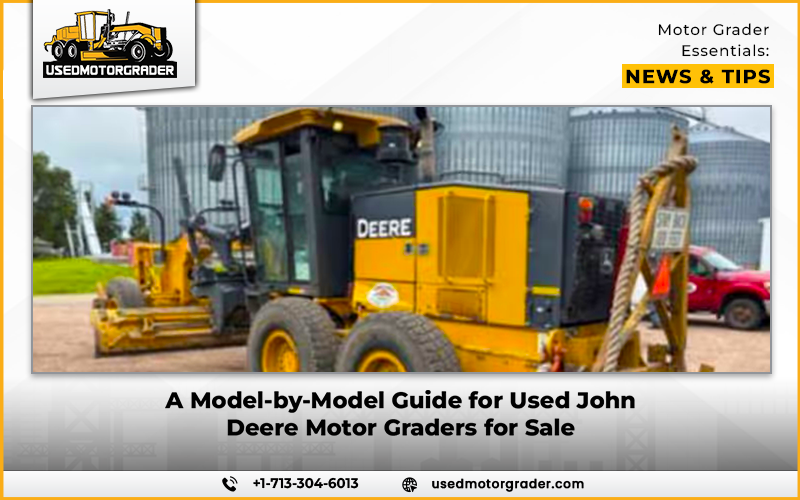
(G-Series vs. D-Series)
In the case of Used John Deere Motor Graders for sale, customers usually pay attention to horsepower, hydraulics, and comfort in the cab. However, there is one mechanical part that contributes to the accuracy of long-term grading even more: the articulation joint. This is the main point of pivot that defines the ease with which the grader turns, distributes the weight, and balances on rough ground. The engineering development of the D-Series and G-Series graders at John Deere re-established the steering, wear, and performance of these machines with time. Being aware of what to look for in such joints can make buyers see the true value and save them the cost of repairing them later.
The Engineering Behind John Deere’s Articulation Systems
Articulation enables a grader to bend at its center, giving it perfect control in creating slopes, ditches, or haul roads. This design was perfected over the years as the D-Series adopted a behind-the-cab design and the G-Series shifted the articulation to the front to provide a better view and control.
- D-Series: The conventional design is equipped with the articulation joint nearer to the rear, which provides high stability but has a little less visibility.
- G-Series: Forward articulation enhances the line of sight of the operator, particularly when performing fine grading operations.
The two are different in hydraulic lines, sensors, and pivot bearings, which influence the accessibility of maintenance and the service requirements in the long term.
Such modifications may not be of much consequence, but they have a profound effect on the ease with which a grader turns, the ease with which it can be serviced, and the duration of its key joints under pressure.
Inspecting the Articulation Joint on D-Series Models
The D-Series graders are praised because of their rugged durability and simple design. Nevertheless, the majority of the models in this series have been widely used, and thus, inspections must be comprehensive.
- Test the center pivot pin to see whether it is loose or not. A loose joint may indicate worn bushings or improperly aligned pins.
- Check hydraulic cylinder mounts for cracks or stress evidence.
- Examine grease fittings, dry, rusted, or absent; these are indications of neglect.
- During a complete cycle of articulation, listen for metal-on-metal contact.
Although the D-Series design offers good stability, the lack of lubrication may result in serious wear, which is expensive when it comes to repairing the frame or pins. To buyers, it is equally important to see a regular maintenance record as well as the engine hours of the grader.
G-Series Upgrades: New Design, New Wear Points
John Deere moved the articulation joint forward to improve balance, precision, and cab comfort when it introduced the G-Series. However, that innovation presented new inspection priorities as well.
- Check the articulation pin mounted on the front of the grader to ensure that it is not corroded or distorted, especially when the grader is used in wet or coastal areas.
- Inspect the steering sensor housing, more exposed in this design and is prone to moisture intrusion.
- Look at the routing of hydraulic hoses, since they may rub against other components in the area because of the reduced space.
- Evaluate cab mounts due to wear and vibration by the proximity of the joint.
In general, the G-Series is easier to control and has better grading accuracy, but its front articulation design requires additional consideration of corrosion, seals, and electronic elements during inspection.
How to Test Drive a John Deere Grader for Articulation Health
Any inspection is not complete without a good test drive. The condition of the articulation joint usually presents itself when the grader is moving.
- Turn lock-to-lock listening for grinding, popping, or slow hydraulic response.
- Observe free movement; any rigidity or tremor can indicate internal contamination.
- Hold articulation in mid-angle and test hydraulic drift (indication of worn seals).
- Note steering feedback; it may be too loose or too tight, and this may be a sign of misalignment of the joint.
A healthy grader must experience a stable and fluid articulation cycle. Should the movement be jerky or uneven, the pivot assembly might need to be rebuilt, which is a significant consideration to anyone considering used John Deere Motor Graders for sale.
Comparing Maintenance Costs Between D-Series and G-Series
Maintenance expenses not only differ according to the age of the model but also according to the design and service of articulation.
- D-Series: Rebuilds tend to be less expensive but more difficult to disassemble because of the rear positioning of the joint.
- G-Series: More accessible to check and maintain, but such parts as sensors and seals are more expensive.
The G-Series tends to reward the owners with minimal downtimes and improved hydraulic performance.
Both series have the potential to give good returns when maintained, but it is important to consider the cost of servicing the unit in the long run before buying a used unit.
Buying Tips: What Dealers May Not Tell You
Do not accept what the salesman is saying and go beyond the sales pitch to service records and observable indications of care.
- Request the receipts or logs of the recent articulation pin replacements.
- Check serial number ranges. John Deere would periodically update designs to correct known wear problems.
- Confirm grease intervals were as recommended by the factory.
- Welded joints are a warning sign, and they usually point to improper repairs in the past.
An honest dealer will be open in terms of service history and inspection reports. Such minute details may make or break the worth of any grader on the lot.
Matching the Right Model to Your Application
In case you have to decide between the D-Series and G-Series, it is a matter of priorities.
- The D-Series is designed to suit buyers who prefer simplicity, which has been tested and has a lower initial cost.
- The G-Series is popular with operators who require sophisticated hydraulics, articulation, and cab comfort.
In any case, by considering articulation health, you will be able to make sure that your investment in a Used John Deere Motor Grader for sale will be able to provide you with the same performance and value over the years.
FAQs
1. How often should the articulation joint on a John Deere grader be greased?
A: To use normally, grease after every 8–10 working hours. Daily greasing should be used in dusty or wet conditions to avoid wear acceleration.
2. Are G-Series articulation components interchangeable with D-Series parts?
A: No. The G-Series forward articulation design incorporates alternative geometry, sensors, and hydraulic routing. Before ordering parts, always verify compatibility.
3. What are the warning signs that an articulation joint needs rebuilding?
A: Symptoms may include steering looseness, articulation imbalance, clunking sounds, or pivot pin and seal wear.
4. Does front articulation improve operator comfort during long shifts?
A: Yes. The G-Series design minimizes the stress on the steering and improves visibility, and is more comfortable for an operator working on a fine-grade or long-haul project.
Tags: John Deere road graders USA, Heavy equipment John deere graders, Road construction motor graders USA