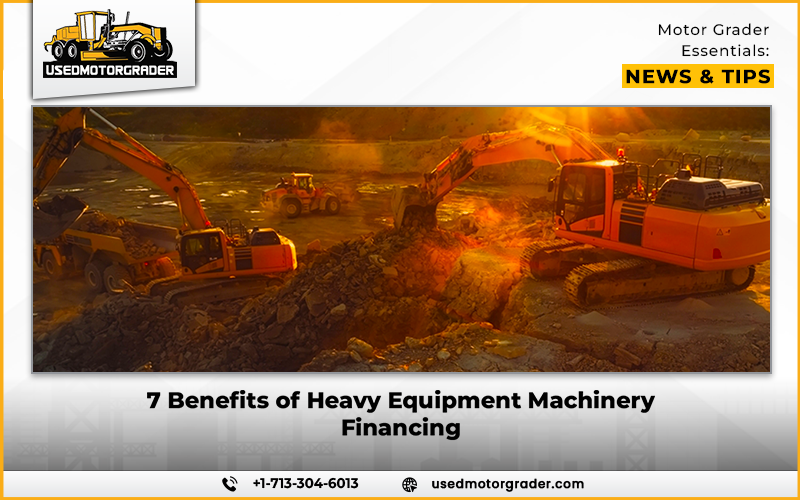
To operate a successful construction or industrial company, one must have the right equipment, and for most, that means having the right heavy equipment machinery in place. However, as the prices of excavators, bulldozers, cranes, and loaders are increasing, it’s not always possible to buy this equipment in full. Equipment financing comes in at that point to solve the problem. It enables businesses to have the equipment they require without straining their capital, ensuring projects stay on schedule and the business remains financially stable.
1. Preserving Cash Flow
Equipment financing is one of the largest benefits to a contractor, as it assists them in securing their working capital. Companies don’t have to tie up huge sums of money in purchasing equipment, but can spread the expense across time, thus allowing them to use the money to meet other operational requirements.
Key benefits include:
- Not making big lump sum payments.
- Maintaining working capital to supply in case of an emergency or a new opportunity.
- Better financial management throughout the project cycle.
Liquidity can be the difference in an industry where costs are variable based on the time of project completion. Funding maintains business flexibility so that the funds can be used in other areas like payroll, materials, or marketing, which leads to business growth.
2. Access to the Latest Equipment
The technology of heavy equipment machinery is changing at a fast rate. In the case of motor graders with sophisticated GPS systems or excavators with fuel-saving engines, keeping up to date is keeping up with the competition. But purchasing new machines directly may be an enormous cost.
Benefits of financing the upgrade:
- The old machines that are either outdated or inefficient are replaced easily.
- Availability of high technology without high initial investments.
- Remaining competitive in an equipment-based market.
Funding assists the contractors to upgrade to newer and efficient models as they are introduced, so that they are never left out in the use of the equipment that is up-to-date and capable of optimizing their safety and performance standards.
3. Flexible Payment Options
Cash flow cycles of different construction firms are unique. There are those with constant monthly revenue, and there are those whose revenue is seasonal. Financing companies realize this and tend to structure payment plans to follow the pattern of a business’s revenues.
Possible payment structure options are:
- Minimal start-up costs with incremental growth.
- Delayed payment schemes at the start-up stages of a project.
- Leasing that has an end-of-term buyout.
This flexibility enables financing for both big contractors and small companies. It allows companies to remain comfortable financially but at the same time pursue new projects without hitches.
4. Building Business Credit and Financial Stability
Funding is not simply a practical decision, but it is also a strategic decision. Businesses that pay regularly and punctually build credit profiles. This enhanced financial position will be a gateway to further funding opportunities in the future, such as bigger loans or lines of credit to expand.
Long-term benefits include:
- Better financial status and credit rating.
- The ability to borrow or obtain future equipment financing or business loans with ease.
- Better ties with lenders and suppliers.
These benefits, over time, provide the construction firms with more bargaining power in the negotiation of terms or bidding on large projects.
5. Tax Advantages
The other major advantage of equipment financing is that there can be tax deductions. Businesses may frequently claim interest, depreciation, and, in certain instances, the entire price of the financed equipment, depending on regional tax regulations.
Potential tax-related advantages:
- Reduced taxable income.
- Quickly depreciated under such tax regulations as Section 179 (in certain nations).
- Faster return on investment.
The contractors are also expected to seek the advice of their accountants on what deductions they are entitled to. However, tax breaks are not only a brilliant business operation but also a good financial decision.
6. Reduced Maintenance Burden
Most of the financing schemes involve maintenance packages, warranty, or service contracts that assist in paying less for long-term repairs. These agreements also ease the budgeting process and guard against unforeseen breakdowns for companies dealing with a number of machines.
Under financing maintenance benefits:
- Major repair and part coverage.
- Planned maintenance expenses make budgeting easier.
- Professional servicing will result in reduced downtime.
Once machines fall under service contracts, operators need not worry so much about how to complete the project but rather about mechanical surprises. This increased trust increases performance and productivity.
7. Scalability and Growth Potential
Probably the least known advantage of financing is its ability to facilitate the growth of the business. Contractors are able to grow their fleet in a short period of time to correspond to the increase in project demands instead of spending years to save up to acquire new machinery.
Growth-related advantages:
- Less financial burden of rapid growth.
- The capability to assume bigger or more projects at a time.
- Increased ability to compete in contract bidding.
Through financing, a small company can gradually expand its business, acquire bigger contracts, and enter new markets without being stagnated by the initial expenditure on equipment.
Financing as a Strategic Advantage
Financing heavy equipment machinery is not simply a matter of affordability in the present competitive construction environment, but it is a matter of strategic growth. It provides the liberty to modernize, extend, and utilize resources economically and remain financially stable. No matter whether the company is a new player in the industry or an experienced contractor that plans to upgrade, financing offers a road to success that doesn’t undermine capital and flexibility.
Smart contractors don’t view financing as a debt; rather, it’s an investment in the future of their company, a move to stable performance, improved cash flow, and sustainable growth.
FAQs
Q1. What types of equipment can be financed under Heavy Equipment Machinery financing?
A: Financing is available on most construction and industrial equipment, such as excavators, loaders, cranes, motor graders, bulldozers, and special attachments.
Q2. Is it better to lease or finance heavy machinery for long-term use?
A: Financing is best for long periods of use, as after the payment period, ownership is transferred, whereas leasing applies to short-term or seasonal projects that require temporarily borrowed equipment.
Q3. How does equipment financing affect a company’s balance sheet?
A: The assets that have been financed are usually treated as the assets owned by the company, which assists in enhancing the net worth and compensating liabilities with the operational value of the equipment.
Q4. Can small construction firms qualify for financing?
A: Yes. Numerous lenders provide financing to small and mid-sized contractors with little initial payment, typically, and with lenient credit requirements.
Tags: Heavy equipment for sale, Heavy equipment trader, High-Quality Used Graders for Sale, Road construction motor grader