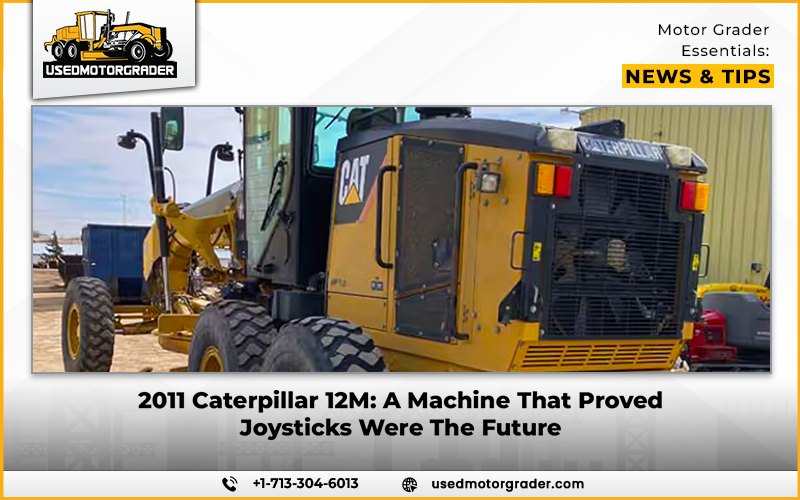
The 2011 Caterpillar 12M was a major industry shift when the M-Series first arrived on the scene. Before its release, operators firmly favored levers and wheels and did not trust machines with joystick controls. There was also the worry that people would miss the tangible feel of the old traditional levers and that electronics would not be able to cope with the harsh conditions of a construction site. However, when Caterpillar introduced the 12M, it became clear that the company had found a balance: the joystick technology offered stability, intuitiveness, and reliability without the over-complicated sensor networks that plague modern models. Buyers now consider this model the sweet spot for used equipment and a representation of the industry’s shift toward joystick-first controls.
The Skeptics: Why Operators Hesitated
The concept of replacing a steering wheel with two joysticks appeared to be dangerous. The fears were about the loss of precision, up to the fear of electronic breakdowns in the extreme conditions of the field. Other operators were concerned about the learning curve and feared a drop in productivity during the transition. Nevertheless, Caterpillar went about the challenge in a strategic manner, creating a machine that dealt with skepticism directly, with a combination of innovation and reliability.
The 2011 Caterpillar 12M was well crafted to attract the traditionalists and early adopters. Its joystick system was developed to a high level of consistency and precise control, but not over-sensitive like the later models. The cab was re-engineered with ergonomics in mind, and the fatigue caused by long shifts was minimized, with all the important controls being easily accessible. Serviceability was improved through simplified diagnostic access, which is vital in the case of contractors who cannot afford downtime.
The 2011 12M Design: The Best of Both Worlds
- The dual joystick design enables fine, fluid blade control.
- Long-term comfort operator cab.
- Electronic controls that were intuitive and provided the user with accuracy without being overly complex.
- The simplicity of access to service points and simplified diagnostics.
- A powerful Variable Horsepower (VHP) engine that has better fuel consumption to operate at low costs.
Joystick controls offered obvious benefits over the conventional lever systems. It was soon discovered by operators that the responsiveness of the machine enabled smoother and more accurate blade movements, and this translated into faster and more accurate grading. Less fatigue and physical strain during extended hours were felt almost immediately. Precision in finish grading was improved, and the overall project efficiency was also enhanced by the reduction of errors and the ease of handling materials.
Joystick vs. Lever: How the 12M Settled the Debate
- There was fast adaptation on the part of the operators with little retraining needed.
- The Proportional Priority Pressure Compensating (PPP-C) hydraulics allowed the machine to operate smoothly with less wear.
- There was also an improvement in grading uniformity among different soils.
- Less chance of accidents due to an accurate, predictable machine response.
- General productivity and efficiency at the job site went up.
The 2011 12M is much demanded on the used market today. It is a unique blend of technology and mechanical simplicity. Although subsequent models added sophisticated sensors and automation, they also added increased costs and increased complexity in maintenance. The 2011 model has not fallen into these traps and provided reliable joystick operation that operators could rely on.
Why the 2011 12M Remains a Collector’s Choice Today
- Long-term reliability and durability in the field.
- Minimum bugs or errors in stable joystick software.
- Large supply of spare parts.
- Competitive prices compared to more advanced sensor-intensive models.
- Good resale and rental demand because operators prefer simplicity and control.
The 12M lessons taught Caterpillar the following decade of grader development. Manufacturers gradually adopted joystick-first designs in future models and improved ergonomics and software stability. The 12M marked a technological turning point, proving that operators could fully implement joystick controls without sacrificing efficiency, reliability, or comfort.
Operator Experiences: Voices from the Field
The first skeptical veterans turned into supporters, frequently referring to the ease of transition as compared to expectations. The joystick layout was intuitive to the younger operators who joined the workforce and could be productive right away. Observers noted that long shifts caused considerably less fatigue and that grading accuracy improved. Nostalgia also drives its popularity: operators remember how easy this model was to use compared with the over-engineered complexity of 2024+ graders.
The 2011 12M’s Place in Grader History
- Rapid learning and ease of use of the joystick.
- Better accuracy and productivity at the workplace.
- Less physical stress and operator exhaustion.
- High regard for the machine’s serviceability.
- Recognition of the 12M as the bridge between the mechanical and digital eras of grading.
To sum up, the 2011 Caterpillar 12M is not merely a machine, but it is the time when the joystick was accepted by the grader world. The 12M served as a transitional step between mechanical tradition and modern technology, offering a dependable, operator-friendly experience that modern models often complicate with excessive sensors and software. Its continued demand in the used equipment market proves its lasting legacy, and many operators use it as the benchmark for all other joystick-equipped graders.
FAQs
1. Why does the 2011 Caterpillar 12M remain popular with used equipment purchasers?
A: The 12M 2011 has a stable joystick software, mechanical simplicity, and reliability. It is cost-effective and simple to maintain as it does not require the complexity and sensor-dependence of newer models.
2. How do joystick controls improve grading precision compared to levers?
A: The use of joysticks enables a more controlled and less fatiguing movement of the blades, and enhances the precision of the operator on narrow or complicated grading. The outcome is quicker and more stable work.
3. Is it difficult for operators to switch from lever controls to joysticks on this model?
A: Not at all. Caterpillar designed the 12M 2011 with ergonomic features and user-friendly software, allowing both experienced and new operators to transition to the new model quickly and easily. In most cases, the new operators do not require much training.
4. Are parts and maintenance for the 2011 12M still readily available?
A: Yes. Caterpillar has a parts network that backs this model, and its mechanical simplicity means that it is easy to maintain in comparison to more sensor-intensive modern machines.
Tags: 2001 Caterpillar 140H, 2011 Caterpillar 140M2, best motor graders in USA