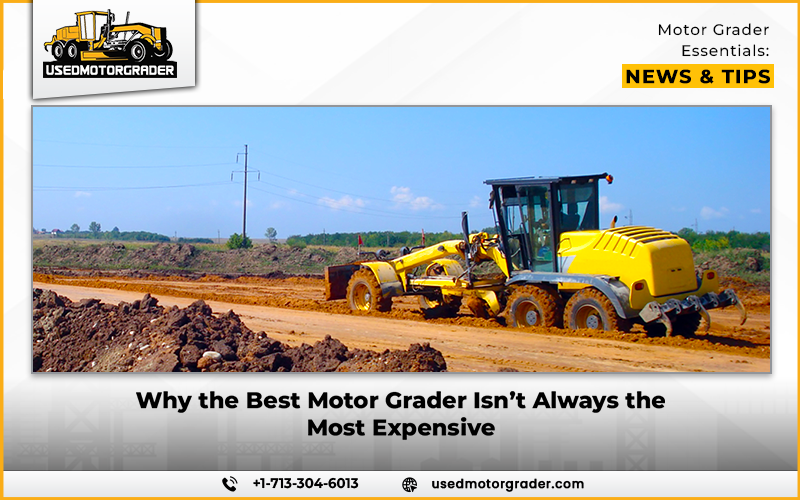
Regarding the selection of heavy equipment, most contractors tend to believe that the higher the price attached, the better the performance. This is more so with the best motor graders, where marketing is commonly synonymous with the ability. As a matter of fact, the costliest machine does not necessarily provide the best payback or even the most effective work in the field. Factors like project match, operational efficiency, and total cost of ownership often outweigh brand hype or high-end specs, making mid-range graders an unexpectedly smart choice for many projects.
The Myth of Price Equals Performance
It is so easy to get into the trap of equating cost and quality. Luxury features, strong engines, and technology are usually emphasized in advertising and show that more money will ensure better performance.
- Expensive does not necessarily imply greater appropriateness to your particular project.
- In some of the grading activities, mid-range graders tend to do better than premium units.
- Large or too complicated machines might make work complicated without increasing efficiency.
- Moderately priced equipment is usually better appreciated by contractors who have a greater emphasis on practical demands. Knowing that price is not the only element of the equation can make operators concentrate on features that actually influence the daily work, instead of pursuing the status of a brand name.
Evaluating ROI: Total Cost of Ownership Matters More Than Purchase Price
Giving attention to purchase price only overlooks the larger picture, which is the overall cost of ownership. A grader is not just a costly tool; its ROI is determined by other factors. The relevant factors that influence ROI are:
- Initial purchase price
- Consumption of fuel during the lifetime of the machine.
- Maintenance and repair expenses.
- End of service life resale value. Graders of lower cost can provide greater ROI in general, provided that they are fuel-efficient, durable, and easy to maintain. Intelligent buying choices center on long-term operational cost-saving as opposed to the short-term brand popularity. This will make sure that the investment in equipment will yield certain returns in the long run and not have the money stuck in an expensive machine that is not being used to its full capacity.
Matching Grader Specs to Project Requirements
Not all grading activities require the biggest or most powerful machine. It is common practice that the right grader to pick will work better than the most expensive one. Assess project type:
- Road construction and road maintenance.
- Light grading or heavy ripping.
- Seasonal or permanent operations. Big machines can raise the price of fuel and maintenance without raising efficiency. Take into account such aspects as the width of the moldboard, hydraulic accuracy, and traction needs. Matching specs to real-world tasks ensures you get maximum productivity and cost-effectiveness. Adapting your purchase to the particular work environment enables the operators to get better results by doing less wear on the machine.
Operational Efficiency Beats Brand Hype
Productivity in the industry is dependent on the comfort of the operators, the responsiveness of the machines, and the ease of control, rather than the cost. The features that enhance operational efficiency are:
- Long shift ergonomic cab design.
- Intuitive control layout
- Accurate and sensitive hydraulics.
- Fluid transmission and torque transfer. Properly-designed graders minimize operator fatigue, error, and downtime. Even mid-range machines can be graded more accurately and more productively by the operators. Investing in functionality, which will improve the performance of the operator, can be more tangible than spending extra money on luxury branding.
Maintenance and Lifecycle Considerations
The savings that may be due to a higher initial purchase cost can be easily overshadowed by maintenance costs. It is important to select a grader that is serviceable and reliable. Long-term reliability considerations:
- Spare parts and service networks.
- Simplicity of carrying out regular maintenance.
- Robustness of the components in the real world. Dependable machines minimize unexpected downtime and increase the life span. Mid-range graders with good support can be a reliable source of productivity at non-premium prices. Choosing a machine with easy maintenance needs is a sure way of having continuous work and reliable costs.
Fuel Efficiency and Environmental Impact
A high cost of operation of motor graders is fuel consumption. The use of an efficient machine is beneficial to the bottom line and the environment.
- Graders that consume less fuel save money in the course of their operation.
- Efficient machines minimize wear on parts by maximizing power consumption.
- Environmental advantages encompass fewer emissions and less energy wastage. In practice, sometimes a smaller, well-optimized grader can be more effective than a larger, thirstier one. Fuel efficiency is one of the factors to consider to ensure that contractors make the most out of cost-effectiveness without performance reduction.
Operator Skills and Training Influence Performance
Even the highest-priced grader will not give the best results unless it is operated by skilled persons. Training sometimes is more effective than a higher expenditure on equipment.
- The familiarity of the operator influences the quality of grading, speed, and accuracy.
- Manufacturers’ support and training boost productivity.
- Mid-range machines can be used to the full capacity of well-trained operators to perform at a similar level as higher-end graders. The skill development of the operators is what makes the machines work to their maximum potential, and this makes operator capability as important as machine capability.
Smart Buying: Balancing Cost, Specs, and Real-World Performance
When selecting the best motor graders, there is a need to balance the price, features, and project needs. Steps for smart selection:
- Assess the size and scope of the project.
- Divide the total cost of ownership.
- Evaluate the operation efficiency and comfort of the operators.
- Take into account resale and service support. Informed decisions made practically tend to be better than decisions made based on brand prestige or price. Mid-range graders often provide greater productivity on a dollar invested. Concentrating on appropriate and efficient, and not on the glamour of an overpriced machine, makes smarter buying decisions.
Key Takeaways
The best motor graders are cost-effective, efficient, and suit the task.
- High cost of purchase does not imply high productivity.
- Place more emphasis on ROI, operational efficiency, and maintenance support rather than brand hype.
- Project-specific decisions are smart and lead to improved performance and savings in the long-term.
FAQs
1. Q: Are the most expensive motor graders always better?
A: Not necessarily. The match with the project, the skill and efficiency of the operator, and not only the purchase price are the factors of performance.
2. Q: How can ROI be higher on mid-range graders?
A: Moderate-cost graders can save money in the long run because they consume less fuel, are easier to maintain, and deliver sufficient productivity.
3. Q: Does operator skill matter more than machine price?
A: Yes. A trained operator will be able to achieve maximum productivity and accuracy on mid-range graders, and in some cases, he or she will be more productive than more expensive machines.
4. Q: What factors should influence motor grader selection besides price?
A: The type of project, the level of efficiency, maintenance services, fuel consumption, and reliability of the machine are essential factors.
Tags: 2006 Caterpillar 12H, best motor grader for contractors, best motor graders for Texas