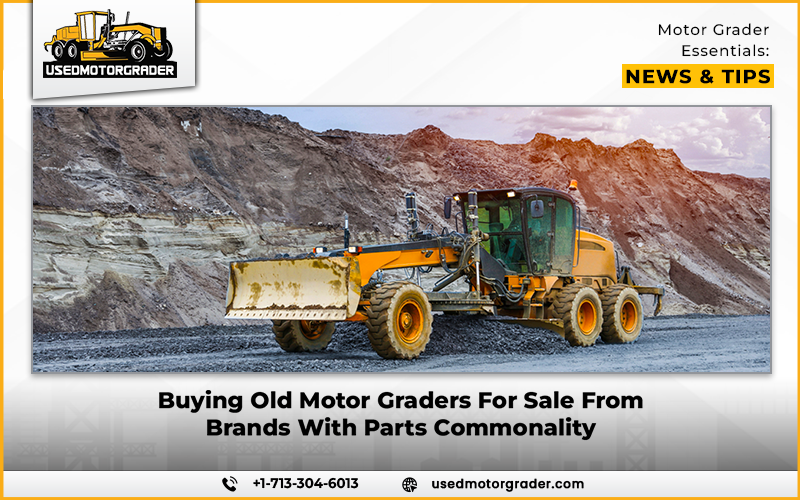
When contractors or fleet managers are looking to purchase old motor graders for sale, they will tend to look at the price, hours, and the general condition of the motor grader. Nevertheless, there is a less evident yet no less critical factor, which is parts commonality. Earlier models of such brands as Caterpillar and John Deere are especially useful since most of their key parts, including differentials, tandem drives, and hydraulic modules, can be used in other models of the fleet. This interchangeability lowers the cost of maintenance in the long term, decreases downtime, and streamlines strategic fleet planning to a much greater extent.
Understanding Component Interchangeability
The concept of component interchangeability is the possibility of applying the same part to a variety of machines or models. This can be a game-changer for fleets that are dependent on consistency and uptime.
Key elements that tend to overlap in models:
- Differentials
- Tandem drives
- Hydraulic cylinders and pumps.
- Powertrain modules
- Advantages of shared components to maintenance efficiency.
- The benefits of standardization in inventory management.
By focusing on graders that have common parts, the contractors will be able to keep a lean parts inventory, and at the same time, the replacements are easily accessible to minimize the cost as well as the logistical hassles.
Popular Brands and Models with High Parts Commonality
Other brands and models have traditionally focused on component standardization, which favors long-term owners.
- Caterpillar older (140H, 140G, etc.) models.
- John Deere older series (770G, 772G)
- Komatsu GD655/665 series with selective overlap of components.
- Reason why these models are popular in the used equipment market.
- The relationship between commonality of parts and resale value.
Caterpillar and John Deere are especially famous in terms of using the same parts in several machines. This implies that a fleet of a few older $140$s or $770$s can share key components, reducing the overall cost of ownership and enhancing operational flexibility.
Financial and Operational Benefits of Investing in Compatible Graders
There are obvious financial and operational benefits to focusing on the parts compatibility in the selection of used motor graders.
- Reduce the long-term maintenance and repair expenses.
- Less inventory is required to stock spare parts.
- Higher availability as a result of quicker component replacement.
- Controllable operating costs throughout the fleet.
As an example, a fleet manager would be able to swap a tandem drive in a single machine with a similar unit in another without the long lead times and costly aftermarket options. This minimises the time loss in important projects and ensures that work continues smoothly.
How Parts Commonality Reduces Obsolescence Risk
One of the largest concerns of fleets that have invested in used equipment is obsolescence. Machines can perform flawlessly; however, when components are difficult to find, maintenance can be extremely expensive, or downtime may be unacceptable. This risk is overcome by investing in graders with high parts interchangeability.
- Persistence of common elements despite model termination.
- Capacity to obtain parts through various sources within the fleet.
- Ability to move parts between machines in case of an emergency.
- Reduced dependence on aftermarket or custom parts.
Fleet Planning Considerations When Buying Old Motor Graders
Strategic fleet planning is not about choosing the cheapest or the latest used machine.
- Evaluate overall fleet make-up and common elements.
- Balance age, hours, and parts compatibility.
- Give preference to models that are compatible with the available inventory to support them easily.
- Test historical consistency and frequent failure.
By comparing the potential purchases to the current fleet, the contractors will be able to make informed decisions that will minimize the risks and enhance the efficiency of the operations in the long run.
Case Examples of Smart Component-Focused Purchases
Several contractors have been able to use the commonality of parts to streamline their fleets.
- The contractors who have invested in the older CAT 140 have reduced the downtime by sharing differentials and tandem drives among machines.
- John Deere mixed fleets also have the advantage of hydraulic and powertrain components overlap, which minimizes conflicts in maintenance scheduling.
The strategies have resulted in quantifiable decreases in downtimes and inventory expenses, and maintain machines in a continuous operation.
Risks and Limitations of Relying on Parts Commonality
Although parts commonality is a significant strength, it does not lack limitations.
- There are still some older models that might have rare or phased-out components.
- Compatibility is not a guarantee of modern performance or fuel efficiency.
- Operators have to balance the availability of components and overall operational needs.
The inspection and planning are still to be done carefully, especially with the high-hour machines or units that have been heavily used in harsh conditions.
Optimizing Fleet Investment
Parts commonality should be a key factor when considering old motor graders for sale. By selecting machines based on the brands with high component interchangeability, such as Caterpillar and John Deere, maintenance costs are minimized, downtimes are minimized, and fleets are not exposed to obsolescence. Not only does strategic selection save money, but it also guarantees the smooth running of various projects, which is a clever strategy of the contractor who is interested in long-term efficiency.
FAQs
1. Why is parts commonality important when buying used motor graders?
A: It saves on maintenance expenses, enables parts to be shared amongst the fleet, and makes sure that machines last longer.
2. Which brands are best for high component interchangeability?
A: Older Caterpillar models, such as the 140H/G, and John Deere 770/772 series, share major components.
3. Can parts commonality help reduce inventory costs?
A: Yes. Fleets require fewer parts but are able to maintain a number of machines, thus making it easier to logistically manage and reducing costs.
4. Are there risks to relying solely on parts commonality?
A: Yes. Certain parts can be out of stock or outdated, and compatibility does not mean that it is going to perform or work efficiently in the modern world.
Tags: John Deere motor grader, low hour motor graders, used motor grader for sale, used motor graders Texas