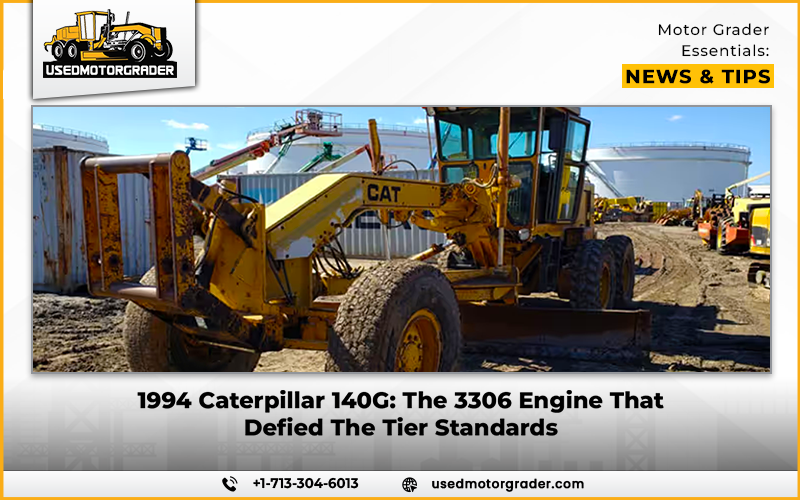
The 1994 Caterpillar 140G is not just an old motor grader, but a machine that is powered by what most mechanics and contractors refer to as the most universal engine on earth. Its Caterpillar 3306 under the hood has anchored decades of industrial performance, and even in 2026, when modern emissions standards have redefined the industry, this engine continues to be the core of the grading business in the outback of Australia, in the mines of Africa, and in the rugged terrain of South America.
Why? In a word, the 3306 is dependable, durable, and simple to service. In areas with limited components and services, operators rely on the mechanical simplicity of the 3306, which lets the old 140Gs outperform many more modern and cleaner machines. This 30-plus-year-old grader continues to make a living for countless operators around the globe.
The Heart of the Machine: What Makes the 3306 Special
Caterpillar launched the 3306 engine in the 1970s as a successor to the 1673 and 3160 powerplants, and it soon earned a reputation as a workhorse across most industries. The 3306 was a six-cylinder inline engine with a capacity of approximately 10.5 liters, designed to deliver consistent and dependable torque in heavy use, and not flashy horsepower.
Here’s what makes it stand out:
- Mechanical simplicity: No electronics or complicated emission systems.
- Sturdy construction: Massive cast-iron components and simple parts.
- Wide applications: Applied in graders, dozers, excavators, trucks, and marine propulsion.
- Field serviceability: Can be repaired with simple tools, and this is a massive advantage in rural areas.
The simple design of the 3306 compared to modern engines that rely on emissions after-treatment systems and complex control modules had fewer points of failure and much easier repairs. It is an engine that can be maintained with a sense of security in environments where technicians must rely on mechanical intuition rather than digital diagnostics.
Built for the Rough Stuff: Why It Works in Africa
Infrastructure development in most areas in Africa occurs way off the tarmac and dealer systems. To a contractor working in this type of environment, the 1994 Caterpillar 140G is a reliable grader due to the fact that you can always find parts or someone who knows how to work on a 3306.
This is what keeps the 3306 going in African operations:
- Availability of parts: There is still a common stock of aftermarket and OEM parts for the 3306.
- Local experience: In small towns, mechanics are conversant with older Cat engines.
- Fuel flexibility: The 3306 can withstand poor-quality fuel much better than many modern diesels.
- Reduction of downtime: Rapid, easy repairs imply that machines have more time to be employed.
In remote mining or road construction, operators require a grader that they can service with minimal resources.
Out in the Australian Outback: Tough Terrain, Tougher Engines
The big, dry interior of Australia requires machines that are able to endure heat, sand, and long days of unrelenting labor. That is where the 3306 comes in. Although emissions levels in Australia have risen over the years, operators continue running many older machines because their simple mechanical systems allow field repairs without waiting for specialized tools or technicians.
The reason why contractors in remote mining camps tend to use well-maintained 1994 Caterpillar 140G graders is that:
- Heat tolerance: The design of the 3306 is able to dissipate heat even when heavily loaded.
- Reliability: Machines have been proven to last thousands of hours with few rebuilds.
- Portability of overhaul: The basic units, such as injectors and pumps, are highly accessible.
Reliability and serviceability are more important than the hypothetical advantages of new technology to operators who are operating far away from major support centres.
South America: Diverse Conditions, One Trusted Powerplant
South America has broad climatic extremes for heavy equipment, from the Andes to the Amazon basin. The 3306 remains a reliable option in areas where service networks might be unreliable, and there is a shortage of specialized diesel mechanics.
In these regions:
- Technicians favor older engines because of the lack of proprietary software locks: A lot of local mechanics were trained on mechanical diesel engines such as the 3306.
- Parts networks are established: Reused parts and rebuild kits are regularly sold across borders.
- Simple diagnostics is the order of the day: Low-tech solutions save expensive downtime.
That is why even more modern mines and construction fleets usually have older 140Gs in service; their availability and simplicity are more than the hypothetical benefits of new technology.
Economics, Parts & the Appeal of Familiarity
What truly makes the Caterpillar 3306 engine a global currency in the heavy machinery world is the economics of ownership. Admittedly, the engines of today are cleaner and more powerful; however, the price of repairing, maintaining, and keeping them running in extreme and remote areas can be much greater.
The economic argument is as follows:
- Less expensive components: The lower parts.
- Little diagnostics needed: Simple tools are frequently sufficient to do repairs.
- Extensive aftermarket support: Build kits, injectors, gaskets, and others are available all over the world.
These benefits are irresistible in a setting where the uptime directly impacts the profits.
A Look at the Future: Old Horses Still Working
The 3306 is less prevalent in new machines as emissions standards keep getting stricter worldwide. However, legacy fleets are also likely to be used over the next few years. Particularly in places where simplicity and field serviceability are of the greatest importance. Workshops around the world still stock parts, share knowledge, and even rebuild these engines because they know their value, both in reliability and economics.
In the case of the 1994 Caterpillar 140G, that universality translates to it being more than a machine; it is a reliable companion in work that requires endurance rather than glitz.
FAQs
1. Why is the 1994 Caterpillar 140G still popular today?
A: Operators favor the 1994 Caterpillar 140G because the Caterpillar 3306 engine is mechanically simple, rugged, and easy to service. Even in areas with limited parts and technical support.
2. What makes the Caterpillar 3306 engine so reliable?
A: Its mechanical simplicity, strong construction, and simple fuel system permit long working hours with little electronic reliance.
3. Are parts for the 3306 easy to find globally?
A: Yes. Aftermarket parts and rebuild kits, which are very common in many areas, keep these older engines running.
4. Does the 3306 meet modern emission standards?
A: No, the 3306 is older than Tier emissions. It is attractive in terms of reliability and simplicity as opposed to emissions compliance.
Tags: Komatsu GD655-6 Motor Grader for Sale, motor grader for road work, motor graders for ranch roads Texas