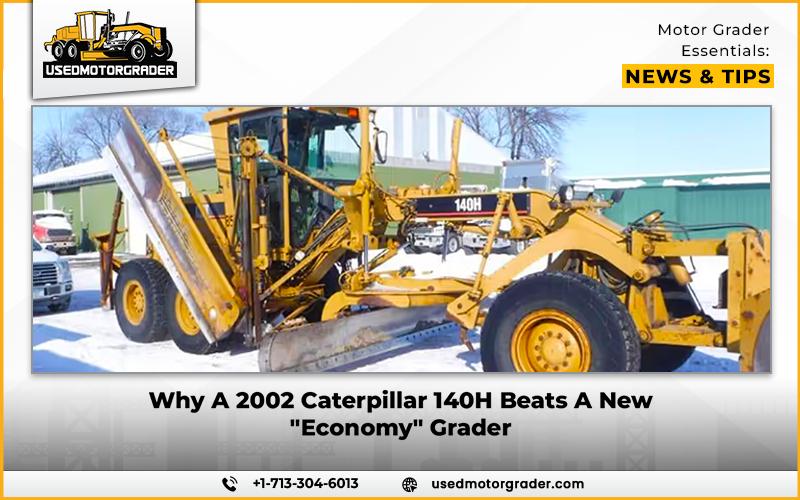
The 20-Year Value Floor in the Heavy Equipment Industry. The 2002 Caterpillar 140H continues to make a counterintuitive argument in a market that is obsessed with new features and new, lower sticker prices: age does not necessarily imply reduced value. In fact, this machine has turned out to be a financial haven for many contractors in 2026, rather than a liability. Although manufacturers market new-economy graders as cost-effective, the ownership equation tells a very different story once depreciation comes into play. The 140H reached its value floor several years ago, providing owners with a stable, predictable asset.
Knowing the Depreciation Curve
All machines have depreciation curves, although not all curves have the same end.
- The largest portion of value is lost by new graders within the first 12 -24 months.
- Budget or tier-2 brands have steeper depreciation because of lower resale demand.
- High-quality legacy models become flat after reaching long-term equilibrium in the market.
The 2002 Caterpillar 140H has already taken all the pain of depreciation. What we are left with is a fixed or, in other places, a rising asset based on scarcity and demand.
Appreciation Paradox: The Explanation
Ironically, buyers expect older machines to be cheaper, yet well-maintained 140H units are selling faster and for higher prices than a decade ago. Several factors explain this:
- High demand in non-regulated international markets.
- International acquaintance of operators and mechanics.
- Established mechanical platforms that are not heavy and software-dependent.
- Regular demand by the developing areas and rental fleets.
The new economy grader might seem to be a bargain, but as soon as it comes out of the dealer yard, the value begins to fall. That is not a strength of ownership; it is a weakness.
New Economy Graders v. Proven Iron
A 2026 budget grader appears to be the intelligent purchase on paper. Reduced initial price, factory warranty, and contemporary styling. However, long-term ownership is a different story.
- Economy models may lose half their value within the initial few years.
- Small networks of dealers decrease resale confidence.
- Proprietary electronics augment the risk of downtime once the warranty expires.
- Weak brand loyalty kills the secondary market prices.
In comparison, the 2002 Caterpillar 140H is still liquid in the second-hand market. Owners are able to get out of ownership without a financial loss, which is not easy with new economy machines.
Maintenance Economics: The Practical Advantage of the Old Guard
The largest issue with older equipment is usually maintenance. However, in the case of the 140H, the figures are often in favor of the buyer.
- Availability of parts is competitive and international.
- No complicated emissions systems to service.
- The machine can be serviced by independent mechanics.
- Anticipated wear patterns minimize unexpected failures.
A more modern economy grader may cost less to purchase, but dealer-only diagnostics and electronic components quickly drive up ownership expenses.
Reliability in the Workplace
Ask the seasoned operators what machine they have confidence in on remote or high-pressure work, and the response is usually predictable. The 2002 Caterpillar 140H is appreciated because it is consistent, rather than new. It starts, performs, and finishes the job without software glitches. Contractors operating in severe environments or managing mixed fleets directly convert such reliability into uptime, and uptime generates money.
Resale Liquidity and Exit Strategy
Buyers rarely consider how easily they can dispose of the machine later when evaluating equipment ownership.
- The 140H has consumers on various continents.
- It has residual value that is highly liquid in the used market.
- The performance of the auction is high annually.
Contractors are not locking up capital when purchasing a 2002 Caterpillar 140H. They are putting money into an asset that can be converted into cash with very little trouble.
Will Old Iron be the Smarter Hedge in 2026?
During unpredictable economic cycles, consistency is more important than innovation. New budget graders can meet the short-term buying objectives, but they subject the owners to the loss of value. The 2002 Caterpillar 140H, however, is more of a hedge; it does not react to sharp drops and is backed by the world demand. It does not imply that new machines are always the wrong choice. However, in the case where financial strength is the factor to consider, history has it that proven iron usually triumphs.
FAQs
1. Why is the 2002 Caterpillar 140H continuing to appreciate in selected markets?
A: The supply is low, the demand is high, and most buyers will choose mechanical, non-regulated engines that have proven reliability, particularly in rural or international areas.
2. Is it risky to purchase a 20-plus-year-old grader?
A: Condition, maintenance history, and application determine risk. A 140H in good condition is likely to be less risky financially than a new economy grader that is depreciating.
3. What is the resale gap between economy graders and high-end older models?
A: Brand loyalty, readily available parts, and operator familiarity help older high-end machines sell faster and retain higher value.
4. Should buyers consider a 2002 Caterpillar 140H in 2026?
A: Contractors focused on long-term ownership value, predictable maintenance costs, and high resale flexibility benefit the most.
Tags: 2007 Caterpillar 12HNA, 2014 Caterpillar 140M2, budget motor graders