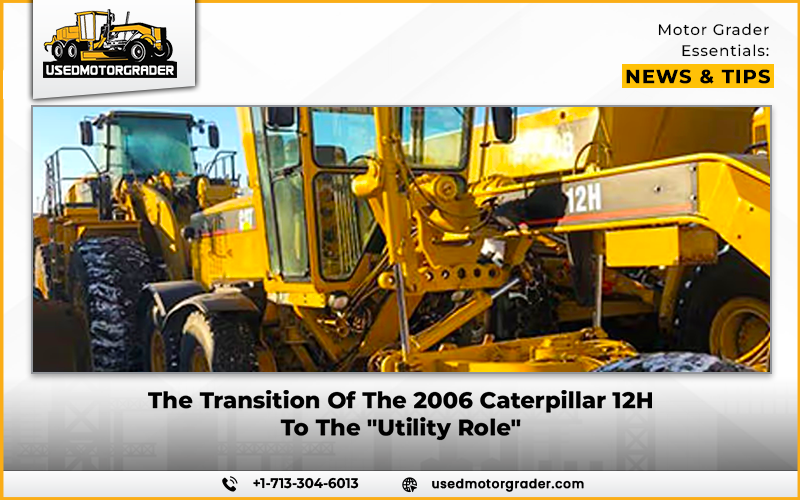
How the 2006 Caterpillar 12H Redefined the “Support Grader” Role
Fast-forward two decades, and the story of the 12H has changed, not due to the machine being rendered useless, but due to the change in its purpose. In 2026, the 2006 Caterpillar 12H has transitioned from the center of the production line to become the ultimate support grader, the one that does some of the most important secondary work to ensure the current job sites are operating smoothly.
The 2006 Context: Why the 12H Was Once the Mainline Production Grader
- Mid-scale and large-scale grading with balanced size and power.
- Reliable, pilot-operated hydraulics that provide a consistent blade feel.
- Simplicity that minimized unforeseen downtime.
- Strong enough to work long shifts with heavy loads.
- A reliable and consistent decision among the operators.
The 12H was capable of doing all the work, including bulk earth-moving to finish trim work in the mid-2000s, and it has earned the reputation of being a go-to grader in production-oriented fleets.
Fleet Stratification Explained: How Equipment Roles Change Over Time
The fleets in the modern world are no longer universal. The roles of equipment have become stratified due to the development of technology, which has introduced levels of specialization in the various types of fleets.
- Contractors assign newer machines to high-precision work and GPS-guided grading.
- They allocate older machines, such as the 12H, to secondary or support tasks.
- This strategy ensures the most expensive assets handle jobs where accuracy matters, while reliable older graders manage predictable but essential work.
Fleet stratification enables operators to utilize productivity to the maximum without overworking newer and more sensitive equipment. Adopting this model, fleets will be able to maximize the uptime and operational efficiency.
From Star Player to Sixth Man: The New Utility Role of the 12H
- Setting up the sites before the primary graders come.
- Keeping haul roads facilitates movement between work areas.
- Removal of snow and seasonal cleanup of industrial premises and cities.
- Grading of the cleanup following the bulk earthmoving with heavy machinery.
- Offering reserve capacity in case primary graders need to be serviced.
The 12H is essential in these functions. It may not be at the head of the production charge any longer, but its efforts are essential to the preservation of larger, more technologically advanced machines to do their special work.
Why the 12H Excels as a Support Grader in 2026
- Mechanical systems that are easy to troubleshoot in the field.
- The experienced operators can intervene with familiar layouts and controls.
- Reduced operating expenses relative to the newer machines that are technology-intensive.
- Less risk in working in severe or uncertain conditions.
- A good supply of parts means that there is minimal downtime during routine maintenance.
These are the attributes that have made the 2006 Caterpillar 12H popular among contractors who seek a low-maintenance machine that is reliable enough to complete difficult support jobs day in, day out.
The Economics of a Second Act
- Since the machine is fully depreciated and approaching the end of its primary lifecycle, operators add significant value with every hour of use.
- The insurance and ownership expenses are also very low compared to newer graders.
- Operators can use it aggressively without worrying about resale value or technological obsolescence.
- Perfect when a contractor needs to add a fleet of graders on a tight budget or when a municipality requires reliable graders.
- Increases overall fleet productivity by handling secondary work, which frees up mainline machines for high-precision tasks.
Economically, the 12H shows that old machines can still be used to create a lot of value when properly used.
Why Crews Still Trust the 12H
- Direct hydraulic feedback enables the blade to be controlled intuitively and responsively.
- No reliance on software, sensors, or GPS calibration routines.
- Easy cab design that operators have been using for decades.
- A highly dependable machine in repetitive, challenging support work.
- The machine remains ideal for night work, snow clearing, and rough terrain grading.
The 12H is more predictable to the operators compared to the newer machines, and the operators like its simplicity and its ability to perform in harsh environments.
The Job Description Shift
- Grading of finishes on highways and runways in airports with high precision.
- Massive work on production with strict deadlines.
- Final trim operations, which need special systems, are GPS-guided.
- Processes in which automation offers an obvious efficiency benefit.
This reallocation does not imply that there will be a decrease; it is a planned change that will maintain the usefulness of the 12H and will streamline the fleet workflow.
What the 12H Teaches Us About Long-Term Fleet Planning
- The value of equipment does not decline with time.
- Intelligent fleet managers design second-life functions prior to the conclusion of the main task of a machine.
- Support machines minimize the wear of high-value, high-tech assets.
- Aging graders are operationally resilient in the event of failure of the newer technology.
The 12H exemplifies effective machine lifecycle management, showing that second acts can match the success of first ones. Converting the 12H into a support grader highlights the importance of fleet planning and the benefits of wisely extending machine life.
The Quiet Backbone of the Modern Job Site
Twenty years later, the 2006 Caterpillar 12H continues to be a treasured part of the construction fleet in the world. Its performance as a support grader shows that practical utility, not novelty, determines relevance. The 12H is an example of the final “sixth man” in 2026: reliable, multi-purpose, and able to take on the necessary responsibilities that maintain sites active and projects on time.
FAQs
1. What makes the 2006 Caterpillar 12H ideal for support roles today?
A: It is simple, reliable, and easy to maintain, and is ideal for secondary duties such as haul road maintenance, snow removal, and site preparation.
2. Can a 12H still perform high-precision grading?
A: It is competent, but less effective than contemporary GPS-controlled graders in doing fine finish work. Its strength lies in predictable and constant support responsibilities.
3. Is it cost-effective to operate a 12H in 2026?
A: Yes. The 12H has low ownership costs, fully depreciated value, and readily available parts, which makes it have a great return on each hour worked.
4. How do operators feel about using older graders like the 12H?
A: The established crews tend to prefer it due to predictable hydraulics, intuitive controls, and comfort in difficult or repetitive support work.
Tags: Best motor grader in the world, Caterpillar Grader for Sale, construction equipment Houston