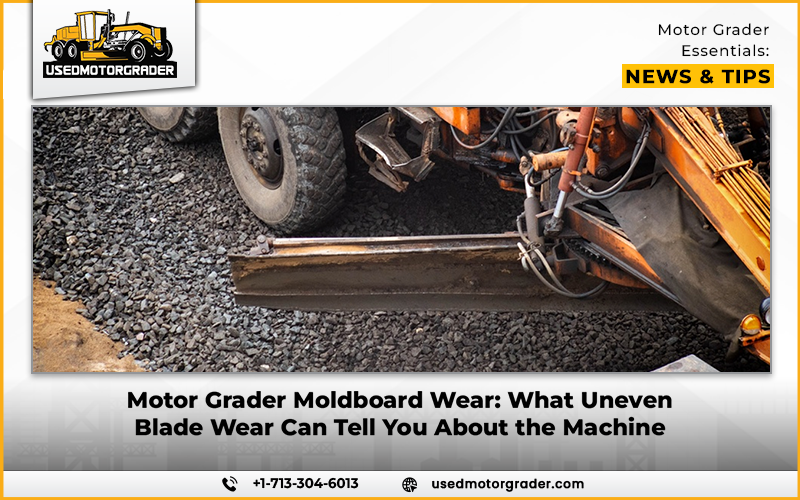
A grader’s paint job can be detailed for sale day. Its hour meter can be reset or simply stopped telling the truth years ago. But the cutting edge and moldboard under the machine have never been coached for a photograph, they carry the actual record of how a grader spent its working life, what it cut, how hard it was pushed, which side an operator favored, and if the circle and drawbar underneath were holding tight or giving up tolerance.
Most buyers glance at a blade, see rust or a fresh edge, and move on to the engine bay. That’s a mistake. Uneven wear is rarely random, it’s the residue of thousands of hours of decisions, from blade angle to down pressure to material, pressed into steel one pass at a time. Reading that record turns a routine walk-around into a real diagnostic exercise, and it changes the question a buyer should ask from “how much life is left” to something more useful: what actually put that wear there.
Why the Moldboard Is a Machine-Condition Clue
Every other major grader component works indirectly. The engine turns a pump, the pump moves fluid, and the fluid reaches the cylinders that position the blade. The moldboard and cutting edge are different; they are the only parts of the machine in constant, direct, load-bearing contact with the ground.
For anyone evaluating used motor graders, that direct contact is exactly why the blade deserves more attention than it usually gets. An engine can be serviced to mask hard use, and a leak cleaned up before a walk-around. A cutting edge that has worn unevenly is harder to disguise, because the pattern reflects hundreds of hours of choices, not one afternoon of detailing.
What Normal Moldboard Wear Looks Like
Cutting edges are designed to wear, that’s their job, protecting the far more expensive moldboard itself. An edge that thins gradually along its length, with a slightly rounded face and no dramatic difference end to end, is behaving exactly the way ground-engaging steel should.
What counts as normal varies by application. A fine-grading crew will replace edges after only an inch or so of wear, long before the edge looks used up, because precision work depends on a straight edge rather than a thick one. A gravel-road maintenance operation wears through edges faster in raw terms but tolerates more wear before replacement, since the finish tolerance is looser.
This is also why hours alone tell a buyer very little. Two graders with identical hour meters can show very different wear if one worked sand and the other soft topsoil, or one ran a standard edge and the other carbide inserts rated for many times the wear life. Hours describe how long a machine ran, not what it ran through.
Reading Uneven Blade Wear Like a Diagnostic Signal
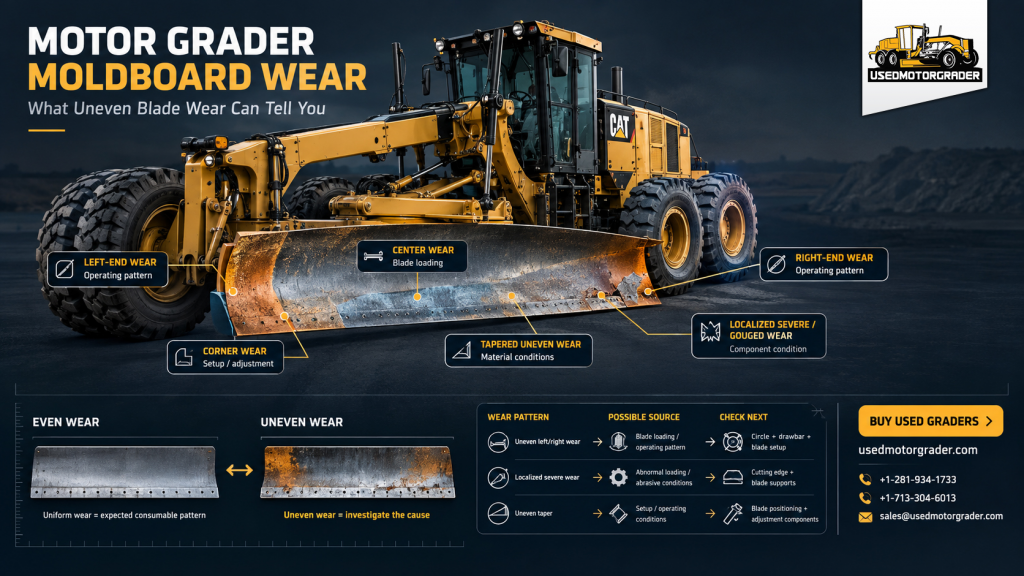
Wear that is asymmetrical, localized, or shaped differently from what the application would predict is where the moldboard becomes a genuine diagnostic tool. A few patterns show up often enough that experienced inspectors look for them by name.
One end wearing faster than the other is the most common complaint, and usually points to an operator favoring one side of the blade. Rounded, “crowned” edges, worn to match the road profile instead of staying straight, show up on machines that run long stretches without an angle change or edge rotation.
Localized gouging traces back to buried rock or a moment of excessive down pressure rather than steady wear. An edge worn unevenly across its width can point to a blade pitch held incorrectly for long periods.
No single pattern proves a single cause. A wear signature is a starting point for a question, not a verdict, and what to check next differs by pattern.
What Moldboard Wear Patterns Can Indicate
| Wear Pattern | Likely Cause | What It May Indicate | What to Inspect Next |
| One end wears faster than the other | Operator consistently leads with one side | A “favorite side” habit rather than alternating leads | Opposite end of the edge, end bits, adjacent wear |
| Rounded, crowned edge profile | Long stretches without an angle change or rotation | Limited rotation practice, infrequent maintenance | Scarifier history, blade angle habits, remaining thickness |
| Localized gouging or chipping | Buried debris, rock strikes, excessive down pressure | An isolated impact event, not an ongoing pattern | Moldboard surface near the gouge, hardware |
| Wear concentrated at the front | Blade run pitched back, not near a right angle | An operating habit or aggressive material action | Moldboard surface wear, fuel/hydraulic strain |
| Heavier wear near curbs or corners | Repeated curb contact, tight-radius work | Application-specific curb and gutter wear | End bit and corner wear, moldboard end damage |
| Wear into cutting-edge bolt holes | Edges left well past replacement point | Deferred maintenance, delayed edge changes | Base metal condition, repair cost exposure |
 Wear Pattern vs. Machine Problem
Not every uneven pattern means something is broken. Separating consumable wear from a mechanical warning starts with one question: does the pattern match what application and operator history would predict, or does it go beyond that?
- Normal consumable wear is gradual and stays roughly proportional across the edge even if one side leads slightly.
- Operator-induced wear is a favorite side, running pitched back, inconsistent angle changes, repeats across multiple edge changes, and is a coaching issue more than a mechanical one.
- Application-induced wear reflects the ground worked. Maintenance-related wear shows up as edges left in service too long, or wear cutting into the moldboard itself.
Mechanical-condition clues travel with looseness elsewhere, play in the circle or drawbar, chatter in the moldboard slide, or a blade that won’t hold a set angle. Uneven wear alongside any of those signs means something that needs more than a new cutting edge.
What Uneven Wear Can Reveal About Operator Technique
Operator habits leave some of the clearest marks, though most are learned behaviors rather than carelessness, a machine that shows them isn’t automatically poorly maintained.
Blade pitch matters more than most new operators realize. Running the edge close to a right angle spreads load evenly and wears more slowly; keeping the moldboard pitched back concentrates wear at the front and pushes more load onto the moldboard surface. Down pressure works the same way, leaning on a hard, dry surface accelerates wear and burns more fuel and horsepower.
Side preference shows up just as clearly. Operators who consistently lead with the same corner, out of comfort rather than necessity, wear that end noticeably faster, while operators who alternate leads and periodically flip edges spread wear more evenly. Curb work adds its own signature: the section near a curb line wears faster than the center because it does more corrective work.
None of this means a grader with uneven wear had a careless operator, it usually means a grader had an operator, making real trade-offs between speed, finish, and material, visible in the steel.
What Uneven Wear Can Reveal About Other Grader Components
A moldboard doesn’t wear in isolation. It’s the last link in a chain running from the drawbar through the circle to the cutting edge, and looseness anywhere in that chain changes how the blade loads and wears.
Volvo Construction Equipment’s grader product team has noted that moldboard slides, circle support shoes, and the drawbar ball stud share one vulnerability: any sliding surface can wear and cost blading tolerance. Circle shoes and slide inserts usually show it first. A grader with uneven wear that also chatters, a fore-and-aft wiggle during operation, often has slide rail inserts needing adjustment rather than a purely operator-driven pattern.
Caterpillar’s product support team describes a simple field check: lift the drawbar, circle, and moldboard off the ground, and watch if the cutting edge moves immediately when the lift cylinder rods move. A gap points to loose linkage, and drawbar wear inserts can be checked the same way.
This doesn’t mean condemning a machine over uneven wear alone, it means the blade-control assembly deserves the same attention as the edge itself. This is one reason so many of the used motor grader maintenance mistakes that quietly drive up ownership costs trace back to the blade and its supporting hardware rather than the engine.
How Application Changes the Wear Story
The same wear pattern can mean different things depending on what the grader was built to do.
Fine-grading work demands the tightest tolerances in the industry, often under a quarter inch, which is why crews favor narrow, thin edges and replace them after comparatively little wear. An edge on a finish-grade machine with only modest wear but noticeable unevenness is a bigger concern than the same pattern on a road-maintenance grader. A buyer shopping for a road grader for sale built for fine-grading duty should expect a very different wear threshold than one shopping for a haul-road machine.
Road maintenance and gravel-road work sit at the other end of the spectrum, running edges through more material and often using carbide-insert or rotating-bit systems because standard through-hardened edges wear too quickly in continuous abrasive conditions.
Mining and heavy site-development work call for heavier moldboards and higher operating weight to maintain penetration at aggressive angles. Snow and winter applications favor carbide or blunt underbody edges suited to light-contact passes rather than deep material displacement. A grader from one of these applications will show a wear signature that looks unusual next to a road-construction machine, without anything being wrong.
How Technology Changes, and Doesn’t Change, the Wear Story
Grade control and automated blade positioning have measurably changed how consistently a moldboard is held on task, which shows up in wear patterns over time. Systems built around dual GNSS receivers can manage blade position across a full 3D design instead of requiring an operator to hold angle, elevation, and cross slope manually every pass.
John Deere motor graders have gone further on newer platforms with a cutting-edge wear feature that lets an operator set a baseline and track wear over the edge’s life, a logged measurement instead of a visual guess.
What automation does not do is eliminate the physical forces that cause wear. A grade-control system commands where the blade should be, it doesn’t change how much abrasive material moves across the edge or how much down pressure gets applied.
A machine running automated blade control in the wrong material, or with a circle and drawbar that already have play, will still wear unevenly; automation just makes it easier to hold a consistent angle while it happens. That’s worth remembering before weighing motor grader features that require constant adjustment against those that don’t: the electronics manage inputs, but the steel still absorbs the outcome.
Seen against how motor grader innovation compares with other heavy equipment categories, grade control is a genuine leap forward, an input-management leap, not a physics-defying one.
How Buyers Should Inspect Moldboard Wear on a Used Grader
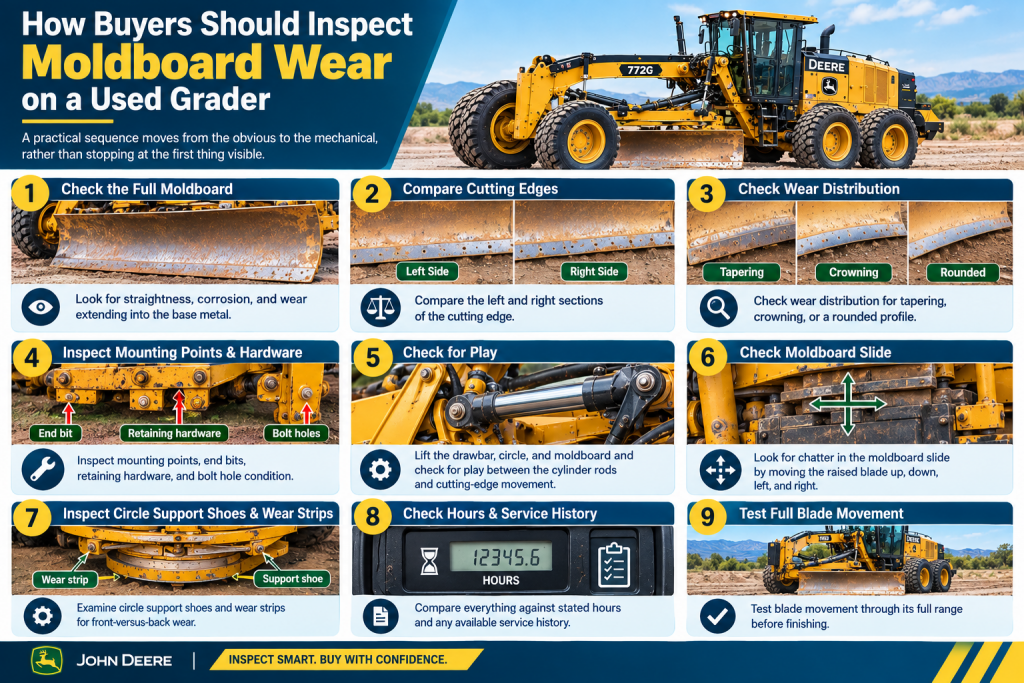
A practical sequence moves from the obvious to the mechanical, rather than stopping at the first thing visible.
- Look at the full moldboard first, check for straightness, corrosion, and wear extending into the base metal.
- Compare the left and right sections of the cutting edge against each other.
- Check wear distribution for tapering, crowning, or a rounded profile.
- Inspect mounting points, end bits, retaining hardware, and bolt hole condition.
- Lift the drawbar, circle, and moldboard and check for play between the cylinder rods and cutting-edge movement.
- Look for chatter in the moldboard slide by moving the raised blade up, down, left, and right.
- Examine circle support shoes and wear strips for front-versus-back wear.
- Compare everything against stated hours and any available service history.
- Test blade movement through its full range before finishing.
A machine that passes this sequence with wear matching its stated application and hours is a far more trustworthy used motor grader for sale than one where the paint looks better than the blade behaves.
Used-Grader Inspection Checklist
| Inspection Area | Normal/Acceptable Condition | Warning Sign | Potential Consequence |
| Cutting edge | Even wear along the length, matched left and right | Sharp taper, one end far thinner | Poor finish quality, uneven material flow |
| Moldboard base metal | No exposure near bolt holes | Wear extending into base steel | Costly moldboard repair or replacement |
| Circle support shoes/slides | Light, even wear; front slightly more than back | Excess play, visible gap under load | Reduced accuracy, repeated shim replacement |
| Drawbar wear inserts | Snug fit, no measurable gap | Visible gap when assembly is raised | Loose linkage, inconsistent blade control |
| Moldboard slide/chatter | Smooth movement, no fore-aft wiggle | Chatter or washboard finish | Washboarded surfaces, accelerated wear |
| Articulation joint | Minimal, even play within spec | Excessive play or uneven wheel lean | Steering inaccuracy, side-loading on the blade |
Moldboard Wear and Used-Machine Value
Some wear issues are cheap and expected. A cutting edge nearing its replacement point on a machine with matching hours and a plausible application history is a normal cost of ownership, belonging in negotiation the same way tires would. Edges, end bits, and circle wear strips are consumable, budgeted items on any working grader.
Other issues carry more weight. Wear reaching the moldboard base metal turns a routine part swap into a structural repair. Circle or drawbar looseness alongside uneven wear can point toward a rebuild that costs far more than a blade change. That’s part of why usedmotorgrader.com built its listings around this kind of transparency, helping contractors buy motor graders whose wear actually matches the paperwork.
Unusually clean-looking wear deserves its own scrutiny rather than automatic credit. A brand-new edge on a machine with high stated hours isn’t necessarily reassuring, it can mean a recent edge change dressed the machine up for sale. A road grader for sale with a suspiciously fresh edge and high hours is exactly the mismatch worth asking about before money changes hands.
Wear Findings and Buyer Response
| Wear/Condition Issue | Likely Source | Cost/Operational Risk | Buyer Response |
| Even wear near the replacement point | Normal consumable use matching stated hours | Low, a budgeted replacement cost | Factor into negotiation as routine maintenance |
| Uneven wear, no mechanical play found | Operator habit (favorite side, blade pitch) | Low to moderate, shorter edge life | Note for future operator practice, minor cost |
| Uneven wear with circle/drawbar play | Worn support components, deferred maintenance | Moderate to high, rebuild cost, downtime | Get a mechanical inspection before agreeing on price |
| Wear reaching moldboard base metal | Edges run well past replacement point | High, moldboard repair or replacement | Price in a major repair, or walk away if unexplained |
| Brand-new edge, high stated hours | Recent cosmetic replacement, unclear history | Uncertain, a documentation gap | Request service records and application history |
What Sellers and Fleet Managers Should Document
Good records turn moldboard wear back into what it should be, a verifiable part of a machine’s history. Cutting-edge replacement dates, the material and application worked between changes, and any circle, drawbar, or slide service belong in a maintenance file that travels with the machine.
Fleet managers who track wear by application, not only by hours, get early warning when a machine wears faster than its peers, often before it shows up as an unplanned repair. That kind of record-keeping is also part of how the most consistent U.S. motor grader contractors earn repeat business: predictable grading quality depends on catching wear before it affects finish work, worth remembering when comparing used motor graders that look similar on paper but very different underneath.
Final Takeaway
A moldboard’s wear pattern is evidence, not a verdict. Read on its own, worn or uneven wear can mean almost anything: a hard-working machine, a heavy-handed operator, an abrasive application, or a circle starting to give up tolerance. Reading alongside hours, service records, and the condition of the circle and drawbar underneath, that same pattern becomes one of the most honest sources of information a used grader has to offer.
The habit worth building is asking what caused the wear before asking how much is left. As the broader hardware-versus-workflow debate in the motor grader industry keeps underscoring, the steel and the system attached to it tell the story together, not separately.
Find Your Next Motor Grader
A grader’s blade tells a true story, but it’s only half the picture, the rest comes from a documented machine with a clean mechanical history behind it. usedmotorgrader.com lists used motor graders inventory for sale/rent from popular brands, including Caterpillar, John Deere, Komatsu, and Volvo, each with documentation to back up its condition and application history.
If you’re comparing wear, hours, and service records the way this guide describes, our current listings make it straightforward to buy motor graders that match what the steel is telling you, with fast, convenient access instead of guesswork.
FAQs
1. How can I tell normal blade wear from abnormal wear?
A: Normal wear is gradual, roughly even across the edge, and matches the material the grader has worked on. Abnormal wear is asymmetrical, sharply tapered, or shows gouging that doesn’t match the application.
2. Does uneven blade wear always mean a motor grader has a mechanical problem?
A: No. It’s just as often an operator habit, like favoring one side of the blade, as it is circle or drawbar looseness. What else turns up during inspection matters more than the wear pattern alone.
3. What should I inspect on a used grader’s moldboard before buying?
A: Start with the cutting edge, comparing wear side to side and checking it hasn’t worn into the moldboard base metal. Then check the circle support shoes, drawbar wear inserts, and moldboard slide for play, and compare everything against the machine’s hours and service records.
4. Should cutting-edge wear alone affect my buying decision?
A: Rarely on its own, edges are a routine, budgeted replacement item. What matters more is if the wear pattern lines up with the machine’s stated history, and if it comes with any looseness in the circle, drawbar, or moldboard slide.
Tags: Grader Machine Performance, Grader Blade Width, Used Motor Grader Trends