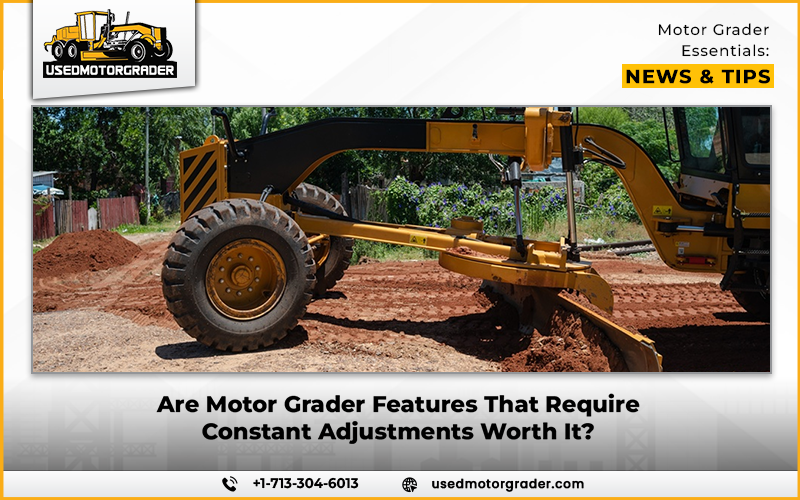
Ask any grader operator what wears them out on a long shift, and horsepower rarely comes up. It’s the menus. The calibration screens. The joystick sensitivity that never feels quite right until an hour into the pass. Motor graders built for 2026 arrive loaded with adjustable systems, cross-slope control, grade automation, and hydraulic tuning, so the real question is simple: does all that fine-tuning make the work better, or does it add another job on top of the job?
What Counts as a “Constant Adjustment” Feature?
A specific group of grader tech demands ongoing attention, the systems operators return to again and again in a single shift:
- Cross-slope and grade-control systems needing recalibration between passes or projects
- Joystick sensitivity and hydraulic response tuned to operator preference
- Blade, circle, and articulation adjustments for changing material and terrain
- Menu settings for switching between 2D and 3D control modes
- Manual overrides that step in when automation misreads the surface
Older lever-based graders skipped most of this. What you set stayed set. Today’s machines trade that simplicity for precision, and that trade is exactly what’s up for debate.
Why Manufacturers Keep Adding More Controls
This push isn’t complexity for its own sake. Manufacturers are solving a real problem: fewer experienced operators and tighter tolerances on finish grading. Adjustable systems exist to:
- Help less experienced operators hit acceptable grade accuracy faster
- Cut rework by holding a consistent cross-slope automatically
- Reduce fatigue by replacing multiple hand levers with fewer, smarter controls
- Let one machine adapt to several job types instead of buying separate equipment
Every sensor and calibration routine is also one more thing that can go wrong, and one more thing an operator has to understand before it helps rather than hinders.
Do Constant Adjustments Actually Slow Operators Down?
For a first-year operator, yes, at least at first. Learning what each setting does takes real time. Veteran operators tell a different story: once a system is understood, it becomes close to automatic, and the productivity gain on cross-slope work is hard to dispute on longer, technical projects. Adjustment-heavy features pay off fastest on complex, high-precision jobs, and matter far less on routine maintenance grading, where a simple, well-kept machine gets the job done just as fast.
CAT Graders for Sale vs John Deere Graders vs Komatsu Grader for Sale
Brand philosophy shapes how much fiddling a machine demands.
- CAT graders for sale are frequently praised for joystick ergonomics that cut hand movement noticeably, shortening the learning curve on tech-heavy models
- John Deere graders lean hard into automation, with auto-articulation and one-button presets built to reduce manual adjustments per pass
- A Komatsu grader for sale often stands out for electro-proportional hydraulics that respond smoothly without constant retuning
Anyone comparing CAT graders for sale against John Deere graders and a Komatsu grader for sale should weigh how much automation the crew will actually use, not just the spec sheet. For a used Cat unit, this breakdown of top features to check on a used Cat motor grader separates a smart buy from a costly one. Safety-focused buyers should review how Deere’s safety systems protect operators on active jobsites before assuming automation adds risk. For where the industry is headed, this rundown of which grader manufacturers are investing most in automation is a useful companion read.
When Are Adjustable Features Overkill, and When Are They a Wise Investment?
Calibration-heavy systems earn their cost on highway grading, fine-finish work, and long-duration projects where small errors compound into rework. They’re overkill for county road maintenance and short jobs, where a simple, well-maintained machine keeps pace without the setup time. Fleet size matters too: a single-machine operation with one steady operator gets more value from a system tuned once and left alone, while larger fleets with rotating operators benefit from automation that standardizes results.
Ownership Cost and Resale Reality
Buyers in 2026 show a clear preference: simpler, well-documented machines are moving faster in the used market, partly because sensors and calibration systems raise the perceived and actual maintenance burden. Feature-heavy graders don’t automatically hold value better, service history and mechanical condition still matter most.
The Verdict
Constant-adjustment features are worth it when the job demands precision an experienced operator can actually put to use. They’re a liability when bolted onto routine work nobody has time to calibrate correctly. The smartest buyers match a machine’s complexity to the job, not the other way around.
Skip the guesswork and put a proven machine to work. Shop used CAT, John Deere, and Komatsu motor graders at usedmotorgrader.com and get the grading power your next project needs.
FAQs
1. Do grade control systems really save time on the job?
A: Yes, mainly on fine grading and slope work, where they cut rework and reduce the passes needed to hit tolerance.
2. Are simpler motor graders better for new operators?
A: Generally yes at first, though modern automation is built to shorten that learning curve over time.
3. Which brand has the easiest controls to live with?
A: It depends on the job. CAT graders feature ergonomic joysticks, John Deere graders leverage automation presets, and Komatsu graders win on hydraulic response.
4. Does feature-heavy technology hurt resale value?
A: Not directly, but poor maintenance records on complex systems make buyers hesitant, which is why service history matters more than spec count.
Tags: Advanced Motor Grader Features, 2026 Motor Grader Market, Motor Grader Features Guide