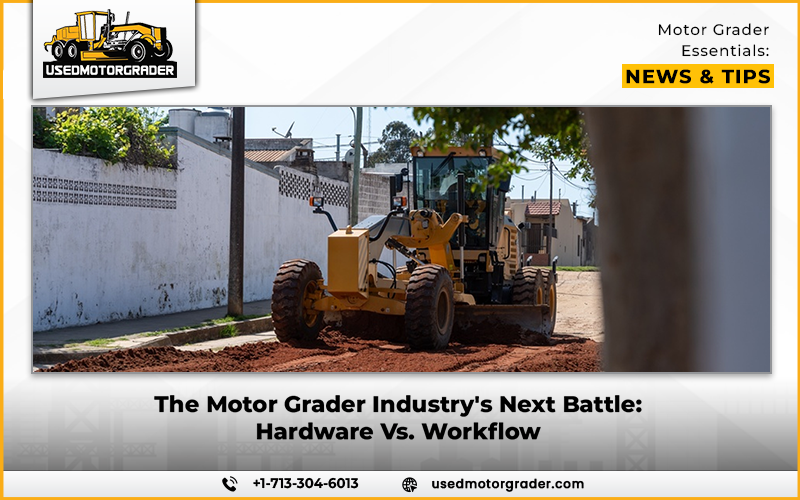
Two contractors bid the same subdivision road package this spring, working within a few miles of each other in central Texas. Both crews ran mid-size graders less than three years old, with comparable horsepower, blade width, and operating weight, the kind of specs that would look nearly identical on a dealer sheet. One crew finished its cul-de-sacs in four passes per lift, handed off clean as-built data to the paving crew, and moved to the next phase two days ahead of schedule.
The other needed six or seven passes on the same material, re-checked grade twice as often, and lost the better part of a week to rework nobody had budgeted for. The machines weren’t the difference. The operator interface, the grade-control setup, and how cleanly the design file moved from the office to the cab were. That gap is becoming the real story in motor graders for 2026: horsepower still matters, but the industry’s next competitive battle may be decided by which machine helps a contractor finish the entire grading job, not just move the material.
The Motor Grader Competition Used to Be About Hardware
For most of the motor grader’s history, buying one meant comparing a short list of mechanical facts: horsepower, operating weight, blade width, moldboard design, articulation range, all-wheel-drive availability, hydraulic flow, transmission speeds, and how the operator sat behind the wheel. These numbers still matter enormously. A grader without enough drawbar pull will bog down in heavy cut material regardless of how sophisticated its cab electronics are, and a machine that’s undersized for the application will underperform no matter what software runs behind the glass. Blade capacity determines how much material moves per pass. Operating weight affects traction and stability on grade. Hydraulic performance sets the ceiling on how fast the blade, circle, and articulation can respond. None of that has stopped mattering.
What has changed is what happens when two machines look nearly identical on those specifications. A contractor comparing a Caterpillar, John Deere, Komatsu, or CASE grader in the same horsepower and weight class today is increasingly comparing machines that could do roughly the same physical work, yet deliver very different results on an actual jobsite. The gap shows up in how the operator interacts with the controls, how grade information reaches the blade, how much correction a pass needs, and how cleanly a design file moves from the engineer’s desktop to the machine.
The Definition of “Performance” Is Changing
For decades, “performance” on a motor grader meant something fairly narrow: production per hour, horsepower, cycle time, fuel burn, and how much material the blade could carry per pass. Those numbers are still tracked, and fleet managers still care about them. But increasingly, they don’t capture what actually determines whether a project finishes on time and on budget.
A broader set of workflow metrics has started to matter just as much: how many passes it takes to hit design grade, how much rework an inconsistent pass triggers, how tightly the finished surface tracks the design file, how much manual correction the operator has to apply, how quickly grade information moves from the office to the machine, how long task setup takes, how consistent results are across different operators on the same machine, how efficiently material gets used instead of wasted, how smoothly a finished section hands off to the next phase, and what the machine costs per completed unit of work once fuel, labor, and rework are counted.
None of this makes horsepower or mechanical capability irrelevant, a machine still has to physically be able to do the job. What’s changing is the scope of what counts as productivity. A grader that finishes a lift in four passes with clean, repeatable results is more productive than one that needs six passes and a follow-up grade check, even if the second machine has a marginally higher horsepower rating. The definition of productivity is getting broader, not replaced.
| Traditional Hardware Lens | Workflow Lens | Why It Matters |
| Horsepower | Passes required to reach finished grade | Raw power sets a ceiling on what’s possible; pass count determines what it actually costs to get there |
| Blade and moldboard capacity | Grade accuracy and rework rate | A wider blade moves more material per pass, but accuracy decides whether that material ends up in the right place the first time |
| Operating weight | Consistency across operators | Weight aids stability, but consistent results depend on how much of the job the machine, not the operator, is managing |
| Steering configuration | Operator fatigue and ramp-up time | Configuration affects comfort, but the workflow question is how quickly a new hire reaches full productivity on it |
| All-wheel-drive and traction | Data continuity across the project | Traction determines what terrain a grader can handle; continuity determines whether the design file, the grade check, and the handoff are talking to each other |
| Hydraulic performance | Setup and calibration time | Strong hydraulics move the blade fast, but setup time determines how much of the shift is actually productive |
| Fuel efficiency at the engine | Fuel burned per completed task | Engine efficiency is one input; the workflow lens counts fuel against how many passes were needed to finish |
| Machine durability | Fleet interoperability | Durability protects the asset; interoperability protects the schedule when machines, plans, and crews all have to work together |
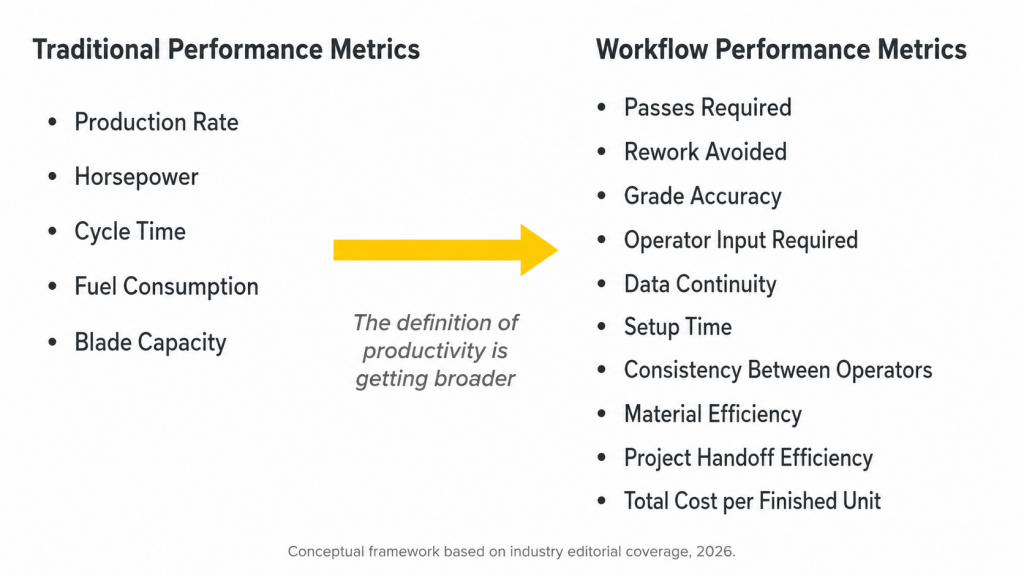
Productivity used to be measured mostly at the machine. Now it’s measured across the whole grading workflow, from setup to handoff.
What “Workflow” Actually Means on a Modern Grading Jobsite
“Workflow” is one of those words that can mean almost anything, so it’s worth being specific about what it covers on an actual grading project. On a modern jobsite, the activity around a motor grader runs through a defined sequence:
- Project design and digital plan preparation
- Machine setup and calibration before work begins
- Transfer of grade and design information to the machine
- Operator setup, including control configuration and machine presets
- Cutting, spreading, shaping, and finishing passes
- Grade verification against the design file
- Correction of any deviations found during verification
- Rework, when corrections aren’t enough
- Data collection and communication back to the project team
- Final handoff to the next phase or trade
Connected technology and machine-control systems don’t just automate the blade in step five. They can affect nearly every stage in that chain: how fast a design file loads onto the machine, how much setup a new task requires, how quickly a deviation gets caught, and how cleanly the finished work gets documented for handoff. Workflow, in other words, is the entire chain of activity that surrounds productive machine operation, not just the moment the blade touches the ground.
Grade Control Is Turning the Motor Grader Into Part of a Digital Workflow
The clearest evidence of this shift sits in grade-control technology. Modern motor graders increasingly ship with, or can be upgraded to, 2D grade-control systems, cross-slope automation, and full 3D machine control tied to GNSS positioning. Caterpillar’s Cat Grade with 3D system is built to help operators reach design grade with fewer manual corrections, and the company’s Next Generation platform, which by 2026 spans the Cat 120 through the newly launched 150 and 160, pairs that grade-control capability with automatic blade control, a factory-calibrated E-fence, and Cross Slope Assist tied to a position-sensing shift cylinder.
John Deere took a comparable step at CONEXPO-CON/AGG 2026, rolling out its P-Tier SmartGrade lineup across eight models, from the 620 through the 872, with grade control run through a 10.1-inch G5 touchscreen that supports either Topcon or Leica hardware and switches between 2D and 3D solutions without leaving the cab.
It’s worth being precise about the difference between assistance and automation here. Cross-slope assist and automatic blade control reduce how often an operator has to manually correct the blade, but they don’t remove the operator from the loop. What changes is the nature of the job: instead of constantly feathering multiple hydraulic functions to hold a line, the operator increasingly manages material flow, machine positioning relative to the design file, and overall grading strategy, while the system handles finer blade corrections.
In its own testing with less-experienced operators, John Deere has reported input reductions of up to roughly 75 percent for certain tasks when automation features are paired with SmartGrade, a manufacturer-reported figure worth noting specifically as Deere’s own study, not as an independently verified industry average. The honest read is that the technology reduces correction burden, and how much depends heavily on the application and the operator behind the controls.
The Operator Is Still the Most Important Part of the Workflow
None of this technology removes the person in the seat from the equation, and treating it that way is probably the fastest way to misread where the industry is headed. Operator experience still shapes outcomes more than any single piece of hardware. A skilled operator reads material, anticipates how the machine will respond, and manages a jobsite’s changing conditions in ways a grade-control system alone can’t replicate. Training, comfort with the technology, and familiarity with a specific control layout all affect how much value any given system actually delivers on a live jobsite.
That’s part of why the long-running steering-wheel-and-lever versus joystick controls debate among U.S. grader operators hasn’t settled into a single answer. Experienced hands who learned on levers often keep their edge on finishing work with a wheel in hand, while newer operators tend to adapt faster to joystick layouts that mirror controls they’ve used on other equipment. A technologically advanced grader can still underperform badly if the operator isn’t trained on the system, if the grade-control setup is configured wrong for the application, if the technology is more complex than the job calls for, or if the operator simply doesn’t trust what the system is telling them. Digital information that doesn’t flow cleanly from office to machine creates the same problem no matter how good the hardware is. The industry’s near-term future looks like operator-plus-technology, not operator-versus-technology.
Why Manufacturer Competition Is Moving Beyond the Machine Itself
Look at how the major manufacturers have actually positioned themselves through 2026, and the strategic direction gets clearer. Caterpillar has pushed its Next Generation platform across nearly its entire lineup: the 120, both lever and joystick configurations of the 140, and now the 150 and 160, bundling automatic blade control, 360-degree camera systems, a People Detection safety alert, and Cat Grade with 3D into a factory-integrated technology stack. Caterpillar and its dealer network have marketed the three-axis joystick option specifically on the reduction in hand and arm movement it offers over a conventional lever-and-wheel setup, a figure the company has put at up to 78 percent less movement, a manufacturer claim framed around fatigue and productivity rather than a raw output number.
John Deere’s answer at CONEXPO-CON/AGG 2026 was broader in scope: eight new P-Tier SmartGrade models built around grade control as a core part of the machine’s architecture rather than a bolt-on option, plus Remote Display Access through the John Deere Operations Center so dealers can troubleshoot machines without a site visit. Komatsu has taken a different route, folding its GD655-7 grader into the company’s wider Smart Construction ecosystem, layering 3D design data, drone-captured aerial maps, and machine telemetry into a single jobsite view rather than treating the grader as a standalone unit.
CASE re-entered the 200-plus-horsepower segment it had exited roughly a decade earlier, bringing electro-hydraulic controls and its SiteConnect telematics module to the category, while Volvo’s public technology messaging has stayed more focused on operator comfort and fuel efficiency than on building out a competing automation stack. Even new entrants matter here: China-based LiuGong brought its first motor grader to the U.S. market in 2026, competing initially on price and basic capability rather than a matching technology ecosystem.
For a closer brand-by-brand breakdown, an analysis of which motor grader manufacturers are investing most in automation lays out the specific technology packages in more depth. The pattern across nearly every manufacturer points the same direction: the companies aren’t just competing to build a better grader anymore. They are competing to build a better grading system, machine, controls, data, and support bundled together.
| Technology | Workflow Area Affected | Potential Operational Benefit | Important Limitation |
| 2D/3D grade control (Cat Grade, Deere SmartGrade) | Cutting and finishing passes | Fewer passes needed to reach design grade | Value depends on clean, current digital design files reaching the machine |
| Cross-slope assist and automatic blade control | Grade verification and rework | More consistent slope without constant manual blade correction | Doesn’t replace periodic manual grade checks or surveying |
| Joystick controls (Cat three-axis, Deere fingertip) | Operator fatigue and training | Manufacturer testing shows meaningfully less hand and arm movement than lever-and-wheel setups | Experienced lever operators can see a temporary productivity dip while switching |
| Telematics and remote diagnostics (Deere Operations Center, Cat Connect) | Data continuity and dealer support | Faster troubleshooting and fewer unplanned service visits | Depends on active subscriptions and reliable jobsite connectivity |
| Machine presets and auto-articulation | Setup time between tasks | Less manual reconfiguration between passes or operators | Presets have to be built and maintained correctly to stay useful |
| Smart Construction-type ecosystems (Komatsu IMC) | Project handoff and documentation | Unifies design data, aerial mapping, and machine telemetry into one view | Requires buy-in and training across the whole jobsite team, not just the grader operator |
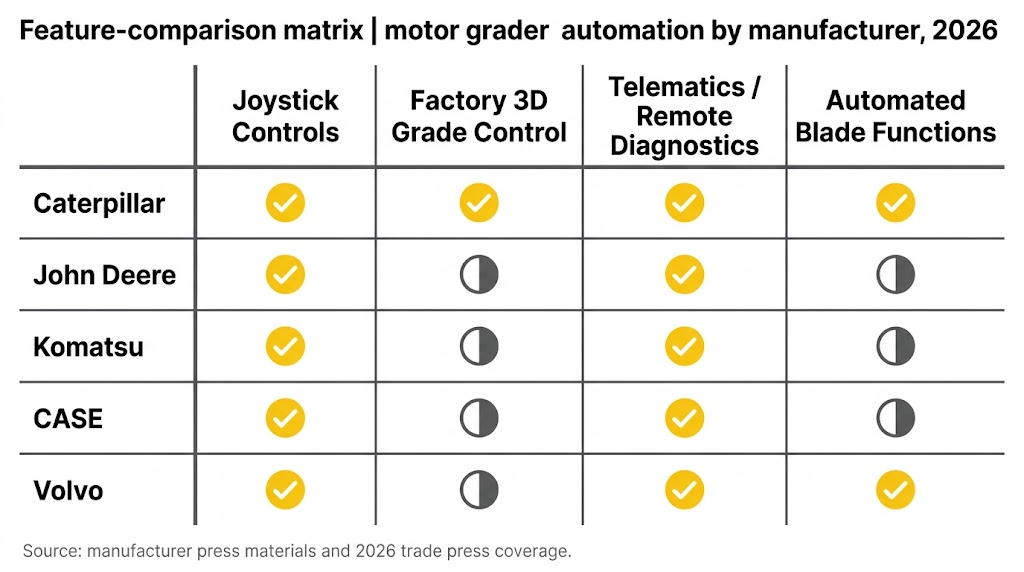
By 2026, every major manufacturer offers some version of grade control and joystick controls, the real differences are in depth and integration.
The Strongest Hardware Can Still Lose to a Better Workflow
None of this means the more automated machine automatically wins. But there are specific, real circumstances where a mechanically strong grader loses ground to a machine with a tighter workflow around it. A grader that needs more passes to reach grade burns more fuel and more shift time regardless of how much horsepower it has under the hood. One that requires frequent manual grade checks because its automation is unreliable or absent adds labor a competing machine avoids. Poor operator visibility to the blade, controls that fight the operator instead of working with them, and weak interoperability with a project’s digital plans all quietly erode productivity in ways a spec-sheet comparison never shows.
This is exactly the tension behind the ongoing debate over legacy versus next-generation grader models: a well-maintained older machine with strong mechanicals can still outperform a newer one on straightforward work, while a technologically thin machine can lose ground fast on a project that depends on tight tolerances and repeatable results. Workflow technology doesn’t automatically beat hardware. Under the right conditions, tight tolerances, high pass counts, mixed-experience crews, digitally designed projects, workflow gaps can cost more than horsepower gaps ever would.
Where Hardware Still Wins
Workflow technology doesn’t erase the cases where raw mechanical capability decides the outcome. Heavy cuts through dense or rocky material, deep ditching, large-scale site preparation, and steep-terrain work still come down to drawbar pull, moldboard strength, and machine stability more than any digital layer on top. Snow removal at scale rewards horsepower, blade capacity, and all-wheel-drive traction over grade-control sophistication. Mining-related applications and high-load, traction-sensitive jobs push machines toward their mechanical limits in ways automation can’t compensate for.
Workflow technology multiplies the value of a machine that’s already right-sized for the work. It doesn’t substitute for the wrong machine. A contractor grading a mining haul road in tough material needs the horsepower and stability first; the digital layer is what makes that capability easier to use consistently, not what replaces the need for it. The best outcomes still come from matching the right hardware to the application before layering workflow technology on top.
Why Workflow Matters Even More as the Operator Pool Changes
The labor picture in construction adds another layer to this shift. The median annual wage for construction equipment operators sat at $58,320 in May 2024, according to Bureau of Labor Statistics data, with the bottom 10 percent earning less than $39,850, a hard number to reconcile with how demanding a motor grader is to learn well. Deloitte estimates that 41 percent of the construction workforce will reach retirement age by 2031, and in the AGC/Sage 2026 Outlook, 80 percent of firms reported difficulty filling salaried positions. Fewer experienced operators are available to mentor the newer ones coming up behind them as a result.
This is exactly where workflow technology earns its keep, separate from any argument about raw productivity. Automation and assist features can’t fix low pay or thin mentorship on their own, and treating them as a complete solution to the operator shortage oversells what they actually do. What they can do is standardize certain machine functions so a less experienced operator produces more consistent results sooner, easing some of the training burden even if it doesn’t eliminate it. A deeper look at why the real operator shortage in the U.S. grader market is retention, not hiring lays out how this labor gap is already reshaping which used graders buyers favor, specifically machines with more forgiving controls and better cab ergonomics, because retention risk makes operator-friendly design a financial consideration, not just a comfort one.
The Hidden Economics of Workflow
The economic case for workflow technology runs through several connected channels rather than one clean number. Fewer passes mean less fuel burned and less machine time logged to finish the same task. Less machine time means less operator time, which on a day-rate or salaried crew translates directly into cost. Fewer passes also tend to mean less material movement and less rework, which can add up to greater project throughput across a season. None of these channels should be assigned an invented dollar figure, the honest way to think about them is as a chain of cause and effect, not a guaranteed savings number.
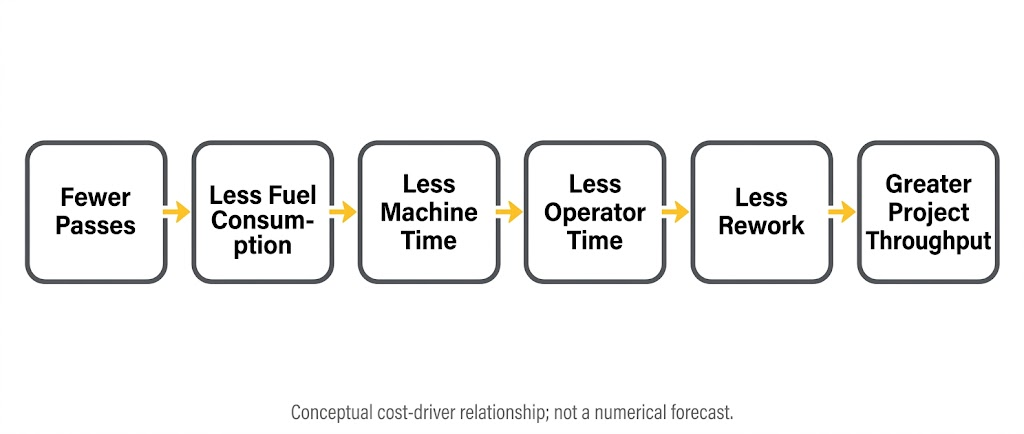
The economics of workflow move through a chain, not a single number, each link compounds into total ownership cost.
What contractors can reasonably evaluate instead is cost per productive hour, cost per finished unit of work once fuel and labor are counted, fuel burned per completed task rather than per hour, operator hours required per finished task, the labor cost of grade-checking and rework, how fully a machine gets utilized across a season, unplanned downtime, and the upfront cost of both the technology and the training required to use it well. Fuel alone is estimated to account for around 30 percent of total heavy equipment operating costs industry-wide, which means even a modest improvement in pass efficiency can move the needle on total ownership cost. The right way to evaluate a technology package is against total workflow economics, not against how many features appear on the spec sheet.
When More Technology Actually Makes the Workflow Worse
It would be easy to write this article as an argument that more technology always wins, and that would be both dishonest and a disservice to the contractors reading it. Technology can genuinely hurt productivity under the wrong conditions. Poor training turns an automation feature into a source of confusion instead of a time-saver. Systems more complex than a given job requires add setup time without adding value. Weak or incomplete digital design data feeding into a grade-control system produces confidently wrong results instead of no results. Incompatible systems between the grader and the rest of a jobsite’s technology stack create friction rather than removing it, and poor jobsite connectivity can strand a machine’s more advanced features entirely. Operator resistance to a new control layout is a real cost, not a soft one, especially on a crew already stretched thin.
This is the heart of the distinction raised in an analysis of whether Caterpillar’s next-generation technology is a genuine productivity tool or an expensive luxury: the answer depends entirely on whether a given contractor’s work actually uses what the technology offers. A high acquisition cost without enough utilization to justify it is a real risk, not a hypothetical one. The smartest grader on a given jobsite isn’t necessarily the one carrying the most technology. It’s the one carrying the technology that actually fits how that contractor works.
What This Means for Used Motor Grader Buyers
For buyers shopping the used market specifically, this debate changes the questions worth asking before a purchase. It’s less about maintenance history and inspection checklists, that’s a separate conversation, and more about technology and application fit. Is the machine’s control layout and grade-control capability compatible with how the fleet already works? Can it integrate with the technology other machines in the fleet already run? Is the grade-control hardware, if any, actually relevant to the kind of projects this contractor takes on? Will operators need significant retraining to run it well? Is the machine’s configuration, blade width, control type, drivetrain, appropriate for the work it will actually do?
None of this means an older, conventional grader is automatically the wrong purchase. A mechanically sound machine without advanced grade control can still be the financially smarter choice for straightforward road maintenance, rural infrastructure work, or secondary grading tasks where the extra technology would largely go unused. For contractors weighing exactly this kind of decision, a breakdown of the motor graders that blend price, technology, and performance most effectively is a useful next step for narrowing the field.
| Buyer Priority | Hardware Question | Workflow Question | What to Prioritize |
| Heavy cuts and ditching | Does it have the horsepower and drawbar pull for the material? | Would automation add much value on tasks this basic? | Mechanical condition and drivetrain health |
| Finish grading and precision work | Is the moldboard and circle in solid condition? | Does it have usable grade-control readiness? | Grade-control compatibility and blade feel |
| Operator availability, newer crew | Can the machine handle the application at all mechanically? | Are the controls forgiving for a less experienced hire? | Joystick or assist-equipped controls, cab visibility |
| Digital jobsite integration | Are hydraulics responsive enough for automated blade control? | Can it connect to the design files and systems the fleet already runs? | Grade-control brand compatibility (Topcon, Leica, Trimble) |
| Fleet standardization | Does it match the mechanical platform of the rest of the fleet? | Does its technology ecosystem match what other machines already use? | Consistency of controls and telematics across the fleet |
| Multi-application work | Is it versatile enough mechanically for varied jobs? | Would workflow technology go underused on lower-precision tasks? | Balance, avoid paying for technology the work won’t use |
| Budget and return on investment | What’s the price gap between conventional and tech-equipped units? | What’s the realistic payback period from fewer passes and less rework? | Total cost of ownership, not purchase price alone |
| Resale planning | Is this a durable, well-known mechanical platform? | Is grade-control hardware increasingly expected by the next buyer? | A machine that appeals to both conventional and tech-forward buyers |
Will Workflow Eventually Influence Used-Grader Resale Value?
There’s a meaningful difference between what’s already happening in the resale market and what could reasonably happen next, and it’s worth keeping those two separate. What’s already happening: grade-control hardware is showing up more often on used equipment listings, particularly for Caterpillar and John Deere models, and buyers dealing with operator turnover are paying closer attention to control type and cab ergonomics when they shop. What hasn’t happened yet, at least not broadly: mechanical condition and hour-meter readings still outweigh automation packages for most buyers in the used market today.
Looking into 2027 and beyond, it’s reasonable to expect grade-control readiness, telematics compatibility, and upgrade potential to play a larger role in resale value as more of the new-machine fleet ships with this technology standard rather than optional. That’s a forecast, not a current fact, and buyers should treat it as directional rather than something to bet a purchase decision on today. The safer assumption for now is that mechanical fundamentals remain the resale floor, with workflow technology adding a growing but still secondary premium on top.
The Future Battle May Be Between Equipment Ecosystems, Not Individual Machines
Zoom out far enough, and the competitive question stops being about individual machines at all. Future equipment decisions increasingly involve an entire stack: the machine itself, its operator interface, its grade-control system, how cleanly it connects to digital project design, its telematics and fleet-management software, the data it generates, the training required to use it well, and the dealer support standing behind all of it. A contractor choosing between a Caterpillar Next Generation grader and a John Deere P-Tier SmartGrade model isn’t really comparing two pieces of hardware anymore, they’re comparing two workflow ecosystems, each with its own control philosophy, grade-control partners, and support network.
That framing matters because it changes what compatibility means for a fleet. A grader that’s mechanically excellent but sits outside a contractor’s existing technology ecosystem adds friction even if its specs look great in isolation. Expect more contractors, over the next few years, to weigh ecosystem fit specifically alongside the traditional hardware comparison, not because hardware stops mattering, but because the ecosystem increasingly determines how much of that hardware’s capability actually reaches the finished project.
So, Who Wins the Hardware vs. Workflow Battle?
The honest answer isn’t that workflow replaces hardware, and it isn’t that hardware still settles every argument on its own either. Hardware determines what a motor grader can physically do. Workflow determines how efficiently a contractor turns that capability into finished, profitable work. A grader that can’t handle the material in front of it fails regardless of how good its software is. A grader that can handle the material but buries the operator in unnecessary corrections, mismatched controls, or disconnected data loses ground to a competitor that doesn’t, even with comparable specs on paper.
The winning machines over the next few years will likely combine genuine mechanical capability with practical, well-implemented automation, controls that fit how operators actually work, useful rather than excessive data, and digital compatibility with the rest of a contractor’s jobsite. None of that changes what a better motor grader fundamentally means, it’s still the machine that gets the job done accurately and profitably. What’s changing is how much of that answer now depends on everything surrounding the machine, not just what’s under the hood.
Motor graders on usedmotorgrader.com are inspected, documented, and matched to how contractors actually run a jobsite, not just how they read on a spec sheet. Compare hardware and workflow fit side by side, request pricing on Caterpillar, John Deere, Komatsu, and CASE units, and put a machine to work that pulls its weight from day one.
FAQs
1. What does workflow mean in the context of a motor grader?
A: Workflow covers everything surrounding the machine’s operation, from digital plan design and grade-information transfer, through operator setup, cutting and finishing passes, grade verification, and any rework, to final data handoff. It’s the complete chain of activity that determines how efficiently a motor grader turns its mechanical capability into finished, profitable work on a jobsite.
2. Does motor grader automation replace experienced operators?
A: No. Grade control and automation features change what the operator manages, shifting attention from constant blade correction toward material flow, positioning, and overall strategy, but they don’t remove the need for skilled judgment. Manufacturers including Caterpillar and John Deere frame these systems as reducing operator workload, not replacing the operator, and poor training still undermines even advanced technology.
3. Is a technologically advanced used motor grader always a better investment?
A: Not necessarily. A technology-heavy grader only pays off if the contractor’s work actually uses what it offers, tight tolerances, digitally designed projects, or high pass counts. For straightforward road maintenance or secondary grading, a mechanically sound conventional grader can be the smarter financial choice, since extra technology adds cost without proportional value on simpler applications.
4. Will workflow technology affect used motor grader value in the future?
A: It’s already having a modest effect, grade-control hardware increasingly appears on used listings, and buyers dealing with operator turnover pay closer attention to controls and cab ergonomics. Mechanical condition still outweighs automation for most used buyers today, but as more new machines ship with workflow technology standard, that influence should grow into 2027 and beyond.
Tags: Motor Grader Industry Trends, Motor Grader Industry Insights, Used Motor Grader Value