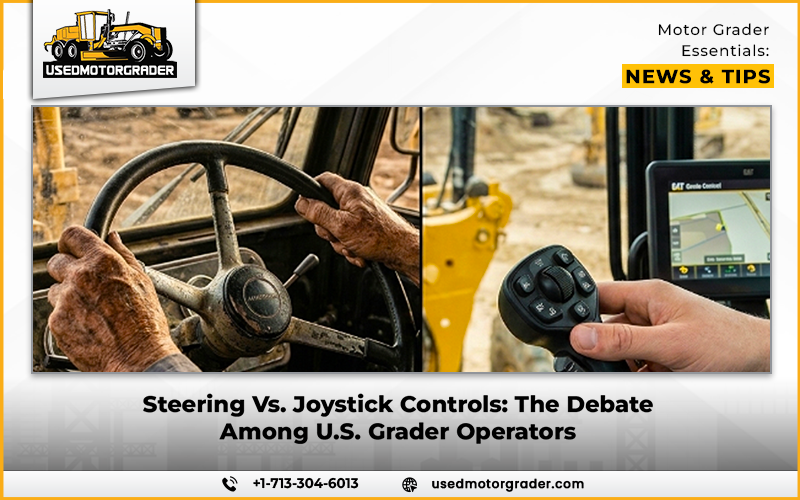
Put a 30-year veteran and a 24-year-old apprentice in front of two identical Cat 140s at the dealer lot, one built with a steering wheel and levers, one built with joysticks, and hand them both a set of keys. The veteran walks straight to the wheel without a second thought. The apprentice climbs into the joystick machine just as fast. Neither one is wrong, and that’s exactly the argument that’s been playing out in grader cabs, dealer showrooms, and OEM engineering departments for the better part of twenty years.
Motor graders aren’t simple machines to run. A skilled operator manages blade angle, pitch, side shift, articulation, wheel lean, and forward speed, often several at once, while reading the material in front of the blade and adjusting on instinct. How that operator physically interacts with the machine, a wheel and a bank of levers, or a pair of electro-hydraulic joysticks, shapes training time, end-of-shift fatigue, and how a used unit sells five years down the road. It’s a real, ongoing debate, and both camps have good reasons for where they stand.
How We Got Here: A Short History of Grader Controls
The motor grader traces back to 1919, when Minneapolis-based Russell Grader Manufacturing Company built what’s generally credited as the first self-propelled grader, mounting a tractor engine onto its pull-behind blade design. Caterpillar acquired Russell in 1928 and, three years later, released the Auto Patrol, the first machine engineered as a single, purpose-built grader rather than a tractor-and-attachment combination. By 1939, “motor grader” had become the industry’s standard term, and the wheel-and-lever operator station that came with it stuck around, largely unchanged in concept, for the better part of seven decades. That layout, a wheel flanked by a bank of individual hydraulic levers, each linked to a single function, became so embedded in operator training that an entire generation learned to run a grader almost by feel. Caterpillar’s own “12” series stayed in continuous production for 81 years before it was eventually rebadged as the 140, the model that leads U.S. sales today.
The disruption arrived in 2006, when Caterpillar introduced the M-Series and, with it, the industry’s first mainstream electro-hydraulic joystick control system. Two three-axis joysticks replaced as many as fifteen individual levers and the wheel itself, cutting hand and arm movement by as much as 78 percent, Caterpillar claimed. Volvo launched its own joystick-optional G900 Series the same year, but took a more conservative path, keeping the wheel in place with steering priority over the joystick at higher travel speeds. The switch wasn’t universally welcomed. Cat tested the water in 2016 by selling a small run of K-Series graders with traditional wheel-and-lever controls back into North America specifically to gauge demand, and the answer, according to Cat product specialist Eric Kohout, came back loud and clear from dealers and customers alike: bring the wheel back. Cat’s 120, and later its 140, were redesigned to offer both configurations side by side, each with its own cab geometry, rather than forcing the market into one camp.
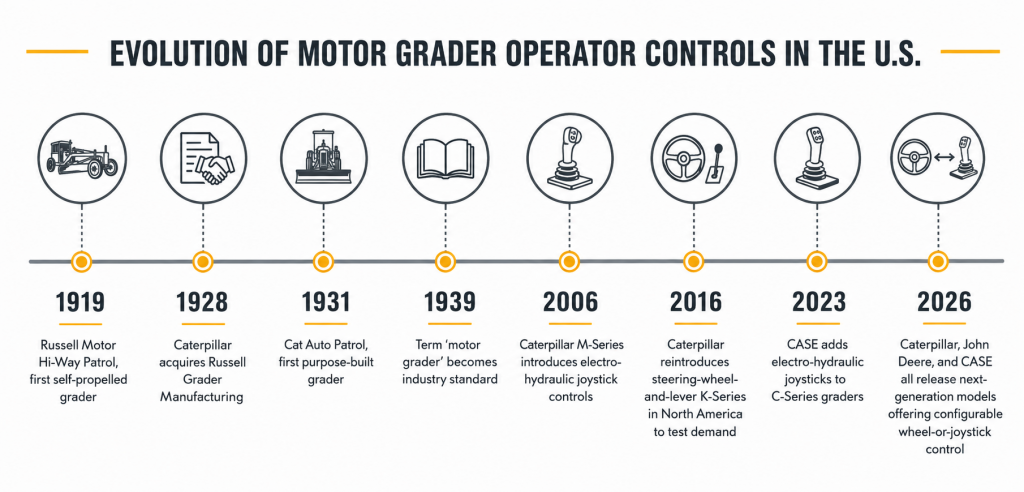
From a 1919 tractor-mounted blade to today’s configurable joystick cabs, grader controls took nearly a century to become a genuine choice. Every major shift came from operators pushing back on what manufacturers assumed they wanted.
Two Ways to Move a Blade: How Each Control System Actually Works
A traditional wheel-and-lever setup uses individual hydraulic levers, each tied to one function: blade lift, side shift, circle turn, articulation, wheel lean, arranged on either side of a mechanically or hydraulically assisted steering wheel. Every function has its own dedicated input, and skilled operators learn a specific hand position and travel distance for each one until the pattern becomes muscle memory.
A joystick system consolidates most of that into two three-axis joysticks, usually built into the seat’s armrests. On Caterpillar’s current layout, for example, the left joystick handles transmission direction, gear shifting, and steering, while the right controls drawbar, circle, and moldboard functions along with throttle and differential lock. Buttons and rollers on the joysticks themselves often carry grade-control activation, return-to-center articulation, and other automated functions that would otherwise require reaching for a separate switch bank.
| Factor | Steering Wheel & Levers | Joystick / Electro-Hydraulic |
| Typical learning curve | Longer, operators often need years to build true “feel” | Shorter, OEMs report new operators reaching baseline competence in weeks to a few months |
| Physical fatigue over a long shift | Higher; more arm, wrist, and shoulder travel across a shift | Lower; Caterpillar cites up to a 78% reduction in hand and arm movement |
| Tactile feedback for fine grading | Direct mechanical/hydraulic feel many veterans rely on | Reduced feel, though modern electro-hydraulic tuning has narrowed the gap considerably |
| Grade-control integration | Usually retrofitted via added switches on the levers | Built for native, plug-and-play compatibility with Topcon, Trimble, and Leica systems |
| Cab design impact | Historically requires a flat-front cab to fit the console | Enables an angled-front cab with improved sightlines to the blade |
| Familiarity across a mixed-age crew | Strongest with operators trained before the mid-2000s | Strongest with operators trained on modern equipment or digital interfaces generally |
| Resale expectations in the used market | Broadly accepted; almost no training friction for a new buyer’s crew | Growing acceptance; some buyers still specifically hunt for wheel-equipped used units |
Why Operators Actually Prefer What They Prefer
The Case for the Wheel
Ask operators who came up running levers why they stick with the wheel, and the answer is rarely nostalgia. It’s feel. A hydraulic lever transmits resistance and response in a way that tells an experienced hand exactly how hard the blade is biting into the material, before a gauge or grade-control display would show it. That tactile loop is especially valued on fine finish work, cul-de-sacs, curb-and-gutter tie-ins, drainage swales, where a half-inch of extra blade pressure matters and an operator wants to feel it happening, not just see it on a screen. Veteran crews also point to consistency: after twenty or thirty years, the wheel-and-lever pattern is wired into muscle memory, and relearning a new input mid-career carries real productivity risk during the transition.
The Case for the Joystick
Newer operators, and increasingly contractors managing long highway and site-development jobs, gravitate toward joysticks for a practical reason: less physical wear over a ten- or twelve-hour shift. Reaching for fifteen separate levers all day adds up, and the reduced hand-and-arm travel OEMs advertise is a genuine, measurable ergonomic win, not just marketing language. Joysticks also pair naturally with 2D and 3D grade-control systems, since the buttons and rollers built into the grips carry automated functions from the outset, rather than switches bolted on after the fact. For contractors running mixed crews, joystick machines tend to shorten the runway between hiring an operator and getting productive work out of them, a real advantage during the current operator shortage. Operators who’ve spent real time behind both configurations remain one of the best resources for anyone deciding which setup fits their crew; conversations with experienced operators of used motor graders consistently surface this exact trade-off between mechanical feel and reduced fatigue.
The Generational Line: Veteran Operators vs. the New Crew
Nowhere is the control debate sharper than across the generational split reshaping the grader workforce. The average proficient motor grader operator in North America is over 50, with a meaningful share of that experienced core within a decade of retirement, while formal heavy-equipment training enrollment has fallen roughly 40 percent nationally over the past ten years. That gap matters directly to the controls question: the incoming generation, trained on digital interfaces and hired into an industry actively trying to shorten onboarding time, is driving joystick demand upward, while the outgoing generation keeps specifying wheel-and-lever machines whenever a fleet gives them the choice.
Fleet managers running mixed crews increasingly buy machines that split the difference, since forcing an entire roster onto a single interface either alienates the veterans who built the company’s reputation for precision work or slows down the new hires meant to solve the labor gap in the first place. A closer look at how veteran and new operators actually differ in what they want from a motor grader shows this isn’t a simple preference split, it touches training investment, automation trust, and how each group defines “comfort” in the cab.
Where Each Control Style Wins: Applications and Jobsites
Control preference doesn’t exist in a vacuum, it tracks closely with the kind of work a grader is doing day to day.
Finish grading and precision work. Subdivision streets, curb tie-ins, and drainage-critical slopes are where the wheel-and-lever crowd holds its strongest ground. Direct hydraulic feedback lets an experienced operator make sub-half-inch corrections by feel, and on this kind of work, getting it right on the first or second pass matters more than speed.
Highway and large-scale earthmoving. Long, high-production runs on wide rights-of-way favor joysticks. Operators repeat the same motions for hours at a stretch, and the fatigue reduction compounds meaningfully over a full shift. These jobs also tend to run grade-control systems from the start, which plays to the joystick’s built-in compatibility.
Snow removal and municipal maintenance. Municipal fleets are a mixed bag, largely because so many public works departments are still running older wheel-equipped units well past 15,000 hours, simply because the budget cycle hasn’t caught up. New municipal purchases, though, increasingly spec joysticks, since long cold-weather plow shifts put a premium on reduced physical strain, and municipal operators often rotate between machines within a single week, favoring a shorter relearning curve.
Tight jobsite maneuverability. Residential infill, small commercial pads, and confined urban work all involve frequent direction changes and articulation adjustments. Joystick machines, with auto-articulation and return-to-straight built in, tend to reduce operator workload in stop-and-go conditions.
Rental fleets. Rental houses lean toward wheel-and-lever machines more than the broader new-equipment market would suggest, since a rental crew could include anyone from a seasoned hand to a first-timer, and the wheel-and-lever pattern still carries the widest base of prior familiarity across a broad customer pool.
| Application | Typically Favored Control | Why It Wins There |
| Finish grading / fine slope work | Steering wheel & levers | Direct tactile feedback for sub-half-inch precision |
| Highway & large earthmoving | Joystick | Lower fatigue over long, repetitive production shifts |
| Snow removal & municipal maintenance | Mixed, trending joystick on new buys | Long fleet replacement cycles keep older wheel units in service |
| Tight jobsite / residential work | Joystick | Auto-articulation and return-to-straight reduce workload in stop-and-go conditions |
| Rental fleet deployment | Steering wheel & levers | Widest familiarity across an unpredictable pool of temporary operators |
| Mining & heavy haul-road work | Joystick or hybrid (wheel-priority) | Comfort over long shifts, paired with wheel as a safety backup on the largest machines |
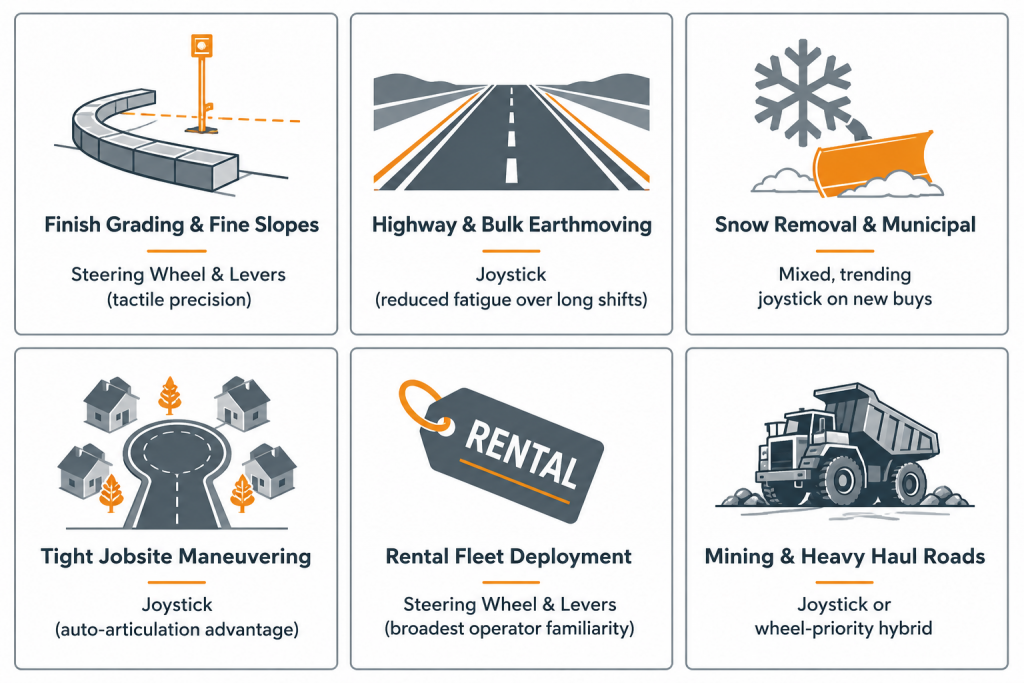
Control preference tracks the job more than it tracks the operator. Fine finish work still favors the wheel’s tactile feedback, while long production shifts and tight maneuvering both lean toward joystick ergonomics.
Brand by Brand: How Manufacturers Built Their Own Answer
Caterpillar
Caterpillar has taken the most public risk on this question of any manufacturer. After the 2006 M-Series joystick launch and the 2016 K-Series wheel test confirmed steady demand for both, Cat rebuilt its Next Generation lineup (120, 140, 150, 160) around a dual-path philosophy: buyers choose joystick (JOY) or lever/steering wheel (LVR) the same way they’d choose tandem versus all-wheel drive. The 140, the top CAT motor grader for sale in the U.S., only gained its joystick option in early 2026 after years as wheel-only, while the larger 160 now ships joystick-standard. Each configuration gets its own cab geometry: flat-front for wheel-and-lever, angled-front for joystick, improving sightline to the blade.
John Deere
Deere’s approach is philosophically distinct from Cat’s either/or model. Every G-Tier and P-Tier John Deere grader, from the 620 through the 872, ships with a steering wheel as standard equipment, full stop. The Grade Pro (GP) trim layers dual-joystick or fingertip armrest controls on top of that wheel, letting the operator move between inputs as conditions demand, but the wheel never leaves the cab, a meaningfully different philosophy from Cat’s two-separate-cabs approach.
CASE
CASE has moved through three control philosophies in under five years. Its earlier C-Series used “Combined Steering,” layering joystick control onto the existing wheel and syncing front-wheel steering, articulation, and wheel lean into one input. The newer D-Series compacts (836D, 856D), launched in 2025, moved to three-axis electro-hydraulic joysticks as the primary control. Then at ConExpo 2026, CASE re-entered the 200-plus-horsepower category with its Bell-built GR Series, offering a choice between electro-hydraulic and traditional mechanical control, echoing Cat’s dual-path strategy up top while keeping the compact D-Series joystick-focused.
Komatsu, Volvo, and the New Arrivals
Komatsu’s GD655-7 and larger GD955-7 offer wheel- and joystick-based configurations, but the brand leans harder into its “Smart Construction” data ecosystem than into pushing one control style for its Komatsu grader for sale lineup. Volvo takes the most conservative dual-input stance of any major brand: an optional joystick, with the wheel always retaining override priority at higher speeds, a safety-first choice held since 2006.
Among newer entrants, the pattern splits sharply. LiuGong’s 4215D launched joystick-only. Sany’s SMG200 runs the industry in reverse, joystick standard, wheel optional. Mauldin’s compact M415XT “Maintainer” runs everything through a single joystick. Weiler’s G65, tracing its lineage to a 1949 Allis-Chalmers design, stayed with traditional hydraulic levers.
| Brand | Representative Model(s) | Wheel Available | Joystick Available | Design Philosophy |
| Caterpillar | 120, 140, 150, 160 (Next Gen) | Yes (LVR configuration) | Yes; standard on 160 | Buyer’s choice, separate cab per configuration |
| John Deere | 620–872, G-Tier/P-Tier | Yes; standard on every model | Yes, as a Grade Pro add-on | Wheel always present; joystick layered on top |
| CASE | 836D/856D (D-Series); GR925–935 (GR-Series) | Optional on GR-Series only | Standard on D-Series; optional on GR-Series | Compact line is joystick-first; large line offers a choice |
| Komatsu | GD655-7, GD955-7 | Yes | Yes | Customer-selectable; differentiation via Smart Construction tech |
| Volvo | G930C–G960C | Yes; retains steering priority | Optional | Wheel-priority hybrid for safety at speed |
| LiuGong | 4215D | No | Standard | Joystick-only new entrant |
| Sany | SMG200 | Optional | Standard | Joystick-first, reverse of most competitors |
| Mauldin | M415XT | No | Standard | Compact multipurpose machine, single joystick |
| Weiler | G65 | Yes | No | Traditional hydraulic lever heritage design |
Grade Control, Automation, and the Shrinking Importance of the Interface
The rise of GPS and GNSS grade control has quietly changed what the steering-wheel-versus-joystick debate is actually about. A decade ago, the argument was purely mechanical: which input feels better, wears less, or trains faster. Today, both Caterpillar and John Deere build 2D and 3D grade-control readiness directly into their top-selling models, and that automation layer handles precision work that used to depend entirely on which lever bank an operator learned first. A newer operator running a joystick machine with active grade control can now hit tolerances that once took years of wheel-and-lever experience to develop by feel.
That doesn’t mean the interface question has disappeared, it’s been reframed. Manufacturers now compete less on “wheel or joystick” and more on how tightly each system integrates with automation and remote diagnostics. A detailed look at which motor grader manufacturers are investing most in automation shows Caterpillar and Deere both building automation directly into next-generation joystick hardware, while CASE and Volvo have taken a more measured pace. The driver behind all of it is the same labor shortage reshaping the rest of the industry, one where AI-assisted and grade-control technology is being positioned as a partial answer to a talent pool aging out faster than it’s being replaced.
The Real Ratio: Estimating Joystick vs. Wheel Adoption in the U.S.
Here’s the honest answer, stated plainly: there is no independently audited national count of how many U.S. motor graders run joysticks versus how many still turn on a wheel. Caterpillar, Deere, CASE, Komatsu, and Volvo don’t publish control-configuration splits, and Equipment Data Associates (EDA), the industry’s primary source for new-equipment financing data, ranks graders by model and manufacturer, not by control type. Anyone handing you a precise national percentage on this specific question is making it up.
What follows instead is a transparent, clearly labeled estimate, built from public sales-ranking data and each manufacturer’s known configuration defaults, not an official statistic.
Start with the top-selling new motor graders in the U.S. today, per EDA’s most recent 12-month new-financed sales ranking. The Cat 140 sits at No. 1, and following its 2026 redesign, it’s now built to order in either configuration with no publicly disclosed split between them. Deere’s 672G and 772G rank third and fourth, with the 872G also cracking the top ten, and, critically, every one of those Deere units ships with a standard steering wheel, regardless of whether the buyer adds the joystick-equipped Grade Pro package. Komatsu’s GD655-7 lands at No. 9 and is likewise built around wheel-based steering as its default layout.
Run that math across just the top-selling models, and wheel-equipped machines outnumber joystick-only cabs among the highest-volume new graders sold in the U.S. today, largely because Deere’s design philosophy keeps a physical wheel in every cab it builds. Layer in that CASE’s D-Series, LiuGong, Sany, and Mauldin all ship joystick-first or joystick-only, and the picture tightens, even if it doesn’t flip.
The estimates built from this method alone: roughly three in five new U.S. motor grader for sale models leaving the factory today still include a steering wheel doing at least part of the steering work, and roughly two in five ship as joystick-only cabs. That excludes the enormous installed base of pre-2006 wheel-and-lever machines still logging hours on job sites, fold those in, and the wheel’s overall share of the working U.S. fleet climbs well past that.
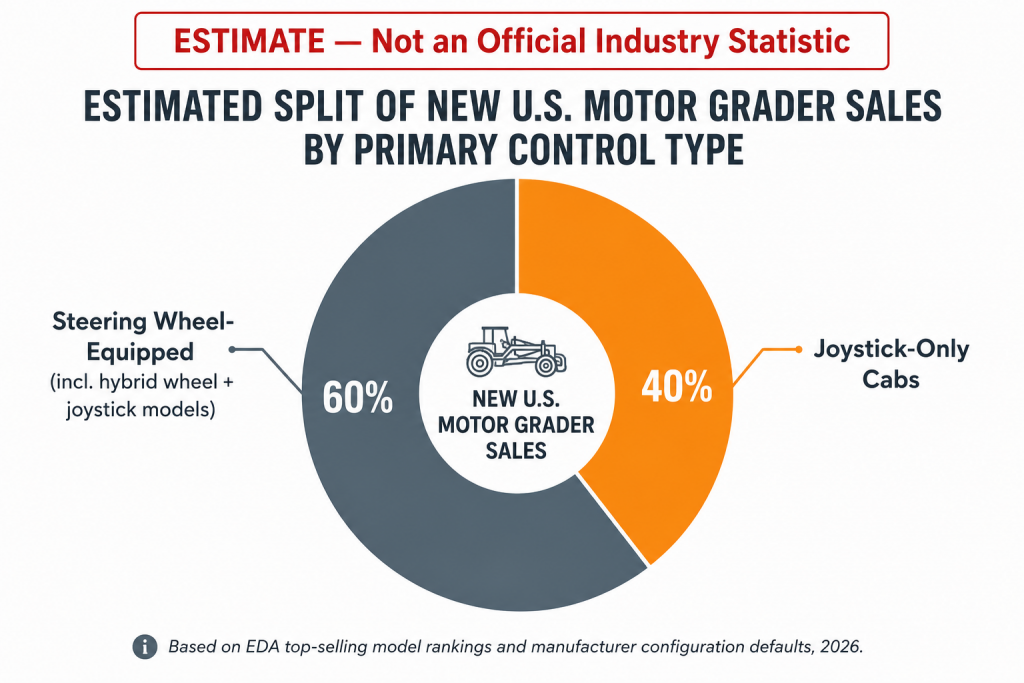
No independent body publishes a national joystick-to-wheel ratio, so this figure is our own estimate built from EDA’s top-selling models and each brand’s default configuration. Treat it as directional, not definitive.
Rental Fleets, Resale Value, and the Used Equipment Angle
The used market tells its own version of this story, and it doesn’t always match new-equipment sales trends. Buyers shopping used graders still weigh mechanical condition and engine hours far above control configuration when it comes to price, but control style increasingly shapes who’s bidding on a given machine. A contractor building a mixed-experience crew often specifically hunts for wheel-equipped used units, since they carry no training friction for veteran hires and remain broadly resalable down the line. A contractor chasing production speed on a young crew, on the other hand, increasingly shops for joystick-equipped used inventory, betting that grade-control retrofits will pay off faster on a machine already built for it.
Rental houses, as noted earlier, still lean toward wheel-and-lever inventory more heavily than the broader new-sales trend would suggest, since a rental fleet has to serve the widest possible range of temporary operators with minimal onboarding. That preference filters down into the used market too, since rental fleets are one of the largest single sources of used grader inventory once units roll off their depreciation schedule.
Regional and Seasonal Patterns Across the U.S.
Control preference isn’t evenly distributed geographically, though the pattern tracks industry type more than pure geography. States and counties with large, long-tenured municipal grader fleets, much of the upper Midwest and mountain West, where county road departments run graders on gravel and unpaved routes year-round, tend to skew toward wheel-and-lever machines simply because so much of their existing fleet predates the joystick era, and replacement budgets move slowly. Sunbelt states with heavy highway and site-development construction, where fleets turn over faster, and grade-control adoption runs higher, show a stronger tilt toward joystick-equipped new purchases. Snow-belt municipalities sit in between: long, cold plow shifts push toward joystick fatigue reduction, but tight public budgets keep older wheel-equipped machines in rotation far longer than a private contractor fleet would tolerate.
What Comes Next: Operator-Assist Tech and the Future of the Cab
The next phase of this debate probably won’t be decided by which input method wins outright, it’ll be decided by how much of the steering and grading task gets automated out of the operator’s hands altogether. Semi-autonomous features like automated blade height control, cross-slope maintenance, and auto-articulation are already standard or near-standard on new machines from Caterpillar and Deere, and both companies are explicit that the goal is reducing the skill threshold required to run a grader productively, not eliminating the operator. As that trend continues, the physical interface, wheel or joystick, matters less for raw precision and more for operator comfort, fatigue management, and how quickly a new hire becomes useful. That shift favors joysticks on pure ergonomics, but it doesn’t erase the wheel’s advantages in fine finish work or its deep familiarity across a veteran-heavy workforce, which is exactly why every major manufacturer continues investing in both.
Bottom Line
There’s no single right answer to steering wheel versus joystick, and the market reflects that: manufacturers keep building both because operators keep asking for both. What matters more than picking a side is matching the control style to the work, the crew, and the shift length in front of you, and increasingly, to the automation package riding along with it.
Get Behind the Controls That Fit Your Crew
Wheel or joystick, the right motor grader comes down to matching machine to job. usedmotorgrader.com stocks dependable used Caterpillar, John Deere, Komatsu, and Volvo graders in both control configurations, inspected and priced to work as hard as your crew does. Call our team today and put a grader on your site that your operators will actually want to run.
FAQs
1. Is one control system objectively better than the other?
No. Joystick controls reduce physical fatigue and shorten training time; steering wheel and lever controls give experienced operators sharper tactile feedback for fine finish work. Which one wins depends on the application and the operator, not on the technology itself.
2. Do new motor graders still come with a steering wheel option?
Yes. Caterpillar, John Deere, CASE (on its GR-Series), Komatsu, and Volvo all currently offer wheel-based configurations alongside joystick options, though a few newer entrants like LiuGong and Mauldin ship joystick-only.
3. Does control type affect the resale value of a used motor grader?
Mechanical condition and engine hours still matter more than control type to most used-equipment buyers, but wheel-equipped machines tend to draw a broader pool of bidders since they carry less training friction for mixed-experience crews.
4. Are joystick controls harder to learn than a steering wheel and levers?
Generally, no, most operators and OEMs report joystick systems have a shorter learning curve, since two three-axis joysticks replace a much larger bank of individual levers. Building true fine-grading “feel” still takes time regardless of which system an operator learns on.
Tags: Experienced Grader Operators, Used Motor Graders Advanced Controls, Cat 12M Joystick Control