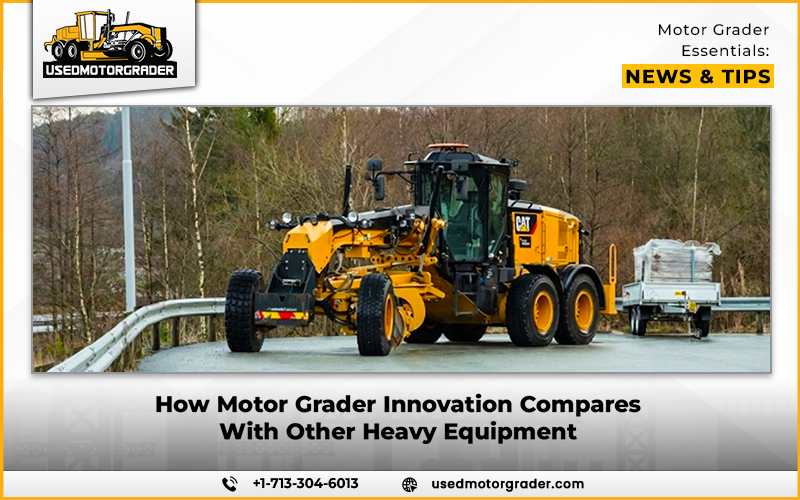
Every headline out of CES and CONEXPO this year belongs to someone else. Driverless haul trucks. Self-guiding excavators. Dozers that grade without a hand on the joystick. Motor graders keep getting quietly left off that list, and it’s made plenty of contractors assume grading has become construction’s forgotten category. Dig into what OEMs actually shipped this year, though, and a different picture shows up. Graders aren’t behind. They’re innovating in a direction nobody’s putting on a conference stage.
How Has Motor Grader Technology Changed in the Last Decade?
Ten years ago, a grader with cross-slope control felt cutting-edge. Now, cross-slope comes standard on most premium lines, and full 3D grade control is one screen tap away. John Deere graders run SmartGrade across the entire P-Tier lineup, letting an operator move between 2D and 3D without leaving the cab. Caterpillar rebuilt its cab design from scratch on the new 120, 140, 150, and 160, adding larger windows, a 10-inch touchscreen, and a rearview camera as standard rather than pricey add-ons. Our breakdown of what the big brands brought to CONEXPO 2026 covers the full shift.
Is Grading Falling Behind the Autonomy Race in Construction?
The honest answer is: partly, and on purpose. At CES 2026, Caterpillar previewed five fully autonomous construction machines: a wheel loader, dozer, haul truck, excavator, and compactor. Motor graders weren’t on that list, and that’s not an oversight. Grading is a finishing operation, and variables like material consistency and real-time slope adjustments are hard to hand off to software without a supervising operator. So dozers and haul trucks chase full autonomy while grader manufacturers pour R&D into something narrower: precision.
What Makes Grade Control Different From Full Autonomy?
Full autonomy removes the operator; grade control sharpens the operator instead. A 3D system reads GPS and site data, compares it to the design plan, and adjusts blade position automatically while a person still runs the machine and makes real-time calls. That shows up across every major brand:
- Caterpillar’s ARO and Cross Slope Assist, which scale up to full 3D as needs grow
- Komatsu’s dual-mode transmission with stall-prevention tech on the GD655 lineup
- John Deere’s SmartGrade, switching between 2D and 3D from a single display
Which Innovations Actually Move the Needle on the Jobsite
Not every feature an OEM announces changes a buying decision. The ones that consistently do:
- Cross-slope and 3D grade control, now standard or close to it across premium lines
- Telematics tracking fuel burn, idle time, and maintenance needs remotely
- Joystick control options replacing dual-lever setups on newer models
- Operator-assist features like stable blade tech and collision-mitigation cameras that cut fatigue
Marketing loves talking about AI. Fleet managers care more about fuel bills and downtime, and that’s where these upgrades earn their keep.
How OEMs Are Positioning Their Grader Lineups
Each brand is carving out a slightly different lane. John Deere graders lean into SmartGrade as an upgrade path, letting buyers start basic and add capability later. CAT graders for sale increasingly include technology packages that used to be dealer add-ons, especially across the redesigned 120 through 160 generation. A Komatsu grader for sale today often carries the brand’s hexagonal cab and stall-prevention transmission, aimed at cutting operator strain. It’s less about who “wins” and more about which platform fits a contractor’s jobsite, a theme our piece on current motor grader trends breaks down further.
Do Used Motor Grader Buyers Care About Innovation?
More than they used to. Buyers shopping for John Deere graders, CAT graders for sale, or a Komatsu grader for sale on the used market aren’t just checking hours and undercarriage wear anymore. They’re asking whether grade control is already installed and what a retrofit would cost if not. That shift ties into a broader change in who’s running these machines, including how women are shaping the construction equipment industry and bringing new expectations for cab comfort into the conversation.
Upgrade your fleet today with a used motor grader from usedmotorgrader.com, backed by trusted names like Caterpillar, John Deere, and Komatsu. Get in touch now and put proven grading power to work on your next project.
FAQs
1. Are John Deere graders more advanced than Caterpillar’s lineup?
A: Both are close. Deere leans on SmartGrade’s upgrade path, while Caterpillar targets the same precision through redesigned cabs and touchscreen integration.
2. Do CAT graders for sale come with grade control already installed?
A: Many newer used listings do, especially from the 120 through 160 generation, though older models may need an aftermarket kit.
3. Is a Komatsu grader for sale a solid pick for fuel efficiency?
A: Yes. The dual-mode transmission and stall-prevention system is built to cut wasted fuel and operator fatigue.
4. Will motor graders eventually go fully autonomous?
A: Possibly, over time. For now, manufacturers focus on assisted precision rather than removing the operator entirely.
Tags: Grader Innovation 2026, Motor Grader Features Guide, Used Motor Grader Market Trends